

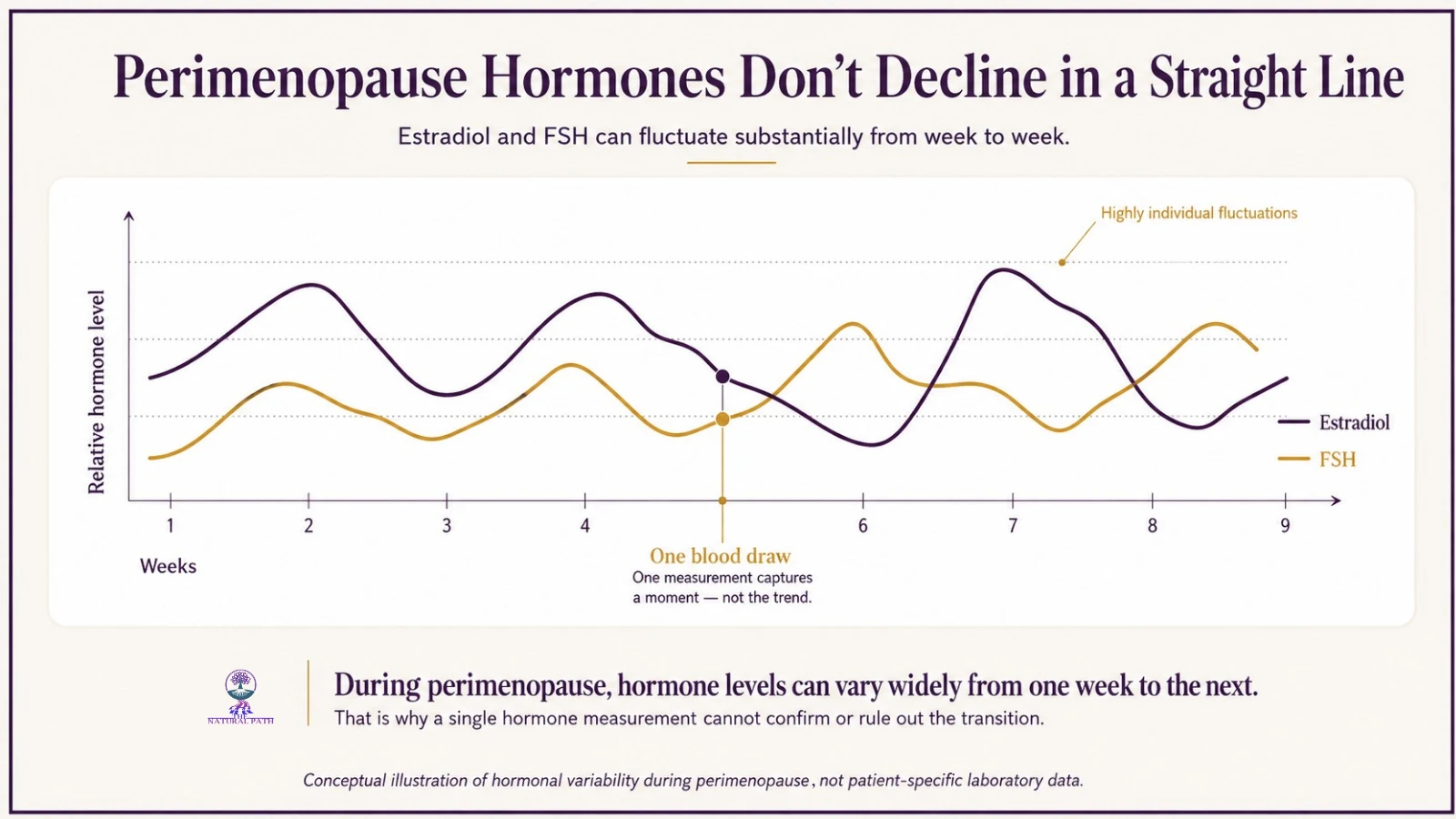
No perimenopause test can confirm or rule out the transition from a single blood draw. Hormones during perimenopause fluctuate week to week rather than declining steadily, so one measurement captures a moment, not a trend. FSH and estradiol can both read normal in a woman with clear symptoms, and abnormal in a woman with none. Diagnosis is made primarily from your cycle pattern and symptoms. Testing still has real value, just a different one: ruling out the conditions that mimic perimenopause, including thyroid disease, iron deficiency, and blood sugar problems. Knowing which question a test can answer is what keeps a normal result from ending the conversation.
Key Takeaways
- A single hormone measurement cannot diagnose perimenopause, because levels fluctuate rather than decline steadily.
- FSH and estradiol both vary widely across days and cycle phase, so timing changes the result.
- Hormonal contraception and hormone therapy suppress FSH, making results uninterpretable.
- Diagnosis rests on cycle pattern and symptoms, which is why three months of tracking beats one blood draw.
- Testing is genuinely useful for excluding thyroid disease, iron deficiency, and metabolic causes.
- A normal perimenopause test does not mean your symptoms lack a cause.
Women are routinely told their hormone panel came back normal, and that the symptoms must so be something else.
The panel usually was normal. That result simply does not carry the meaning the conversation assigned to it. Hormone symptoms are among the conditions we work with most, and a normal perimenopause test is the usual starting point, not a closing argument.
What a Perimenopause Test Measures
Standard hormone panels measure FSH, estradiol, and sometimes LH, progesterone, or AMH.
FSH, follicle stimulating hormone, is the signal the pituitary sends to the ovaries. As ovarian response declines, the pituitary tends to send a stronger signal, so FSH tends to rise across the transition.
The logic is sound. The problem is that “tends to” is doing heavy lifting. FSH rises across the transition on average, over years, in populations. It does not rise cleanly in one woman across one month, which is the timeframe a single perimenopause test actually samples.
Why Fluctuation Breaks the Single Blood Draw
Hormones do not decline in a line during perimenopause, and measurement shows this clearly.
The Swiss Perimenopause Study followed 127 women aged 40 to 56 over thirteen months with repeated sampling. The researchers reported that time did not significantly predict estradiol levels, and that they did not find a continuous decline across the observed transition. What they described instead were highly individual fluctuations without consistent directional trends.
Read that against how a perimenopause test usually happens. One draw, on one day, reported as normal or abnormal against a range built for a population. The measurement is accurate. The inference drawn from it is where the error enters.
Why Timing Changes Your Result
The same woman can produce very different numbers depending on when blood is drawn.
Estradiol varies substantially by cycle phase, so a draw in the follicular phase and one in the luteal phase are not comparable. During perimenopause, cycles themselves become irregular, which means the phase at any given draw is often unknown. FSH varies day to day for the same reason.
| Factor | Effect on the result |
|---|---|
| Cycle day of the draw | Estradiol can read low, normal, or high depending on phase |
| Cycle irregularity | Phase is frequently unknown, so results cannot be placed in context |
| Hormonal contraception | Suppresses FSH, making the value uninterpretable |
| Hormone therapy | Lowers FSH for the same reason |
| Recent illness or acute stress | Shifts several markers temporarily |
If you are on hormonal contraception, an FSH test cannot tell you what you are hoping it will tell you. That is a common and avoidable disappointment.
What Testing Is Genuinely Useful For
Testing earns its place by excluding the conditions that imitate perimenopause.
This is the reframe worth taking away. The valuable question is not “do my hormones prove I am perimenopausal,” which cycle tracking answers better. The valuable question is “what else could be producing these symptoms,” and that has clear laboratory answers.
- Thyroid function. Subclinical hypothyroidism affects roughly 3% to 15% of the US population, rising to 18% to 20% in older patients, and produces a nearly identical symptom set. A full thyroid panel belongs in this workup.
- Iron stores. Fatigue responds to iron repletion in non-anemic women, and the response occurs in those with ferritin below 50 ng/L, a band most labs report as normal. Heavy perimenopausal bleeding makes this more likely, not less.
- Blood sugar and insulin. Metabolic change during the transition is real and measurable, and fasting insulin is rarely ordered.
- Vitamin D and B12. Both common, both correctable, both capable of producing fatigue and low mood.

Free 3-minute quiz from Dr. Angela Goldstein, ND
Stress, thyroid and sex hormones work as one system. Answer 22 quick questions and see which one is under the most strain for you.
What you’ll get:
- ✓A score for each system: stress, thyroid and sex hormones
- ✓Which pattern your answers fit, and how the systems pull on each other
- ✓Built on published research
- ✓A clear next step for your pattern
Free. 22 questions, about 3 minutes.
Educational content. Always talk with your doctor before changing any treatment.
What Cycle Tracking Tells You That Blood Cannot
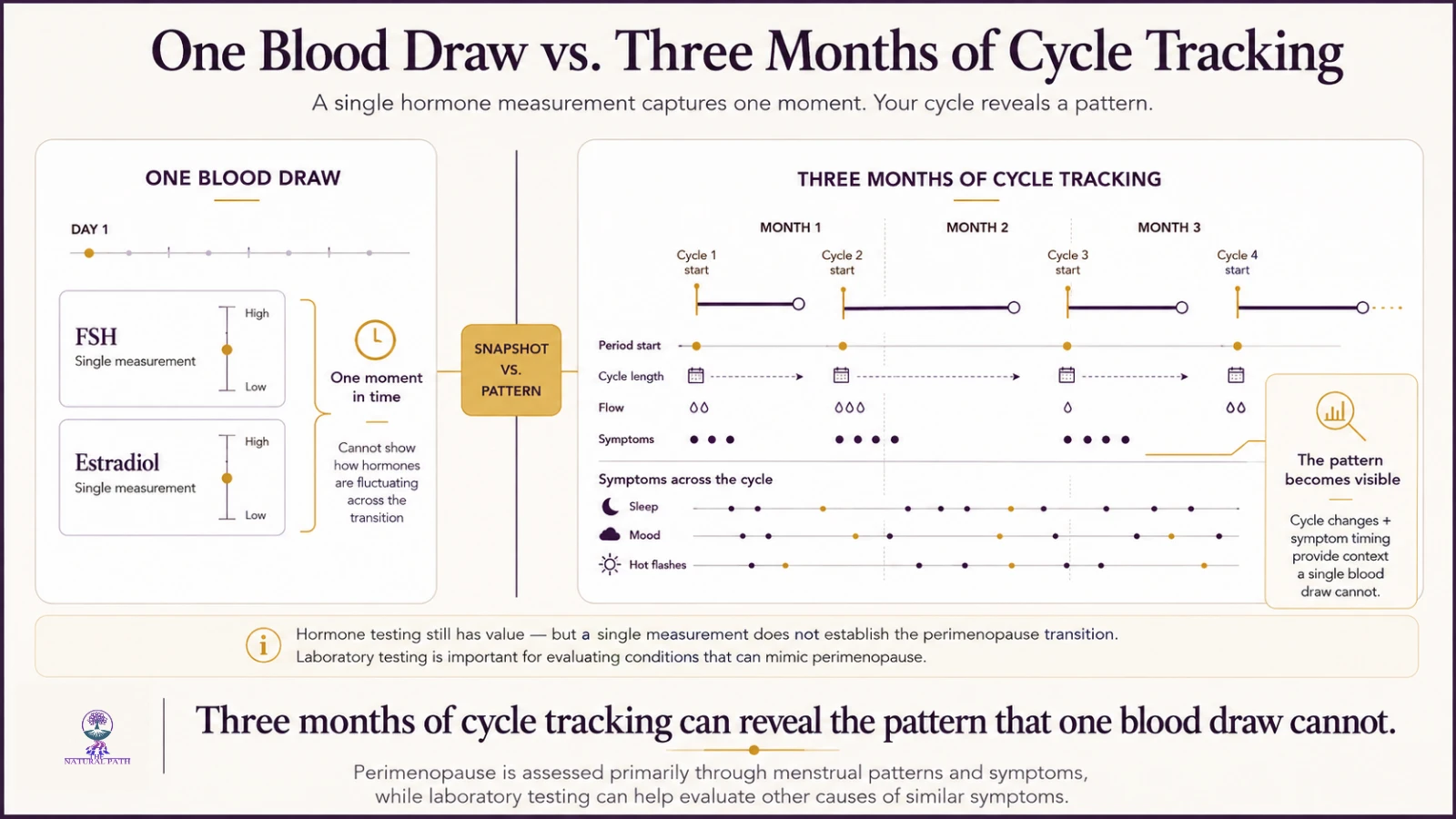
Three months of cycle records outperform any single hormone panel for staging the transition.
Clinicians stage perimenopause using menstrual criteria. Early in the transition, cycle length becomes variable, with intervals differing by seven or more days between cycles. Later, gaps of sixty days or more appear, marking the late transition, which typically occurs one to three years before the final period.
- Record start date and flow for every cycle for three months minimum.
- Note symptom timing against cycle day, particularly sleep, mood, and hot flashes.
- Flag intervals that differ by seven or more days from your own previous pattern.
- Bring the record to your appointment. It is data your clinician cannot generate any other way.
About At-Home Perimenopause Tests
At-home kits measure real hormones accurately and still cannot resolve the diagnosis.
Most measure FSH from urine or blood spot. The measurement itself is generally reliable. The limitation is the same one that affects clinic testing: a single value from a fluctuating hormone, without cycle context. A kit can tell you your FSH was elevated on Tuesday. It cannot tell you whether that reflects the transition or an ordinary fluctuation.
An at-home perimenopause test is reasonable curiosity. It is not a substitute for the cycle record or for the workup that excludes other causes.
When Results Should Prompt Further Evaluation
Certain findings need follow-up rather than reassurance.
Persistently elevated FSH with absent periods before age 40 suggests primary ovarian insufficiency and requires evaluation. Very high or rapidly rising FSH in your thirties deserves the same. Separately, any bleeding between periods, bleeding after intercourse, cycles closer than 21 days apart, or bleeding after twelve months without a period needs assessment regardless of what hormone values show. You can review the conditions we work with most for context, though these specific patterns belong with a physician promptly.
Frequently Asked Questions
These are the questions patients ask most about hormone testing.
Can a blood test confirm perimenopause?
Not reliably on its own. Hormones fluctuate too much during the transition for a single measurement to be conclusive. Diagnosis is made primarily from cycle pattern and symptoms, with testing used to exclude other causes.
What FSH level indicates perimenopause?
There is no single threshold that settles it. FSH tends to rise across the transition, but values fluctuate widely between draws, and a woman in perimenopause can produce a result in the reproductive range on any given day.
When in my cycle should hormones be tested?
If your clinician orders estradiol, cycle day matters and they should specify it. During irregular cycles this becomes difficult, which is part of why cycle tracking is more informative than the draw itself.
Does birth control affect a perimenopause test?
Yes. Hormonal contraception suppresses FSH, so the result cannot be interpreted as a measure of ovarian function. This applies to hormone therapy as well.
Is AMH a better perimenopause test?
AMH varies less across the menstrual cycle than FSH or estradiol and correlates with proximity to menopause, which makes it more stable. It still does not diagnose perimenopause on its own or predict a specific timeline for an individual.
My hormone panel was normal, so what now?
A normal panel rules out very little in this context. The useful next steps are three months of cycle tracking and a workup that checks thyroid, iron, vitamin D, and metabolic markers, since those explain overlapping symptoms and are treatable.
Where to Start
If a hormone panel came back normal and nothing changed, the missing pieces are usually a cycle record and a wider workup. Dr. Goldstein’s free Master Class explains how she reads several results as one picture rather than as separate values. Start with the free Master Class.
More answers patients ask for are on the main FAQ page.
Begin the cycle record today. Three months from now it becomes the most useful document you own.
By Dr. Angela Goldstein, ND, licensed naturopathic doctor, 25+ years in practice. Last reviewed: 2026-09-16. This article is for general education and is not medical advice. It does not establish a doctor-patient relationship and is not a substitute for care from your own clinician. Do not delay seeking care, and do not stop or change any prescribed medication, based on what you read here. If you have an urgent medical concern, contact your physician or emergency services.