
Leaky gut symptoms are the digestive and whole-body complaints people connect to a gut lining that has become more permeable: bloating, abdominal pain, food reactions, diarrhea or constipation, fatigue, brain fog and skin changes. Two things are true at once. “Leaky gut syndrome” is not an accepted medical diagnosis. Increased intestinal permeability is a real, measurable physiological finding, documented in celiac disease, inflammatory bowel disease, irritable bowel syndrome and type 1 diabetes.
What researchers have not settled is direction: whether a leakier barrier drives those conditions or results from them. That distinction changes what a leaky gut label can and cannot answer about your own symptoms.
Key Takeaways
- Leaky gut is shorthand for increased intestinal permeability, a measurable change in what crosses the gut lining.
- “Leaky gut syndrome” is not a formal diagnosis. Increased intestinal permeability is a documented physiological finding.
- Some permeability is normal, because the junctions between gut cells are built to be selective, and permeability changes are documented in celiac disease, inflammatory bowel disease, irritable bowel syndrome and type 1 diabetes.
- Whether a leakier barrier drives illness or follows from it is unresolved.
- No validated clinical test exists, so a symptom list alone cannot name your cause.
You have been told it is stress. Then that it is aging. Then that it is all in your head. Somewhere in there you found the phrase leaky gut, and for the first time something fit.
That recognition deserves to be taken seriously. So does the science, which is more interesting than either the people selling a gut protocol or the people rolling their eyes at the term. It is also why gut and digestive health is read as one system at The Natural Path.
What Leaky Gut Means, and What Intestinal Permeability Is
Leaky gut is popular shorthand for increased intestinal permeability, a change in how readily substances cross the gut lining.
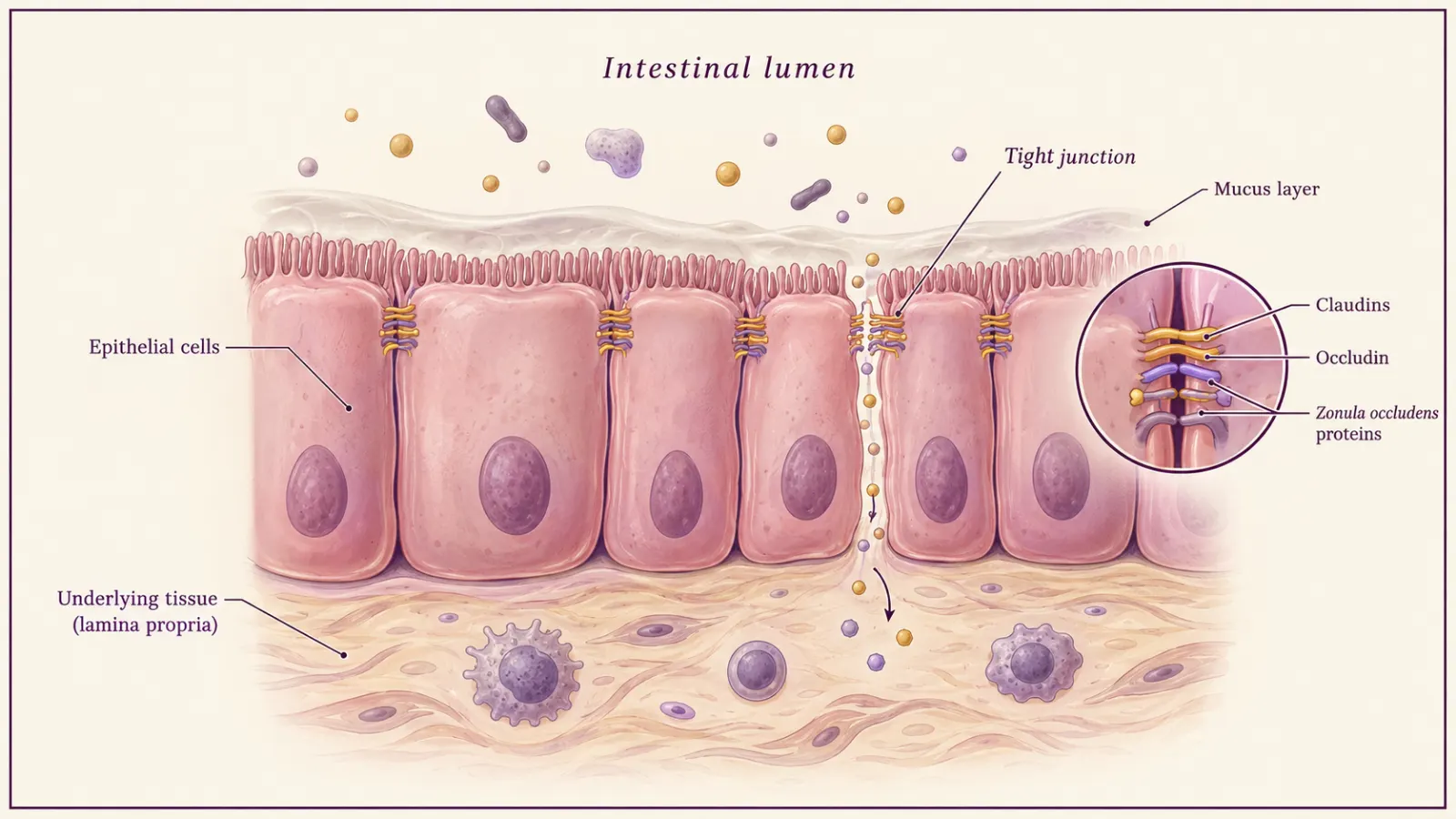
The intestinal barrier is the single layer of cells lining your small intestine and colon, plus the mucus, microbes and immune cells around it, that decides what crosses into your bloodstream.
Intestinal permeability is how readily substances pass between those cells, through the junctions holding them together.
Those junctions have names. A 2024 review in Gastroenterology & Hepatology describes tight junctions built from “transmembrane proteins, such as claudins and occludin,” which interact with zonula occludens scaffold proteins. Inflammation, poor blood flow or a medication can injure the lining, and the junctions open.
Here is the part the sales pages skip. The same review notes that “all individuals are subject to a baseline level of intestinal permeability.” Your gut is built as a filter, not a wall.
Permeability also moves. It shifts with diet, exercise, infection, alcohol and regular NSAID use, so one measurement is hard to read on its own.
Leaky Gut Symptoms People Report Most Often
The symptoms attributed to leaky gut are digestive first and whole-body second, and every one shows up in other conditions.
Digestive
- Bloating and abdominal distension
- Abdominal pain
- Diarrhea, constipation, or both in turn
- Gas
- Nausea, early fullness, and fullness that lingers
Whole body
- Fatigue
- Brain fog
- Headache
- Food sensitivities, including to foods you used to tolerate
- Skin changes
- Joint aches
The 2024 review lists the same core set: “diarrhea, bloating, distension, abdominal pain, and dyspeptic symptoms of early satiety, nausea, and postprandial fullness.” Harvard Health notes that leaky gut syndrome “isn’t a clinical diagnosis.”
Now the number that reframes the list. The 2024 review reports that 18% of the global population bloats at least weekly, and that more than 70% of people with irritable bowel syndrome report bloating. Bloating is not a rare signal pointing at one cause.
So the symptom list is a poor diagnostic tool by itself. If you have seen doctors for years and nothing changed, your symptoms were rarely missing from a list. The list points everywhere at once, which is why labs that came back normal leave so many people without an answer.
Cause or Consequence, the Open Question in the Research
The barrier is real and measurable. What remains open is the direction of the arrow.
| Settled | Still open |
|---|---|
| The barrier exists and its permeability can be measured in research | Whether increased permeability causes the conditions it travels with |
| Inflammatory and ulcerating diseases produce barrier dysfunction | Whether repairing the barrier changes the course of any disease |
| Permeability responds to diet, exercise, infection and medications | Whether permeability explains fatigue, brain fog or other nonspecific symptoms |
On causation, a 2019 review in Gut by a Mayo Clinic gastroenterologist is blunt: “altered permeability may be an epiphenomenon.”
An epiphenomenon is a finding that travels with a disease without driving it, the way a fever travels with an infection it did not cause.
It adds that increased permeability “is not necessarily deleterious,” and that no convincing evidence shows an intervention improving barrier function in humans can alter the course of disease.
Evidence points the other way too. The same review cites studies where increased permeability preceded relapse of Crohn’s disease. There, the barrier looks like part of what happens next.
Both patterns sit in the data. Anyone telling you the question is closed, in either direction, is ahead of the evidence.
The Conditions Where Increased Permeability Is Documented
First, plainly: if fatigue and brain fog are your main complaints, those are real and deserve a workup. The question is whether the gut barrier is the mechanism behind them.
| Condition | What the association establishes |
|---|---|
| Celiac disease | Barrier dysfunction is uncontroversial, because the disease damages the lining directly |
| Crohn’s disease and inflammatory bowel disease | Same, plus permeability preceding relapse |
| Irritable bowel syndrome | A documented association, causal direction unresolved |
| Functional dyspepsia and type 1 diabetes | Documented associations |
| Graft-versus-host disease, HIV/AIDS, multiple organ dysfunction | Documented in seriously ill populations |
| NSAID-related ulceration | Structural damage to the lining, so barrier dysfunction follows |
Now the honest other half. The 2024 review found minimal to no reliable evidence that leaky gut syndrome plays a causative role in the conditions most often tied to it: fibromyalgia, chronic fatigue syndrome, allergies, headache and brain fog. Because permeability shifts with diet, exercise and infection, its authors conclude “it remains impossible to reliably attribute these nonspecific symptomatologies to impaired intestinal barrier function.”
That is a statement about a mechanism, not about you. Your fatigue still has a cause. The evidence has not shown that this is the cause, which is different from showing there is none. Where the immune system is involved, autoimmune conditions get worked up on their own terms.

Free training from Dr. Angela Goldstein, ND
If you have tried the gut protocols and the relief never held, this free training shows why protocols built for everyone often miss you, and what to look at instead.
When you watch today, you’ll learn:
- ✓Why “normal” labs can miss what is actually wrong
- ✓The three systems that break down together, and why treating one at a time rarely lasts
- ✓Why even natural approaches fall short when they treat symptoms instead of systems
- ✓Real patient stories from 25+ years of practice
Free, instant access. Start watching right now.
Educational content. Always talk with your doctor before changing any treatment.
What Is Worth Ruling Out First
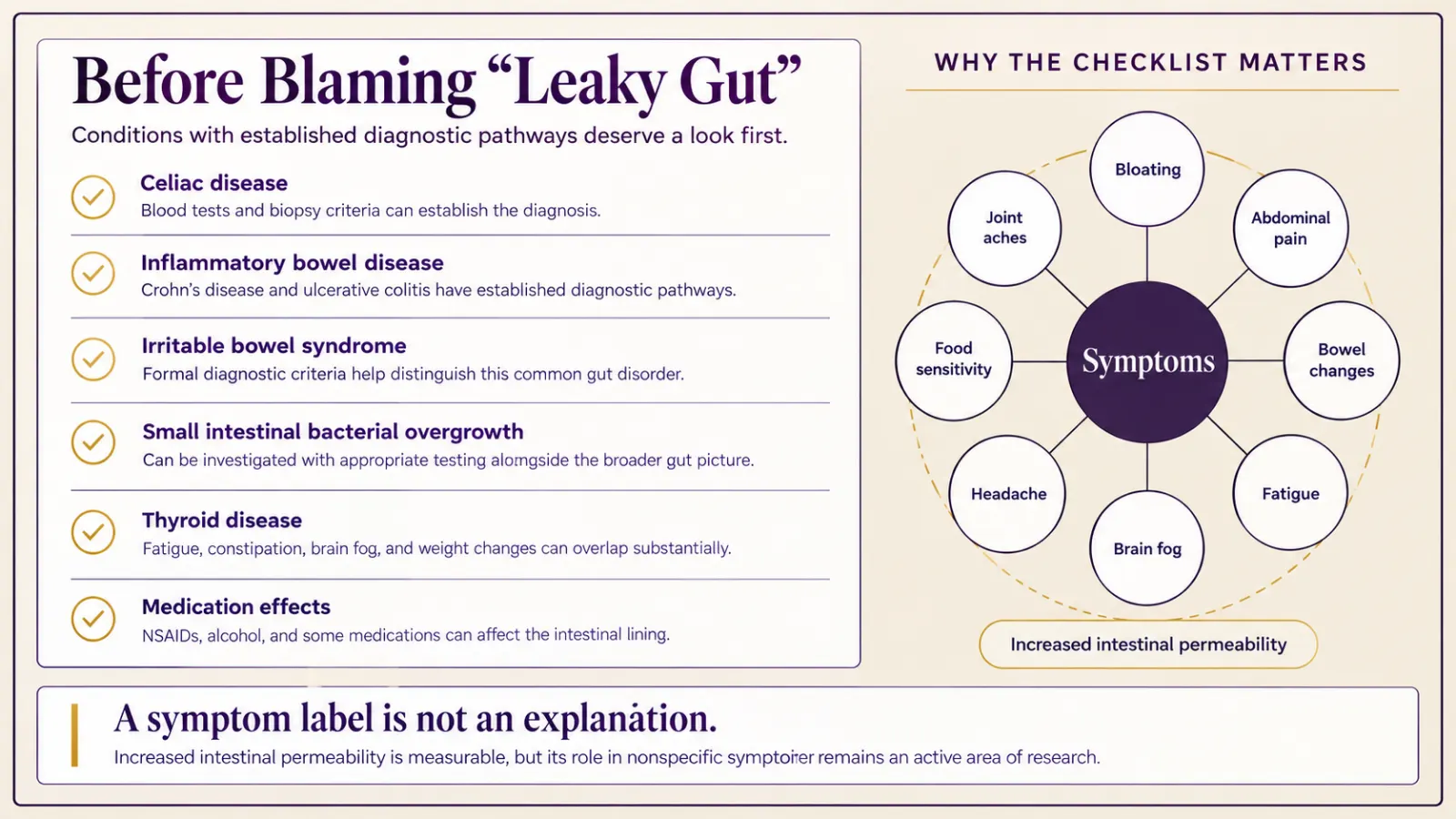
Before a leaky gut label explains your symptoms, the conditions with real diagnostic tests deserve a look.
- Celiac disease. Blood-test and biopsy criteria, this exact symptom picture, and a different management plan.
- Inflammatory bowel disease. Crohn’s disease and ulcerative colitis are diagnosable and treatable, and delay carries cost.
- Irritable bowel syndrome. Formal criteria, and common enough to be the likeliest explanation for many readers.
- Small intestinal bacterial overgrowth. Testable, and worked up alongside the rest of the gut picture.
- Thyroid disease. Fatigue, constipation, brain fog and weight change overlap heavily, which puts thyroid and Hashimoto’s on the list.
- Medication effects. Regular NSAID use, alcohol and several prescriptions act on the lining.
The principle underneath the list is simple. A label that describes your symptoms is not an explanation of them. “Leaky gut” restates what you already told the room.
Testing for Leaky Gut, and What Each Test Measures
There is no validated clinical diagnostic test for leaky gut syndrome. The 2019 review says it plainly: “there are no validated clinical diagnostic tests.”
| Test | What it measures | Current status | What it cannot tell you |
|---|---|---|---|
| Lactulose:mannitol urinary ratio | How much of two swallowed sugars reaches urine | The research standard, though the 2024 review calls it possibly less accurate than long assumed | Whether a symptom came from what it measured |
| Serum or stool zonulin | A protein linked to tight junction regulation | The 2024 review reports commercial assays “are methodologically flawed, and results do not correlate with disease states” | Anything reliable about disease state |
| Direct-to-consumer stool panels | Fecal markers sold as permeability indicators | Widely marketed, clinical utility called questionable | Whether a marker relates to your symptoms |
| Confocal laser endomicroscopy | Direct view of the lining during endoscopy | A specialty and research tool, not a screening test | Anything about whole-body symptoms |
The 2019 review sums up the category: “there is no current gold standard with clear performance characteristics of the tests for barrier function.”
Dr. Goldstein’s framing on laboratory testing is useful here. In her words, “standard labs measure diseases, not function. They’re checking to see if your engine is completely broken, not whether it’s running at 40% capacity.”
A permeability result has the mirror-image problem. It reports on function without naming the condition behind it. That is why functional lab testing is used as one input among many rather than as a verdict.
When Gut Symptoms Need Prompt Medical Attention
Some symptoms call for evaluation, not another supplement.
Contact a clinician promptly for blood in the stool, black or tarry stools, unintended weight loss, persistent vomiting, fever with abdominal pain, pain severe enough to wake you at night, anemia, or new digestive symptoms starting after age 50. These findings need a workup, not a gut protocol.
Why Leaky Gut Symptoms Come Back After a Gut Protocol
Relief that fades after a few weeks usually means the work addressed one system while others kept driving.
Dr. Goldstein names this pattern in natural medicine, as a failure of her own field rather than someone else’s. In her words: “someone has a gut problem and they get the gut healing protocol.” Her objection is to the sequencing, not the tools. “Protocols are designed for populations, not individuals.”
Asked what drives inflammation, she answers: “stress, poor diet, toxins, gut dysfunction, hormonal imbalances. See how it’s all connected? Everything feeds into everything else.”
Read against the research, that view holds up. Permeability responds to stress, diet, infection and medications, which is what you expect from something embedded in a system rather than at the head of one. A barrier that keeps shifting because of something upstream gives the same protocol the same short-lived result. That is why symptoms that span more than one system get read together.
Frequently Asked Questions
Is leaky gut a real medical condition?
Increased intestinal permeability is real and measurable. The standalone diagnosis is not. Cleveland Clinic calls leaky gut syndrome “a hypothetical condition that’s not currently recognized as a medical diagnosis.”
How do I know if I have leaky gut?
You cannot know from symptoms alone, because they overlap dozens of conditions and no validated test exists. The more useful question is what else produces this picture, which puts celiac disease, inflammatory bowel disease and thyroid disease first.
Can leaky gut cause fatigue and brain fog?
Both are frequently attributed to leaky gut, and the 2024 review found minimal to no reliable evidence supporting a causal role in either. Both symptoms are real and worth investigating, and the evidence points toward another cause.
Are at-home leaky gut tests accurate?
Direct-to-consumer blood and stool panels, most featuring zonulin, are not established. The 2024 review reports that commercial zonulin assays “are methodologically flawed, and results do not correlate with disease states,” so a kit result should not drive a treatment plan.
Can leaky gut symptoms go away on their own?
The 2024 review states that “the true natural history of leaky gut syndrome is unknown,” because no study has followed a diagnosed group over time. Its authors draw indirect insight from postinfectious irritable bowel syndrome, where at least half of patients report resolution five years after onset.
Should I stop a prescribed medication if I think my gut is the problem?
No. Keep taking what you have been prescribed and bring the full list to your appointments. Several common medications act on the intestinal lining, which makes that list useful clinical information. Any change belongs to the prescriber.
Where to Start
The most useful next step is excluding the other explanations before accepting this one.
Bring your symptom timeline, medication list and prior testing to a clinician who will read them together. The Natural Path works up gut symptoms alongside inflammation, hormones and detoxification, in office in San Juan Capistrano, Orange County, and by video across California. If your symptoms have outlasted your answers, speak with the clinical team about a full-picture read.
Keep the distinction this page opened with. The physiology is real. The label is not yet an explanation. Knowing which is which keeps you from spending another two years on the wrong question.
By Dr. Angela Goldstein, ND, licensed naturopathic doctor, 25+ years in practice. Last reviewed: 2026-09-16.
This article is for general education and is not medical advice. It is not intended to diagnose or treat any disease, does not establish a doctor-patient relationship, and is not a substitute for care from your own clinician. Do not start, stop or change any prescribed medication based on what you read here. If you have an urgent medical concern, contact your physician or emergency services.