

If your labs are normal but you still feel tired, the most likely explanation is not that nothing is wrong. Standard panels are built to detect disease, so a result inside the reference range means disease was not found. It does not confirm a system is working well. Reference ranges are wide, and several common drivers of fatigue sit inside a normal lab range: iron stores low enough to cause symptoms without anemia, thyroid function that has shifted but not yet crossed a diagnostic threshold, and hormone patterns that routine panels never measure. Normal lab results narrow the list of possibilities. They rarely finish the investigation on their own, which is why normal labs and real symptoms so often arrive together.
Key Takeaways
- A normal lab result means disease was not detected, not that function is optimal.
- Reference ranges describe a population distribution, not your personal baseline.
- Iron stores below 50 ng/L can cause fatigue while a standard blood count still looks fine.
- Thyroid function can shift meaningfully before TSH crosses the treatment threshold.
- Routine panels rarely include the hormone, gut, or nutrient markers that explain persistent fatigue.
- The pattern across several results usually matters more than any single value.
Most people with persistent fatigue and normal labs are told the same three things: it is stress, it is age, or it is in your head.
None of those is a finding. They are what gets said when a panel comes back clean and the appointment is ending. Meanwhile the symptom is real, measurable in its effect on your life, and usually explainable. Persistent fatigue is one of the conditions we work with most, and normal lab results are the norm rather than the exception among those patients.
What a Normal Lab Result Actually Means
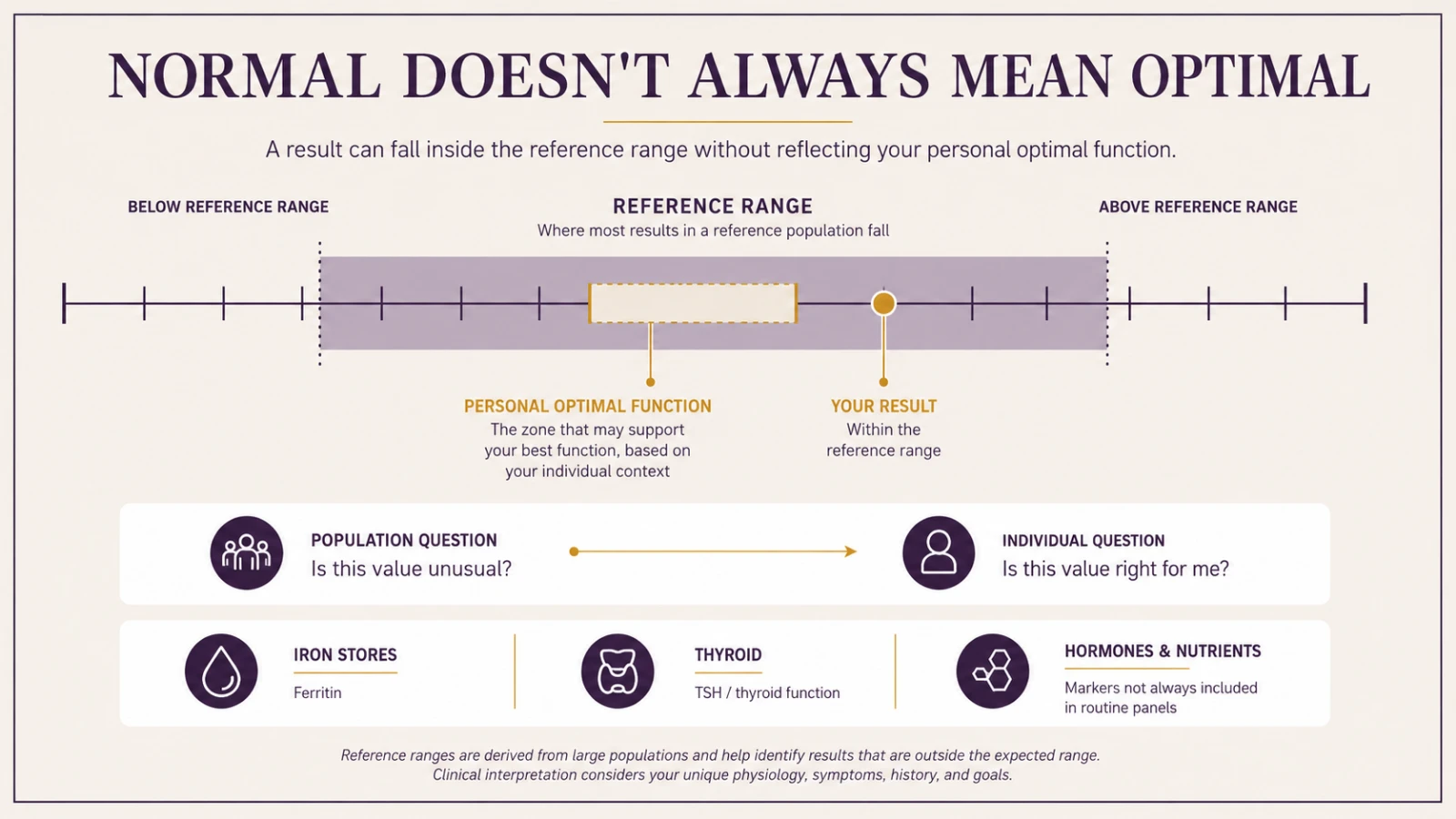
A normal result means your value fell inside the range where most tested people fall.
A reference range is the interval containing the central 95% of results from a reference population, which means roughly 1 in 20 healthy people fall outside it by definition, and plenty of unwell people fall inside it.
That distinction matters more than almost anything else in this conversation. The range answers a population question: is this value unusual? It does not answer your question: is this value right for me. Dr. Angela Goldstein puts it in an engine. Standard labs check whether the engine is completely broken. They are not designed to tell you it is running at 40% capacity.
Someone whose value has drifted steadily across a decade can sit at the edge of a normal lab range and feel nothing like themselves, while the chart shows no abnormality at any single visit.
Iron Stores Can Be Low While Your Blood Count Looks Fine
You can have fatigue from low iron without having anemia, and a standard complete blood count will not catch it.
Anemia is diagnosed on hemoglobin. Iron stores are measured by ferritin, a separate test that is frequently absent from a normal lab panel. In a randomized placebo-controlled trial of non-anemic women with unexplained fatigue, iron supplementation improved fatigue, and the response occurred only in women with a serum ferritin below 50 ng/L. Many laboratories flag ferritin as abnormal only below roughly 10 to 15.
That gap between 15 and 50 is a wide band of results reported as normal, in which some people feel noticeably better once iron is restored.
Thyroid Function Shifts Before It Crosses a Threshold
Thyroid problems can affect how you feel long before a normal lab result turns abnormal enough to qualify for a diagnosis.
Subclinical hypothyroidism is an elevated TSH with a normal free T4, meaning the pituitary is working harder to keep thyroid output in range.
It is common. StatPearls reports it affects roughly 3% to 15% of the US population, rising to 18% to 20% in older patients, and it is more frequent in women. Most people with it are described as asymptomatic, though the same source notes some experience fatigue, weight gain, cold intolerance, constipation, and dry skin. A scientific review places US prevalence at 4% to 8.5%, increasing with age.
Two people can carry the same TSH value and feel completely different. That is why thyroid patterns get read alongside symptoms rather than in isolation, and why a single number rarely settles the question.
What Routine Panels Usually Do Not Include
Most of what explains persistent fatigue is not on a standard annual panel at all.
| Commonly ordered | Frequently not ordered |
|---|---|
| CBC, basic metabolic panel | Ferritin, full iron studies |
| TSH | Free T3, free T4, thyroid antibodies |
| Total cholesterol panel | Fasting insulin, inflammatory markers |
| Glucose | Vitamin D, B12, magnesium status |
| (rarely) one hormone value | Cortisol pattern, full sex hormone panel |
Nothing in the right column is exotic. These are ordinary tests simply outside the standard screening set. Screening is designed to catch disease efficiently across a population, not to explain why one person feels unwell, which is how a normal lab panel and a real problem coexist.
Why the Pattern Matters More Than Any Single Value
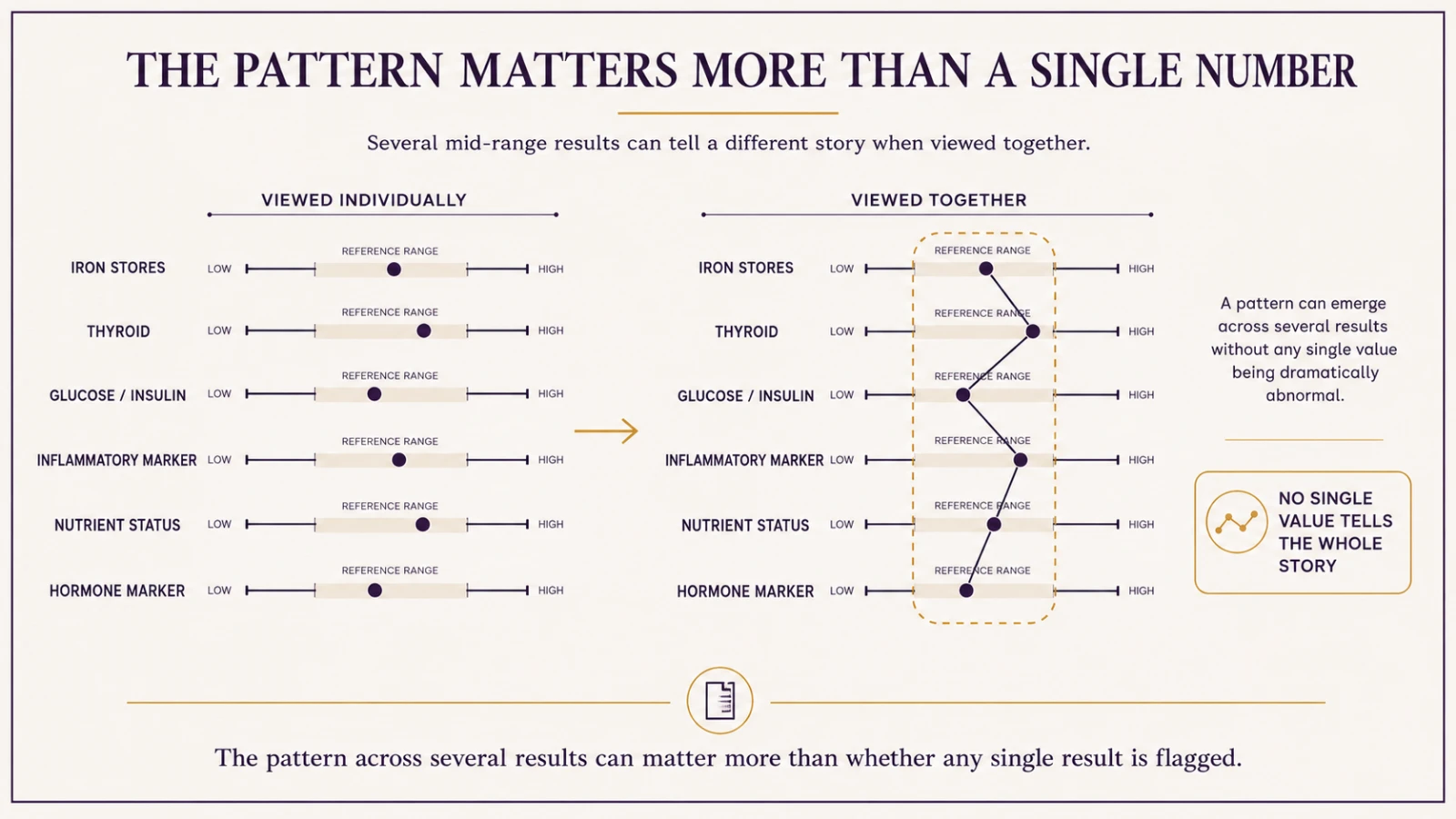
A normal lab value read in isolation hides relationships that become obvious when results are read together.
Dr. Goldstein describes the endocrine system as an orchestra. Thyroid, stress, and sex hormones play together, and when one instrument is out of tune the whole arrangement sounds wrong. Testing one instrument tells you little about the sound. She describes the same problem another way: chronic stress raises cortisol, high cortisol signals the thyroid to slow down, and a slowed thyroid disrupts sex hormones. One upstream driver, three systems affected, and a long list of symptoms that look unrelated on a chart.
Read as a pattern, several mid-range results pointing the same direction often say more than one flagged value on an otherwise normal lab report.

Free 3-minute quiz from Dr. Angela Goldstein, ND
Stress, thyroid and sex hormones work as one system. Answer 22 quick questions and see which one is under the most strain for you.
What you’ll get:
- ✓A score for each system: stress, thyroid and sex hormones
- ✓Which pattern your answers fit, and how the systems pull on each other
- ✓Built on published research
- ✓A clear next step for your pattern
Free. 22 questions, about 3 minutes.
Educational content. Always talk with your doctor before changing any treatment.
Why This Rarely Gets Sorted Out in a Standard Visit
There is usually not enough time, and that is structural rather than anyone’s fault.
Research on how physician time is actually spent found the median primary care visit ran 15.7 minutes and covered about 6.5 topics. Roughly five minutes went to the largest concern, and each remaining topic received about 1.1 minutes. If you arrive with fatigue, weight change, poor sleep, and low mood, that is four topics competing for a few minutes. Most physicians would gladly take longer. The constraint sits in how visits are reimbursed.
Sorting a multi-system pattern takes a longer conversation and functional lab testing chosen from that conversation rather than from a standard set.
What to Do When Your Labs Are Normal and You Still Feel Unwell
Take four concrete steps rather than accepting a normal lab panel as the end of the inquiry.
- Get your actual numbers. Request the values from every normal lab report, not the summary. “Normal” is not data.
- Look at direction over time. Compare this year to three years ago. A value drifting steadily inside the range is a finding.
- Ask what was not tested. Ferritin, full thyroid panel, and hormone markers are often simply absent rather than normal.
- Bring everything to one longer appointment. Symptoms considered together reveal patterns that separate visits cannot.
This is also the honest limit of an article. Some fatigue has causes that need conventional workup, including sleep apnea, depression, anemia with a clear source, and medication effects. Those deserve a physician, not a supplement.
When to See a Doctor Promptly
Some fatigue needs same-week medical attention rather than investigation over months.
Seek prompt care for fatigue that arrives suddenly and severely, or comes with chest pain, breathlessness at rest, fainting, unexplained weight loss, fever that will not settle, or new confusion. These patterns need urgent evaluation. The slow multi-system fatigue described here is a different problem with a different timeline. If you are unsure which one you have, ask your physician first.
Frequently Asked Questions
These are the questions patients ask most when results come back clean.
Can you be sick and still have normal lab results?
Yes. A normal lab panel screens for specific diseases at diagnostic thresholds. Conditions that are early, functional, or simply not covered by the tests ordered can produce real symptoms alongside a clean panel.
What tests should I ask for if I am always tired?
Reasonable additions to a basic panel include ferritin, a full thyroid panel with free T3 and antibodies, vitamin D, B12, fasting insulin, and inflammatory markers. Which ones make sense depends on your history, so the list should follow a conversation rather than replace one.
What if my normal lab results sit near the edge of the range?
It means the value is uncommon but not flagged. Edge-of-range results are worth tracking over time, particularly when several sit at the same edge and your symptoms fit the direction they point.
Is fatigue with normal labs just stress?
Stress is a genuine physiological driver rather than a dismissal, and it changes cortisol, thyroid output, and sex hormones measurably. Treating it as an explanation is reasonable only after those measurable effects have actually been looked at.
How long should I wait before pushing for more testing?
If fatigue has persisted beyond a few months and is affecting your work, sleep, or relationships, that is enough reason to investigate further. Waiting rarely makes the pattern easier to read.
Do I need to stop my medications before further testing?
No. Do not stop any prescribed medication on your own. Bring the complete list, including doses and supplements, so results can be interpreted with them in mind.
Where to Start
If every normal lab report leaves you feeling no better, the next useful step is a longer conversation rather than another isolated test. Dr. Goldstein’s free Master Class covers the three connected systems she sees break down most often, and it explains the framework before you spend anything. Start with the free Master Class.
More answers patients ask for are on the main FAQ page.
Bring your old results with you. They are more useful than most people expect.
By Dr. Angela Goldstein, ND, licensed naturopathic doctor, 25+ years in practice. Last reviewed: 2026-09-16. This article is for general education and is not medical advice. It does not establish a doctor-patient relationship and is not a substitute for care from your own clinician. Do not delay seeking care, and do not stop or change any prescribed medication, based on what you read here. If you have an urgent medical concern, contact your physician or emergency services.