

At your first functional medicine appointment, expect a full hour built around one question: what is actually driving your symptoms. A functional medicine practitioner takes a complete health history from childhood forward. They build a timeline of when things changed, review every medication and supplement you take, and read your existing lab work as a pattern rather than a list of isolated results. Testing is ordered after that conversation, not before it, so the panel is chosen for your history rather than pulled from a standard set. You leave understanding what is being investigated and why. A written plan generally follows at a second visit, once results are back.
Key Takeaways
- A first functional medicine appointment runs about an hour, because a complete history cannot be taken in the time a standard visit allows.
- The practitioner builds a health timeline, not just a symptom list, to find when your body changed.
- Lab work you already have gets reviewed again, including results you were told were normal.
- Testing is selected after the conversation, so two people with identical symptoms may be tested differently.
- You will not usually leave with a finished treatment plan on day one. That comes once results are back.
- A functional medicine appointment suits persistent, multi-system problems, not emergencies or quick prescriptions.
In a standard primary care visit, the average patient raises about six concerns, and every one after the first gets roughly a minute of attention.
That comes from a study of how physician time is spent, not a complaint about doctors. Researchers found the median office visit ran 15.7 minutes and covered an average of 6.5 topics. About five minutes went to the longest topic. Each remaining concern received 1.1 minutes.
If your health problem is one thing, that structure works. If your fatigue, weight change, sleep disruption, and mood shift are one connected problem wearing four different faces, 1.1 minutes per face will never surface it. That gap is the reason functional medicine appointments are built differently.
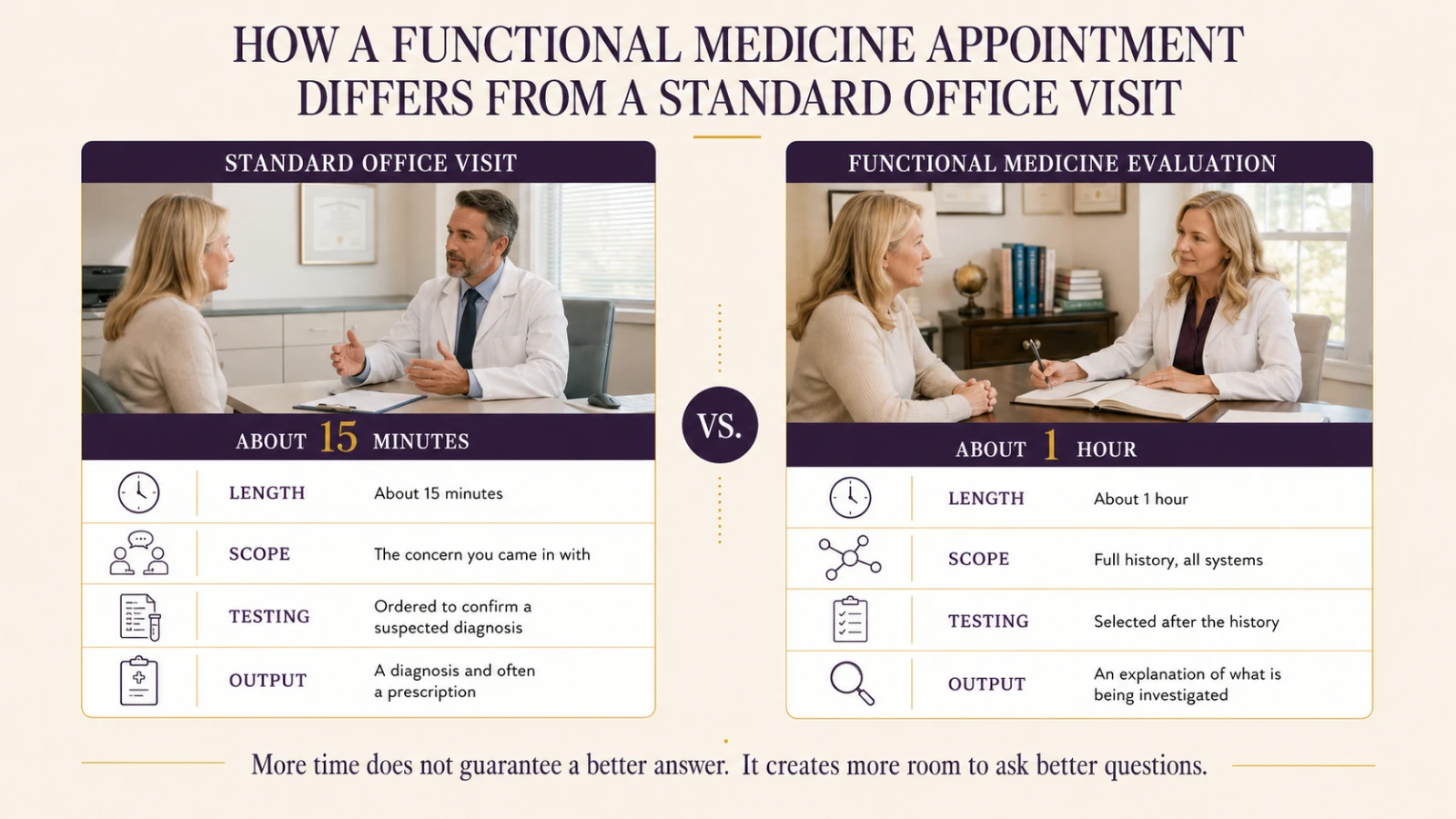
How a Functional Medicine Appointment Differs From a Standard Office Visit
The difference is time and scope, and both exist so the root cause has room to surface.
Functional medicine is an approach that treats symptoms as signals from connected body systems, and works to identify what is driving those signals rather than suppressing each one separately.
A conventional visit is built to identify a problem that fits a billing code and to address it efficiently. That is what the appointment length is designed around. Most physicians would gladly take longer. The constraint sits in the payment structure, not in their intentions.
Chronic, overlapping symptoms do not fit that structure well. As of 2023, 51.4% of US adults, roughly 131 million people, reported multiple chronic conditions. Among adults aged 35 to 64 the figure was 52.7%. Earlier national data found 27.2% of adults living with two or more. Carrying several conditions at once is ordinary, not unusual.
| Standard office visit | Functional medicine evaluation | |
|---|---|---|
| Length | About 15 minutes | About 1 hour |
| Scope | The concern you came in with | Full history, all systems |
| Testing | Ordered to confirm a suspected diagnosis | Selected after the history |
| Output | A diagnosis and often a prescription | An explanation of what is being investigated |
Dr. Angela Goldstein describes the endocrine system as an orchestra. Thyroid, stress, and sex hormones all play together. When one instrument is out of tune, the whole arrangement sounds wrong, and testing that instrument alone tells you little. That is why the appointment covers systems you may not think are related to the symptom that brought you in.
What Happens During the Hour, Step by Step
The hour follows four stages, and each one answers a different question.
Step 1: Your story, from the beginning
Most practices send an intake questionnaire beforehand, and the visit starts from your answers. You will be asked about your health well before your symptoms started, often back to childhood. This surprises people. The root cause frequently sits years upstream of the symptom you noticed. It might be an illness, a pregnancy, prolonged stress, or a course of antibiotics.
Step 2: The timeline
Next comes sequencing. When did things change, and what else changed then? A patient who dates her fatigue to the same season she developed reflux and stopped sleeping has given three data points that belong to one story. Listed separately, they look like three unrelated complaints.
Step 3: Your existing labs, read as a pattern
Bring the results you already have. They get reviewed again, including the ones you were told looked fine. Standard panels are built to detect disease, so a result inside the reference range means disease was not detected. It does not confirm a system is working well. Read together, several results often show a direction no single value shows.
Step 4: What gets investigated next, and why
The hour ends with an explanation. You should hear which patterns stood out, what needs confirming, and what would change depending on the answer. If functional lab testing is recommended, you should also hear the specific question each test is meant to settle.
Patients often say this explanation is the part they never received before. Dr. Goldstein has practiced functional medicine for 25+ years, and treats it as the point of the appointment.
Why Functional Medicine Testing Comes After the Conversation
Testing follows the history because the history determines which tests are worth running.
Functional lab testing is testing chosen to answer a specific question raised by your history, covering areas such as hormone patterns, gut function, nutrient status, inflammatory markers, and detoxification capacity.
Two patients can arrive with identical fatigue and leave with different panels, because their timelines point at different systems. Ordering the same broad panel for everyone produces data, though much of it answers questions nobody asked. When a test would not change what happens next, there is little reason to run it.
You will hear what testing is likely to cost before anything is ordered.
What Happens After Your First Visit
You will not usually leave with a finished plan, and that is intentional.
- Results return. Turnaround varies by panel, commonly one to three weeks.
- A second visit interprets them. Results are read against your timeline, not as isolated numbers.
- A written care plan follows. It is sequenced deliberately, since some issues must be addressed before others can improve.
- Follow-up continues at intervals. Patterns that developed over years respond over months, and the plan is adjusted as they do.
Nobody can promise you a timeline, and anyone who does is guessing.

Free training from Dr. Angela Goldstein, ND
If you want to know exactly how Dr. Goldstein thinks before you ever book, this free training walks you through the framework behind every evaluation.
When you watch today, you’ll learn:
- ✓Why “normal” labs can miss what is actually wrong
- ✓The three systems that break down together, and why treating one at a time rarely lasts
- ✓Why even natural approaches fall short when they treat symptoms instead of systems
- ✓Real patient stories from 25+ years of practice
Free, instant access. Start watching right now.
Educational content. Always talk with your doctor before changing any treatment.
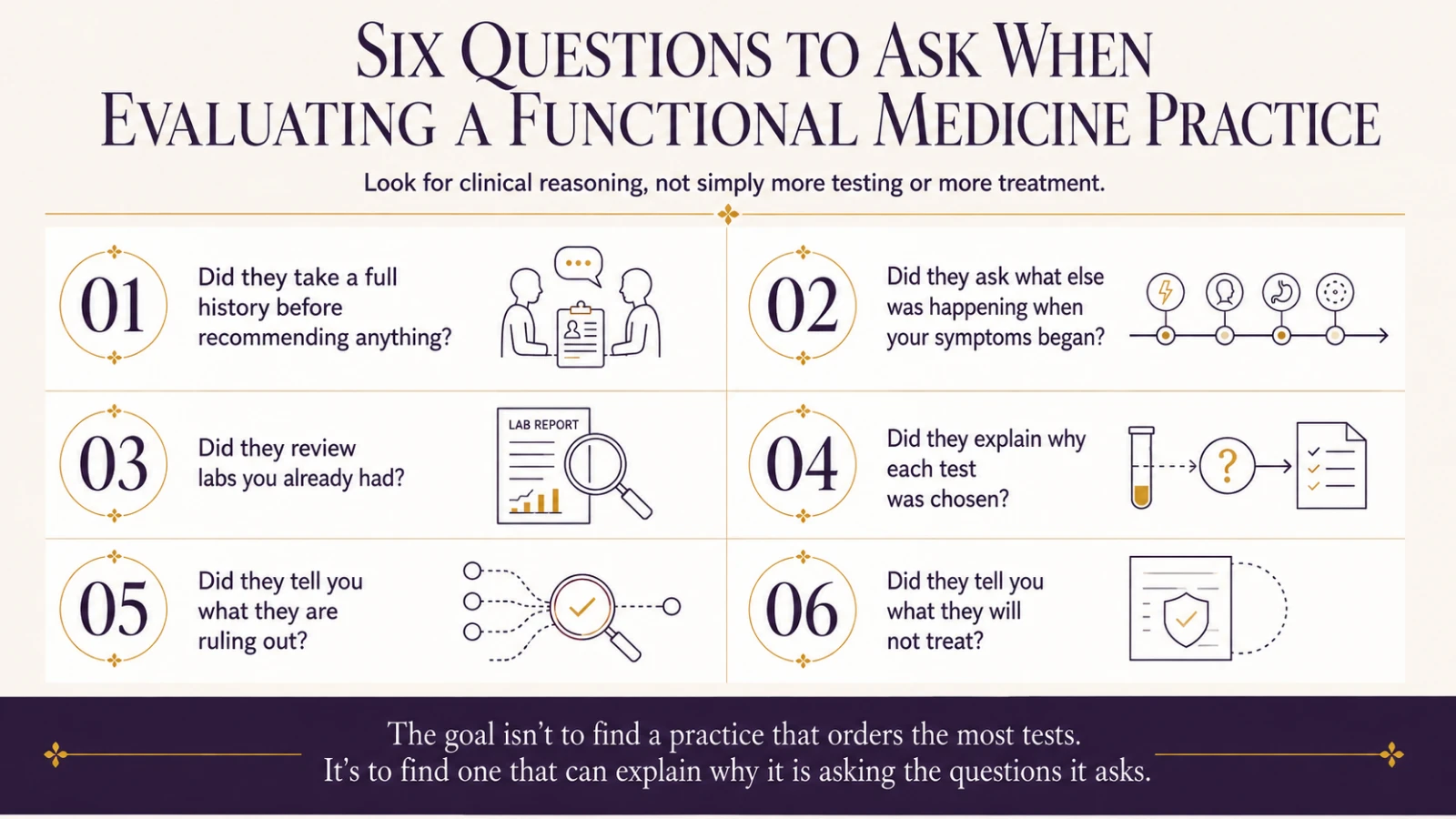
How to Tell a Thorough Evaluation From a Superficial One
Use this checklist on any functional medicine practice you are considering, including this one.
- Did they take a full history before recommending anything? A recommendation that arrives before the history is a product being sold, not a conclusion being reached.
- Did they ask what else was happening when your symptoms began? Timeline questions signal pattern thinking. Symptom-only questions signal a protocol.
- Did they review labs you already had? A practitioner who ignores them and orders everything fresh is collecting, not reading.
- Did they explain why each test was chosen? You should be able to repeat the reason back in one sentence.
- Did they tell you what they are ruling out? Good clinicians name what they are excluding, not only what they suspect.
- Did they tell you what they will not treat? A practitioner who treats everything has not defined anything.
Who This Appointment Is For, and Who It Is Not For
This evaluation fits a specific situation, and being direct about that saves everyone time.
It is a good fit if:
- Your symptoms span several systems and have lasted months or years
- Your lab work keeps coming back normal while you continue to feel unwell
- You carry several diagnoses that appear unrelated
- You want to understand the driver, not just reduce the symptom
- You are prepared for a process measured in months
It is the wrong fit if:
- You have an urgent or emergency medical problem. Go to urgent care or an emergency department.
- You want a single therapy without an evaluation first. Choosing a treatment before identifying the problem inverts the order.
- You need a guaranteed timeline or outcome. No responsible clinician offers one.
- You want to replace your primary care physician. Functional medicine works alongside conventional care, not instead of it.
Dr. Goldstein is direct that even natural medicine fails when it treats symptoms instead of systems. Protocols are designed for populations. A supplement plan aimed at a symptom whose cause was never identified is, in her words, scooping water out of a sinking boat. A functional medicine evaluation exists so the plan that follows is aimed at something real.
What a Functional Medicine Appointment Costs
The Comprehensive Wellness Evaluation is $87, reduced from its usual $287.
The Comprehensive Wellness Evaluation is the one-hour first appointment described above: your full history, your timeline, a review of existing lab work, and an explanation of what to investigate next.
Care here is not billed through insurance, which is what makes an hour-long first appointment possible.
Testing costs are separate, vary by panel, and are always discussed with you before anything is ordered.
Appointments In Person and by Telemedicine
Both formats deliver the same functional medicine evaluation, so the choice is about convenience rather than quality.
The office is in San Juan Capistrano. Video visits are available to patients anywhere in California, which matters for people who have already driven to more specialists than they can count. Licensure limits care to California residents.
The history, the timeline, the lab review, and the explanation are identical either way. Hands-on therapies require an in-person visit, and those come later in a plan.
Frequently Asked Questions
These are the questions patients ask most before booking. More answers patients ask for are on the main FAQ page.
How long is a first functional medicine appointment?
About one hour. The length exists so a complete history can actually be taken, since the pattern behind chronic symptoms rarely surfaces in a shorter visit.
What should I bring to my first appointment?
Bring lab work from the past two to three years, every medication and supplement you take with doses, and a rough timeline of when symptoms started. Results you were told were normal are still useful.
Do I need to stop my current medications before the visit?
No. Do not stop any prescribed medication before your appointment. Bring the full list instead, including doses, so it can be reviewed as part of your history.
Will I get a treatment plan on the first day?
Usually not. The first visit identifies what needs investigating. The written plan follows once results are back and can be interpreted against your history.
Is a functional medicine appointment covered by insurance?
Care here is not billed through insurance. Some patients submit receipts to an HSA or FSA, though coverage depends on your individual plan.
Can I do my first appointment by video?
Yes, for patients anywhere in California. The evaluation is identical. Only hands-on therapies require an in-person visit, and those are never part of a first appointment.
Ready to Start?
Most patients begin with the free Master Class before booking. It covers the three connected systems Dr. Goldstein sees break down most often, so you arrive at your functional medicine appointment already understanding the framework. Start with the free Master Class, then book when you are ready.
Whichever practice you choose, take the checklist above with you.
By Dr. Angela Goldstein, ND, licensed naturopathic doctor, 25+ years in practice. Last reviewed: 2026-09-16. This article is for general education and is not medical advice. It does not establish a doctor-patient relationship and is not a substitute for care from your own clinician. Do not delay seeking care, and do not stop or change any prescribed medication, based on what you read here. If you have an urgent medical concern, contact your physician or emergency services.