

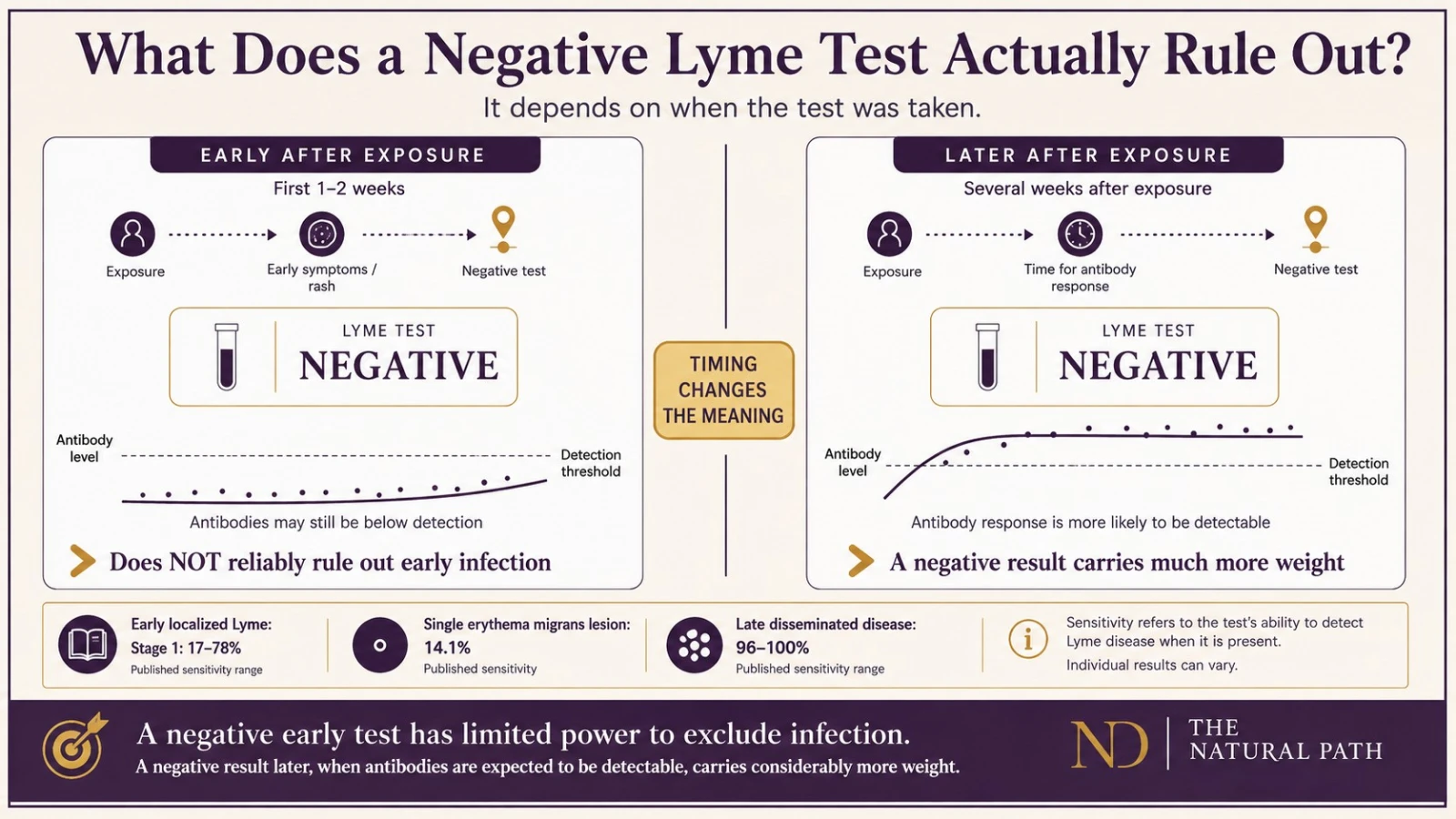
Lyme tests come back negative in early infection because they measure antibodies rather than the bacteria itself, and antibodies take weeks to build. Published sensitivity for standard two-tier testing in stage 1 disease ranges from 17% to 78%, and falls as low as 14.1% in patients with a single erythema migrans rash. Antibody levels sit below the detection limit of current tests during the first seven days after exposure. The same testing performs very differently later, reaching 96% to 100% sensitivity in late disseminated disease. A negative result early tells you far less than most people assume. A negative test is not the same as an absence of infection.
Key Takeaways
- Lyme serology detects your antibody response, not the bacteria, so timing determines the result.
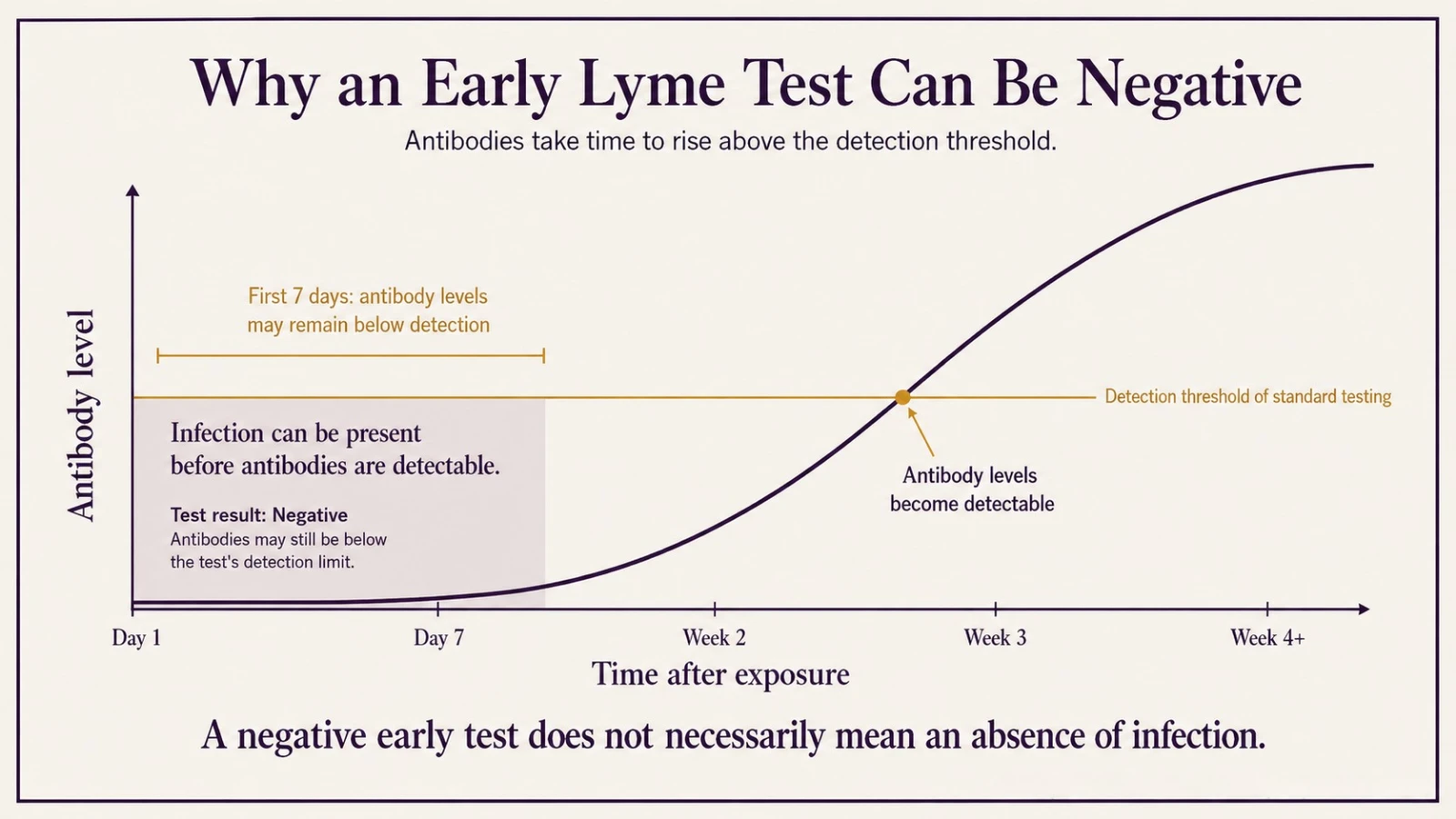
- Antibody levels stay below detection limits for roughly the first seven days after exposure.
- Two-tier sensitivity in stage 1 ranges from 17% to 78%, and is as low as 14.1% with a single rash.
- The same testing reaches 96% to 100% sensitivity in late disseminated disease.
- If a rash is expanding, treatment should not wait for a blood test.
- A negative early test that is not repeated is the most common way an infection gets missed.
If you had an early Lyme test and it came back negative, there is a reasonable chance the test was working correctly and still missed the infection.
That sounds contradictory until you understand what the test measures. It is not looking for the bacteria. It is looking for your immune system’s reply, and that reply takes time to write. Lyme disease and co-infections is one area where a single early result gets treated as final far too often.
What Lyme Testing Actually Measures
Standard Lyme testing is an antibody test, which means it measures your response rather than the organism.
Two-tier testing is the standard approach: a first screening test, usually an ELISA, followed by a confirmatory test on samples that screen positive or equivocal. Both tiers detect antibodies your immune system produced against Borrelia burgdorferi.
This design has a built-in consequence. If your immune system has not yet produced enough antibody, the test has nothing to find. The bacteria can be present and the result still negative. That is not a laboratory error. It is the method working as designed, at the wrong moment.
Why the First Weeks Are the Blind Spot
Antibodies take weeks to reach detectable levels, and that window is when most people get tested.
A review in the Cleveland Clinic Journal of Medicine reports that antibody levels remain below the detection limits of current serologic tests in the first seven days after exposure. IgM titers peak between 8 and 14 days after tick contact. A test drawn in the first week will almost always be negative in an infected person.
The timing is unfortunate because the first week is exactly when people notice a bite, notice a rash, or feel unwell and seek testing. The test is being asked a question it cannot yet answer.
The Sensitivity Numbers by Disease Stage
Test performance changes dramatically depending on how long the infection has been present.
| Stage | Two-tier sensitivity |
|---|---|
| Stage 1, early localized | 17% to 78% |
| Single erythema migrans lesion | 14.1% |
| Multiple erythema migrans lesions | 65.4% |
| Late stage 3, disseminated | 96% to 100% |
Those figures come from the Cleveland Clinic Journal of Medicine review. Columbia University Irving Medical Center reports the same problem from the other direction. In early Lyme disease, it states, the test is negative 50% to 65% of the time, with sensitivity in the range of 35% to 50%. The reason is the same: antibodies can take two to three weeks to develop.
Read the table again with the single-rash figure in mind. A patient with a classic expanding rash, the most recognizable presentation there is, has roughly a one in seven chance of a positive two-tier result at that moment.
Why a Negative First Tier Stops the Process
The screening step gates everything after it, which compounds the problem.
In two-tier testing, the confirmatory second tier is generally only run when the first screening test is positive or equivocal. If the ELISA is negative, the more specific test typically never happens. That is an efficient design for a population screening program. For an individual tested in week one, it means a single early sample can close the question prematurely.
The same review notes a further wrinkle. In early localized infection, the Western blot is only about half as sensitive as ELISA testing. The sequence is weakest exactly when the patient needs it most.
What a Negative Result Does and Does Not Rule Out
A negative test narrows the possibilities without settling them.
A negative result is reasonably reassuring when: the exposure was more than four to six weeks ago, you have no ongoing symptoms, and no rash occurred. Sensitivity is high in later disease, so a negative test well after exposure carries real weight.
A negative result means very little when: the test was drawn within two weeks of a bite or rash, it was never repeated, or symptoms continued with no alternative explanation found. In those situations the test has not excluded much.
Dr. Angela Goldstein’s approach to this is the same one she applies to any lab: a result inside a normal range means a specific thing was not detected, not that nothing is wrong. She is described as Lyme-literate, which is a term the patient community uses for clinicians experienced with tick-borne illness. It is not a board certification and should never be presented as one.

Free training from Dr. Angela Goldstein, ND
If a negative test closed the conversation but your symptoms never got the message, this free training shows how Dr. Goldstein looks past a single result to the systems underneath.
When you watch today, you’ll learn:
- ✓Why “normal” labs can miss what is actually wrong
- ✓The three systems that break down together, and why treating one at a time rarely lasts
- ✓Why even natural approaches fall short when they treat symptoms instead of systems
- ✓Real patient stories from 25+ years of practice
Free, instant access. Start watching right now.
Educational content. Always talk with your doctor before changing any treatment.
When Treatment Should Not Wait for a Test
An expanding rash is a clinical diagnosis, and delaying for serology is the wrong call.
Columbia’s guidance is explicit: physicians should not wait for blood test results in early disease with an expanding rash. Negative results are unreliable at that stage, and treatment should begin on the clinical presentation alone. A spreading circular rash after possible tick exposure is a same-week conversation with a physician.
What to Do When the Test Is Negative and Symptoms Persist
Four steps, in order.
- Establish the timeline. Date the possible exposure, the first symptom, and the blood draw. If the draw was inside two weeks, the result may simply be too early to mean anything.
- Ask about repeat testing. Patients suspected of early Lyme who are seronegative at first testing are generally advised to have follow-up testing to look for seroconversion. A single early negative was never meant to be the final word.
- Rule out the overlapping conditions. Thyroid dysfunction, iron deficiency, sleep disorders, and autoimmune conditions produce similar fatigue and joint symptoms. Functional lab testing for those answers a different and often more productive question.
- Get the whole history reviewed at once. Symptoms that developed across months rarely resolve into a pattern in a short appointment. The timeline usually carries more information than any single result.
This sits among the conditions we work with most, and the evaluation continues from the history rather than from a repeat panel.
What Research Is Trying to Fix
Better tests are an active area of federal research, which is itself an acknowledgment of the problem.
The National Institute of Allergy and Infectious Diseases funds work on Lyme diagnostics specifically because current tests perform poorly in early infection. Newer approaches under study include modified two-tier algorithms and single-tier assays aimed at detecting infection earlier. None of that changes what is available in a clinic today, though it does confirm that the limitation is recognized rather than fringe.
Frequently Asked Questions
These are the questions patients ask most after a negative result.
How long after a tick bite should I be tested for Lyme?
Testing within the first week is generally uninformative, since antibody levels sit below detection limits then. Roughly four to six weeks after exposure gives the immune response time to become measurable. If you have an expanding rash, seek treatment immediately rather than waiting to test.
Can you have Lyme disease with a negative test?
Yes, particularly in early infection. Published sensitivity in stage 1 ranges from 17% to 78%, and is as low as 14.1% with a single erythema migrans lesion, so a negative early result does not exclude infection.
Should I repeat a negative Lyme test?
If the first test was drawn early and suspicion remains, repeat testing to look for seroconversion is the standard recommendation. Discuss the timing with your physician.
Are Lyme tests more accurate later in the illness?
Considerably. Two-tier sensitivity reaches 96% to 100% in late disseminated disease, which is why a negative test long after exposure carries far more weight than an early one.
Does a negative test mean my symptoms are not real?
No. It means Lyme antibodies were not detected in that sample at that time. Persistent symptoms still need an explanation, whether that turns out to be tick-borne illness or something else entirely.
What is a Lyme-literate doctor?
It is a term used within the patient community for clinicians experienced in tick-borne illness and its co-infections. It is not a recognized board certification, and any practitioner presenting it as a formal credential is misrepresenting it.
Where to Start
If your test was negative and your symptoms have not resolved, bring the dates: exposure, first symptom, and blood draw. That sequence often explains the result by itself. Dr. Goldstein’s free Master Class covers how she reads a history and a set of results as one picture.
Start with the free Master Class.
More answers patients ask for are on the main FAQ page.
By Dr. Angela Goldstein, ND, licensed naturopathic doctor, 25+ years in practice. Last reviewed: 2026-09-16. This article is for general education and is not medical advice. It does not establish a doctor-patient relationship and is not a substitute for care from your own clinician. Do not delay seeking care, and do not stop or change any prescribed medication, based on what you read here. If you have an urgent medical concern, contact your physician or emergency services.