
Early autoimmune symptoms are almost always non-specific. Fatigue, aching joints, rashes, digestive trouble, brain fog and low-grade fever are the usual first signs. The Office on Women’s Health notes that although each autoimmune disease is unique, many “share hallmark symptoms, such as fatigue, dizziness, and low-grade fever.” Those same symptoms belong to dozens of ordinary conditions, which is why early autoimmune disease is difficult to identify. Grouping the early signs of autoimmune disease by body system is more useful than a flat list, because it shows how scattered complaints can belong to one picture. None of this is self-diagnosable. Autoimmune disease is diagnosed and managed by a physician, and the purpose of recognizing a pattern is to bring it to one.
Key Takeaways
- Early autoimmune symptoms are non-specific, and the same complaints have ordinary causes.
- More than 80 types exist, affecting more than 23.5 million Americans, per the Office on Women’s Health.
- Symptoms come and go, so the worst day is rarely the appointment day.
- Research describes a preclinical phase in which autoantibodies appear years before diagnosis.
- Up to 15 percent of healthy people have a positive ANA test, so one result settles little.
- Diagnosis belongs to a physician. Bring a complete written symptom record.
Most people reading this have already heard one of three things. It is just stress, take an antidepressant. It is just aging, learn to live with it. It is all in your head, see a therapist. Patients with autoimmune disease often hear all three for years before anyone names what is happening.
Why the Early Signs of Autoimmune Disease Are Easy to Miss
They are easy to miss because they look like everything else.
Autoimmune disease is a condition in which the immune system turns on the body it protects. Per the National Institute of Arthritis and Musculoskeletal and Skin Diseases, “proteins known as autoantibodies target the body’s own healthy tissues by mistake, signaling the body to attack them.”
There are more than 80 known types, affecting more than 23.5 million Americans. The Office on Women’s Health is blunt about the diagnostic problem: many autoimmune diseases share the same symptoms, “and many symptoms of autoimmune diseases are the same for other types of health problems too. This makes it hard for doctors to find out if you really have an autoimmune disease, and which one it might be.”
So the difficulty is structural. A single complaint of tiredness is not a signal. A pattern across several systems, held over time, is worth investigating. That is the reason to read autoimmune and inflammatory conditions as a whole picture rather than one symptom at a time.
Early Autoimmune Symptoms by Body System
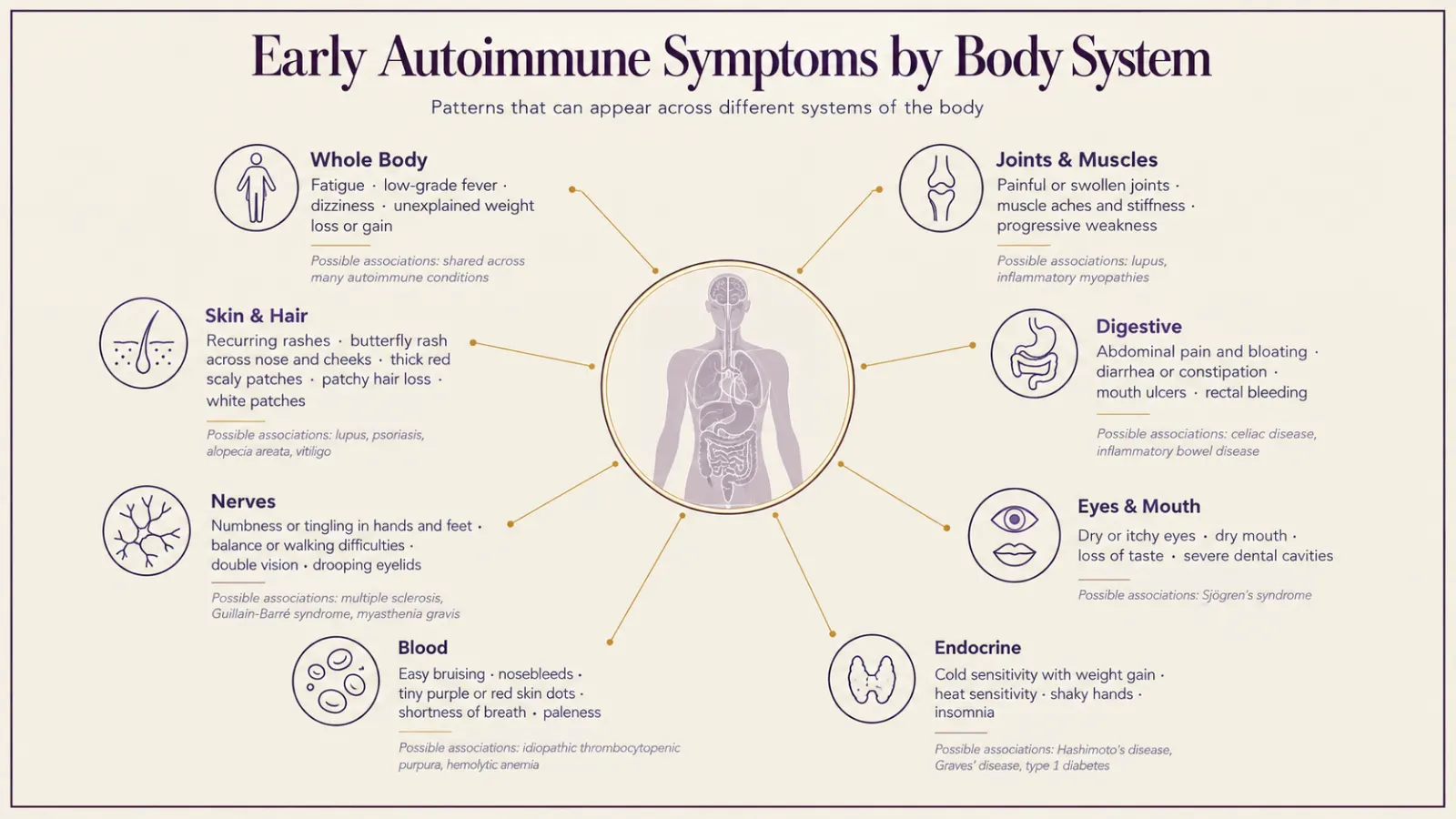
Early autoimmune symptoms group into eight body systems, and reading them that way turns a scattered history into something a person can describe at an appointment. Every symptom below comes from the Office on Women’s Health disease summaries.
| Body system | What people notice | Conditions where it appears |
|---|---|---|
| Whole body | Fatigue, low-grade fever, dizziness, weight loss or gain without trying | Shared across most types |
| Joints and muscles | Painful or swollen joints, muscle aches and stiffness, progressive weakness | Lupus, inflammatory myopathies |
| Skin and hair | Rashes that come and go, a butterfly rash across the nose and cheeks, thick red scaly patches, patchy hair loss, white patches | Lupus, psoriasis, alopecia areata, vitiligo |
| Digestive | Abdominal pain and bloating, diarrhea or constipation, mouth ulcers, rectal bleeding | Celiac disease, inflammatory bowel disease |
| Nerves | Numbness or tingling in the hands and feet, trouble with balance and walking, double vision or drooping eyelids | Multiple sclerosis, Guillain-Barre syndrome, myasthenia gravis |
| Eyes and mouth | Dry or itchy eyes, dry mouth, loss of the sense of taste, severe dental cavities | Sjogren’s syndrome |
| Blood | Easy bruising, nosebleeds, tiny purple or red dots on the skin, shortness of breath, paleness | Idiopathic thrombocytopenic purpura, hemolytic anemia |
| Endocrine | Cold sensitivity with weight gain, or heat sensitivity with shaky hands and insomnia | Hashimoto’s and Graves’ disease, type 1 diabetes |
Read the table the way a clinician would. Any single row has common explanations unrelated to autoimmunity. What earns attention is a pattern spanning more than one row that persists.
Symptoms That Come and Go Are Still Worth Reporting
The episodic course is part of the disease, not a sign the symptoms were imagined.
A flare is the sudden and severe onset of symptoms. Remission is a period when symptoms go away for a while.
Because symptoms rise and fall, people often book an appointment on a bad week and arrive on a good one. Describe the pattern over months, not the state of a single morning. The Office on Women’s Health puts it plainly: “Record any symptoms you have, even if they seem unrelated, and share it with your doctor.”
What Happens Before Anything Shows Up on a Test
Research describes a stage of autoimmune disease that precedes diagnosis, and this is the part most symptom articles leave out.
The preclinical phase is the stretch before a diagnosis in which immune changes are already underway and symptoms are either absent or too vague to name.
A 2022 review in Frontiers in Immunology states that “the preclinical phase of autoimmune disorders is characterized by an initial asymptomatic phase of varying length followed by nonspecific signs and symptoms.” In rheumatoid arthritis, the authors report that autoantibodies with low level inflammation “are found on average 5 years before the onset of symptoms.” In lupus, anti-Ro antibodies are detectable “approximately four years before SLE clinical manifestations.”
Read that carefully, because it says something specific and something limited. A long stretch of vague, shifting symptoms before a diagnosis is a documented shape researchers have measured in populations. The finding says nothing about whether any individual’s test result was accurate, and it does not mean earlier testing would have changed an outcome. Our guide to what to consider when standard labs come back normal covers that question separately.
How Long an Autoimmune Diagnosis Can Take
Long enough that researchers have measured it, though the best data covers one family of conditions.
A 2022 systematic review in the Orphanet Journal of Rare Diseases pooled 27 studies of myositis, a group of muscle-inflammation conditions, and found a mean diagnostic delay of 27.91 months. Inclusion body myositis averaged 61.32 months, other types 12.52. Those figures describe myositis specifically, not autoimmune disease in general.
The broader point holds across types. As the Office on Women’s Health says, “Getting a diagnosis can be a long and stressful process.”

Free training from Dr. Angela Goldstein, ND
If you have spent years with symptoms that come and go and a stack of normal results, this free training shows how inflammation, hormones and stress feed each other.
When you watch today, you’ll learn:
- ✓Why “normal” labs can miss what is actually wrong
- ✓The three systems that break down together, and why treating one at a time rarely lasts
- ✓Why even natural approaches fall short when they treat symptoms instead of systems
- ✓Real patient stories from 25+ years of practice
Free, instant access. Start watching right now.
Educational content. Always talk with your doctor before changing any treatment.
What a Positive ANA Test Actually Means
Less than most people assume, in both directions.
ANA, or antinuclear antibody, is a blood test that looks for antibodies directed at the material inside a person’s own cells.
The American College of Rheumatology is direct about the limits. A positive result “means autoantibodies are present, but it’s not a sure sign of an autoimmune disease.” The same source states that “up to 15% of completely healthy people have a positive ANA test.” A positive result calls for follow-up testing, an examination and a symptom review by a rheumatology provider.
An unremarkable panel also leaves the question open on its own, which is why history and examination carry so much weight. Dr. Goldstein describes the gap this way: “Standard labs measure diseases, not function. They’re checking to see if your engine is completely broken, not whether it’s running at 40% capacity.” That is a clinical framing, not a verdict on any particular result. The Natural Path treats functional lab testing as added context alongside a physician’s workup.
Autoimmune Disease Symptoms That Usually Turn Out to Be Something Else
Most of the time, fatigue is fatigue.
Autoimmune disease symptoms overlap heavily with conditions that are far more common: thyroid changes, perimenopause, iron or B12 deficiency, poor sleep, infection, and stress physiology. The Office on Women’s Health also notes that chronic fatigue syndrome and fibromyalgia are not autoimmune diseases, although “they often have symptoms of some autoimmune disease, like being tired all the time and pain.”
That overlap cuts both ways: a reason to stay calm about a single symptom, and a reason to keep asking when several persist together. Either way the next step is a physician evaluation. Ongoing tiredness has its own diagnostic path, which our page on unexplained persistent fatigue sets out.
When to Seek Medical Care Promptly
Some symptoms need attention today. Seek urgent medical care for:
- Chest pain or trouble breathing
- Sudden weakness, numbness, one-sided drooping, or difficulty speaking
- Sudden vision loss or double vision
- Severe abdominal pain, or blood in the stool
- A rash that spreads quickly, blisters, or comes with a high fever
- A fever that will not settle, or symptoms worsening over hours
These belong to emergency services or your physician, not to an article.
How to Get Your Symptoms Taken Seriously
Bring a written record, start with the specialist who matches your largest symptom, and keep asking. The Office on Women’s Health publishes the steps for people who are not getting answers:
- Write down a complete family health history, including extended family, and share it with your doctor.
- Record any symptoms you have, even if they seem unrelated, and share it with your doctor.
- See a specialist who has experience dealing with your most major symptom. If you have symptoms of inflammatory bowel disease, start with a gastroenterologist.
- Get a second, third, or fourth opinion if need be.
The agency then adds the sentence many patients have waited years to hear from anyone official: “If your doctor doesn’t take your symptoms seriously or tells you they are stress-related or in your head, see another doctor.”
It also says this: “Don’t give up if you’re not getting any answers.”
Where a Naturopathic Practice Fits
Alongside a physician, and on the questions a diagnosis does not answer by itself.
Physicians diagnose and manage autoimmune disease, with rheumatology, endocrinology, gastroenterology and neurology each carrying parts of that work. Nothing here is a reason to delay or decline that care.
What a naturopathic appointment adds is time and a wider read. In 25+ years of practice, Dr. Angela Goldstein, ND, has worked from the premise that inflammation, hormones, gut function and detoxification influence each other rather than operating as separate complaints. She uses an orchestra to explain it: “if one instrument is out of tune, if one hormone system is off, the whole orchestra sounds terrible.”
“See how it’s all connected? Everything feeds into everything else.”
Dr. Angela Goldstein, ND
That is the view behind how care works at The Natural Path: a long first appointment, a full history, and attention to the systems around a diagnosis.
Frequently Asked Questions
What are the earliest signs of an autoimmune disease?
Fatigue, dizziness and low-grade fever are the hallmark early symptoms shared across many autoimmune diseases, often with joint pain, rashes or digestive changes. All are non-specific, so they point toward an evaluation, not a conclusion.
Can you have an autoimmune disease with normal blood work?
Standard blood work leaves the question open on its own. Clinicians read results alongside history, examination and the symptom pattern over time, which is why a physician assessment matters more than any single panel.
What does a positive ANA test mean?
It means antinuclear antibodies are present. The American College of Rheumatology states this is not a sure sign of autoimmune disease, and that up to 15 percent of completely healthy people test positive. It calls for follow-up with a rheumatology provider.
How long does it usually take to get an autoimmune diagnosis?
It varies widely by condition. A systematic review of myositis found a mean delay of 27.91 months, ranging from 12.52 months for some types to 61.32 for inclusion body myositis. Researchers have not pooled other autoimmune diseases the same way.
Which doctor should I see for possible autoimmune symptoms?
Start with your primary care physician, who can order initial testing and refer onward. The Office on Women’s Health suggests seeing a specialist experienced with your largest symptom, such as a gastroenterologist for digestive symptoms.
Are fibromyalgia and chronic fatigue syndrome autoimmune diseases?
No. The Office on Women’s Health classifies both as separate conditions that often share symptoms with autoimmune disease, including constant tiredness and pain.
Where to Start
The most useful next step is a written record, not a search result.
Write down every symptom, when it started, and how it changes week to week, including the ones that seem unrelated. Take it to your physician. The Natural Path sees patients in person in San Juan Capistrano, Orange County, and by video visit across California, alongside the physicians already involved in a patient’s care.
Dr. Goldstein’s free Master Class explains how she reads inflammation, hormones, gut and detoxification as connected systems. Watch it here, and bring the questions it raises to your next appointment.

By Dr. Angela Goldstein, ND, licensed naturopathic doctor, 25+ years in practice. Last reviewed: 2026-09-16.
This article is for general education and is not medical advice. It is not intended to diagnose or treat any disease, does not establish a doctor-patient relationship, and is not a substitute for care from your own clinician. Autoimmune disease requires evaluation, diagnosis and ongoing management by a physician. Do not start, stop or change any prescribed medication based on what you read here. If you have an urgent medical concern, contact your physician or emergency services.