

Written by The Natural Path clinical content team, based on the teaching of Dr. Angela Goldstein, ND.
Hormone pellets are tiny cylinders of estradiol, testosterone or both that a clinician implants under the skin, where they slowly dissolve over roughly 3 to 6 months. Their main appeal is convenience: one short office procedure replaces daily pills, patches or creams.
Their main drawbacks are regulatory and practical. In the United States the hormone pellets used for women are compounded, so they are not FDA-approved, and once a pellet is in, it is designed to dissolve rather than be taken out. This page explains how pellet therapy works, what regulators and medical societies say, the honest pros and cons, and the other delivery forms that exist.
Key Takeaways
- A hormone pellet is a delivery form, a way of getting estradiol or testosterone into the body. It does not tell you whether you need either hormone.
- Pellets are placed through a small incision, usually in the upper buttock or lower abdomen, and new pellets are generally inserted every 3 to 6 months.
- Compounded drugs are not FDA-approved, so the FDA does not verify their safety, effectiveness or quality before they are marketed. Testopel, an FDA-labeled testosterone pellet, lists its indications for males.
- ACOG says compounded menopausal hormone therapy should not be prescribed routinely when FDA-approved products exist, and recommends preparations other than pellets for testosterone.
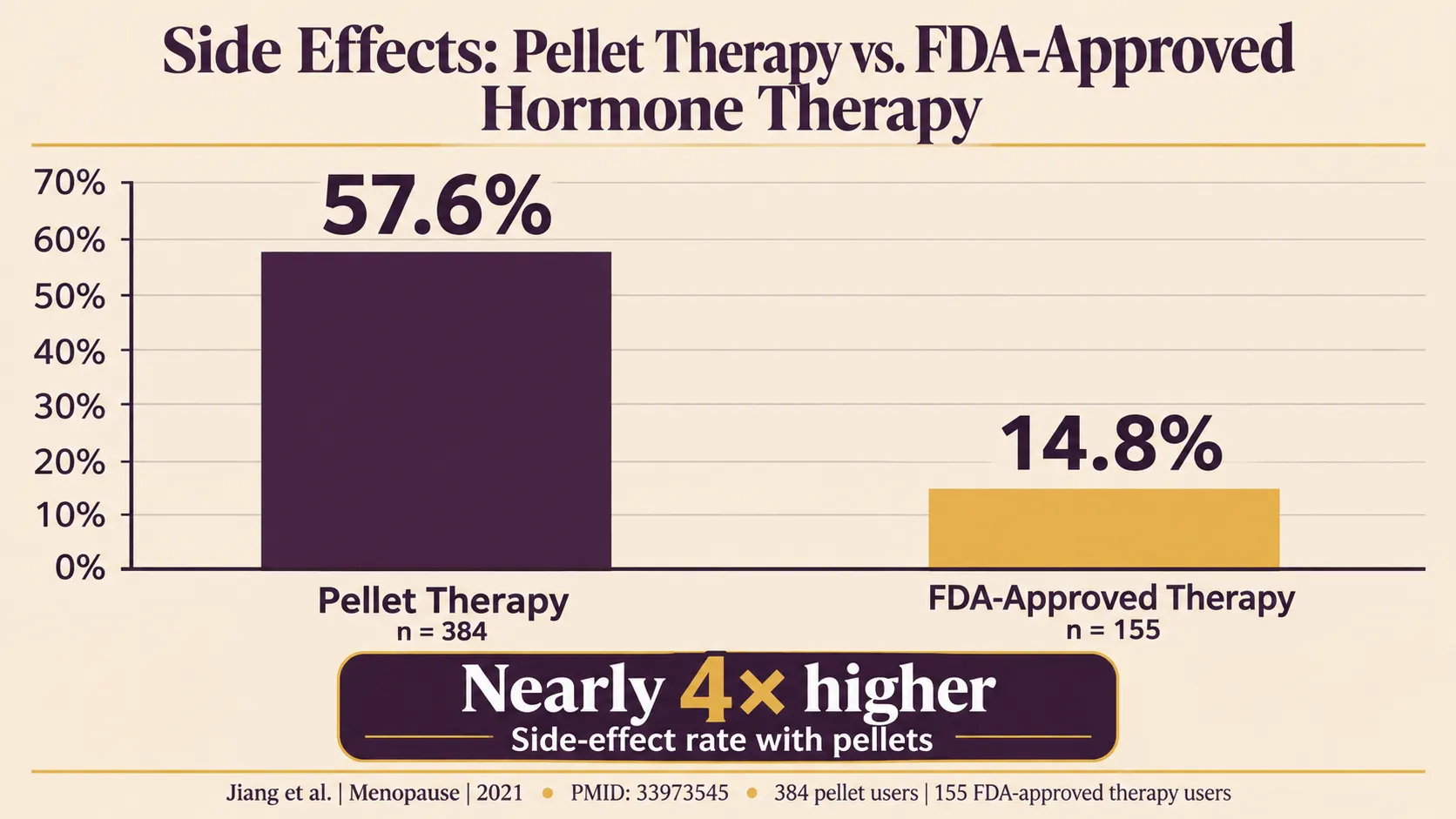
- In a 2021 study of 539 postmenopausal women, pellet users had more side effects (57.6% vs 14.8%) and much higher peak estradiol and testosterone levels than women on FDA-approved therapy.
- FDA-approved alternatives include estradiol tablets, patches, gels, sprays and a vaginal ring, plus oral micronized progesterone.
On this page: What pellets are · How they are placed · Regulation · What societies say · The evidence · Pros and cons · Alternatives · Questions to ask · The bigger picture · California · FAQ
If you searched this phrase, you are probably weighing pellets against something else, or you were offered them and want a second opinion. This guide sticks to the pellet itself: how it is placed, how it behaves in the body and what the evidence shows. It follows the teaching of Dr. Angela Goldstein, ND, who has 25+ years in practice in San Juan Capistrano and asks one question before any delivery form: which system is driving the symptoms? For the broader definition of bioidentical hormones across every form, read our guide to what bioidentical hormones are.
What Hormone Pellets Are
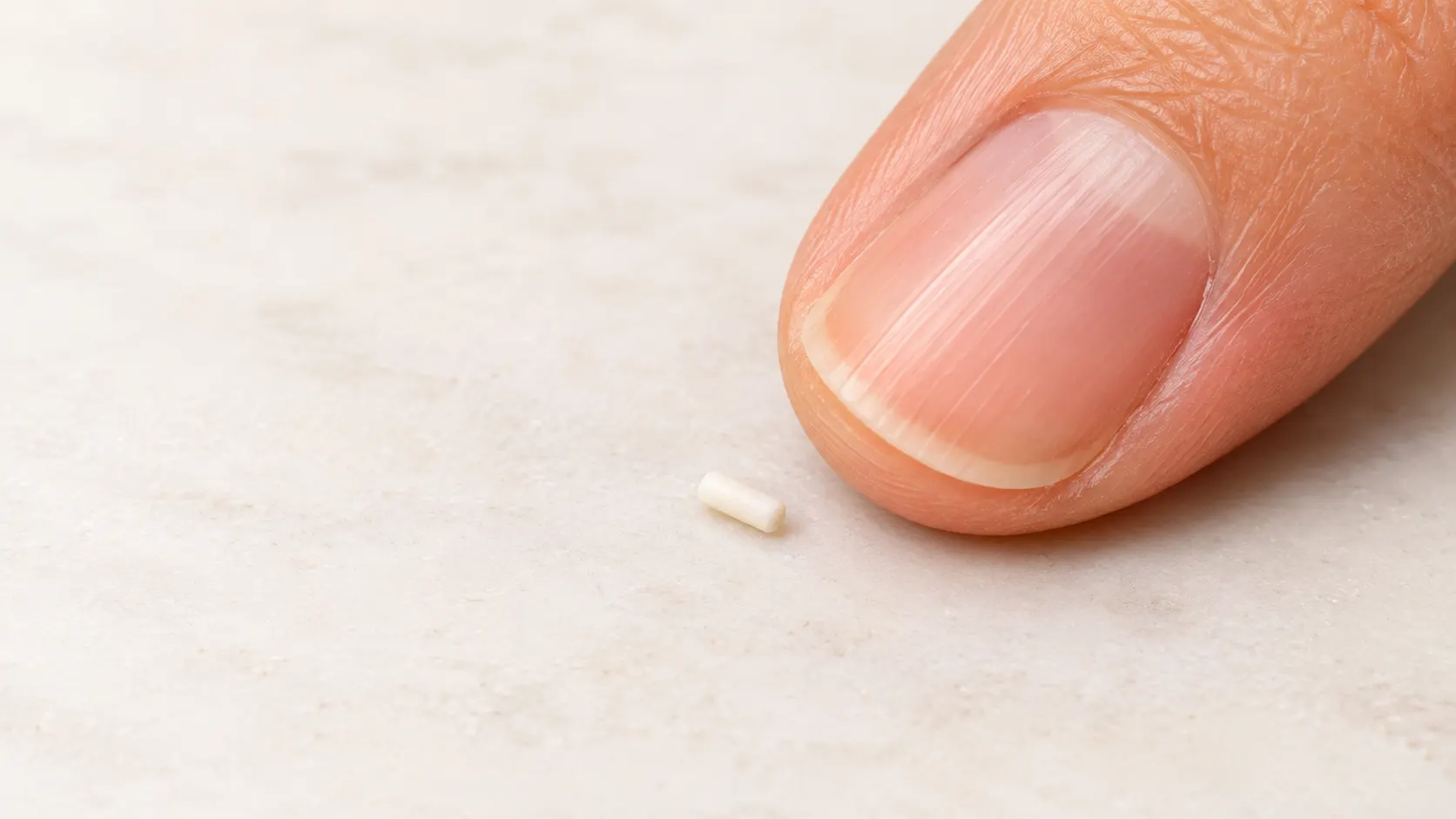
A hormone pellet is a compressed cylinder of hormone that sits under the skin and releases the hormone as it dissolves.
Hormone pellet therapy is a way of delivering estradiol, testosterone or both through a small implant placed in the fat under the skin. The National Academies of Sciences, Engineering, and Medicine describes the pellet form as a tiny cylinder that is implanted under the skin.
The pellets used in women’s hormone care are usually compounded, meaning a pharmacy prepares them from a prescription. A 2021 report of pellet procedures describes them as made from United States Pharmacopeia testosterone and estradiol powder with stearic acid as a binder, compressed in a pellet press and then sterilized.
Pellets come up most often in two situations: menopause symptoms such as hot flashes, where estradiol is the hormone in question, and low libido, where testosterone is the hormone in question. Those are different decisions with different evidence, and the sections below keep them apart.
How Hormone Pellets Are Placed
Pellet insertion is a short in-office procedure with a small incision.
Donovitz described the procedure in Therapeutic Advances in Endocrinology and Metabolism (2021), in what the paper calls the largest retrospective study of pellet implants. There, pellets were placed with a stainless steel trocar, a hollow tube that pushes the pellet under the skin. The insertion site was usually the upper gluteal area or the lower abdomen, and a local anesthetic numbed the area. Women were asked to avoid baths, swimming and strenuous exercise involving the gluteal muscles for 3 days.
What happens next:
- Release. The pellet dissolves slowly. Writing about testosterone pellets, ACOG states that the pellet “is not designed to be removed, but instead to dissolve over time.”
- Repeat. ACOG notes that new testosterone pellets are generally inserted every 3 to 6 months.
- Site reactions. The FDA label for Testopel, the FDA-approved testosterone pellet for males, reports post-marketing cases of implant-site infection and pellets working their way back out of the skin (extrusion), mostly within the first month.
Those first two points are the core trade-off of the form. Fewer doses means more convenience, and it also means a dose cannot be stopped the same day if it turns out to be too high.
Are Hormone Pellets FDA-Approved?
The estradiol and testosterone pellets used for women are compounded, and compounded drugs are not FDA-approved.
Compounded drug: a medicine a pharmacy prepares for an individual prescription. The FDA states: “Compounded drugs are not FDA-approved,” which means the FDA does not verify their safety, effectiveness or quality before they are marketed.
One pellet product does carry FDA labeling. The Testopel label on DailyMed lists its indications under the heading “MALES,” for conditions in which the body makes little or no testosterone. The label lists adverse reactions reported in women given androgens, including unwanted hair growth, deepening of the voice and male-pattern baldness.
ACOG’s 2023 Clinical Consensus states that there is no FDA-approved testosterone formulation for the management of menopausal symptoms, and that clinicians and patients should use shared decision-making when considering compounded testosterone.
The National Academies took the pellet question a step further. Its 2020 report recommended that compounded hormones in pellet form be considered for the FDA’s Difficult to Compound List. The reasons it gave were the complexity of the delivery mechanism, insufficient guidance for compounders and a lack of required bioavailability testing.

Free training from Dr. Angela Goldstein, ND
If your labs keep coming back normal and you still do not feel right, this free training shows how stress, thyroid and sex hormones pull on each other. Dr. Goldstein walks you through it.
When you watch today, you’ll learn:
- ✓Why “normal” labs can miss what is actually wrong
- ✓The three systems that break down together, and why treating one at a time rarely lasts
- ✓Why even natural approaches fall short when they treat symptoms instead of systems
- ✓Real patient stories from 25+ years of practice
Free, instant access. Start watching right now.
Educational content. Always talk with your doctor before changing any treatment.
What Medical Societies Say About Pellet Therapy
The major menopause and gynecology bodies are cautious about pellets, for slightly different reasons.
| Organization | Document | What it says about pellets or compounded hormones |
|---|---|---|
| The Menopause Society (published as NAMS) | 2022 Hormone Therapy Position Statement | Compounded hormones may use “nonstandard or untested routes such as subdermal implants, pellets, or troches,” and present safety concerns including overdosing and underdosing |
| ACOG | Clinical Consensus No. 6 (2023) | Compounded menopausal hormone therapy “should not be prescribed routinely when FDA-approved formulations exist”; recommends preparations other than pellets for testosterone |
| National Academies | 2020 report on compounded bioidentical hormones | Restrict compounded hormones to an ingredient allergy or a dose form not available as an FDA-approved product |
| International consensus on testosterone for women | Global Consensus Position Statement (2019) | Testosterone preparations that result in supraphysiologic levels, “including pellets and injections,” are not recommended |
A note on names: the North American Menopause Society (NAMS) changed its name to The Menopause Society in 2023. Its 2022 position statement was published under the older name.
The 2022 position statement names five safety concerns with compounded hormone therapy. They are minimal government regulation and monitoring, overdosing and underdosing, impurities and lack of sterility, a lack of efficacy and safety data, and no label outlining risks. It adds that patient preference alone should not justify a compounded preparation when a government-approved one is available.
ACOG’s Clinical Consensus No. 6 is specific about testosterone: “Based on the lack of safety data and inability to remove the pellet, ACOG recommends preparations other than pellet therapy for the delivery of testosterone.”
The 2019 Global Consensus Position Statement was endorsed by groups including the International Menopause Society and The Endocrine Society. It says the only evidence-based indication for testosterone in women is hypoactive sexual desire disorder (HSDD), low sexual desire that causes distress. That indication applies to postmenopausal women after a full assessment. It also states that the safety of long-term testosterone therapy has not been established.
What the Research Shows
The pellet evidence splits into two camps: large practice databases that report few complications, and comparison studies that report high hormone levels and more side effects.
The supportive data. The 2021 Donovitz report reviewed 1,204,012 pellet procedures in 376,254 patients from 2012 to 2019; 85% of the procedures were in women. It reported an overall complication rate under 1%, with pellet extrusion the most common problem.
The same paper reports that 43% of patients stopped pellet therapy after the first insertion, and that 93% of those who had a second insertion continued; it did not capture why so many stopped. The author is the founder and chief medical officer of BioTE Medical, a pellet company, a conflict the paper discloses. ACOG also notes that pellet testosterone “has the potential for better bioavailability and more predictable absorption” than injections or patches.
The comparison data. A 2021 study in Menopause by Jiang and colleagues compared 384 postmenopausal women on pellets with 155 on FDA-approved hormone therapy at one hospital system.
| Outcome | Pellet therapy | FDA-approved therapy |
|---|---|---|
| Any side effect | 57.6% (221 of 384) | 14.8% (23 of 155) |
| Abnormal uterine bleeding (women with a uterus) | 55.3% (136 of 246) | 15.2% (12 of 79) |
| Hysterectomy (women with a uterus) | 20.3% (50 of 246) | 6.3% (5 of 79) |
| Mean peak estradiol | 237.70 pg/mL | 93.45 pg/mL |
| Mean peak testosterone | 194.04 ng/dL | 15.59 ng/dL |
Four women on pellets had estradiol above 1,000 pg/mL, and nine had testosterone above 400 ng/dL. The authors concluded that pellet users had more side effects and significantly higher supraphysiologic peak levels, meaning levels above what the body normally makes. For scale, ACOG gives 40 to 100 pg/mL as a generally reasonable estradiol range for symptom relief.
The Jiang study was retrospective and from a single institution, so it shows an association rather than proof that the pellet caused each outcome. It is still the clearest head-to-head comparison published.
ACOG’s review adds the adverse effects reported in testosterone pellet studies: increases in facial hair and acne, perceived voice changes, mood swings, anxiety, weight gain, acute uterine bleeding and hysterectomy for abnormal uterine bleeding. On breast cancer, ACOG says the risk in testosterone pellet users “is still unclear.” It lists limitations in the cohort study that reported a lower breast cancer incidence, including heavy loss to follow-up and a historical control group.
Hormone Pellets Pros and Cons, Side by Side
Hormone pellets trade daily dosing for a dose that cannot be stopped once it is placed, and the evidence on side effects leans against them. Each line below ties to the sources above.
| Pros | Cons |
|---|---|
| A few office visits a year replace daily dosing | The pellet cannot be removed once placed; a dose that is too high runs its course |
| ACOG notes testosterone pellets may have better bioavailability and more predictable absorption than injections or patches | Compounded pellets are not FDA-approved, and the FDA does not verify their safety, effectiveness or quality before marketing |
| A large practice database reported complications under 1% | That database was authored by a pellet company founder, and 43% of its patients stopped after one insertion; comparison data show far more side effects than FDA-approved therapy |
| No daily step to forget | Peak estradiol and testosterone ran well above normal ranges in pellet users in the Jiang study |
| ACOG and the 2019 testosterone consensus both recommend other forms for testosterone | |
| Each insertion is a minor procedure with a small risk of infection or extrusion |
Convenience is a real benefit, and for some women it matters a great deal. The cons cluster around one theme: control. ACOG contrasts the pellet with preparations such as topical creams and pills that “can be easily discontinued.”
Alternatives to Hormone Pellets
Estradiol, the main hormone offered in pellet form for menopause symptoms, also exists in several FDA-approved forms.
ACOG’s 2023 consensus lists these FDA-approved bioidentical options:
| Hormone | FDA-approved forms listed by ACOG |
|---|---|
| Estradiol | Oral tablets; transdermal patches; gels, emulsions and sprays; vaginal ring with systemic levels for 90 days |
| Progesterone | Oral micronized progesterone (100 and 200 mg) |
| Combination | Oral estradiol 1 mg with micronized progesterone 100 mg |
| Testosterone | Gels approved for men; ACOG notes these can be titrated for women, and none is formally approved for women |
ACOG’s table also lists a vaginal progesterone gel and insert, with a note that they are approved to support assisted reproduction, not for menopausal use.
ACOG adds that FDA-approved patches “provide a more consistent delivery, with a relatively steady level of estradiol, and may have a lower risk of venous thromboembolism” than oral hormones. The NAMS 2022 statement lists the systemic estrogen routes as oral drugs, transdermal patches, sprays and gels, and vaginal rings.
Two points matter for women comparing these with pellets:
- Estrogen and the uterus. Pellet discussions often focus on estradiol and testosterone. A woman with a uterus who takes systemic estrogen in any form needs adequate progestogen to protect the uterine lining. Our guide to bioidentical progesterone covers that evidence in detail.
- Testosterone. No FDA-approved testosterone product exists for women’s menopausal symptoms, according to ACOG. For women with HSDD, the 2019 consensus says that where an approved female product is unavailable, off-label prescribing of an approved male formulation is reasonable, provided levels stay in the physiologic female range. It recommends a baseline testosterone level before starting and a repeat level 3 to 6 weeks later.
Whatever the form, Dr. Goldstein’s caution applies: most practitioners “treat symptoms, not systems.” Choosing a patch over a pellet changes the route, and it still leaves open why the hormone fell.
For what the different forms tend to involve financially, see our guide to bioidentical hormone costs.
Questions to Ask Before Pellet Therapy
If pellets have been suggested to you, these questions turn a sales conversation into a clinical one.
- Which hormone, and what was the reason? Ask which symptom each hormone is meant to address and what testing pointed to it.
- Is there an FDA-approved form that would work? NAMS and the National Academies both say compounded hormones belong to specific situations, such as an ingredient allergy or a dose not available as an approved product.
- What happens if the dose is too high? Ask how side effects would be managed while the pellet dissolves.
- How will levels be checked? ACOG says clinicians can consider testing pellet users to rule out supraphysiologic testosterone levels, and it notes that direct assays for testosterone are highly unreliable in the female range, so the method matters.
- What protects my uterus? If estradiol is part of the plan and you have a uterus, ask what progestogen, at what dose, protects the lining.
- Has anything upstream been looked at? Thyroid, stress and blood sugar can produce the same symptoms that lead women to ask about hormones.
A Delivery Method Is Not a Diagnosis
A pellet settles how a hormone gets into the body. Why the symptoms started is a separate question, and it is the one Dr. Goldstein asks first.
Her teaching starts with the limits of a single number: “Standard labs measure diseases, not function.” She adds that “Your hormones can be in range while being completely out of balance as a system.” A woman with fatigue, weight gain and low libido can see a testosterone or estradiol level on a page and still not know what drove it.
Dr. Goldstein’s three-system model puts the thyroid, the adrenals and the sex hormones in one loop: “These three systems are interconnected. You cannot fix one without addressing the others.” She describes the chain this way: chronic stress keeps cortisol high, and “High cortisol tells your thyroid to slow down because your body thinks there’s a famine.” A slower thyroid then disrupts the sex hormones.
The physiology literature supports the stress link. A 2010 review by Whirledge and Cidlowski in Minerva Endocrinologica looked at glucocorticoids, the stress hormone family that includes cortisol. It concludes that they act mainly above the pituitary, probably by interrupting the brain’s GnRH signal that drives the ovaries. If stress is part of why sex hormones fell, a pellet changes the blood level without touching that driver.
She is equally direct about one-size answers in natural medicine: “protocols are designed for populations, not individuals.” One patient story in her Master Class is a woman whose hot flashes and weight gain had been met with hormones she did not need. Her symptoms resolved once nutrition and detoxification were addressed. That is the risk the Jiang numbers describe in a different language: a dose the body did not need, in a form that cannot be taken back.
Our hormone testing guide explains which labs help answer the “why.”
The hormones and perimenopause page shows how The Natural Path reads the thyroid, adrenal and sex hormone systems together.
Hormone Pellet Questions in Orange County and Across California
The Natural Path sees women in person at its San Juan Capistrano office, an easy drive from San Clemente and Aliso Viejo, and by video visit anywhere in California. Its bioidentical hormone therapy page says hormone support is considered after a full evaluation of thyroid, adrenal, metabolic and sex hormone function, not offered as a default answer to fatigue or weight gain.
That order matters whether you already have pellets in place or someone has offered them: the system question comes before the delivery question. Video visits are explained on the telemedicine page.
Directions and hours for the San Juan Capistrano office are on the contact page.
Frequently Asked Questions
How long do hormone pellets last?
Hormone pellets generally last 3 to 6 months; ACOG states that new testosterone pellets are generally inserted on that schedule as the previous pellet dissolves. How long one lasts in a given woman varies, which is one reason level checks matter.
Can hormone pellets be removed?
No, not routinely: ACOG says the pellet is not designed to be removed and instead dissolves over time. That is why its consensus cites the “inability to remove the pellet” as one reason to prefer other testosterone preparations.
Are hormone pellets safe?
Hormone pellets have not been shown to be as safe as FDA-approved hormone therapy. Compounded pellets are not FDA-approved, and a 2021 comparison found more side effects and higher peak hormone levels in pellet users than in women on FDA-approved therapy. A large company-authored database reported complications under 1%.
Are testosterone pellets for women FDA-approved?
No testosterone product is FDA-approved for women’s menopausal symptoms, according to ACOG. Testopel, an FDA-labeled testosterone pellet, lists its indications for males.
Do hormone pellets cause weight gain?
ACOG lists weight gain among the adverse effects reported in testosterone pellet studies, along with acne, facial hair, mood swings and voice changes. Weight gain in midlife also has thyroid, cortisol and blood sugar explanations worth checking.
What is the best alternative to hormone pellets?
There is no single best form. FDA-approved estradiol comes as tablets, patches, gels, sprays and a vaginal ring, and progesterone for menopause care as an oral micronized capsule. ACOG notes that patches give relatively steady estradiol levels. The right choice depends on your history and what testing shows.
Where to Start
Before choosing a delivery form, it helps to know which system is actually driving your symptoms. Take the free hormone quiz to see where your symptoms point.
Written by The Natural Path clinical content team, based on the teaching of Dr. Angela Goldstein, ND.
This article is for general education and is not medical advice. It does not establish a doctor-patient relationship and is not a substitute for care from your own clinician. Do not start, stop or change any hormone or prescribed medication based on what you read here. If you have an urgent medical concern, contact your physician or emergency services.