
What are bioidentical hormones? They are hormones made in a laboratory to be chemically and structurally identical to the hormones your body produces, most often estradiol, progesterone and testosterone. Manufacturers often synthesize them from plant compounds, such as soybean sterols, and they fall into two regulatory groups. Some are FDA-approved manufactured products, reviewed for safety and efficacy. A pharmacy compounds the others for one prescription, and those have not gone through FDA approval. Both groups require a prescription, and both come in several delivery forms, including creams and gels, oral capsules and injections.
Key Takeaways
- Bioidentical describes a molecule’s structure, identical to a human hormone, regardless of the plant or lab it came from.
- Estradiol, progesterone and testosterone are available as FDA-approved bioidentical products.
- Compounded bioidentical hormones are not FDA-approved and are not required to prove safety or effectiveness before they are dispensed.
- The National Academies found the data do not support claims that compounded versions are safer or work better than FDA-approved ones.
- Common delivery forms include creams and gels, oral capsules, patches, vaginal inserts and injections.
On this page: What bioidentical means · Which hormones · What they are made from · FDA-approved vs compounded · Delivery forms · 2025 FDA label change · Questions to ask · FAQ
In a US survey of 801 women, 86% did not know that compounded hormone products are not FDA-approved. That gap matters, because “bioidentical” and “natural” are often read as “tested” or “safer.”
This guide gives you the vocabulary. To see how we evaluate hormone symptoms as a whole, read our page on hormone imbalance and perimenopause care.
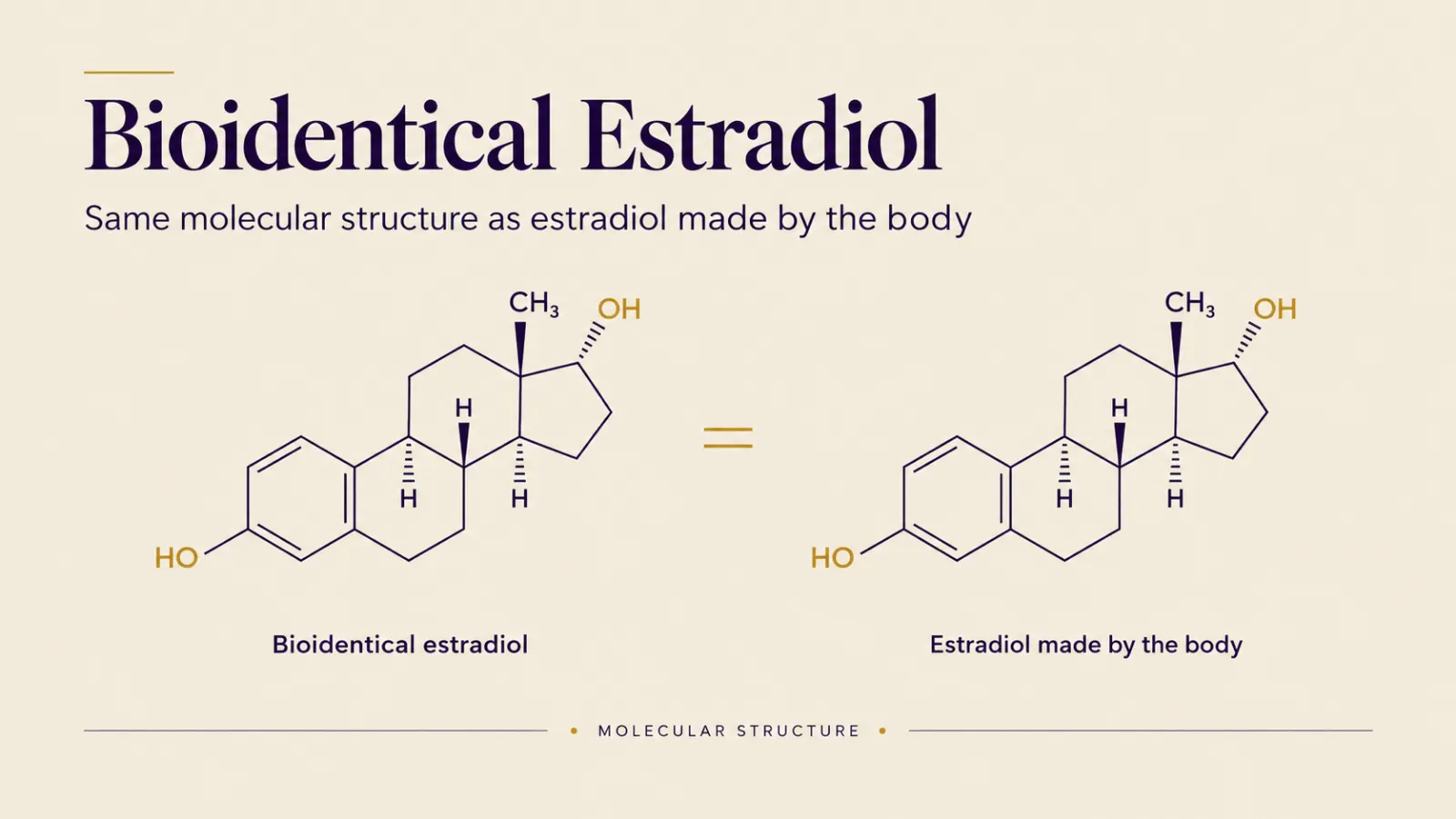
What “Bioidentical” Actually Means
“Bioidentical” means a hormone has the same chemical structure as one the human body makes.
Bioidentical hormone describes a hormone chemically and structurally identical to one the human body produces, expected to act the way the body’s own hormone does.
That definition comes from the National Academies of Sciences, Engineering, and Medicine (NASEM) report on bioidentical hormones. The report adds a point most marketing leaves out: the molecule’s structure, not its source, determines whether a hormone is bioidentical.
The contrast is with synthetic hormones, which NASEM classifies as molecules not native to the body. So “bioidentical” is a description of chemistry, not a regulatory category or a safety rating.
Which Hormones Are Bioidentical
The bioidentical hormones used most often are forms of estrogen, progesterone and testosterone.
| Hormone | What it is | FDA-approved bioidentical form exists? |
|---|---|---|
| Estradiol | An estrogen made mainly in the ovaries | Yes, 7 dosage forms |
| Progesterone | Counterbalances estrogen’s effect on the uterine lining | Yes, 4 dosage forms |
| Testosterone | Present in both women and men | Yes, 4 dosage forms |
| Estriol | An estrogen formed in the placenta during pregnancy | No, compounded only |
The dosage-form counts come from the National Academies’ review of available preparations. Estriol is the outlier: it appears in compounded blends, but NASEM identified no FDA-approved estriol product.
A hormone level on its own does not tell anyone which of these belongs in a plan. Our guide to what perimenopause hormone tests can and cannot show explains why.
What Are Bioidentical Hormones Made From?
Bioidentical hormones are made in a laboratory, even when the starting material is a plant.
- Plant sterols are the raw material. Plants do not make cholesterol, the body’s starting point for hormones. They make related compounds called plant sterols, and soybean sterols are one documented source.
- A laboratory converts the sterols. Chemical processing turns those sterols into steroid hormones, according to NASEM.
- The finished hormone becomes a medicine. The same active ingredient can go to a drug manufacturer or to a compounding pharmacy.
This is why “plant-derived” can mislead: the plant supplies raw material, and the laboratory makes the hormone.
FDA-Approved vs Compounded Bioidentical Hormones
The biggest practical difference between bioidentical hormones is regulation, not chemistry.
Compounded bioidentical hormone therapy is a hormone preparation a pharmacy mixes for an individual prescription, often marketed as “bioidentical” or “natural,” as an alternative to FDA-approved products.
Drug manufacturers make FDA-approved bioidentical products in set doses, and the FDA reviews them for safety and efficacy. A pharmacy mixes compounded bioidentical hormones for one prescription. Because compounded preparations are exempt from certain federal requirements, the National Academies report states they are not required to demonstrate safety or effectiveness before they are dispensed.
| FDA-approved bioidentical | Compounded bioidentical | |
|---|---|---|
| FDA approval | Yes | No |
| Safety and efficacy review before use | Required | Not required |
| Standardized label and package insert | Required | Not federally required |
| Dosage forms available | 13 | At least 32 |
| Evidence of superior safety or effectiveness | Not applicable | Data do not support it |
Compounding is common. The report estimated 26 to 33 million compounded hormone prescriptions a year, costing upwards of $2 billion. A separate survey analysis estimated that up to 2.5 million US women aged 40 or older may use compounded hormone therapy annually, accounting for 28% to 68% of hormone therapy prescriptions.
The National Academies concluded the data do not support claims that compounded preparations are safer or more effective than FDA-approved bioidentical products. Its first recommendation was to restrict compounded use to a documented allergy to an ingredient in an FDA-approved product, or a documented need for a different dosage form.
Plain takeaway: a compounded hormone can have a legitimate reason behind it. You should know what that reason is.

Free 3-minute quiz from Dr. Angela Goldstein, ND
Stress, thyroid and sex hormones work as one system. Answer 22 quick questions and see which one is under the most strain for you.
What you’ll get:
- ✓A score for each system: stress, thyroid and sex hormones
- ✓Which pattern your answers fit, and how the systems pull on each other
- ✓Built on published research
- ✓A clear next step for your pattern
Free. 22 questions, about 3 minutes.
Educational content. Always talk with your doctor before changing any treatment.
Delivery Forms: Creams, Oral Capsules and Injections
Common routes for bioidentical hormones include the skin, the digestive tract and injection, and the right form depends on the hormone and the person.
The Natural Path uses creams, oral and injectable forms. Pellets are not offered here. That choice sits inside a broader plan, described on our page about how bioidentical hormone therapy is used in this practice.
Creams and gels
You apply creams and gels to the skin, and the hormone absorbs from there. FDA-approved gels exist for estradiol, progesterone and testosterone. Many compounding cream bases, NASEM noted, are not required to be tested for how well they deliver hormones through the skin.
Oral capsules
You swallow oral capsules, and the digestive tract absorbs the hormone. Progesterone is available as an FDA-approved oral capsule. The 2020 NASEM review counted two FDA-approved progesterone capsule strengths, against many more compounded strengths.
Injections
Injections deliver a hormone into muscle or tissue. Progesterone is available as an FDA-approved injectable solution.
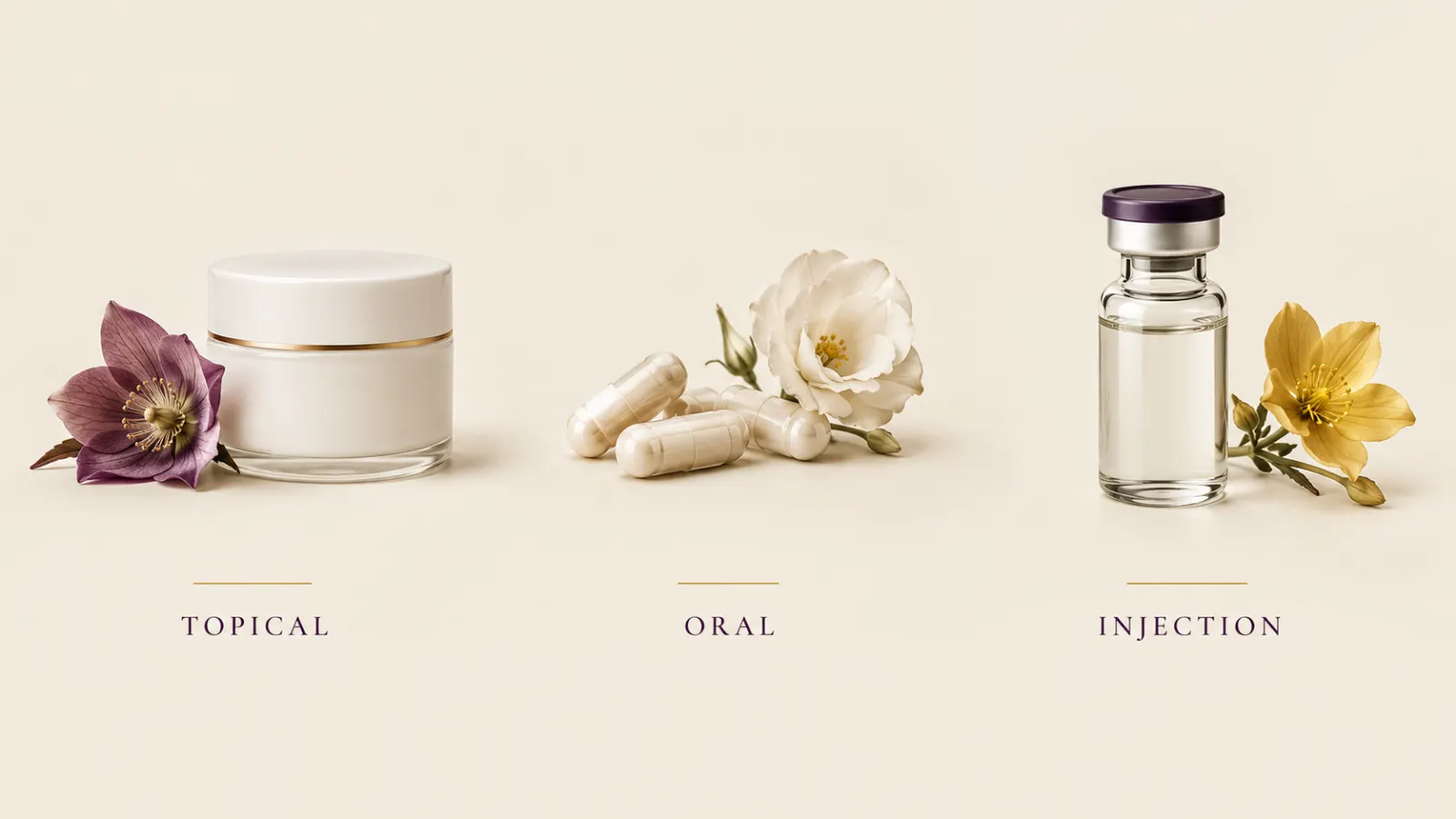
| Form | How it enters the body | Example FDA-approved bioidentical option |
|---|---|---|
| Cream or gel | Through the skin | Estradiol gel, progesterone gel |
| Oral capsule | Digestive tract | Progesterone capsule |
| Injection | Muscle or tissue | Progesterone solution |
What the 2025 FDA Label Change Covers
In November 2025 the FDA began removing the boxed warnings for cardiovascular disease, breast cancer and probable dementia from estrogen-containing menopausal hormone therapy, with labels rewritten to note benefit when therapy starts within 10 years of menopause onset.
Scope: per the FDA announcement, the boxed warning for endometrial cancer stays on systemic estrogen-alone products. The FDA’s labeled timing is to start within 10 years of menopause onset or before age 60.
This change applies to product labels, which FDA-approved products carry. Compounded preparations are not federally required to carry full product labels or standardized package inserts. A woman using one may never see this information in print. The label change also does not decide whether hormones suit any one woman.
Questions to Ask Before Starting Any Bioidentical Hormone
Five questions tell you what you are being offered and why.
- [ ] Is this an FDA-approved product or a compounded preparation?
- [ ] If compounded, what is the documented reason an FDA-approved form will not work?
- [ ] Why this form, cream, oral or injection, for this hormone?
- [ ] What else was evaluated first, such as thyroid, stress physiology and blood sugar?
- [ ] How will the dose be monitored and adjusted?
The fourth question matters because hormones work as a system. Describing what most doctors miss, Dr. Goldstein puts it this way: they “test estrogen, and if it’s low, they prescribe estrogen replacement. They’re treating one instrument and orchestra and ignoring all others.” Her approach, built over 25+ years, is to look for the underlying driver before any hormone is chosen.
The Natural Path sees patients in person in San Juan Capistrano, Orange County, and through telemedicine across California.
Frequently Asked Questions
Are bioidentical hormones natural?
Bioidentical hormones are made in a laboratory, often from plant sterols. They match human hormones in structure, but they are processed medicines. NASEM notes that compounded hormone products are often marketed as “natural.”
Are bioidentical hormones FDA-approved?
Some are. The FDA has approved several bioidentical hormone medications at different doses and routes, including estradiol, progesterone and testosterone products. Compounded bioidentical hormones are not FDA-approved.
Are bioidentical hormones safer than other hormone therapy?
The National Academies found the data do not support claims that compounded bioidentical preparations are safer or more effective than FDA-approved products. Risks and benefits depend on the individual.
Is progesterone available as a bioidentical capsule?
Yes. Progesterone is available as an FDA-approved oral capsule in two strengths, and compounded progesterone capsules come in many more strengths.
Can I get bioidentical hormones without an evaluation?
Bioidentical hormones are prescription medicines, so a licensed clinician has to evaluate you first. The Natural Path considers hormones only after a full evaluation, described in what a first root-cause evaluation involves.
Where to Start
Choosing a hormone form is the last step, after someone has worked out why your hormones changed. Dr. Goldstein’s free Master Class walks through the three systems she reads together before hormones enter a plan. Watch the free Master Class.
By Dr. Angela Goldstein, ND, licensed naturopathic doctor, 25+ years in practice. Last reviewed: 2026-09-16.
This article is for general education and is not medical advice. It does not establish a doctor-patient relationship and is not a substitute for care from your own clinician. Do not start, stop or change any hormone or prescribed medication based on what you read here. If you have an urgent medical concern, contact your physician or emergency services.