

Written by The Natural Path clinical content team, based on the teaching of Dr. Angela Goldstein, ND.
Bioidentical progesterone is progesterone with the same chemical structure as the progesterone a woman’s ovaries make. In the United States the FDA-approved version is micronized progesterone, sold under the brand name Prometrium, and pharmacies also compound versions of it. Doctors use it for three main reasons: to protect the uterine lining when a woman takes estrogen, to restart missing periods, and, outside its labeled uses, to help with sleep and night sweats. This page covers what it is, how it differs from synthetic progestins, what the research supports, and who should not take it.
Key Takeaways
- “Bioidentical” describes structure. Micronized progesterone is structurally identical to the progesterone made by the corpus luteum, the structure in the ovary that forms after ovulation.
- Synthetic progestins such as medroxyprogesterone acetate, norethindrone acetate and levonorgestrel are different molecules.
- The best-documented use is endometrial protection: women with a uterus who take systemic estrogen need an adequate progestogen.
- Sleep research is real but modest, and it is mostly in women who also take estrogen.
- The FDA label lists contraindications, including peanut allergy, unexplained vaginal bleeding, a history of breast cancer, blood clots, stroke and liver disease.
- Compounded progesterone is not FDA-approved, and the FDA does not verify its safety, effectiveness or quality before it is marketed.
On this page: What it is · Progestins · FDA-approved vs compounded · Forms · When it is used · Endometrial protection · Sleep · Risks · The bigger picture · California · FAQ
If you searched this phrase, you probably want a plain answer to two questions: is this the same as the progesterone my body made, and is it safe for me. This page answers both with the FDA label, the North American Menopause Society (NAMS) 2022 position statement and peer-reviewed studies. For the broader definition covering estradiol and testosterone too, read our guide to what bioidentical hormones are.
What Bioidentical Progesterone Is
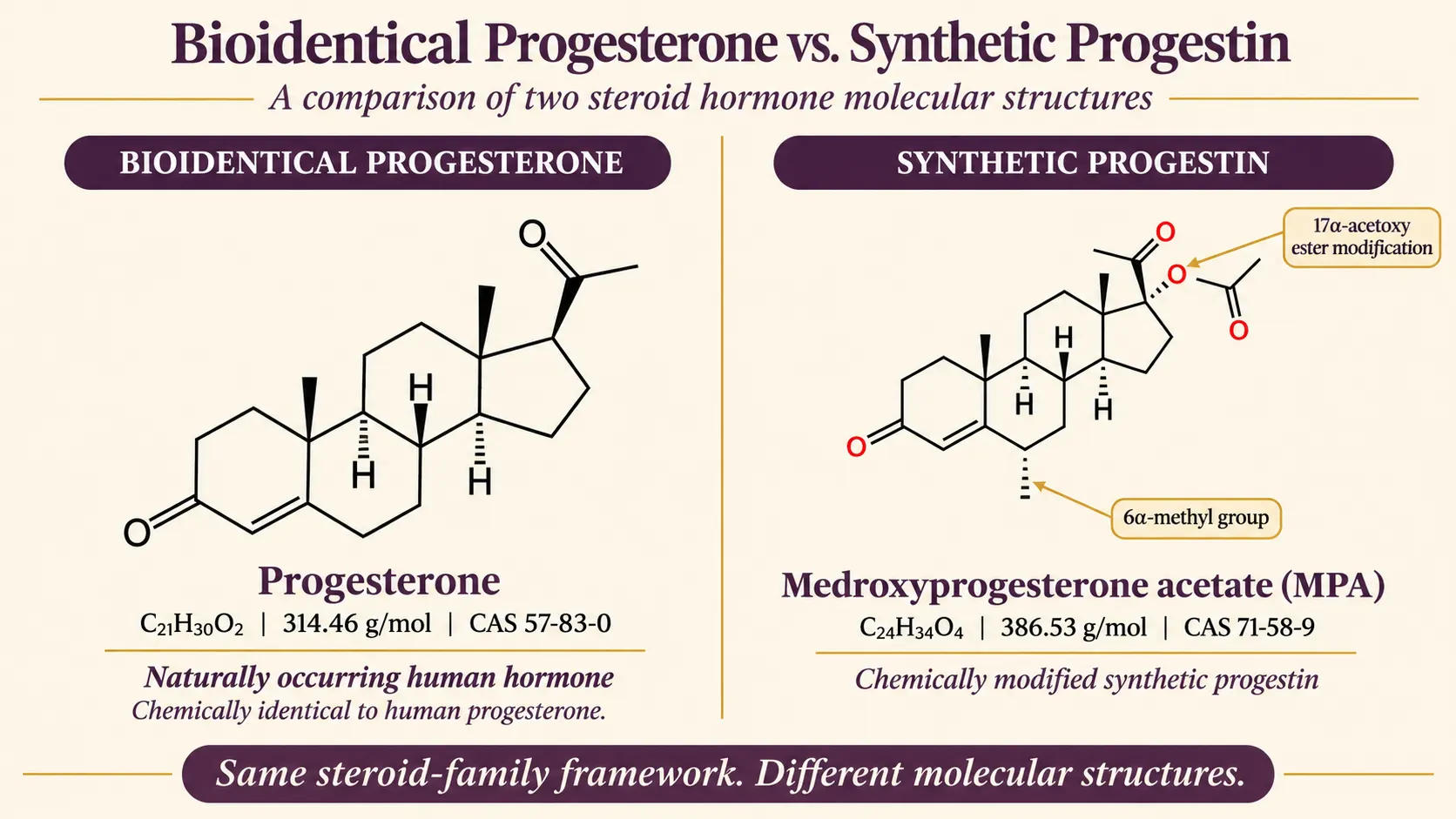
Bioidentical progesterone is progesterone whose structure matches the hormone the ovary produces.
Micronized progesterone is progesterone ground into very small particles so the body absorbs it better when swallowed. The FDA label for Prometrium describes it as an oral form of progesterone that is “chemically identical to progesterone of ovarian origin” and notes that micronization increases oral bioavailability.
Your body makes progesterone mainly after ovulation. Our page on low progesterone symptoms walks through how that feels and what else can cause the same symptoms.
The “plant” part of the story is a manufacturing detail. According to the FDA-approved Prometrium label, the progesterone is “synthesized from a starting material from a plant source” and is chemically identical to progesterone of human ovarian origin. A laboratory makes the finished hormone, even when the starting material grew in a field.
Progesterone vs Synthetic Progestins
Progesterone and progestins are both progestogens, but they are different molecules.
The NAMS 2022 hormone therapy position statement uses “progestogens” as the general category that includes synthetic progestins and progesterone. It lists medroxyprogesterone acetate, levonorgestrel and norethindrone acetate as synthetic progestins, and states that micronized progesterone is structurally identical to the progesterone produced by the corpus luteum.
| Micronized progesterone | Synthetic progestins | |
|---|---|---|
| Examples | Prometrium (FDA-approved capsule) | Medroxyprogesterone acetate, norethindrone acetate, levonorgestrel |
| Structure | Same as ovarian progesterone | Different from ovarian progesterone |
| Used for endometrial protection with estrogen | Yes | Yes |
| Studied in the Women’s Health Initiative (WHI) combination trial | No | Yes, medroxyprogesterone acetate was the only progestogen studied |
That last row explains much of the confusion. The WHI estrogen-plus-progestin trial used one progestogen, medroxyprogesterone acetate, with one oral estrogen, so its findings were gathered with a synthetic progestin.
NAMS says micronized progesterone “may be less thrombogenic than other progestins.” It also says it is unknown whether oral regimens containing micronized progesterone carry the same breast cancer, stroke, heart attack or clot risks as the WHI regimen, because trials have not yet been designed to examine those outcomes.
A 2025 narrative review in the Journal of Clinical Medicine says the effects of synthetic progestins on metabolic, cardiovascular, skeletal and cognitive systems vary and are not uniformly beneficial. The authors argue that micronized progesterone behaves more physiologically.
FDA-Approved Micronized Progesterone vs Compounded
The meaningful difference between two “bioidentical” progesterone products is regulation.
Compounded progesterone is progesterone a pharmacy prepares for an individual prescription. The FDA states: “Compounded drugs are not FDA-approved,” which means the FDA does not verify their safety, effectiveness or quality before they are marketed.
NAMS describes the FDA-approved side this way: approved bioidentical hormones, including micronized progesterone, are regulated and monitored for purity and efficacy, and come with package inserts that can include black-box warnings. Compounded versions are prepared by a compounding pharmacist and may combine hormones in untested combinations or nonstandard routes. NAMS also lists a lack of a label outlining risks among the safety concerns with compounded hormone therapy.
| FDA-approved micronized progesterone | Compounded progesterone | |
|---|---|---|
| FDA approval | Yes | No |
| Reviewed for safety and effectiveness before marketing | Yes | No |
| Label outlining risks | Yes, package insert with extensive product information | NAMS lists “lack of a label outlining risks” as a safety concern |
| Strengths | 100 mg and 200 mg capsules (Prometrium) | Custom strengths and bases |
| Peanut oil | Prometrium contains it | Depends on the pharmacy’s formulation |
The National Academies of Sciences, Engineering, and Medicine reviewed this question in 2020. It found that custom-compounded hormone preparations are not required to demonstrate safety or effectiveness, and that the data do not support claims of superior safety or efficacy compared with FDA-approved products. A 2021 review in Climacteric raised concerns about the purity, potency and quality of custom-compounded formulations.
There are legitimate reasons to compound. The National Academies report offers an example: a patient with a peanut allergy would need a single-agent progesterone product. The Prometrium label confirms the capsules contain peanut oil.
NAMS lists two situations where compounded hormones could be considered: an allergy to an ingredient in an approved product, or a dose not available in approved products. It says patient preference alone should not justify a compounded preparation when an approved one exists. NAMS also calls salivary and urine hormone testing for dosing unreliable.
Plain takeaway: if a compounded progesterone is on the table, ask what the documented reason is. If the answer is a peanut allergy or a dose that does not exist as an approved product, that is a clear reason. If the answer is “it is more natural,” the molecule is already the same.
For the cost side of this decision, see our guide to what bioidentical hormones cost.

Free 3-minute quiz from Dr. Angela Goldstein, ND
Stress, thyroid and sex hormones work as one system. Answer 22 quick questions and see which one is under the most strain for you.
What you’ll get:
- ✓A score for each system: stress, thyroid and sex hormones
- ✓Which pattern your answers fit, and how the systems pull on each other
- ✓Built on published research
- ✓A clear next step for your pattern
Free. 22 questions, about 3 minutes.
Educational content. Always talk with your doctor before changing any treatment.
Forms of Bioidentical Progesterone
The form determines how the hormone reaches the body, and the studies behind each form differ.
- Oral capsule. The FDA-labeled form. The label directs it as a single daily dose at bedtime, and notes it may cause transient dizziness and drowsiness. For endometrial protection with conjugated estrogens, the label dose is 200 mg for 12 days per 28-day cycle. For secondary amenorrhea, it is 400 mg for 10 days. Most of the safety and efficacy data in this article come from oral micronized progesterone.
- Vaginal gel. NAMS describes a trial in which women with a uterus took oral estradiol with progesterone vaginal gel sequentially, and a trial of heart-health outcomes. It shows the form is in research use.
- Creams and other compounded routes. A 2021 Climacteric review specifically examined the effect of topical progesterone creams on the endometrium, which signals the question is not settled by assumption. If a cream is offered as the uterine protection for an estrogen user, ask what evidence shows it protects the lining at that dose.
The Natural Path states on its hormone pages that creams, oral and injectable forms are used and pellets are not. That is a practice statement about forms in general, and our bioidentical hormone therapy page explains the clinical approach around it.
When Bioidentical Progesterone Is Used
Progesterone is used in three situations, and only the first two are on the FDA label.
| Use | Status | What the sources say |
|---|---|---|
| Protect the uterine lining in women with a uterus who take estrogen | FDA-labeled (Prometrium, with conjugated estrogens) | NAMS: women with an intact uterus using systemic estrogen should receive adequate progestogen |
| Secondary amenorrhea (periods that stopped) | FDA-labeled | Prometrium label |
| Hot flashes, night sweats and sleep | Off-label | NAMS: progestogen use without estrogen for these purposes is off-label |
A 2024 review in Reviews in Endocrine and Metabolic Disorders also lists other endocrine uses, including abnormal uterine bleeding from disordered ovulation, luteal phase deficiency and premenstrual syndrome. That review is a summary of the literature. Each of those uses still needs a clinician’s judgment about the cause first. Irregular bleeding in your 40s, for example, deserves a workup before anyone adds a hormone.
What Research Shows: Endometrial Protection With Estrogen
This is the strongest evidence for progesterone, and it is the reason most women with a uterus who take estrogen also take a progestogen.
Estrogen alone thickens the uterine lining. NAMS states that unopposed systemic estrogen in a postmenopausal woman with an intact uterus increases the risk of endometrial cancer (Level I evidence). It also states that when adequate progestogen is combined with estrogen, the risk of endometrial neoplasia is not higher than in untreated women.
The Prometrium label reports the trial behind its approval. Over three years, endometrial hyperplasia occurred in 6% of women (7 of 117) who took cyclic Prometrium 200 mg with conjugated estrogens. It occurred in 64% (74 of 115) of women who took conjugated estrogens alone, and in 3% (3 of 116) of women on placebo.
Dose and duration matter. NAMS says progestogen dose and duration are important to endometrial protection. It gives 200 mg daily for 12 to 14 days a month as an example of an adequate oral micronized progesterone regimen. It also cites a systematic review that suggested an increased risk of endometrial hyperplasia with micronized progesterone-containing estrogen-plus-progestogen therapy, and says oral micronized progesterone should be adequately dosed. Unscheduled bleeding more than six months after starting therapy should be investigated.
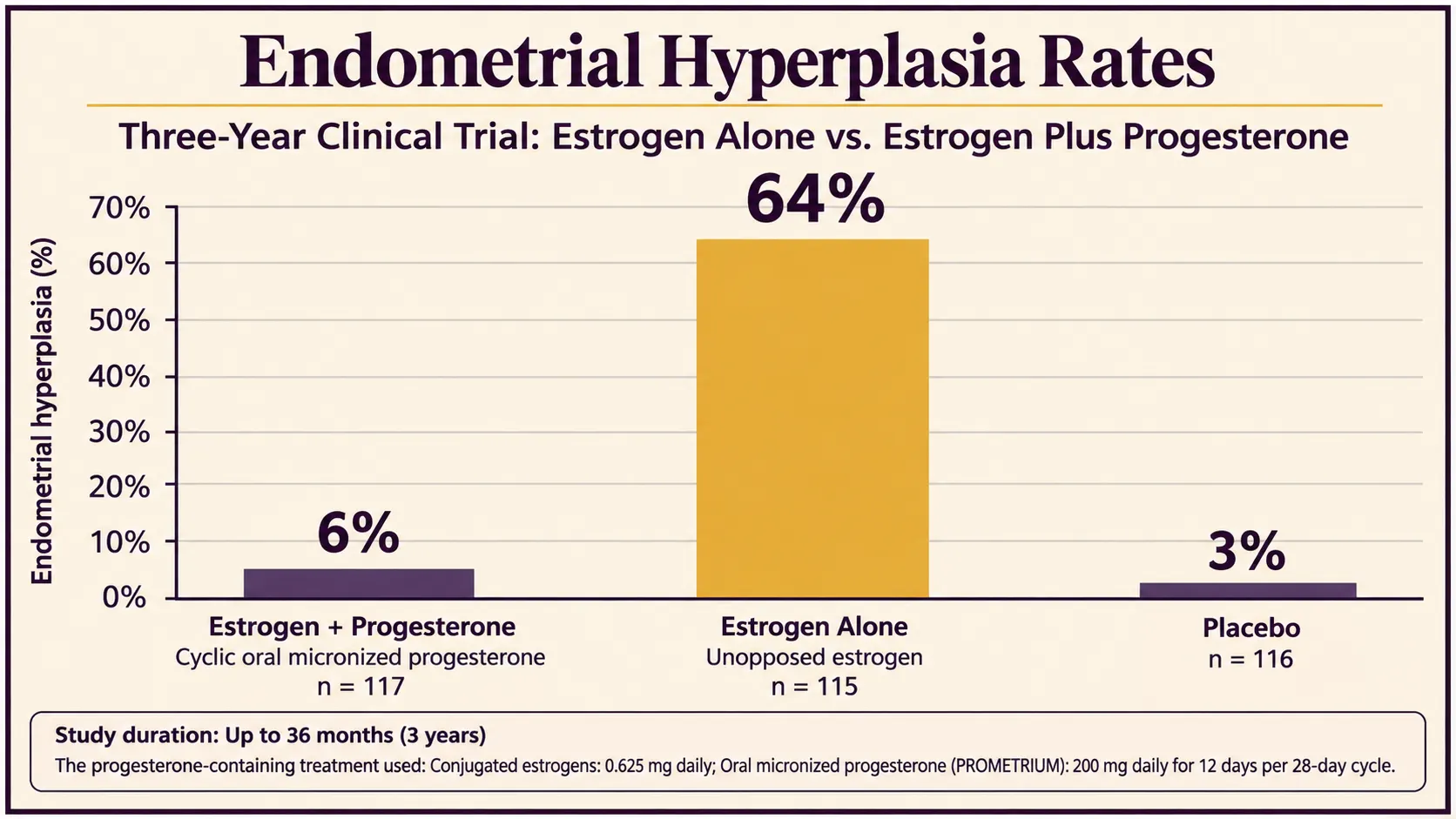
The label’s trial tested the oral capsule with one oral estrogen. That is why a product, dose and schedule need to be chosen together, rather than assuming any progesterone form does the same job.
What Research Shows: Sleep
Progesterone and sleep are linked, and the clinical evidence is more modest than most marketing suggests.
On the biology side, a 2023 review in the Journal of the Endocrine Society reports that progesterone and its metabolites generally have sleep-promoting effects. It also reports that a steep drop in progesterone, such as in the late luteal phase, is associated with sleep disruption.
On the treatment side, three sources give a balanced picture:
- NAMS (2022). In trials, micronized progesterone 300 mg nightly reduced hot flashes and night sweats compared with placebo and improved sleep. NAMS rates this Level II evidence, notes no long-term results exist, and says use without estrogen is off-label.
- Pan and colleagues (2022). A systematic review and meta-analysis in Menopause of 15 randomized trials found that hormone therapy improved self-reported sleep but not sleep measured by polysomnography. Estrogen combined with micronized progesterone had a positive effect on sleep disturbance (SMD -0.22; 95% CI -0.37 to -0.06).
- Hirose and colleagues (2026). In a retrospective study of 36 Japanese women who switched from a synthetic progestin to micronized progesterone, sleep induction and nighttime awakenings improved at 3 months, but benefits faded by 1 year, and the 11 women with few sleep complaints at the start scored worse.
The label’s own side-effect data point the same direction. Drowsiness and dizziness are listed effects, which is why the capsule is taken at bedtime. In the label’s three-year trial, dizziness was reported by 15% of women on Prometrium with estrogen and 9% on placebo.
If poor sleep is your main complaint, progesterone is one possible explanation among several. Thyroid, cortisol and blood sugar all affect sleep, and our guide to what perimenopause labs can and cannot show explains why a single hormone number rarely settles it.
Risks, Side Effects and Who Should Not Use It
The FDA label names who should not take micronized progesterone, and these are the clearest rules on this page.
Contraindications on the Prometrium label:
- Allergy to an ingredient, including peanuts, because the capsules contain peanut oil.
- Abnormal vaginal bleeding of unknown cause.
- Known, suspected or past breast cancer.
- Active blood clots in the legs or lungs, or a history of them.
- Active arterial thromboembolic disease such as stroke or heart attack, or a history of these.
- Known liver disease or dysfunction.
Common side effects. The label’s three-year trial of 875 women reported adverse reactions with cyclic Prometrium 200 mg plus conjugated estrogens versus placebo. Reactions more common with treatment included breast tenderness (27% vs 6%), depression (19% vs 12%), dizziness (15% vs 9%), abdominal bloating (12% vs 5%) and vaginal discharge (10% vs 3%). Hot flashes (11% vs 35%) and night sweats (7% vs 17%) were less common with treatment.
What the large trials do and do not tell us. The label states that the WHI estrogen-plus-progestin findings on clots, stroke, heart attack and breast cancer came from one combination, oral conjugated estrogens with medroxyprogesterone acetate. It says the relevance to other products is not known.
NAMS reports a higher breast cancer incidence with that combination versus placebo in the WHI. It notes that observational data show breast cancer risk rising with duration of estrogen-plus-progestogen use. NAMS rates the benefit-risk balance as favorable for women under 60 or within 10 years of menopause with no contraindications, and less favorable after that.
When to call a doctor right away. Heavy or unexpected bleeding, leg swelling or pain, sudden shortness of breath, chest pain, or stroke symptoms need prompt medical care. Pregnancy and trying to conceive are separate questions for your OB-GYN or fertility doctor, because this page is about menopausal-age hormone care.
Why a Progesterone Prescription Is Only Part of the Question
Progesterone fits into a system, and the system decides whether adding it is the right move.
Dr. Goldstein teaches that “standard labs measure diseases, not function,” and that hormones can be “in range while being completely out of balance as a system.” Her three-system model puts thyroid, adrenals and sex hormones in one loop: “These three systems are interconnected. You cannot fix one without addressing the others.”
Stress is a good example for progesterone. A review of stress and reproduction reports that at the hypothalamus, glucocorticoids such as cortisol inhibit the release of gonadotropin-releasing hormone. That signal sits upstream of ovulation, the event that produces progesterone each cycle. A woman whose progesterone dropped because of long-running stress and a slowing thyroid may need those upstream drivers addressed alongside any hormone.
That is also why our hormone testing guide matters here: a progesterone level depends on the day of the cycle and the lab, and it does not say why the level is what it is.
The Natural Path’s page on hormones and perimenopause explains how that reading is done.
Bioidentical Progesterone in Orange County and Across California
The Natural Path sees women in person at its San Juan Capistrano office, a short drive for many women in Dana Point and Laguna Niguel, and by video visit anywhere in California. According to the practice’s hormone page, prescribing requires an evaluation and ongoing monitoring, and hormones are considered after thyroid, adrenal, metabolic and sex hormone function have been read together. Details on video care are on the telemedicine page.
Directions and hours are on the contact page.
Frequently Asked Questions
Is bioidentical progesterone the same as natural progesterone?
Both terms usually describe progesterone with the same structure as the hormone your ovaries make. The FDA label says the micronized progesterone in Prometrium is chemically identical to progesterone of human ovarian origin. It is synthesized from a plant starting material, so “natural” describes the starting material and not a lack of processing.
Is bioidentical progesterone FDA-approved?
One form is. Prometrium (micronized progesterone capsules) is FDA-approved. Compounded progesterone is not FDA-approved, and the FDA does not verify its safety, effectiveness or quality before it is marketed.
Can I take progesterone without estrogen?
Doctors do prescribe it alone for secondary amenorrhea, which is on the label. For hot flashes, night sweats and sleep, NAMS states that progestogen use without estrogen is off-label, and that no long-term study results are available. Taking it alone is a decision to make with a clinician who has reviewed your history.
Does a woman with a uterus need progesterone if she takes estrogen?
NAMS says women with an intact uterus using systemic estrogen should receive adequate progestogen to protect the uterine lining. NAMS describes the menopause-related indication for a progestogen as protecting against endometrial overgrowth during estrogen use.
Is bioidentical progesterone safer than a synthetic progestin?
Evidence is incomplete. NAMS says micronized progesterone may be less thrombogenic than other progestins, and that it is unknown whether oral regimens containing it carry the same risks as the WHI regimen. The WHI findings that dominate headlines came from a synthetic progestin, and the label says their relevance to other products is not known.
What are the side effects of micronized progesterone?
The label lists drowsiness and dizziness, which is why it is taken at bedtime, along with breast tenderness, headache, bloating and mood changes in its trial data. Report heavy or unexpected bleeding, leg pain or swelling, chest pain or sudden shortness of breath promptly.
Where to Start
Progesterone is one piece of a larger hormone picture, and Dr. Goldstein walks through how thyroid, stress and sex hormones fit together in her free Master Class. Watch the free Master Class.
Written by The Natural Path clinical content team, based on the teaching of Dr. Angela Goldstein, ND.
This article is for general education and is not medical advice. It does not establish a doctor-patient relationship and is not a substitute for care from your own clinician. Do not start, stop or change any hormone or prescribed medication based on what you read here. If you have an urgent medical concern, contact your physician or emergency services.