
Written by The Natural Path clinical content team, based on the teaching of Dr. Angela Goldstein, ND.
Low progesterone symptoms in women most often include irregular or skipped periods, trouble sleeping, anxiety or low mood, headaches and bloating. Progesterone is the hormone that rises after ovulation, so low levels usually trace back to a cycle that is not ovulating normally. In the late 30s to 50s the most common reasons are perimenopause, ongoing stress and a slow thyroid. Many of these symptoms overlap with other conditions, so a blood test timed to your cycle and a full history are what separate them. If you are pregnant or trying to conceive, the guidance is different: see your OB or fertility doctor.
If you are pregnant, think you might be, or are trying to conceive: this page is written for women who are not pregnant. Spotting or bleeding during pregnancy, or a history of miscarriage, belongs with your OB or fertility specialist right away.
Key Takeaways
- Low progesterone shows up as cycle changes first, then sleep and mood changes.
- Progesterone rises after ovulation, so anything that disrupts ovulation can lower it: perimenopause, chronic stress, thyroid problems and PCOS.
- Heavy bleeding, bleeding between periods and periods less than 21 days apart need a clinician’s check, whatever the cause.
- A progesterone blood test only makes sense when it is timed to your cycle, and it is read alongside your symptoms.
- In Dr. Goldstein’s model, stress is the first domino, then the thyroid, then the sex hormones, so progesterone is rarely read alone.
Maybe your periods have changed, you wake at 3 a.m. with your mind running, and your doctor said your labs look fine or that this is just your age. A symptom list will not settle that by itself, so this page does two jobs. It shows which symptoms are linked to low progesterone, and it shows what else produces the same picture, so you know what to ask for.
What Low Progesterone Means in Women
Low progesterone means the body is not making enough of the hormone that supports the second half of the menstrual cycle. Cleveland Clinic describes progesterone as a hormone that plays an important role in the reproductive system.
Progesterone is a sex hormone made mainly after ovulation that prepares the uterine lining and helps regulate the cycle.
Anovulation is a cycle in which the ovary does not release an egg, which means progesterone does not rise the way it normally does.
MedlinePlus explains that progesterone rises in the second half of the cycle, known as the luteal phase, after an ovary releases an egg. That timing is the key to everything below. When ovulation is irregular or missing, progesterone stays low even if estrogen is still being made.
Low Progesterone Symptoms in Women
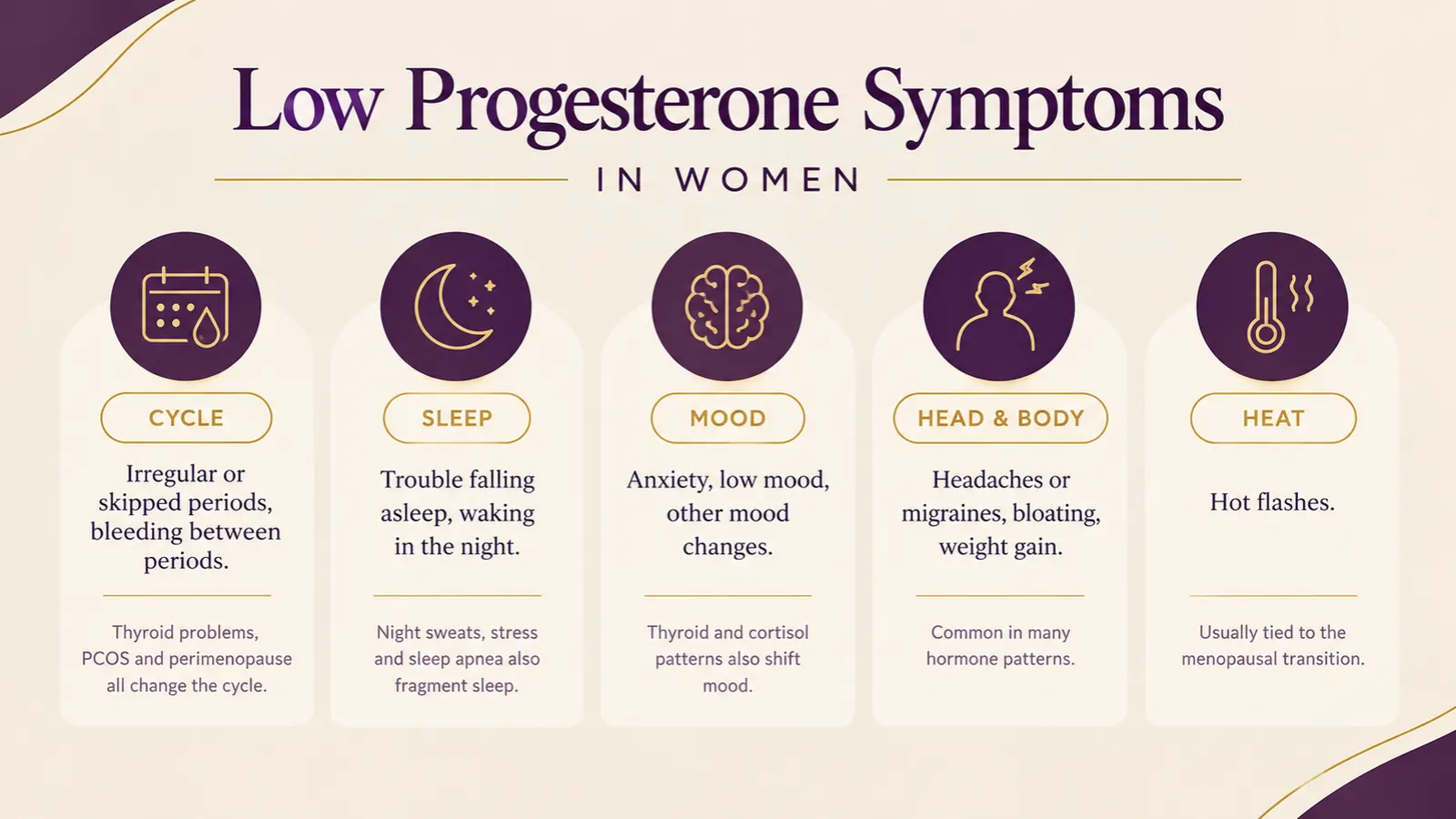
The most common low progesterone symptoms are irregular periods, headaches, mood changes, trouble sleeping, hot flashes and bloating or weight gain, according to Cleveland Clinic. Each one has other possible causes, which is why the sorting section further down matters more than the list.
| Symptom group | What is reported | Why it is not specific |
|---|---|---|
| Cycle | Irregular or skipped periods, bleeding between periods | Thyroid problems, PCOS and perimenopause all change the cycle |
| Sleep | Trouble falling asleep, waking in the night | Night sweats, stress and sleep apnea also fragment sleep |
| Mood | Anxiety, low mood, other mood changes | Thyroid and cortisol patterns also shift mood |
| Head and body | Headaches or migraines, bloating, weight gain | Common in many hormone patterns |
| Heat | Hot flashes | Usually tied to the menopausal transition |
Source for the first two columns of symptoms: Cleveland Clinic on low progesterone. The third column is general clinical context. Women who want the full spectrum of changes can read the 34 symptoms of perimenopause.
Low Progesterone Symptoms in Your 40s and 50s
In the late 30s through the 50s, low progesterone most often belongs to perimenopause. Perimenopause is the transition before menopause, and Cleveland Clinic notes it can begin as early as the mid-30s or as late as the mid-50s, usually lasting about four years and sometimes up to eight.
During this stretch, hormone levels fluctuate unpredictably, and the balance between estrogen and progesterone is thrown off. The pattern many women describe:
- Cycles that run shorter, longer or skip, with flow that turns heavier or lighter
- Waking in the night and not falling back asleep
- Anxiety and irritability that feel new
- Premenstrual days that hit harder than they used to
- Fatigue that sleep does not fix
Cleveland Clinic lists irregular periods, sleep problems and irritability among the common perimenopause symptoms, and adds that many people feel more anxious. The federal Office on Women’s Health names trouble sleeping, irritability or anxiety and shifts in the menstrual cycle too. That overlap is why a symptom list cannot tell you whether progesterone is the cause. The perimenopause care page explains how this transition is evaluated here.

Free 3-minute quiz from Dr. Angela Goldstein, ND
Stress, thyroid and sex hormones work as one system. Answer 22 quick questions and see which one is under the most strain for you.
What you’ll get:
- ✓A score for each system: stress, thyroid and sex hormones
- ✓Which pattern your answers fit, and how the systems pull on each other
- ✓Built on published research
- ✓A clear next step for your pattern
Free. 22 questions, about 3 minutes.
Educational content. Always talk with your doctor before changing any treatment.
Symptoms That Need a Doctor Promptly
Heavy bleeding, bleeding between periods and very short cycles deserve a clinician’s check no matter what the cause turns out to be. Cleveland Clinic advises seeing a provider to rule out other causes if you have:
- Very heavy periods or large blood clots
- Pad or tampon changes about every one to two hours
- Periods lasting several days longer than usual
- Spotting or bleeding between periods
- Bleeding after sex
- Periods less than 21 days apart
The Office on Women’s Health adds a firm line: vaginal bleeding after 12 months with no period is not normal, and you should see your provider right away.
If you are pregnant or trying to conceive, low progesterone is a fertility and obstetric question. Spotting during pregnancy, a history of miscarriage or trouble conceiving belongs with your OB or a fertility specialist, who can monitor and treat it. Cleveland Clinic lists miscarriage and ectopic pregnancy among the complications linked to low progesterone in pregnancy, so call promptly rather than waiting.
Other Conditions That Look Like Low Progesterone
Several conditions produce the same symptoms, and sorting them is the real work. The sorting question is why ovulation, or the cycle, is off.
| Possible cause | What it adds to the picture | How it is checked |
|---|---|---|
| Perimenopause | Cycle changes starting in the late 30s to 50s, hot flashes, night sweats | History and cycle pattern, sometimes labs |
| Chronic stress | Poor sleep, wired-and-tired feeling, cycle changes after a hard season | History, then the other systems |
| Underactive thyroid | Fatigue, weight gain, cold intolerance, heavy periods | Thyroid labs, starting with TSH |
| PCOS | Irregular ovulation, acne, excess hair | Exam and labs |
| Sleep apnea or low iron | Fatigue, poor sleep, heavy bleeding | Sleep and iron evaluation |
Cleveland Clinic names stress, perimenopause, anovulation and an underactive thyroid as causes of low progesterone, and MedlinePlus lists not ovulating normally, PCOS, high stress and perimenopause. A research review of thyroid and reproductive hormones also found hypothyroidism associated with heavy bleeding. If fatigue and weight change lead your list, thyroid or perimenopause walks through how to tell the two apart.
How Stress Cuts Into Progesterone
Stress can lower progesterone because the same brain signals that start ovulation are sensitive to stress hormones. Cleveland Clinic states that too much stress can interfere with the body’s ability to make progesterone.
A 2010 review in Minerva Endocrinologica reported that glucocorticoids such as cortisol inhibit the release of GnRH, the brain signal that starts the reproductive chain. That chain is what leads to ovulation, and ovulation is what raises progesterone.
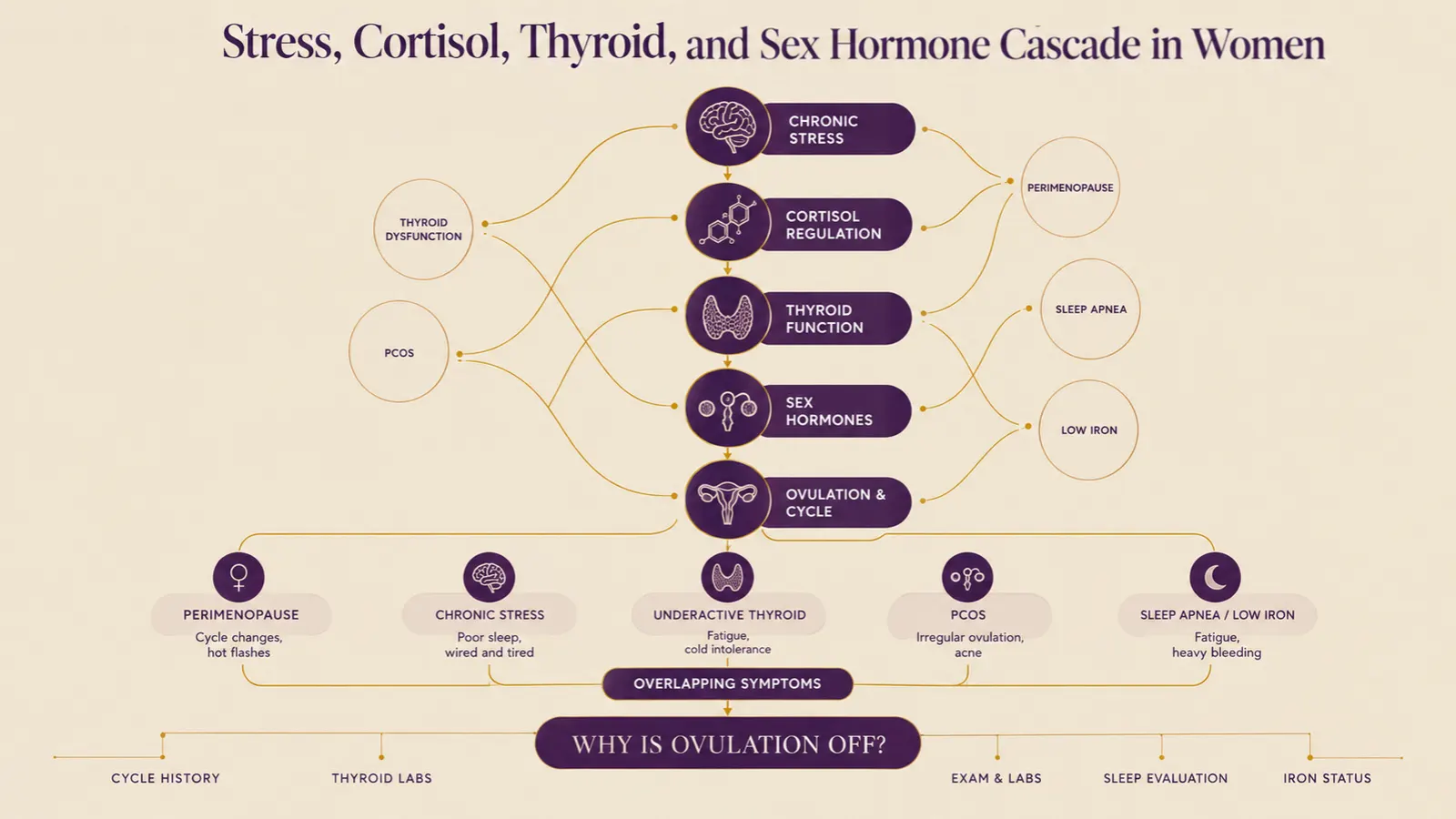
Dr. Goldstein teaches the same sequence in her Master Class, and it is why progesterone is read as part of the whole picture:
- Chronic stress keeps cortisol high.
- Dr. Goldstein says: “High cortisol tells your thyroid to slow down because your body thinks there’s a famine.”
- “Your thyroid slowing down disrupts your sex hormones because your body thinks it’s not safe to reproduce.”
- Sex hormones, including progesterone, drift out of tune. This is the last instrument the signal reaches.
The full physiology of the first two steps is covered in how cortisol and thyroid hormones interact.
Women who feel flat rather than wired can compare their symptoms with low cortisol symptoms.
If this sequence sounds like your last few years, the free Hormone Orchestra Quiz scores the stress response first, then thyroid and sex hormones. A quiz score is a starting point for a conversation with a clinician.
How Low Progesterone Is Tested
A blood test measures progesterone, and the result only makes sense when the draw is timed to your cycle. MedlinePlus states that interpretation depends on where you were in the cycle when blood was drawn, and that repeated testing may be needed because levels change. Cleveland Clinic notes levels peak about one week after ovulation.
That has a practical meaning for women with irregular cycles. A draw on the wrong day can read low in a healthy cycle. A single number is one data point in a much longer story. How cycle day, medications and stage of life change what labs show is covered in hormone testing for women.
What an Evaluation Looks Like
An evaluation for suspected low progesterone starts with the history, because the history tells the clinician which test to order and when. At The Natural Path, the Comprehensive Wellness Evaluation is a one-hour visit with Dr. Goldstein, in person in San Juan Capistrano or by video anywhere in California. It looks at:
- Your cycle history, including how it has changed over the past two to three years
- Sleep, mood and energy patterns, and when they began
- The stress response, thyroid and sex hormones together, as one system
- Which labs fit your cycle and which ones are worth running
- Urgent causes first: heavy or unusual bleeding goes to the right physician before anything else
The point is to find the driver instead of managing each symptom alone. Treatment choices are individualized, and some women need conventional care for part of the picture.
Low Progesterone Care in Orange County and Across California
The Natural Path sees women with symptoms like these in person at its San Juan Capistrano office and by video visit anywhere in California. The office is open Monday, Tuesday and Thursday from 10:00am to 6:00pm, a practical drive for women in Laguna Hills, Lake Forest and the rest of South Orange County, with directions on the contact page.
Women outside Orange County can have the same one-hour visit by telemedicine across California.
Frequently Asked Questions
What are the first signs of low progesterone?
The earliest signs are usually cycle changes: shorter, longer, skipped or heavier periods, with spotting between periods in some women. Sleep disruption and premenstrual mood changes often follow.
Can low progesterone cause anxiety and poor sleep?
Cleveland Clinic lists mood changes, anxiety and trouble sleeping among its symptoms. Because perimenopause, stress and thyroid problems also cause both, the cause needs sorting before anything is assumed.
Can stress cause low progesterone?
Cleveland Clinic and MedlinePlus both list stress as a possible cause, and a research review reports that glucocorticoids such as cortisol inhibit release of GnRH, the brain signal that starts the chain leading to ovulation. Stress is one of several causes, so it is read with the thyroid and cycle history.
Can you have low progesterone with a regular period?
Yes. A cycle can arrive on schedule while ovulation is weak. Timed testing and symptom history are how clinicians sort it out.
Does low progesterone cause weight gain?
Bloating or weight gain is on Cleveland Clinic’s symptom list. The thyroid and cortisol also affect weight, and perimenopause weight gain covers how those interact.
Should I take progesterone or a supplement on my own?
No. Whether progesterone is appropriate depends on your age, cycle, symptoms and history, and only a prescriber starts, stops or changes hormone therapy.
I am trying to get pregnant. Is this page for me?
This page is written for women who are not pregnant. If you are trying to conceive or have had a miscarriage, see your OB or a fertility specialist, who can test and treat low progesterone in that setting.
Where to Start
Dr. Goldstein’s free Master Class walks through the three connected systems behind the symptoms on this page. Watch the free Master Class.
Written by The Natural Path clinical content team, based on the teaching of Dr. Angela Goldstein, ND.
This article is for general education and is not medical advice. It is not intended to diagnose or treat any disease, does not establish a doctor-patient relationship, and is not a substitute for care from your own clinician. Do not start, stop or change any prescribed medication or hormone therapy based on what you read here. If you are pregnant or trying to conceive, contact your OB or fertility specialist. If you have an urgent medical concern, contact your physician or emergency services.