
Cortisol and thyroid function are directly linked. Sustained cortisol from chronic stress suppresses the brain signals that drive the thyroid, TRH and TSH, and slows the conversion of T4 into active T3. Thyroid hormones help regulate the reproductive axis, stress hormones suppress that axis directly, and estrogen changes how the blood carries thyroid hormone. Together, the thyroid, the adrenal stress response and sex hormones behave as one interacting circuit. In 25+ years of practice, Dr. Angela Goldstein, ND, has seen these three systems break down together more often than any others, which is why she reads them as one. A problem that starts in one of them can surface as symptoms in another.
Key Takeaways
- Cortisol and thyroid signaling are connected at the brain, in the blood and inside the cells that activate thyroid hormone.
- High cortisol can lower TSH and shift T4 conversion toward reverse T3, an inactive form.
- Thyroid hormones help regulate GnRH, the signal at the top of the reproductive axis.
- Estrogen raises thyroxine-binding globulin, the main protein that carries thyroid hormone.
- Because the effects run in more than one direction, the order the systems fail in differs from person to person.
- Treating one system while the others keep driving is a common reason relief does not last.
Maybe a clinician treated your thyroid, then another treated your hormones, then someone addressed your stress, one appointment at a time. If you still do not feel like yourself, the separation itself may be the problem.
Most people in that position have heard “it’s just stress,” “it’s just aging,” or “it’s all in your head.” The cortisol and thyroid physiology below explains why the symptoms keep returning.
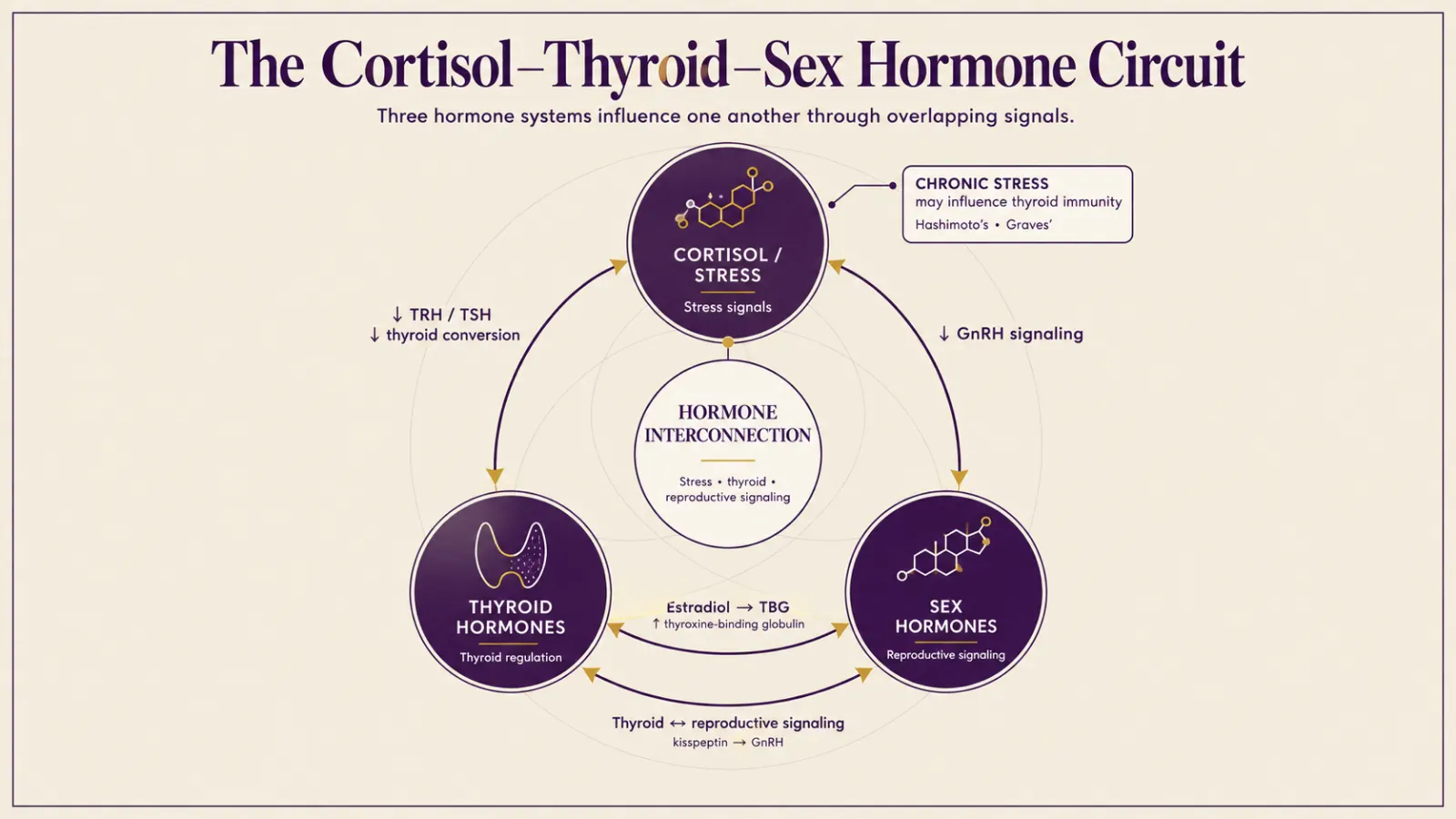
How Cortisol and Thyroid Signaling Connect
Cortisol slows the thyroid at two levels: the brain signals that drive it, and the activation of thyroid hormone in the body. That is why stress physiology is part of thyroid and Hashimoto’s care at The Natural Path.
The HPA axis (hypothalamic-pituitary-adrenal axis) is the stress-response chain that runs from the brain to the adrenal glands and ends in the release of cortisol.
At the top of the chain, cortisol inhibits TRH in the hypothalamus and TSH in the pituitary, according to a 2026 review in Endokrynologia Polska. That can reduce output along the HPT (hypothalamic-pituitary-thyroid) axis. Further down, cortisol inhibits type 1 deiodinase, reduces type 2 and increases type 3, the enzymes that decide how T4 is activated.
Reverse T3 is a metabolically inactive form of thyroid hormone made from T4 instead of active T3.
Immunity is affected too. Chronic stress increases susceptibility to autoimmune thyroid disease, including Hashimoto’s thyroiditis, and the authors concluded that HPA-axis evaluation belongs in the diagnostic workup for thyroid disorders.
How the Thyroid Affects Sex Hormones
Thyroid hormone helps set the signals that run the reproductive system, so a thyroid problem can show up as a hormone or cycle problem.
GnRH (gonadotropin-releasing hormone) is the brain signal at the top of the reproductive axis, the chain that ends in sex hormone production.
Thyroid hormones regulate the secretion of kisspeptin and GnRH, reports a 2023 review in the International Journal of Molecular Sciences. Hypothyroidism is linked with heavy bleeding and more frequent periods, and women are 3 to 5 times more likely than men to be treated for thyroid disorders.
Dr. Goldstein puts it plainly: when the thyroid slows, “your body thinks it’s not safe to reproduce.”
How Stress Hormones Reach the Reproductive System Directly
Stress hormones act on the reproductive axis directly, without passing through the thyroid first.
Glucocorticoids such as cortisol inhibit the release of GnRH at the level of the hypothalamus, per a review in Minerva Endocrinologica. Its authors name infection, malnutrition, anxiety and depression as stressors that suppress reproductive function this way.
So a sustained stress load can reach sex hormones by two routes at once: straight down the reproductive axis, and indirectly by slowing the thyroid.
How Estrogen Changes Thyroid Numbers
Estrogen changes the way thyroid hormone travels in the blood, which is one reason clinicians interpret thyroid results alongside hormone status.
Thyroxine-binding globulin (TBG) is the principal protein that carries thyroid hormone through the bloodstream.
High estradiol stimulates TBG production, and TBG roughly doubles in pregnancy because of elevated estrogen, per the same 2023 review. When carrier protein changes, the relationship between total and free thyroid hormone can change with it.
Hormone results have their own limits, covered in our guide to what a single hormone blood test can and cannot show.
The Cortisol and Thyroid Circuit at a Glance
Cortisol and thyroid hormones, together with sex hormones, affect each other in at least four documented directions.
| Direction | What the evidence shows | Source |
|---|---|---|
| Stress hormones to thyroid | Cortisol inhibits TRH and TSH, inhibits type 1 deiodinase and increases type 3, favoring reverse T3 | Gierach & Junik, Endokrynologia Polska, 2026 |
| Stress to thyroid immunity | Chronic stress increases susceptibility to Hashimoto’s and Graves’ disease | Gierach & Junik, 2026 |
| Thyroid to sex hormones | Thyroid hormones regulate kisspeptin and GnRH; hypothyroidism is associated with heavy bleeding | Brown et al., Int J Mol Sci, 2023 |
| Stress hormones to sex hormones | Glucocorticoids inhibit GnRH release at the hypothalamus | Whirledge & Cidlowski, Minerva Endocrinol, 2010 |
| Sex hormones to thyroid | High estradiol stimulates thyroxine-binding globulin | Brown et al., 2023 |
Read across the rows and the circuit becomes visible: stress reaches both of the other systems, and thyroid and sex hormones act on each other.
Dr. Goldstein’s Three-System Read
Dr. Goldstein’s clinical model treats thyroid, adrenals and sex hormones as one system, because in her experience they fail together.
“I found three systems break down most often: thyroid, adrenals, and sex hormones. These three systems are interconnected. You cannot fix one without addressing the others.”
Dr. Angela Goldstein, ND
The example she uses to show how the three connect runs like this:
- Stress. Chronic stress keeps cortisol high. In her words, the body reads it as a famine.
- Thyroid. In a famine, the body slows the thyroid to conserve energy: weight gain, fatigue, feeling cold, brain fog.
- Sex hormones. A slowed thyroid signals that it is not safe to reproduce: hot flushes, mood swings, low drive.
She compares the endocrine system to an orchestra: when one instrument is out of tune, the whole orchestra sounds wrong. That is the thinking behind hormone imbalance and perimenopause care at The Natural Path, where the evaluation reads thyroid and stress physiology with sex hormones rather than after them.

Free 3-minute quiz from Dr. Angela Goldstein, ND
Stress, thyroid and sex hormones work as one system. Answer 22 quick questions and see which one is under the most strain for you.
What you’ll get:
- ✓A score for each system: stress, thyroid and sex hormones
- ✓Which pattern your answers fit, and how the systems pull on each other
- ✓Built on published research
- ✓A clear next step for your pattern
Free. 22 questions, about 3 minutes.
Educational content. Always talk with your doctor before changing any treatment.
Why Treating One System at a Time Gives Temporary Relief
Treating one system while the other two keep driving tends to produce partial, temporary improvement.
Here is how it usually plays out when each symptom gets its own appointment:
- Fatigue gets a thyroid prescription.
- Hot flushes get estrogen.
- Low mood gets an antidepressant.
Three prescriptions, often from three clinicians, and nobody has addressed the stress load that may have started the sequence. Each clinician is right about their piece. Nobody owns the whole picture.
Time is part of the reason. Primary care visits run a median of 15.7 minutes, with about 1.1 minutes for each concern after the main one. Three interacting hormone systems do not fit in that space, which is why a root-cause evaluation is built around a much longer conversation.
Why the Order Is Different for Every Person
The three systems interact in several directions, so the order they fail in is individual.
Stress can slow the thyroid or suppress sex hormones directly. Shifting estrogen can change thyroid carrier protein, and a thyroid problem can disturb the reproductive axis. Two people with nearly identical symptoms can arrive by different routes.
The practical point: a symptom checklist can show which systems are involved. It cannot show which one moved first. That order is the treatment plan, and finding it is what an evaluation is for.
The history and symptoms then decide which functional lab testing makes sense, and the results get interpreted as one picture. Patients describe the difference simply: “it’s not just about your bloodwork.”
What the Evidence Says About “Adrenal Fatigue”
“Adrenal fatigue” is a functional-medicine concept only, and it is not a recognized medical diagnosis.
Reviewing the published evidence in 2016, researchers in BMC Endocrine Disorders found no substantiation that “adrenal fatigue” is an actual medical condition, and The Natural Path agrees. The accurate terms are HPA-axis activity and cortisol rhythm.
Genuine adrenal disease, such as adrenal insufficiency, is a serious diagnosis that requires conventional testing and care. Where the phrase “adrenal fatigue” is used at all, it should describe a symptom pattern worth investigating.
What Reading the Systems Together Looked Like for One Patient
Veronica’s case shows what changes when a clinician reads the same systems together.
Veronica was 35, a PhD biochemist and a triathlete when her health came apart. She saw more than twenty doctors in several countries, and no set of tests produced an answer that changed anything.
When Dr. Goldstein evaluated her, the stress load came first, as the driver of cortisol and everything downstream. Next, Dr. Goldstein read thyroid, adrenal and sex hormones against each other to see which had moved first and which were following. Then came the gut, because inflammation there feeds back into hormone signaling.
“Largely the same numbers other doctors had already seen. What changed was the order the questions were asked in.”
She went on to compete again. If your own results keep coming back clean, our guide on why normal labs can miss a struggling system explains that side of the story.
Individual results vary. This account reflects one patient’s experience and is not a guarantee of any specific outcome. Never stop a prescribed medication without guidance from the clinician who prescribed it.

When to See a Doctor Promptly
Some symptoms that overlap with thyroid and hormone patterns need urgent medical attention rather than a longer investigation.
Seek prompt care for:
– a racing or irregular heartbeat, chest pain or fainting
– severe weakness, vomiting or confusion
– sudden, heavy or post-menopausal bleeding
– unexplained weight loss or a new lump in the neck
Contact your physician or emergency services the same day.
Frequently Asked Questions
Can stress cause thyroid problems?
Chronic stress can affect the thyroid. The cortisol and thyroid research shows cortisol suppresses TSH, shifts T4 conversion toward reverse T3 and raises susceptibility to autoimmune thyroid disease.
Does high cortisol affect how thyroid hormone works?
It can. Cortisol reduces the enzymes that convert T4 into active T3, so less active hormone may reach the tissues. Never change a thyroid dose on your own.
Does estrogen affect thyroid test results?
Estrogen raises thyroxine-binding globulin, the main carrier of thyroid hormone, which can change how total and free thyroid values relate.
Is adrenal fatigue a real diagnosis?
No. A systematic review found no substantiation for adrenal fatigue as a medical condition. HPA-axis activity and cortisol rhythm are the accurate terms.
Can a thyroid problem change my period or hormones?
Yes. Thyroid hormones help regulate GnRH, and hypothyroidism is associated with heavier and more frequent bleeding. Mention cycle changes whenever a clinician assesses your thyroid.
Should I stop a thyroid or hormone medication if stress seems to be the driver?
No. Keep taking prescribed medications and bring the full list to your appointments. Make any change with the clinician who prescribed them.
Where to Start
The most useful next step is understanding the whole cortisol and thyroid circuit before anyone treats one part of it.
Dr. Goldstein’s free Master Class walks through the three connected systems, including why treating them separately rarely holds. The Natural Path sees patients in person in San Juan Capistrano, Orange County, and by telemedicine across California.
Watch the free Master Class, and bring the questions it raises to your next appointment.
By Dr. Angela Goldstein, ND, licensed naturopathic doctor, 25+ years in practice. Last reviewed: 2026-09-16.
This article is for general education and is not medical advice. It is not intended to diagnose or treat any disease, does not establish a doctor-patient relationship, and is not a substitute for care from your own clinician. Do not start, stop or change any prescribed medication based on what you read here. If you have an urgent medical concern, contact your physician or emergency services.