

Written by The Natural Path clinical content team, based on the teaching of Dr. Angela Goldstein, ND.
Low cortisol symptoms in women include long-lasting fatigue, muscle weakness, loss of appetite, weight loss, dizziness on standing, salt cravings and irregular or missed periods. When the adrenal glands do not make enough hormone, the condition is adrenal insufficiency, including Addison’s disease. It is a medical diagnosis, confirmed with blood tests and treated with hormone replacement, and it needs prompt conventional care. A separate, stress-driven pattern in cortisol rhythm sits inside Dr. Angela Goldstein’s three-system model, where the stress response is read alongside the thyroid and sex hormones. “Adrenal fatigue” is a popular name for that second pattern and is not a recognized medical diagnosis.
Key Takeaways
- Two different things get called low cortisol: adrenal insufficiency, a diagnosed medical condition, and a stress-driven pattern with no diagnostic label.
- Adrenal insufficiency symptoms come on slowly and are easy to confuse with other illnesses, so a physician confirms it with blood tests.
- Dizziness or fainting on standing, salt cravings, darkening skin, weight loss with poor appetite and repeated vomiting belong on a physician’s list first.
- Confusion, loss of consciousness, severe weakness, high fever or vomiting with abdominal pain can signal adrenal crisis, an emergency.
- In Dr. Goldstein’s model, thyroid, adrenals and sex hormones are interconnected, so the stress pattern is read together with the other two.
Maybe you have heard “it’s just stress,” “it’s just aging,” or “it’s all in your head,” and you still feel flat by early afternoon. Maybe a post online called it low cortisol. That label deserves a careful look, because the answer changes who you should see first. This page starts with the one that cannot wait.
What Low Cortisol Means in Women
Low cortisol means the body is not making enough cortisol, and the diagnosed medical form is adrenal insufficiency. Cortisol is one instrument in the endocrine orchestra, so the first job is to find out whether this instrument has failed or whether something else is out of tune.
Cortisol is a hormone made by the adrenal glands and released as part of the body’s stress response.
Adrenal insufficiency is a disorder that occurs when the adrenal glands do not make enough of certain hormones, and Addison’s disease is one form of it, according to the NIDDK.
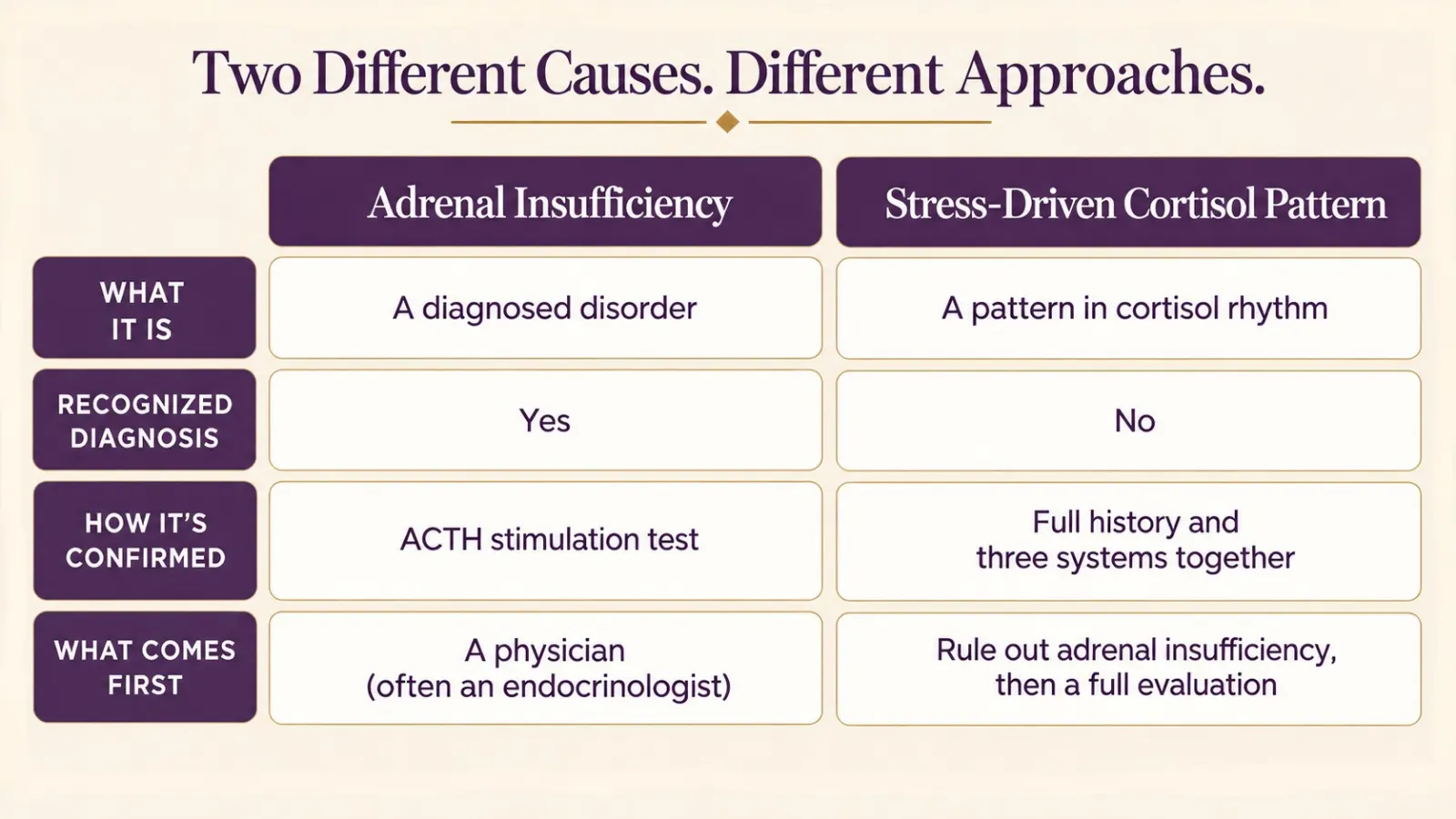
People use “low cortisol” for two different situations, and they call for different first steps.
| Adrenal insufficiency | Stress-driven cortisol pattern | |
|---|---|---|
| What it is | A diagnosed disorder: the adrenal glands do not make enough hormone | A pattern in cortisol rhythm and stress response, read with thyroid and sex hormones |
| Recognized diagnosis | Yes | No. The popular label “adrenal fatigue” is not recognized |
| How it is confirmed | Blood tests, most often an ACTH stimulation test | Full history and a read of the three systems together, with no single confirming test |
| What comes first | A physician, often an endocrinologist | Ruling out adrenal insufficiency, then a full evaluation |
How cortisol and thyroid hormones interact is covered in cortisol and thyroid: how three hormone systems interact.
Low Cortisol Symptoms in Women
The most common symptoms of adrenal insufficiency are long-lasting fatigue, muscle weakness, loss of appetite, weight loss and abdominal pain, per the NIDDK. Any one of these can come from several systems, which is why the sorting table further down matters more than the list itself.
| Symptom group | What is listed | Source |
|---|---|---|
| Energy | Chronic fatigue, muscle weakness, extreme weakness and slow, sluggish movement | NIDDK, MedlinePlus |
| Digestion and weight | Loss of appetite, nausea, vomiting, diarrhea, abdominal pain, weight loss with reduced appetite | NIDDK, MedlinePlus |
| Blood pressure | Low blood pressure that drops further when you stand up, causing dizziness or fainting | NIDDK |
| Salt and sugar | Craving salty foods, low blood sugar | NIDDK, MedlinePlus |
| Skin | Darkening of the skin, including darker skin inside the cheeks and lips | MedlinePlus |
| Mood and joints | Irritability, depression, joint pain | NIDDK |
| Women’s health | Irregular or no menstrual periods, loss of interest in sex | NIDDK |
Sources: NIDDK symptoms and causes and MedlinePlus on Addison disease.
One feature makes this hard to catch. Because the symptoms come on slowly over time, the NIDDK notes they may be overlooked or confused with other illnesses. A woman can adapt to feeling worse a little at a time, and then it feels like her new normal.
Low Cortisol Warning Signs That Need a Doctor Promptly
Some symptoms on that list should go to a physician first, and a few mean an emergency room. Ruling out the urgent cause comes before any other question.
Adrenal crisis is a medical emergency that can follow untreated adrenal insufficiency, for example during a severe infection or vomiting.
MedlinePlus lists these among its symptoms: abdominal or flank pain, confusion or loss of consciousness, severe weakness, dizziness, high fever, low blood pressure, low blood sugar, vomiting, rapid heart rate and unusual sweating. It advises going to the emergency room or calling the local emergency number, such as 911, if you develop them.
The NIDDK advises that if you always feel tired, weak or are losing weight, you ask your health care professional whether you might have adrenal insufficiency. See a physician promptly for:
– dizziness or fainting when you stand up
– strong salt cravings
– skin that is getting darker, especially inside the cheeks or lips
– weight loss with a poor appetite and no change in what you eat
– repeated vomiting, diarrhea or abdominal pain
Tell the prescriber right away if you take steroid medicine such as prednisone, or recently stopped it. The NIDDK names suddenly stopping corticosteroids after taking them for a long time as the most common cause of adrenal insufficiency overall. Do not stop a steroid on your own.
How Adrenal Insufficiency Is Diagnosed and Treated
A physician diagnoses adrenal insufficiency with blood tests and treats it by replacing the missing hormone. This is the kind of problem standard labs are built to find, because, in Dr. Goldstein’s words from the Master Class, they measure “diseases, not function.”
- Review. The doctor reviews your symptoms and runs tests to confirm that cortisol levels are low.
- Testing. The ACTH stimulation test is the test used most often. A blood test can also find the antibodies present in autoimmune Addison’s disease, and imaging helps find the cause.
- Treatment. Cortisol is replaced with a corticosteroid, most often hydrocortisone, taken two or three times a day by mouth. Higher doses are needed during physical stress, and a severe infection, diarrhea or vomiting that stops you from taking the pills needs immediate medical attention.
Suspected adrenal insufficiency needs a physician and blood tests first.
Where “Adrenal Fatigue” Fits
“Adrenal fatigue” is a popular name for a stress-related symptom pattern, and it is not a recognized medical diagnosis. Your symptoms are real even though the label is not.
A 2016 systematic review in BMC Endocrine Disorders searched 3,470 articles, kept 58 studies that met its criteria, and found no substantiation that “adrenal fatigue” is an actual medical condition. The authors note that no endocrinology society has recognized the term. This page uses the terms HPA axis and cortisol rhythm instead.
The HPA axis (hypothalamic-pituitary-adrenal axis) is the chain from the brain to the adrenal glands that ends in the release of cortisol.
The label is also where care often goes wrong. In the Master Class, Dr. Goldstein says that “most practitioners, even natural ones, treat symptoms, not systems.” Her example is a patient who comes in with fatigue and gets an adrenal support protocol. Real symptoms and a real stress load deserve a full investigation after adrenal insufficiency has been considered.

Free 3-minute quiz from Dr. Angela Goldstein, ND
Stress, thyroid and sex hormones work as one system. Answer 22 quick questions and see which one is under the most strain for you.
What you’ll get:
- ✓A score for each system: stress, thyroid and sex hormones
- ✓Which pattern your answers fit, and how the systems pull on each other
- ✓Built on published research
- ✓A clear next step for your pattern
Free. 22 questions, about 3 minutes.
Educational content. Always talk with your doctor before changing any treatment.
What Research Shows About Stress and Low Cortisol Output
Research describes lower-than-expected cortisol in some stress-related conditions, and proposes it can follow a long period of an overactive stress response.
A 2005 overview in Psychoneuroendocrinology reports that low cortisol levels have been observed in stress-related disorders such as chronic fatigue syndrome, fibromyalgia and post-traumatic stress disorder. The authors describe a symptom triad of enhanced stress sensitivity, pain and fatigue. They propose that hypocortisolism may develop after a prolonged period of HPA-axis hyperactivity from chronic stress, as illustrated in an animal model.
That is a research observation. It shows why the order of events matters: when did the exhaustion start, and what was your life like in the years before it? The 2016 review above also found conflicting results from most of the methods used to measure cortisol rhythm, which is why a single number is a weak basis for a label. For the practice’s page on one of the conditions in that research, see chronic fatigue syndrome care.
How the Stress Response Connects to Thyroid and Sex Hormones
In Dr. Goldstein’s model, the stress response is one of three interconnected systems that break down most often.
“In my 25 years of practice, I found three systems break down most often. Thyroid, adrenals, and sex hormones. […] These three systems are interconnected. You cannot fix one without addressing the others.”
Dr. Angela Goldstein, ND, Master Class
She describes the connection as a cascade that starts with too much cortisol:
- Stress. “When you’re under chronic stress, your adrenal pumps out cortisol constantly.”
- Thyroid. “High cortisol tells your thyroid to slow down because your body thinks there’s a famine.”
- Sex hormones. “Your thyroid slowing down disrupts your sex hormones because your body thinks it’s not safe to reproduce.”
Research supports the link from cortisol to the thyroid. A 2026 review in Endokrynologia Polska found that cortisol suppresses TRH and TSH secretion, the brain signals that drive the thyroid. She compares the endocrine system to an orchestra. In her words, “if one instrument is out of tune, if one hormone system is off, the whole orchestra sounds terrible.” That is why a stress pattern is read together with thyroid and Hashimoto’s care.
The same reading applies to hormone and perimenopause care. Another line from the Master Class: “Your thyroid can be normal while still being shut down by stress.”
Which System Does This Symptom Point To?
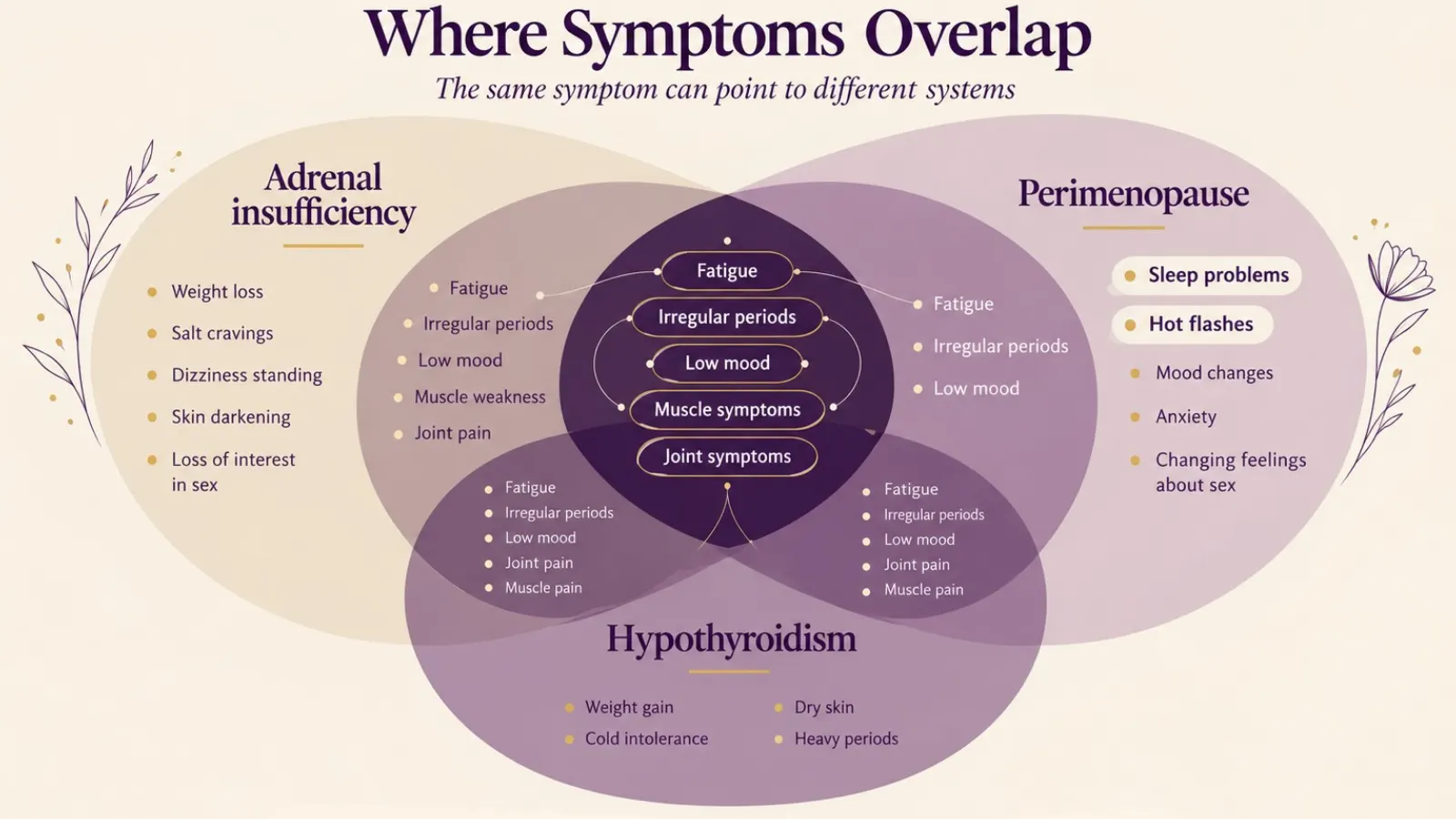
Treating a symptom without finding its system is how women end up with the wrong fix. Many low cortisol symptoms are also listed for an underactive thyroid and for perimenopause, so the useful rows are the ones only one system lists.
| Symptom | Adrenal insufficiency | Hypothyroidism | Perimenopause |
|---|---|---|---|
| Fatigue | Listed | Listed | Daytime tiredness from poor sleep |
| Weight change | Weight loss | Weight gain | Not listed |
| Irregular periods | Listed | Heavy or irregular periods | Irregular periods or bleeding |
| Low mood | Irritability and depression | Depression | Mood changes, depression and anxiety |
| Interest in sex | Loss of interest | Not listed | Changing feelings about sex |
| Muscle and joint symptoms | Muscle weakness, joint pain | Joint and muscle pain | Not listed |
| Sleep problems | Not listed | Not listed | Listed |
| Hot flashes | Not listed | Not listed | Listed |
| Trouble tolerating cold, dry skin | Not listed | Listed | Cold chills after hot flashes only |
| Salt cravings, dizziness on standing, skin darkening | Listed | Not listed | Not listed |
“Listed” means the named source includes the symptom in its list, and “Not listed” means that source does not name it. Sources: NIDDK on adrenal insufficiency, MedlinePlus on Addison disease, NIDDK on hypothyroidism and OWH on perimenopause symptoms.
Salt cravings, dizziness on standing and darkening skin appear only in the adrenal column, so they move a physician visit up the list. Cold intolerance and dry skin are listed for the thyroid, and hot flashes for perimenopause. For the full perimenopause picture, see the perimenopause symptoms guide, and for the wider map, see hormone imbalance symptoms in women.
What an Evaluation of the Stress Response Looks Like
Once urgent causes are excluded, the next step is a full-history evaluation that treats the whole system. Dr. Goldstein’s Comprehensive Wellness Evaluation is a one-hour private appointment, in person in San Juan Capistrano or by video visit. It covers:
- a complete health history review
- the root cause across hormonal, metabolic and detox systems
- the barriers that may be in the way: stress, nutrition, toxins and the gut
- a clear roadmap to leave with
Bring your timeline: when the symptoms started and what was happening in your life just before. One patient review puts the difference simply: “it’s not just about your bloodwork.” If your results keep coming back clean, read why normal labs can miss a struggling system.
What to expect at a first functional medicine appointment walks through the hour from intake to roadmap.
Frequently Asked Questions
Can stress cause low cortisol?
Research links prolonged stress with lower cortisol in some conditions, and authors propose the mechanism, but it is a research observation and not a diagnosis. In Dr. Goldstein’s Master Class cascade, chronic stress starts with high cortisol. A physician rules out adrenal insufficiency first.
Is low cortisol the same as adrenal fatigue?
No. Low cortisol from adrenal insufficiency is a diagnosed medical condition. A 2016 systematic review found no substantiation for “adrenal fatigue” as a medical condition.
What test checks for low cortisol?
A physician orders blood tests, and the ACTH stimulation test is used most often to diagnose adrenal insufficiency.
Can low cortisol cause weight gain?
Weight loss with reduced appetite is the pattern listed for adrenal insufficiency, while weight gain is listed for hypothyroidism. See perimenopause weight gain for how stress, thyroid and estrogen interact.
Can low cortisol change my periods?
It can. The NIDDK lists irregular or no menstrual periods among the symptoms of adrenal insufficiency, and thyroid problems and perimenopause also change cycles, as covered in is it thyroid or perimenopause. Mention any change to your clinician.
Should I take something to raise my cortisol?
Not on your own. A physician treats adrenal insufficiency with prescribed hormone replacement, and only the prescriber starts, stops or changes steroid medicine.
What kind of evaluation looks at the stress response?
The Comprehensive Wellness Evaluation reviews your full health history and looks for the root cause across hormonal, metabolic and detox systems, including stress. If warning signs from the list above fit you, see a physician first, because adrenal insufficiency is diagnosed with blood tests.
Where to Start
Dr. Goldstein’s free Master Class walks through the three connected systems. The Natural Path sees patients in person in San Juan Capistrano, Orange County, and by telemedicine across California.
The free Hormone Orchestra Quiz can help you prepare. Its first section scores the stress response in seven questions, before moving on to thyroid and sex hormones. A quiz score is a conversation starter and not a diagnosis.
Watch the free Master Class, or book the one-hour Comprehensive Wellness Evaluation and bring your symptom timeline and any prior lab results.
Written by The Natural Path clinical content team, based on the teaching of Dr. Angela Goldstein, ND.
This article is for general education and is not medical advice. It is not intended to diagnose or treat any disease, does not establish a doctor-patient relationship, and is not a substitute for care from your own clinician. Do not start, stop or change any prescribed medication, including steroids, based on what you read here. If you have an urgent medical concern, contact your physician or emergency services.