
Written by The Natural Path clinical content team, medically reviewed by Dr. Angela Goldstein, ND. Last reviewed: 2026-09-27.
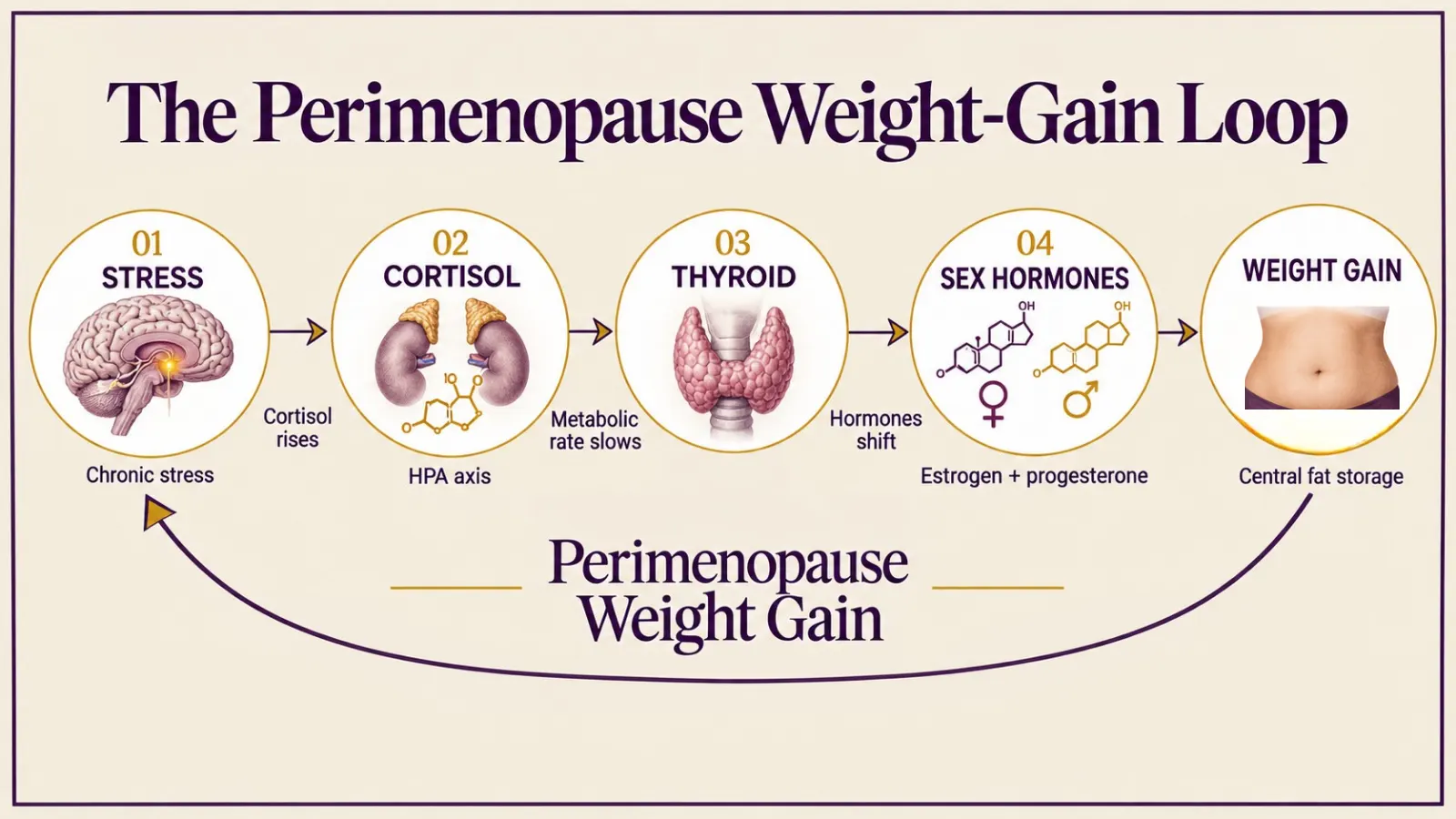
Perimenopause weight gain often happens without any change in diet or exercise because several hormone systems shift at once. Falling estrogen moves fat toward the abdomen and lowers the energy your body uses at rest. Chronic stress keeps cortisol high, and high cortisol slows the thyroid signals that help set metabolic rate. Dr. Angela Goldstein, ND, describes one loop: stress raises cortisol, cortisol slows the thyroid, sex hormones shift, and weight follows.
Aging and muscle loss add to it. In the long-running SWAN study, the rate of weight gain held steady at the menopause transition while the rate of fat gain doubled and lean mass began to fall. The scale can look similar while the body underneath changes.
Key Takeaways
- Perimenopause weight gain is usually a change in body composition first: more fat, less muscle, more of it around the middle.
- Falling estrogen is linked to more visceral (deep abdominal) fat and lower energy use during sleep.
- Chronic stress keeps cortisol high, and cortisol can suppress the thyroid signals that set metabolic rate.
- Cortisol, thyroid and sex hormones feed each other, so weight often tracks all three rather than one.
- Aging and muscle loss are real contributors to perimenopause weight gain, and they explain only part of it.
If you are eating the way you always have and your waistband disagrees, you are not imagining it. Most women in this position have heard “it’s just stress,” “it’s just aging” or “eat less and move more.” Each holds a piece of the truth. None explains why everything changed at once, or why weight arrives with the rest of the perimenopause symptoms by body system.
Why Perimenopause Weight Gain Happens Without Eating More
Perimenopause weight gain happens mostly because the body changes what it is made of and where it stores fat, even when food and activity stay the same.
The menopause transition is the stretch of years before the final menstrual period when ovarian hormones fluctuate and then decline. Perimenopause is the common name for it.
The clearest data comes from SWAN, the Study of Women’s Health Across the Nation. Researchers tracked body composition around the final period. They found that at the start of the transition the rate of fat gain doubled and lean mass declined (Greendale et al., JCI Insight, 2019). Both changes leveled off about two years after the final period.
Here is the surprise: weight itself kept climbing at its usual steady rate. The mix underneath it changed.
Why the scale can mislead: gaining fat while losing muscle at the same time can leave your weight looking steady while your waist, energy and strength change.
A separate four-year study measured energy use. After menopause, sleeping energy expenditure fell by 7.9%, compared with 5.3% in women who did not, and fat oxidation fell by 32% (Lovejoy et al., International Journal of Obesity, 2008).
The Loop Behind Perimenopause Weight Gain
The loop behind perimenopause weight gain starts with stress, runs through cortisol and the thyroid, and ends in shifting sex hormones and a slower metabolism.
In 25+ years of practice, Dr. Goldstein has found that three systems break down most often: thyroid, adrenals and sex hormones. Here is the sequence she teaches:
-
- Stress. Chronic stress keeps the HPA axis, the brain-to-adrenal stress chain, releasing cortisol.
- Cortisol. High cortisol tells the thyroid to slow down, because, in her words, “your body thinks there’s a famine.”
- Thyroid. A slower thyroid lowers metabolic rate and disrupts sex hormones, because the body reads the moment as unsafe for reproduction.
- Sex hormones and weight. Estrogen and progesterone shift, fat storage moves toward the middle, and weight follows.
The result, as she describes it, is weight gain from a slower thyroid, fatigue from depleted adrenals and hormonal symptoms on top.
“One problem, three systems affected, multiple symptoms.”
Dr. Angela Goldstein, ND
She compares the endocrine system to an orchestra: “if one instrument is out of tune, if one hormone system is off, the whole orchestra sounds terrible.” The brain signals and enzymes behind each step are laid out in our guide to how cortisol, thyroid and sex hormones interact.
How Cortisol Adds Weight Around the Middle
Cortisol is linked to perimenopause weight gain around the abdomen, and research suggests the stress response itself may contribute.
Cortisol is the main stress hormone made by the adrenal glands. It helps the body respond to threat and is meant to rise and fall across the day.
In a study of 59 healthy premenopausal women, those with more fat around the waist secreted significantly more cortisol under stress (Epel et al., Psychosomatic Medicine, 2000). The authors concluded that stress-induced cortisol “may contribute to central fat.” The study was small and cross-sectional, so it shows a link rather than proof of cause.
Cortisol rarely acts alone. It raises blood sugar, and sustained high blood sugar drives insulin up, the path toward insulin resistance. That metabolic side of perimenopause weight gain is explained on our metabolic health and weight resistance page.
How a Slower Thyroid Feeds Perimenopause Weight Gain
A slower thyroid lowers metabolic rate, which can feed perimenopause weight gain, and chronic stress is one force that slows it.
The NIDDK, part of the National Institutes of Health, lists weight gain, fatigue and trouble tolerating cold as common hypothyroidism symptoms. Women are much more likely than men to develop it. The overlap with perimenopause is why so many women in their 40s wonder whether it is their thyroid or perimenopause.
A 2026 review in Endokrynologia Polska reports that cortisol suppresses TRH and TSH secretion and shifts T4 conversion toward reverse T3, which reduces how much active T3 reaches the tissues.
Reverse T3 is an inactive form of thyroid hormone. The body makes it from T4 instead of the active T3 that drives metabolism.
This is why Dr. Goldstein says “your thyroid can be normal while still being shut down by stress.” Her explanation of standard labs applies directly: “They’re checking to see if your engine is completely broken, not whether it’s running at 40% capacity.”
Why Estrogen Changes Where Weight Lands
Estrogen decline is tied to where fat is stored more than to how much you weigh.
In the Lovejoy study, all the women gained fat just under the skin as they aged. Only those who became postmenopausal, whose estradiol fell, had a significant increase in visceral fat.
Visceral fat is fat stored deep inside the abdomen around the organs, as opposed to subcutaneous fat, which sits just under the skin.
Aging explains some of the fat gain in perimenopause weight gain, and the hormone transition explains where it goes. Because estrogen swings, a single blood draw rarely captures this, as our guide explains in what a single hormone blood test can show.

Free 3-minute quiz from Dr. Angela Goldstein, ND
Stress, thyroid and sex hormones work as one system. Answer 22 quick questions and see which one is under the most strain for you.
What you’ll get:
- ✓A score for each system: stress, thyroid and sex hormones
- ✓Which pattern your answers fit, and how the systems pull on each other
- ✓Built on published research
- ✓A clear next step for your pattern
Free. 22 questions, about 3 minutes.
Educational content. Always talk with your doctor before changing any treatment.
The Perimenopause Weight Gain Loop at a Glance
Each link in the perimenopause weight gain loop has published evidence behind it.
| Link in the loop | What the research shows | What you may notice | Source |
|---|---|---|---|
| Menopause transition | Fat-gain rate doubles and lean mass falls, while weight keeps its usual pace | Clothes fit differently before the scale moves much | Greendale et al., JCI Insight, 2019 |
| Estrogen decline | Visceral fat rises only in women who become postmenopausal | More weight around the middle | Lovejoy et al., Int J Obes, 2008 |
| Lower energy use | Sleeping energy use falls 7.9% and fat oxidation falls 32% | Same meals, different result | Lovejoy et al., 2008 |
| Stress and cortisol | Women with central fat secrete more cortisol under stress | Belly weight during stressful stretches | Epel et al., Psychosom Med, 2000 |
| Cortisol to thyroid | Cortisol suppresses TSH and lowers active T3 | Fatigue, feeling cold, a slower metabolism | Gierach & Junik, Endokrynol Pol, 2026 |
| Thyroid | Weight gain is a common hypothyroid symptom, more common in women | Weight plus fatigue and cold hands | NIDDK |
Read down the rows: stress reaches the thyroid, thyroid and estrogen both reach metabolism, and it all lands at the waist.
What You Get Told, and What It Leaves Out
The usual explanations for perimenopause weight gain each describe one link and stop there.
- “It’s just aging.” Aging is real, and in SWAN weight climbed steadily with age. The same study found the fat and muscle shift is tied to the transition itself.
- “Eat less and move more.” Food and movement matter. In the Lovejoy data, resting energy use and fat burning also fell with menopause.
- “It’s just stress.” Stress is the first link in the loop, and the other links keep running once it starts.
Dr. Goldstein knows this from the inside. Eating organic and exercising, she was still putting everyone else first. “I gained weight, lost energy, started experiencing the same symptoms my patients were coming to me with,” she says.
Patients notice the difference when they are read as a whole. One patient wrote that she had been “seeing doctors for years that never changed anything,” and that with Dr. Goldstein “it’s not just about your bloodwork.” That full-picture approach is what a root-cause evaluation is built around.
What Is Worth Checking Before Blaming Willpower
The most useful first step is gathering the facts that show which links in the perimenopause weight gain loop are active for you.
Bring these to your next appointment:
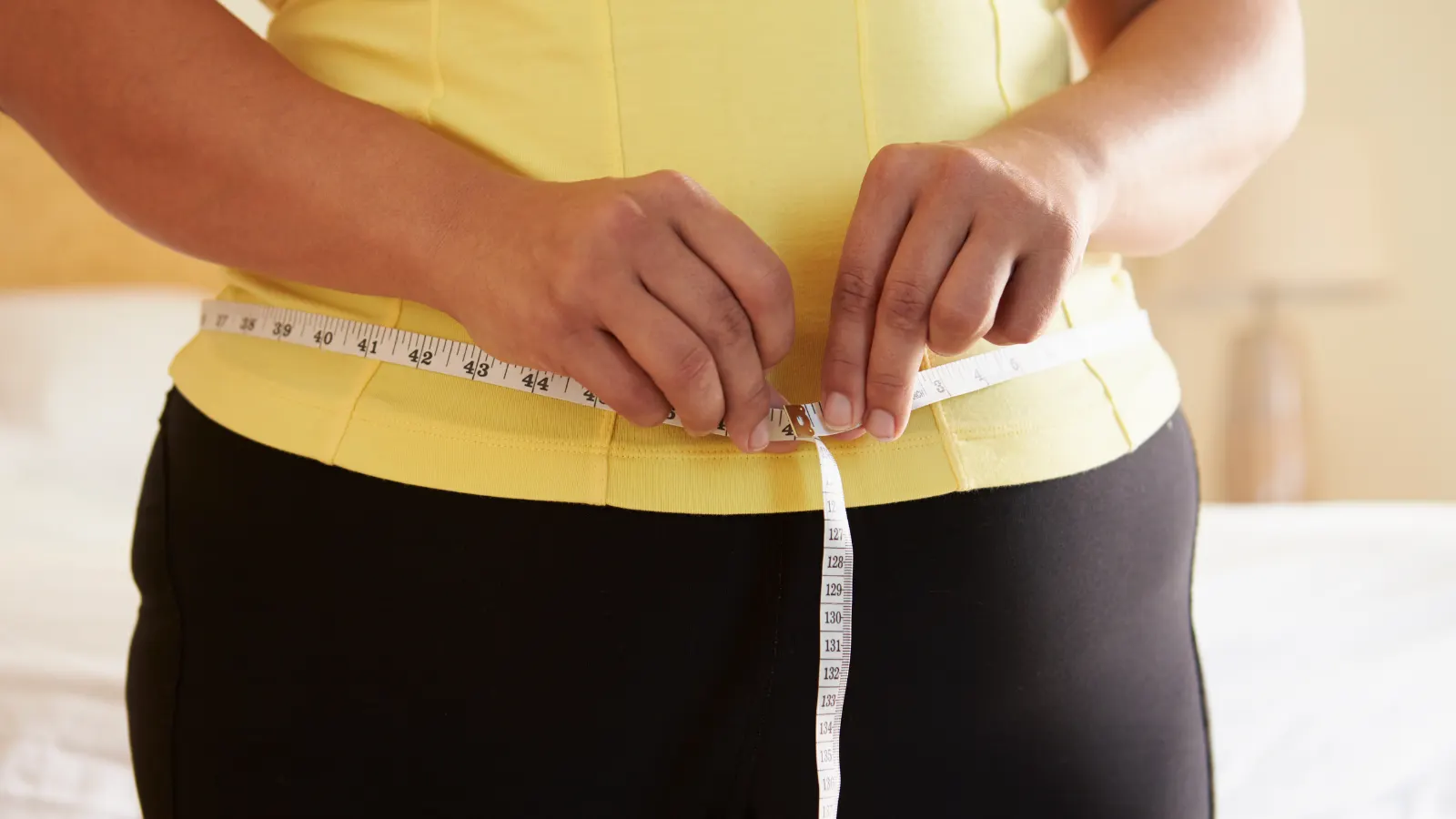
- Waist, as well as weight. A tape measure can show a composition shift the scale misses.
- Sleep. How often you wake, and whether night sweats are involved.
- Stress load. What has been sustained for months.
- Cycle changes. Dates, length and flow over six to twelve months.
- Which thyroid tests were run. Ask whether results covered more than TSH.
- Your medication and supplement list.
With those in hand, the question becomes “which system moved first?” That question drives perimenopause and hormone care at The Natural Path, where thyroid and stress physiology are read together with sex hormones.
When Weight Change Needs Prompt Medical Attention
Some weight changes need prompt medical care before a longer investigation.
Contact your physician promptly for:
– rapid weight gain with swelling in the legs, shortness of breath or chest pain
– unexplained weight loss
– a new lump or swelling in the neck
– heavy, prolonged or post-menopausal bleeding
For chest pain or trouble breathing, call emergency services.
Frequently Asked Questions
Does perimenopause weight gain go away?
The shift usually slows rather than undoing itself. In SWAN, fat gain and muscle loss leveled off about two years after the final period.
Can high cortisol cause weight gain in perimenopause?
It can contribute, especially around the waist, and it can slow thyroid signaling. Cortisol usually works alongside estrogen changes, sleep and blood sugar.
Can a thyroid problem cause weight gain if my TSH is normal?
It is worth a closer look. Cortisol can lower active T3, so one normal TSH does not describe the whole thyroid picture. Ask which markers were measured.
Why does perimenopause weight go to the belly?
Falling estrogen is linked to more visceral fat, the deep abdominal fat around the organs. Cortisol is also associated with fat stored at the waist.
How much weight do women gain in perimenopause?
Perimenopause weight gain varies widely. In SWAN, the pace of weight gain held steady while the rate of fat gain doubled and lean mass declined. Body shape often changes more than the number.
Should I change my thyroid or hormone medication to lose weight?
No. Keep taking prescribed medications as directed and bring the full list to your appointments. Any change belongs with the clinician who prescribed them.
Where to Start
The most useful next step with perimenopause weight gain is seeing the whole loop before anyone treats one part of it.
Dr. Goldstein’s free Master Class walks through the three connected systems. The Natural Path sees patients in person in San Juan Capistrano, in Orange County, and by telemedicine across California.
Watch the free Master Class, and bring the questions it raises to your next appointment.
Written by The Natural Path clinical content team, medically reviewed by Dr. Angela Goldstein, ND. Last reviewed: 2026-09-27.
This article is for general education and is not medical advice. It is not intended to diagnose or treat any disease, does not establish a doctor-patient relationship, and is not a substitute for care from your own clinician. Do not start, stop or change any prescribed medication based on what you read here. If you have an urgent medical concern, contact your physician or emergency services.