

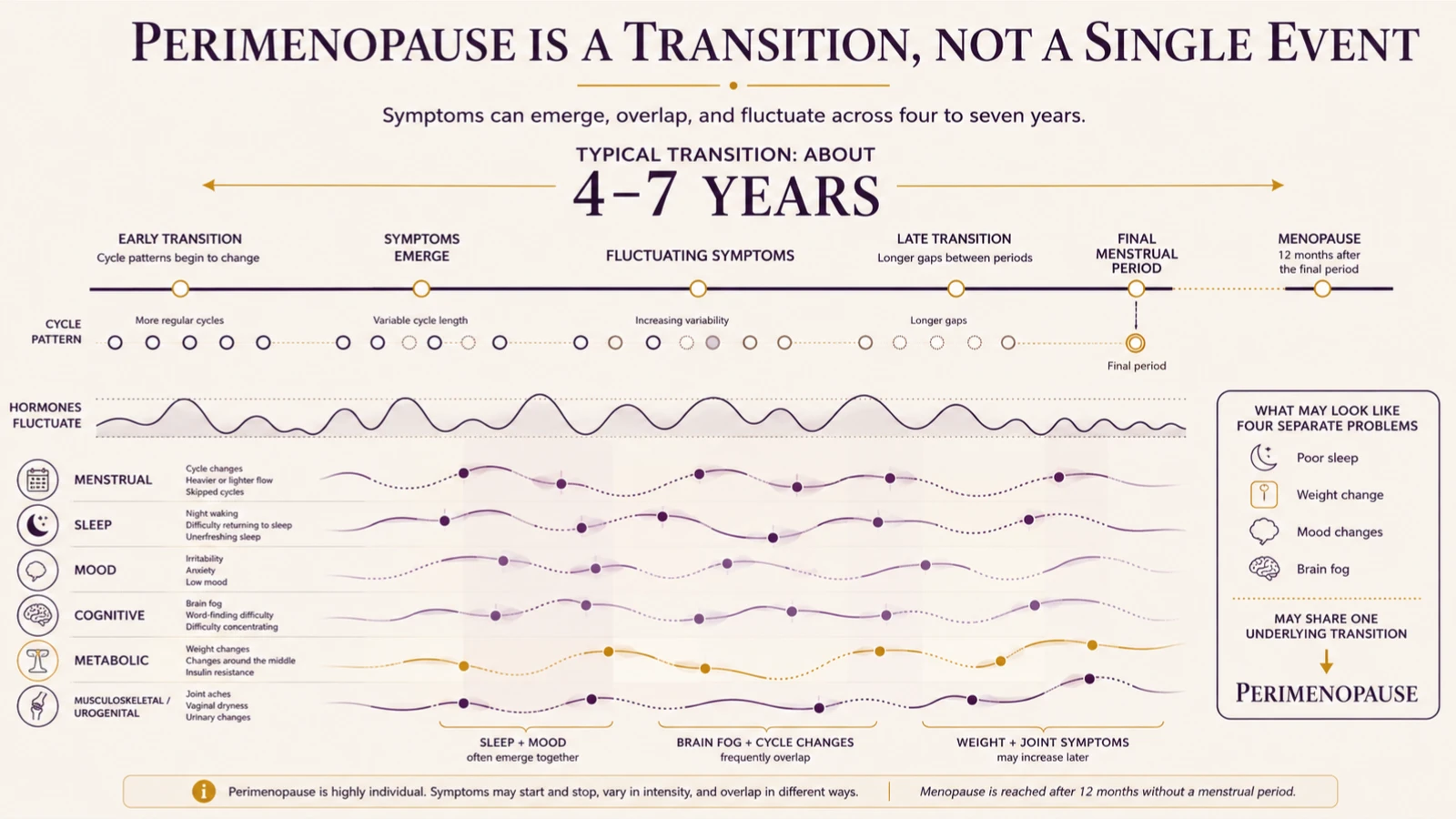
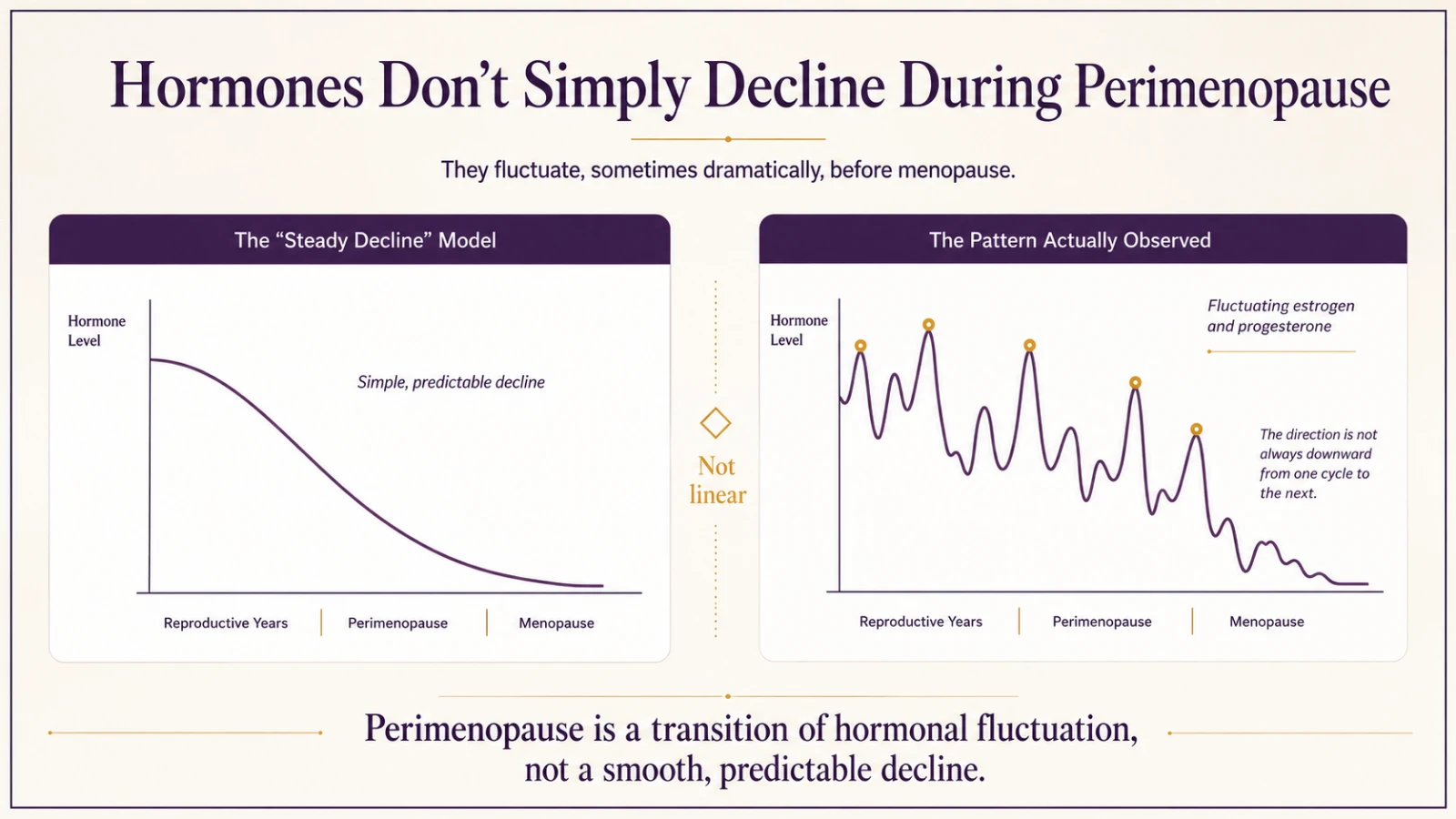
Perimenopause symptoms extend well beyond hot flashes, which is why so many women spend years being treated for four separate problems that share one cause. The menopausal transition typically runs about four to seven years, beginning with menstrual irregularity in the later reproductive years and ending one year after the final period. During it, estrogen and progesterone do not decline in a smooth line. They fluctuate, sometimes dramatically, week to week. That instability is what produces the sleep disruption, mood changes, brain fog, weight change, joint aches, and cycle shifts that patients rarely connect to each other. Recognizing the full symptom set is usually the step that reorganizes years of confusing history into one picture.
Key Takeaways
- The menopausal transition commonly lasts four to seven years and often begins in the mid-forties.
- Hormones fluctuate during perimenopause rather than declining steadily, which is why symptoms come and go.
- Symptoms span at least six body systems, and most women are only asked about one or two.
- Thyroid disease produces an overlapping symptom set and should be ruled out rather than assumed.
- Perimenopause is diagnosed primarily from cycle pattern and symptoms, not from a single hormone test.
- Roughly 75% to 80% of women experience vasomotor symptoms, with wide variation in severity.
Most women arrive with four complaints on separate lines of the chart: exhausted, not sleeping, gaining weight, and feeling unlike themselves.
Treated separately, each gets its own answer. A sleep aid. A diet. An antidepressant. Treated together, they often describe one transition that has been running for three years. Perimenopause symptoms are among the conditions we work with most, and this fragmentation is the usual history.
What Perimenopause Is and When It Starts
Perimenopause is the transition into menopause, and it begins years before periods stop.
Perimenopause, also called the menopausal transition, is the period that begins with menstrual cycle irregularity in the later reproductive years and continues until twelve months after the final menstrual period.
The transition commonly spans about four to seven years. Natural menopause itself most commonly occurs between ages 45 and 56, with a median age of 51 in the United States, which places the start of the transition for many women in their mid-forties. Some women begin noticeably earlier.
Clinicians stage the transition using cycle changes rather than lab values. Early on, cycle length becomes variable, differing by seven or more days between cycles. Later, gaps of sixty days or more appear, which signals the late transition and typically occurs one to three years before the final period.
Why Symptoms Come and Go Rather Than Build Steadily
Symptoms fluctuate because the hormones driving them fluctuate, and the pattern is highly individual.
This is the point most explanations get wrong. Perimenopause is often described as a steady decline, but that is not what measurement shows. In the Swiss Perimenopause Study, which followed 127 women aged 40 to 56 across thirteen months, the researchers reported that time did not significantly predict estradiol levels and that they did not find a continuous decline across the observed transition. What they found instead were highly individual fluctuations without consistent directional trends.
That explains something patients describe constantly and rarely get validated: a good month followed by a terrible one, with nothing obvious changing in between.
Perimenopause Symptoms by Body System
The symptom set spans at least six systems, which is exactly why it gets fragmented across specialists.
| System | What patients notice |
|---|---|
| Menstrual | Cycle length changing, heavier or lighter flow, skipped cycles, worse premenstrual weeks |
| Vasomotor | Hot flashes, night sweats, palpitations, temperature intolerance |
| Sleep | Waking at 2 to 4am, difficulty returning to sleep, unrefreshing sleep |
| Cognitive and mood | Word-finding trouble, brain fog, irritability, anxiety that feels new, low mood |
| Metabolic | Weight gain around the middle with unchanged habits, new insulin resistance |
| Musculoskeletal and urogenital | Joint aches, vaginal dryness, urinary urgency, changes in libido |
Vasomotor symptoms are the most recognized. Approximately 75% to 80% of women experience them with varying severity, and genitourinary symptoms affect roughly 50% to 75%. The systems most often missed are the cognitive and metabolic ones, because neither sounds hormonal to a patient or, frequently, to a busy clinician.
The Symptoms Most Often Attributed to Something Else
Four perimenopause symptoms are routinely explained as separate diagnoses.
- Anxiety that feels chemically different. Often new, often worst in the days before a period, and frequently treated as primary anxiety.
- Middle-of-the-night waking. Commonly treated as insomnia when it tracks with cycle phase and night sweats.
- Weight gain around the middle. Usually met with dietary advice, though the metabolic shift is real and not a matter of effort.
- Brain fog. Frequently frightening for women in demanding roles, and rarely connected to the transition.
Each is a legitimate complaint on its own. The question worth asking is whether they began around the same time as cycle changes, because that timing is what turns four complaints into recognizable perimenopause symptoms.
What Overlaps With Thyroid Disease and Must Be Ruled Out
Thyroid dysfunction produces a nearly identical symptom set and is common in the same age group.
Fatigue, weight change, cold intolerance, brain fog, hair changes, and mood shifts appear in both. Subclinical hypothyroidism affects roughly 3% to 15% of the US population, rising to 18% to 20% in older patients, and it is more common in women. Assuming perimenopause without checking thyroid function risks missing a treatable condition, and assuming thyroid disease without considering the transition risks the reverse.
Iron status, vitamin D, and blood sugar regulation belong in the same conversation, since each produces fatigue that overlaps with perimenopause symptoms.

Free 3-minute quiz from Dr. Angela Goldstein, ND
Stress, thyroid and sex hormones work as one system. Answer 22 quick questions and see which one is under the most strain for you.
What you’ll get:
- ✓A score for each system: stress, thyroid and sex hormones
- ✓Which pattern your answers fit, and how the systems pull on each other
- ✓Built on published research
- ✓A clear next step for your pattern
Free. 22 questions, about 3 minutes.
Educational content. Always talk with your doctor before changing any treatment.
How Perimenopause Is Actually Diagnosed
Diagnosis rests on your cycle pattern and symptoms, with testing used to exclude other explanations.
Because hormones fluctuate so widely, a single blood draw captures one moment rather than a trend. That is why a normal result does not rule perimenopause out, and an abnormal one does not confirm it. Functional lab testing is genuinely useful for the surrounding picture: thyroid, iron, vitamin D, inflammatory markers, and metabolic function. Those results change what happens next.
Track your cycles for three months if you are unsure. Cycle length variation of seven or more days between cycles is a more reliable signal than any single hormone value.
What Actually Helps
Options range from lifestyle change to hormone therapy, and the right one depends on your symptom pattern and history.
Sleep, strength training, protein intake, and alcohol reduction all have measurable effects on vasomotor symptoms and metabolic changes, and they are reasonable first steps. Where symptoms are disruptive, bioidentical hormone therapy is one option among several, with real benefits and real considerations that belong in a conversation with a clinician who knows your history.
What rarely works is treating each of the perimenopause symptoms separately without addressing the transition underneath. Dr. Angela Goldstein describes that approach as scooping water out of a sinking boat.
When to Seek Care Sooner
Some bleeding patterns need evaluation rather than watchful waiting.
Contact a physician promptly for bleeding between periods, bleeding after intercourse, periods that are suddenly much heavier or last longer than seven days, cycles closer than 21 days apart, or any bleeding after twelve months without a period. These are not assumed to be perimenopause symptoms and require assessment.
Frequently Asked Questions
These are the questions patients ask most about the transition.
How long do perimenopause symptoms last?
The menopausal transition commonly runs four to seven years. Vasomotor symptoms specifically persist for an average of one to six years, and continue as long as fifteen years in 10% to 15% of postmenopausal women.
What is usually the first sign of perimenopause?
Changes in cycle length are usually first, with intervals varying by seven or more days between cycles. Sleep disruption and mood changes often arrive around the same time and get noticed sooner.
Can you get perimenopause symptoms in your late thirties?
Yes, though it is less common. Symptoms starting before 40 deserve evaluation rather than assumption, since other causes including thyroid disease and iron deficiency are more likely at that age.
Is a hormone test needed to confirm perimenopause?
Not usually. Diagnosis rests on cycle pattern and symptoms, because hormone levels fluctuate too much for a single measurement to be conclusive. Testing is more useful for ruling out overlapping conditions.
Can you still get pregnant during perimenopause?
Yes. Ovulation becomes unpredictable rather than absent, so contraception remains necessary until twelve months have passed without a period.
Why do symptoms feel worse some months than others?
Because hormone levels fluctuate rather than declining steadily. Research following women across a year found highly individual fluctuations without a consistent downward trend, which matches the good-month, bad-month pattern patients describe.
Where to Start
If several of these symptoms describe your last few years, the useful next step is looking at them together instead of one at a time. Dr. Goldstein’s free Master Class explains the three connected systems she sees break down most often in this age group. Start with the free Master Class.
More answers patients ask for are on the main FAQ page.
Track your cycles for three months first. That record is worth more than any single test result.
By Dr. Angela Goldstein, ND, licensed naturopathic doctor, 25+ years in practice. Last reviewed: 2026-09-16. This article is for general education and is not medical advice. It does not establish a doctor-patient relationship and is not a substitute for care from your own clinician. Do not delay seeking care, and do not stop or change any prescribed medication, based on what you read here. If you have an urgent medical concern, contact your physician or emergency services.