
Written by The Natural Path clinical content team, based on the teaching of Dr. Angela Goldstein, ND.
You skipped a period, then another. Sleep fell apart, and the hot flashes started showing up at 2 a.m. Now you are typing the question you have been saving up: how long is this going to last?
How long does menopause last? Menopause itself lasts one day, because it is confirmed only when 12 months have passed since your final period. The part you feel is the transition around that day. In the Study of Women’s Health Across the Nation (SWAN), the median length of that transition ran from about 4.4 to 8.6 years, depending on the age it began. Frequent hot flashes and night sweats lasted a median of 7.4 years, including a median of 4.5 years after the final period. Postmenopause then lasts the rest of your life. Your own timeline depends on when your transition started and what else is stressing your system.
Key Takeaways
- Menopause is a single point. It is confirmed at 1 year after the final menstrual period (The Menopause Society).
- Perimenopause is the long part. SWAN found an adjusted median of 4.37 years when it began at the oldest ages and 8.57 years when it began at the youngest.
- Hot flashes often continue past the final period. The median total was 7.4 years in SWAN, and the median after the final period was 4.5 years.
- Starting early is linked to a longer run. Women who were premenopausal or in early perimenopause when frequent hot flashes began had a median of more than 11.8 years. Women who were already postmenopausal when theirs began had a median of 3.4 years.
- Postmenopause is permanent. The symptoms that travel with it have causes that can be found and addressed, one system at a time.
For what each symptom means and how it is organized by body system, see our perimenopause symptoms guide. This page answers the question of how long.
How Long Does Menopause Last? One Day, Plus the Stages Around It
People use the word “menopause” for the whole experience, which is why the answer to “how long” sounds so inconsistent. Three terms carry three different lengths.
| Stage | How it is defined | How long it lasts |
|---|---|---|
| Perimenopause (the menopausal transition) | The time before menopause. Cycle length starts to differ by 7 days or more between cycles. | Several years. SWAN medians ranged from 4.37 to 8.57 years. |
| Menopause | Confirmed at 1 year after the final menstrual period. | One day, identified in hindsight. |
| Postmenopause | Everything after that 12-month point. | The rest of your life. Early postmenopause is staged at roughly 5 to 8 years. |
The Menopause Society describes perimenopause as “the time before natural menopause” and says menopause is confirmed at 1 year after the final menstrual period. Clinicians stage the transition with the Stages of Reproductive Aging Workshop + 10 (STRAW+10). It defines the early transition by a persistent difference of 7 days or more in the length of consecutive cycles (Harlow et al., J Clin Endocrinol Metab 2012).
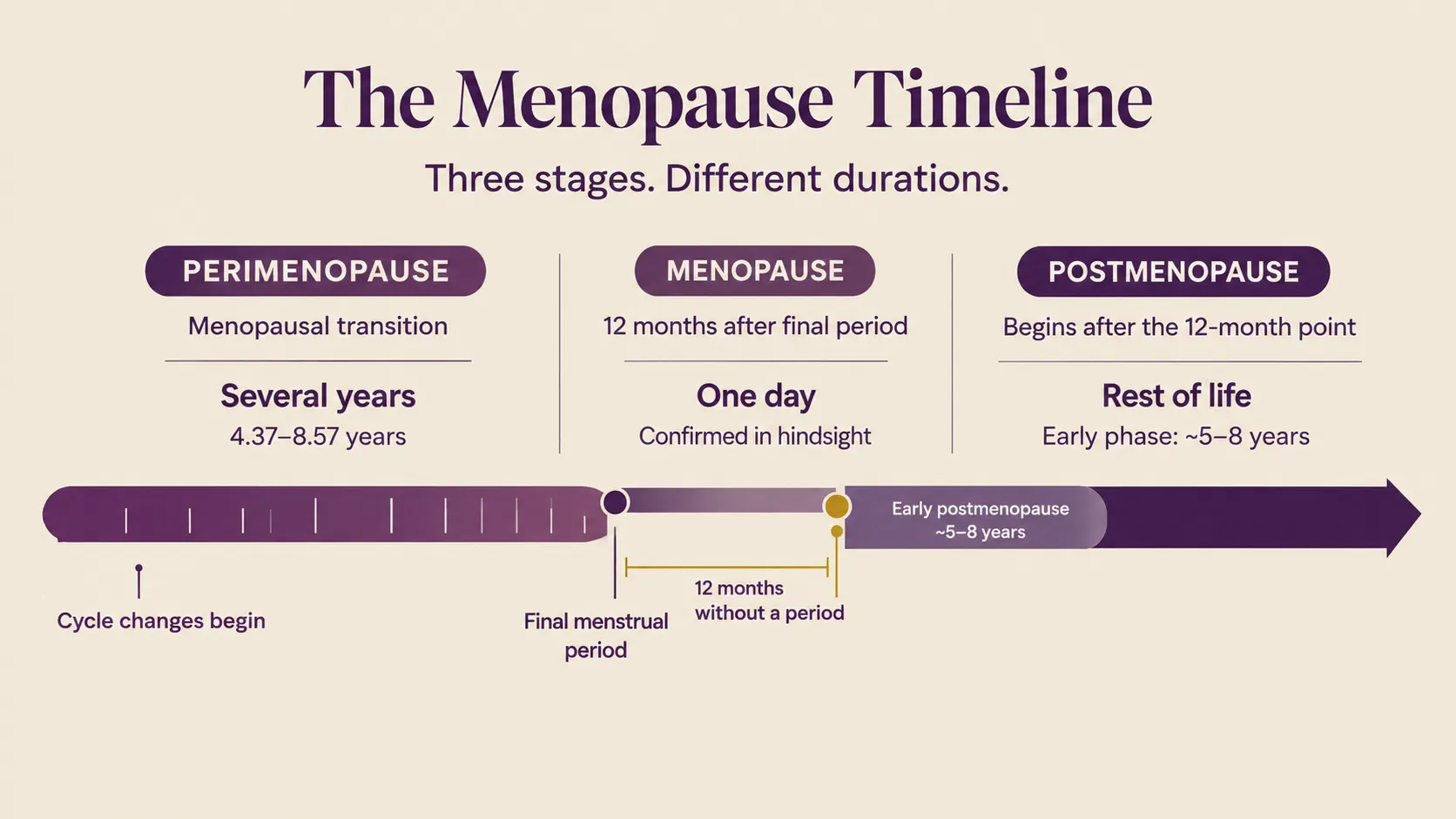
Because menopause is only confirmed after a full year with no period, nobody can tell you in the moment that a given period was your last one. That is why the 12-month rule exists, and why a date on the calendar matters more here than a lab number.
How Long Perimenopause Lasts
STRAW+10 estimates that the late menopausal transition, the stage with longer gaps between periods, lasts on average 1 to 3 years. Early postmenopause is estimated at about 2 years for its first two substages, then 3 to 6 years more, so the entire early postmenopause stage lasts approximately 5 to 8 years.
The best long-term data on the whole transition comes from SWAN. The analysis followed 1,145 women with daily menstrual calendars from 1996 to 2006. The adjusted median duration of the transition, from onset to the final menstrual period, ranged from 4.37 years to 8.57 years. The shortest was among women who started at the oldest ages, and the longest among those who started at the youngest (Paramsothy et al., Menopause 2017). The authors concluded that earlier onset was associated with a longer transition. In that study, cigarette smoking was linked to a shorter duration and African American women had a longer duration than white women.
So “four to eight years” is a fair rule of thumb, with the caveat that the range depends on when the first change appeared. A woman whose cycles started drifting at 41 should not expect the same timeline as a woman whose cycles started drifting at 50.
Free 3-minute quiz from Dr. Angela Goldstein, ND
Stress, thyroid and sex hormones work as one system. Answer 22 quick questions and see which one is under the most strain for you.
What you’ll get:
- ✓A score for each system: stress, thyroid and sex hormones
- ✓Which pattern your answers fit, and how the systems pull on each other
- ✓Built on published research
- ✓A clear next step for your pattern
Free. 22 questions, about 3 minutes.
Educational content. Always talk with your doctor before changing any treatment.
How Long Hot Flashes and Night Sweats Last
Duration research is strongest for hot flashes and night sweats, which researchers call vasomotor symptoms. The Menopause Society says they occur in up to 80% of women and last a mean of 7 to 10 years. Each episode typically lasts between 1 and 5 minutes (The Menopause Society).
The most cited study behind those numbers is a SWAN analysis of 3,302 women followed from 1996 to 2013. It counted symptoms as frequent when they occurred on at least 6 days in the previous 2 weeks (Avis et al., JAMA Internal Medicine 2015).
| Group in the SWAN analysis | Median duration of frequent hot flashes or night sweats |
|---|---|
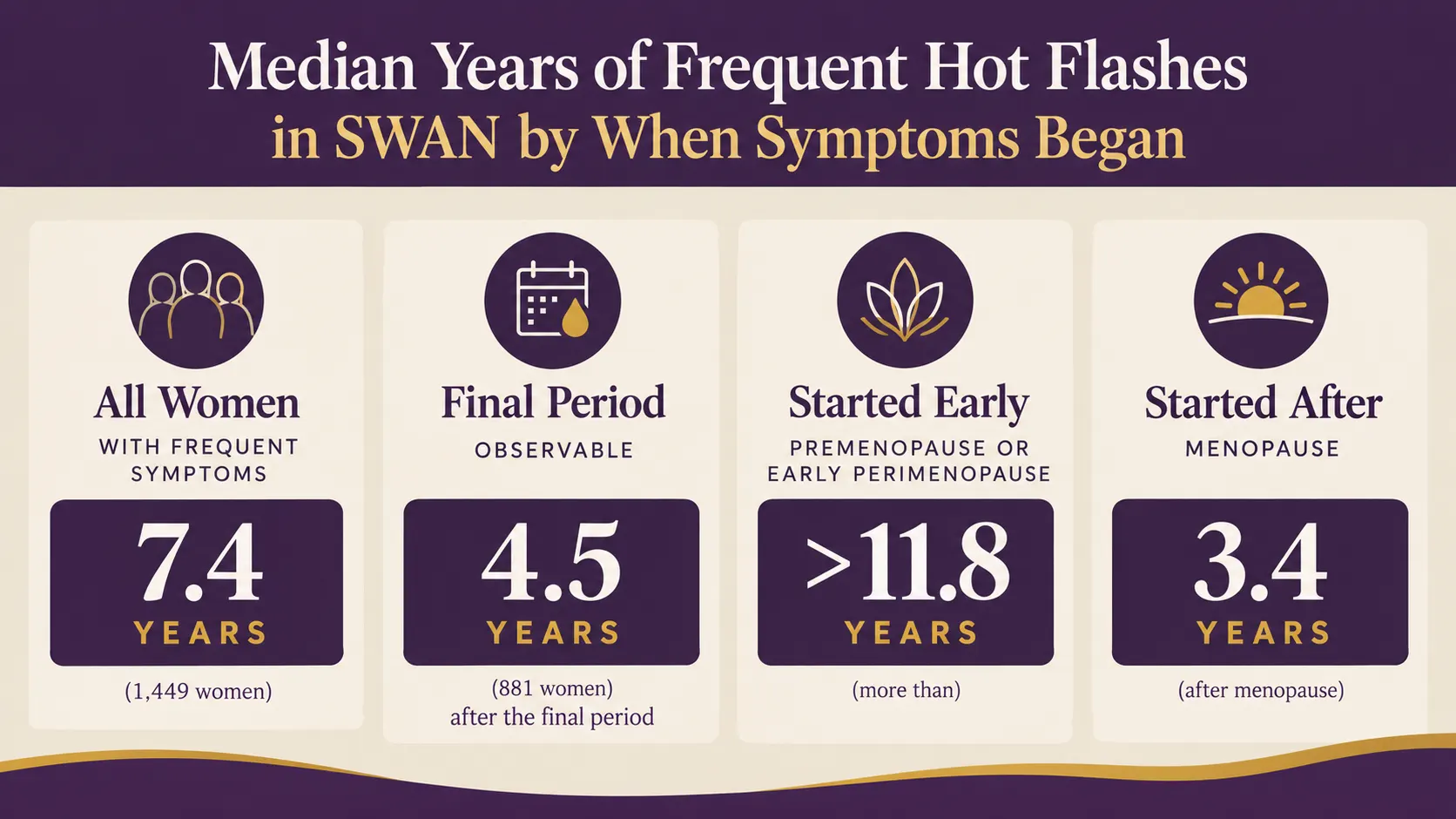
| All women with frequent symptoms (1,449 women) | 7.4 years total |
| Women with an observable final period (881 women) | 4.5 years after the final period |
| Symptoms began premenopause or early perimenopause | More than 11.8 years |
| Symptoms began after menopause | 3.4 years |
The authors wrote that frequent symptoms lasted more than 7 years during the transition for more than half of the women, and advised clinicians to counsel women to expect that. The numbers differed by group as well. Median total duration was 4.8 years in Japanese women, 5.4 years in Chinese women, 6.5 years in non-Hispanic white women, 8.9 years in Hispanic women and 10.1 years in African American women.
Two limits on these numbers matter. First, they describe frequent symptoms, so milder or occasional flashes are not counted. Second, a median is a midpoint. Half of the women in the study had symptoms for longer than the median, and half for less.
Why Your Timeline Will Not Match Hers
The group that had the longest runs is the group whose symptoms began early. The SWAN authors also found several factors related to a longer duration of hot flashes. They were younger age, less schooling, higher stress, greater attention to bodily sensations, and more depression and anxiety when symptoms were first reported. These are associations, and the study cannot say that stress caused the longer duration. It does point to something worth knowing: the stress side of the picture travels with the hormone side.
Dr. Goldstein explains why that matters:
“So when you’re under chronic stress, your adrenal pumps out cortisol constantly. High cortisol tells your thyroid to slow down because your body thinks there’s a famine. Your thyroid slowing down disrupts your sex hormones because your body thinks it’s not safe to reproduce.”
That chain, stress to cortisol to thyroid to sex hormones, is the model behind how the practice reads a midlife timeline. A thyroid that is struggling can produce hot flashes, poor sleep and a racing heart that look exactly like menopause, which is why our guide on telling thyroid trouble from perimenopause exists. Dr. Goldstein puts the testing problem plainly: “Your thyroid can be normal while still being shut down by stress.”
So the first question at the practice is a timeline question: when did this begin, and what came before it? A move, a loss, a year of 60-hour weeks, a surgery or a bout of illness that preceded the first skipped period changes what the next few years are likely to look like.
Want to see which of your systems is speaking loudest? The Hormone Orchestra Quiz is free, has 22 questions and takes about 3 minutes. It scores three connected systems: your stress response, your thyroid and your sex hormones.
What Changes After Your Last Period
Once you hit the 12-month mark you are postmenopausal, and that label does not expire. What changes is how the body behaves inside it.
In SWAN, the median hot flash run after the final period was 4.5 years, so symptoms can continue well after the date you thought of as “the end.” Body composition has a clearer finish line. A SWAN analysis of fat and lean mass found that the rate of fat gain doubled and lean mass declined at the start of the transition. Those changes continued until 2 years after the final period, and then the trajectories decelerated to zero slope (Greendale et al., JCI Insight 2019). If the scale is what worries you most, our page on perimenopause weight gain goes through the mechanisms.
Not every symptom follows the hot flash clock, and the duration research here is for vasomotor symptoms. For sleep, mood and brain fog, a clear start date, a symptom log and a full-picture lab read tell you more than any population median.
What to Do While the Timeline Plays Out
Waiting has a cost. A transition that runs 4 to 8 years, with hot flashes continuing 7 or more, is a long time to run on broken sleep. These are the steps worth taking now.
- Start a cycle and symptom log. Write down the first day of each period, the night sweats, the sleep, the mood. Perimenopause is staged from cycle pattern, and a log lets a clinician place you on the STRAW+10 map instead of guessing.
- Rule out the look-alike. A struggling thyroid can produce a symptom set that resembles this transition. Our page on what perimenopause labs show covers what a test can and cannot tell you.
- Know what the evidence supports. The Menopause Society says hormone therapy has been shown to be the most effective treatment for bothersome hot flashes. It also notes that only two nonhormone medications are approved by the FDA to treat them, and that certain low-risk lifestyle measures can help manage them. Whether any of these fits you is a conversation with a clinician who has your full history.
- Read the whole system. Dr. Goldstein says: “Standard labs measure diseases, not function.” A panel can come back in range while your sleep, temperature and mood say otherwise. That is the gap a functional lab read is designed to close.
If you are a candidate for hormone support, how Dr. Goldstein approaches bioidentical hormone therapy as a clinical decision after the full picture explains the process.
One Google reviewer, Tanya Morrison, wrote that Dr. Goldstein “eased my symptoms during menopause.” Dr. Goldstein says women whose tests keep coming back normal eventually hear one of three answers: it is just stress, it is just aging, or it is all in your head.
Menopause Care in San Juan Capistrano or by Video Across California
Dr. Goldstein sees patients at the San Juan Capistrano office, and women come in from towns such as San Clemente, Mission Viejo and Aliso Viejo. Telemedicine is available anywhere in California, so a woman in Sacramento or San Diego can start with a video visit and bring her cycle log with her.
Our telemedicine page explains how a video visit works.
For the broader practice approach to this stage of life, see perimenopause and hormone care for Orange County women.
Dr. Goldstein has 25+ years in practice, and the practice does not bill insurance. The office address and hours are on the contact page.
Frequently Asked Questions
How long does menopause last?
Menopause is a single point, confirmed at 1 year after your final period. The transition before it (perimenopause) ran a median of 4.37 to 8.57 years in SWAN depending on the age it began, and postmenopause lasts the rest of your life.
How long does perimenopause last?
There is no single number. STRAW+10 estimates the late transition at 1 to 3 years on average. Across the whole transition, SWAN found earlier onset was associated with a longer duration, so a woman whose changes start in her early forties can expect a longer run than one who starts later.
How long do hot flashes last after menopause?
In SWAN, the median persistence after the final menstrual period was 4.5 years. The Menopause Society cites a mean of 7 to 10 years for hot flashes overall.
Can menopause symptoms last 10 years or more?
Yes. In SWAN, women who were premenopausal or in early perimenopause when frequent hot flashes began had a median total duration of more than 11.8 years, and the median was 10.1 years in African American women. Symptoms that begin early are more likely to run long.
When am I officially postmenopausal?
At 12 months after your final period. Until then you are still in the transition, which is why the date can only be named in hindsight.
Do hot flashes ever stop on their own?
For most women they ease over time. The Menopause Society states that in most women hot flashes will ease over time. If yours are costing you sleep, you do not have to wait for that to happen.
Where to Start
You now know the shape of the timeline. The next question is what is driving your version of it. Dr. Goldstein’s free Master Class walks through the three connected systems she sees break down most often, thyroid, stress response and sex hormones, and shows how they work as one. Watch the free Master Class.