

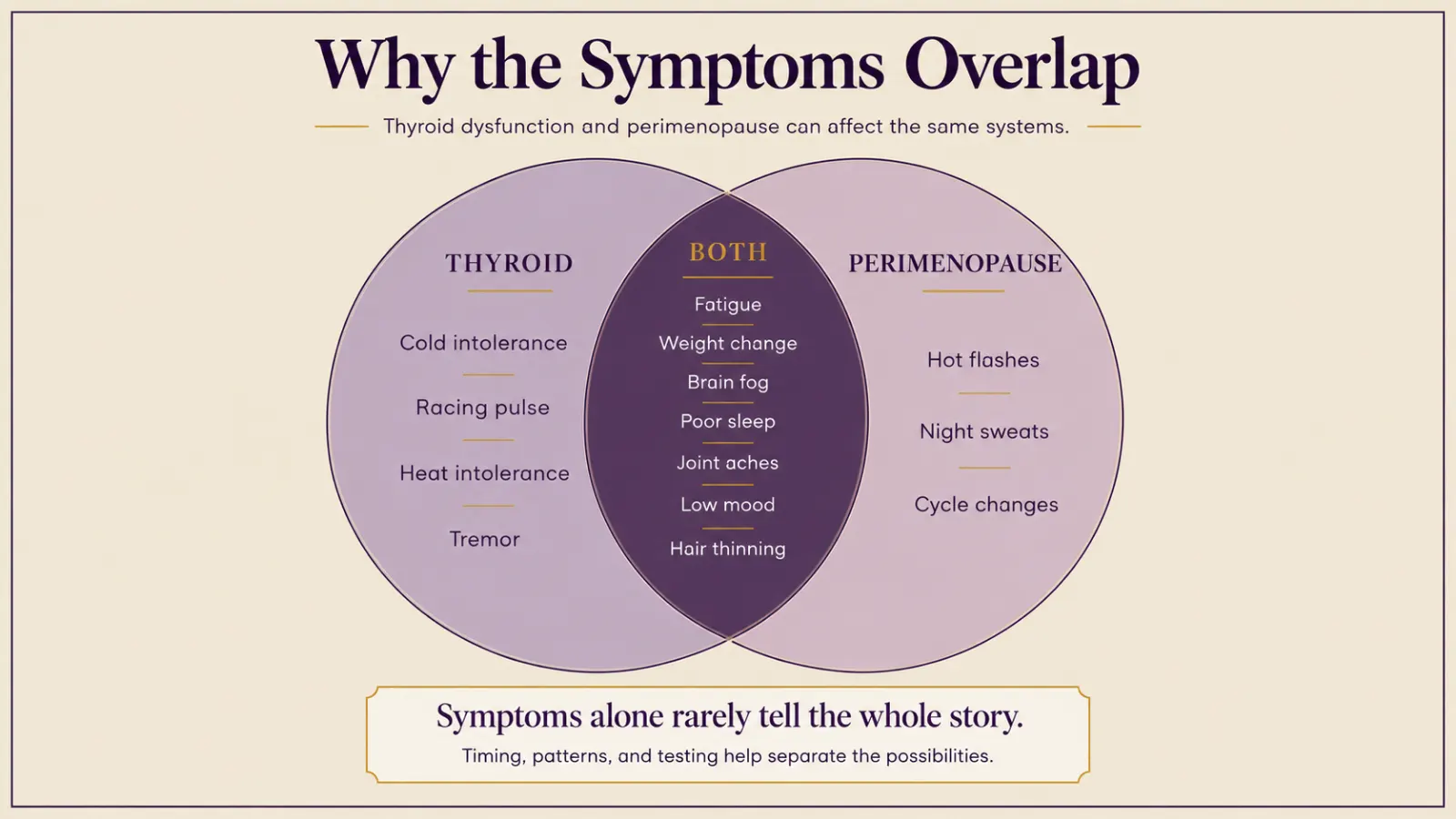
Whether it is your thyroid or perimenopause cannot be settled from symptoms, because the two produce nearly the same list: fatigue, weight change, brain fog, poor sleep, mood swings, joint aches and thinning hair. Only a few symptoms lean one way. Hot flashes and night sweats lean toward the menopausal transition, and persistent cold intolerance leans toward an underactive thyroid. Everything else is shared. Testing separates them: TSH, free T4, free T3 and thyroid antibodies answer the thyroid question, while your menstrual cycle pattern answers the perimenopause question. Both can be true at once, and in your forties that is common.
Key Takeaways
- Symptoms alone cannot settle thyroid or perimenopause, because most of the overlap is non-specific.
- Hot flashes and night sweats are the symptoms most specifically attributable to the menopausal transition.
- Thyroid function is answered by a blood panel. Perimenopause is answered by your cycle pattern.
- Thyroid abnormality is common in this exact age band, so it is worth testing rather than assuming.
- The two frequently coexist, and treating one while the other keeps driving gives partial relief.
- The order you test in settles the question in one appointment instead of four.
You are not confused because you are missing something obvious. You are confused because the two likeliest explanations for how you feel in your forties produce almost the same symptom list, and they arrive in the same decade of your life.
Most women reading this have already heard one of three answers: it is just stress, take an antidepressant. It is just aging, learn to live with it. It is all in your head, see a therapist. None of those is a differential diagnosis. This page is the differential.
Why Thyroid and Perimenopause Produce the Same Symptoms
Both change the same things, because both are signalling systems that set your metabolic pace, temperature, mood and sleep.
Perimenopause is the menopausal transition, the years of shifting ovarian hormone output leading up to the final menstrual period.
Thyroid dysfunction is a thyroid gland producing too little hormone (hypothyroidism) or too much (hyperthyroidism), which changes metabolic rate body-wide.
The overlap is documented. A 2023 review in Deutsches Ärzteblatt International reports that “one can expect a marked overlap of complaints and symptoms of hyperthyroidism with those of the menopause”. The underactive side overlaps just as heavily. The NIDDK lists hypothyroid symptoms as fatigue, weight gain, cold intolerance, joint pain, dry skin, thinning hair and irregular periods. The National Institute on Aging lists the transition as bringing hot flashes, night sweats, trouble sleeping, joint discomfort and difficulty concentrating. Our complete perimenopause symptom guide sets out the full picture by body system.
Timing makes it worse. TSH was elevated in 10% of women aged 45 to 54 in an iodine-replete population, per the same review. That is the decade perimenopause usually arrives in.
Dr. Goldstein compares the endocrine system to an orchestra: one instrument out of tune makes the whole orchestra sound wrong, and the sound alone does not tell you which instrument.
Which Symptoms Separate Thyroid or Perimenopause
A few symptoms carry real discriminating value. Most do not.
| Symptom | Leans toward | Why |
|---|---|---|
| Hot flashes, night sweats | Perimenopause | The complaints most specifically attributable to the transition |
| Persistent cold intolerance | Hypothyroidism | Reduced metabolic rate lowers heat production |
| Racing pulse, heat intolerance, tremor | Hyperthyroidism | Accelerated metabolic rate, the opposite pattern |
| Cycle length changing month to month | Perimenopause | Cycle variability defines the early transition |
| Heavy or more frequent bleeding | Either | Hypothyroidism and the transition both do this |
| Fatigue, weight change, brain fog, joint ache, poor sleep, low mood, hair thinning | Both | Shared, and these are most of what you are feeling |
The discriminating rows are the short list. The shared row is long, and it holds the symptoms that drove you to search. A Germany-wide survey cited in the same review found that only vasomotor symptoms can be specifically attributed to the menopause, while sleep disorders and joint pain increased with age regardless.
Cycle change is weaker evidence than it looks. Hypothyroidism is linked with heavy and more frequent bleeding, though significant differences in menstrual disturbance appear mainly in severe thyroid disease. A changed cycle points toward perimenopause, while a thyroid cause stays on the list until it is tested.
How Perimenopause Is Actually Diagnosed
Perimenopause is staged on your menstrual cycle pattern, not on a blood test.
The Stages of Reproductive Aging Workshop criteria are the standard used in clinical staging. They define the early transition by increased variability in menstrual cycle length, a persistent difference of about seven days between consecutive cycles. Persistence means the variation recurs within ten cycles. The late transition is marked by skipped cycles or at least 60 days without a period.
The practical consequence: three to six months of cycle dates is a more definitive perimenopause test than any single blood draw, and it costs nothing.
A hormone panel is still worth running for narrower questions. Our guide to what a perimenopause hormone panel can confirm covers FSH and estradiol.
What Thyroid Testing Answers
The thyroid question, unlike the perimenopause question, has a blood test that answers it.
Health care professionals usually check the amount of TSH in your blood first, per the NIDDK. A high TSH most often means an underactive thyroid, a low TSH an overactive one, and an abnormal result needs a further test to find the cause.
What a fuller panel adds:
- Free T4. The hormone available to tissues. The NIDDK notes many clinicians prefer free T4 because binding protein changes do not affect it.
- Free T3. The active form, useful when T4 is normal and symptoms persist.
- Thyroid antibodies. Made when the immune system attacks the thyroid by mistake, so they identify autoimmune thyroid disease such as Hashimoto’s.
Frequency argues for testing rather than assuming. Thyroid disorders affect nearly 14% of adult women, per a 2023 review in the International Journal of Molecular Sciences, and women are 3 to 5 times more likely than men to be treated for them. The Deutsches Ärzteblatt review is blunter about this age group: the indication to check TSH “should be made generously.” That reasoning shapes how thyroid and Hashimoto’s concerns are assessed at The Natural Path.
The Test Order That Settles Thyroid or Perimenopause
Running everything at once produces a pile of numbers. Running them in order produces an answer.
- Start the cycle log today. Dates, flow, and which week symptoms land in. Nothing else answers the perimenopause question, and it needs months to say anything, so it starts first.
- Run thyroid next. TSH with free T4, free T3 and antibodies. Quick, widely available, and a clearly abnormal result changes the plan immediately.
- Read hormone results against cycle timing. A value drawn on an unknown cycle day cannot be interpreted, so the cycle day is part of the result.
- If both come back unremarkable, widen rather than repeat. Iron stores are the common miss, because ferritin can be low while a blood count looks fine. Nutrient status, blood sugar and the stress response belong in the same conversation.
Each step answers one question and changes what happens next, which is what functional lab testing is for.

Free 3-minute quiz from Dr. Angela Goldstein, ND
Stress, thyroid and sex hormones work as one system. Answer 22 quick questions and see which one is under the most strain for you.
What you’ll get:
- ✓A score for each system: stress, thyroid and sex hormones
- ✓Which pattern your answers fit, and how the systems pull on each other
- ✓Built on published research
- ✓A clear next step for your pattern
Free. 22 questions, about 3 minutes.
Educational content. Always talk with your doctor before changing any treatment.
When Both Are True at the Same Time
Thyroid or perimenopause is often the wrong question, because both being present is the common case here. Thyroid abnormality shows up in roughly one in ten women in their late forties and early fifties, and every woman passes through the menopausal transition. Those facts collide in the same years, in the same body.
What that changes: a positive thyroid result does not rule out perimenopause, and a clear perimenopause pattern does not rule out a thyroid problem. Treat one while the other keeps driving and partial improvement is the expected outcome.
That is the pattern behind a sentence patients say often: the treatment helped a little, then it stopped helping. Eileen, a patient of Dr. Goldstein’s, described the difference in her Google review as a doctor who “gets to the root of your problem” after “doctors for years that never changed anything.”
Dr. Goldstein looks for the underlying driver instead of managing symptoms in isolation. In her model, thyroid, the stress response and sex hormones are read together rather than across three appointments, because in 25+ years of practice she has seen them fail together. That thinking shapes hormone and perimenopause care at the practice.
When the Thyroid Panel Comes Back Normal
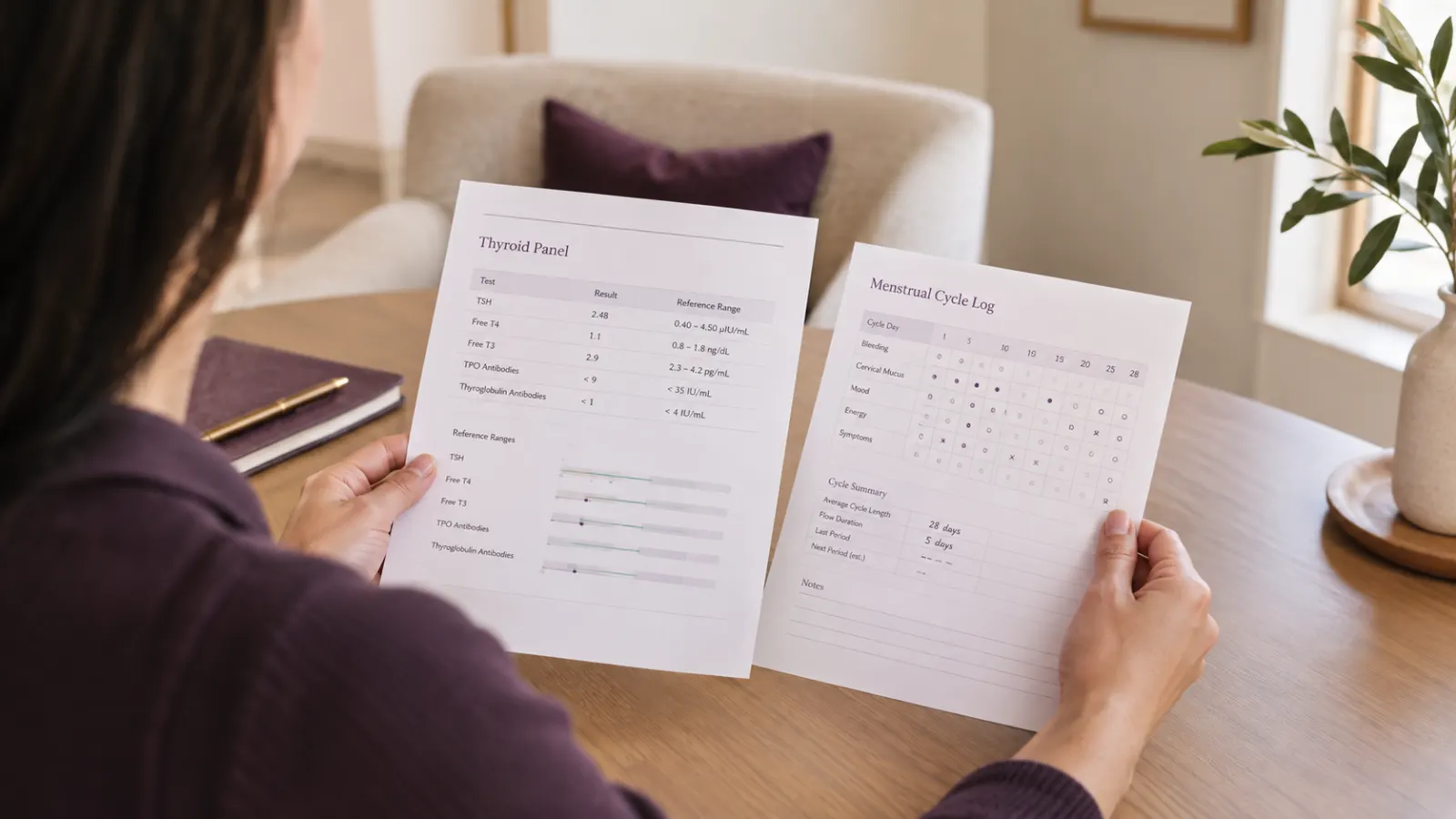
A normal thyroid panel establishes that your results sat inside the laboratory reference range on the day of the draw, which is narrower than “your thyroid is fine.” Those numbers also move with other hormones: the NIDDK notes that in pregnancy or on oral contraceptives, thyroid hormone levels will be higher, because those states change the blood protein that binds T4.
Reference range is the span of values found in a laboratory’s comparison population. It describes where most people sit, which is a different question from where you function best.
Dr. Goldstein’s framing: standard labs measure diseases, not function. They check whether the engine is completely broken, not whether it is running at 40% capacity. She also says a thyroid can test normal while still being slowed by a sustained stress load, which is why the stress response belongs in the same assessment. Patients put it in their own words. As one wrote, “it’s not just about your bloodwork.” Our article on why a normal panel can still miss a struggling system covers that ground.
When to Get Checked Sooner
Some symptoms need prompt attention rather than a longer investigation. Contact your physician the same day, or emergency services if severe, for:
- a racing or irregular heartbeat, chest pain, or fainting
- a new lump or swelling in the neck, or trouble swallowing
- unexplained weight loss
- bleeding between periods or after sex, or unusually heavy bleeding
- any bleeding after 12 months with no period
What to Bring So One Appointment Can Answer It
Most of the delay in settling thyroid or perimenopause is missing information you can gather yourself. Bring:
- Three to six months of cycle dates, with flow and length. If you have fewer, bring what you have.
- A symptom note by week. Whether symptoms track your cycle or run flat through the month is diagnostic information.
- Every prescription and supplement with doses, because several change thyroid numbers.
- Prior thyroid results with the reference ranges printed, not the word “normal”.
- Family history of thyroid or autoimmune disease.
- What has been tried and what happened, including partial responses.
The constraint here is usually time. A standard visit is short, and a differential spanning two hormone systems needs a longer conversation, which is what a root-cause evaluation is built around.
Frequently Asked Questions
Can perimenopause cause thyroid problems?
The two are linked rather than causal in one direction. Shifting estrogen changes the proteins that carry thyroid hormone, which changes how results read. Autoimmune thyroid disease also becomes more common in midlife.
What blood test tells the difference between thyroid and perimenopause?
TSH is checked first, usually with free T4, free T3 and thyroid antibodies. No blood test confirms perimenopause on its own, because those values move from cycle to cycle. Cycle pattern over several months is the evidence.
My TSH was normal, so is it perimenopause?
A normal TSH makes overt thyroid disease less likely on that day. Perimenopause is established by cycle pattern rather than by ruling the thyroid out, and other causes, iron stores among them, are worth checking.
Can you have perimenopause and a thyroid problem at the same time?
Yes, and it is common in this age group. One result does not cancel the other, and treating only one tends to produce partial improvement that stalls.
Is adrenal fatigue the answer if both come back normal?
“Adrenal fatigue” is a functional-medicine concept, not a recognized medical diagnosis. A systematic review in BMC Endocrine Disorders found no substantiation that “adrenal fatigue” is an actual medical condition. The accurate terms are HPA-axis activity and cortisol rhythm.
Where to Start
The most useful next step is understanding both systems before anyone treats either.
Dr. Goldstein’s free Master Class walks through how thyroid, the stress response and sex hormones interact, including why treating them one at a time gives temporary relief. The Natural Path sees patients in person in San Juan Capistrano, Orange County, and by video visit across California.
Watch the free Master Class, then bring your cycle log and prior results to your next appointment.
By Dr. Angela Goldstein, ND, licensed naturopathic doctor, 25+ years in practice. Last reviewed: 2026-09-16.
This article is for general education and is not medical advice. It is not intended to diagnose or treat any disease, does not establish a doctor-patient relationship, and is not a substitute for care from your own clinician. Do not start, stop or change any prescribed medication based on what you read here. If you have an urgent medical concern, contact your physician or emergency services.