
Written by The Natural Path clinical content team, based on the teaching of Dr. Angela Goldstein, ND.
Perimenopause heart palpitations are common and usually not serious, but a palpitation is a symptom and not a diagnosis, so your heart rhythm and your thyroid should be checked before anyone blames hormones. In the Study of Women’s Health Across the Nation (SWAN), 15.9% of women had a high probability of palpitations through perimenopause and early postmenopause, and another 34.3% had a moderate probability. Hot flashes, poor sleep and stress travel with palpitations in the research, and baseline estradiol did not separate the high-palpitation group from the others. Call 911 for chest pain, fainting, shortness of breath, unusual sweating or dizziness. For everything else, see your doctor, get an ECG and thyroid blood work, and keep a log.
Call 911 first if palpitations come with any of these:
- chest pain
- shortness of breath
- loss of alertness (consciousness)
- unusual sweating
- dizziness or lightheadedness
MedlinePlus lists these as reasons to call 911 or your local emergency number. The American Heart Association adds chest discomfort with nausea or other heart attack symptoms, and says the feeling you are about to pass out needs medical attention sooner rather than later.
No emergency signs? Still see your doctor or a cardiologist first. A heart rhythm problem has to be ruled out before palpitations are put down to perimenopause, and the next section shows what that visit covers.
Key Takeaways
- Palpitations are common in the menopausal transition, and most are not serious.
- Chest pain, fainting, shortness of breath, unusual sweating or dizziness with palpitations means 911.
- Heart rhythm and thyroid come first: an ECG, blood work and sometimes a monitor can settle both.
- In the research, palpitations cluster with hot flashes, poor sleep and stress, and in SWAN the groups did not differ in baseline estradiol.
- An overactive thyroid causes a rapid or irregular heartbeat and overlaps with perimenopause.
- A simple palpitation log turns “my heart does weird things” into something a clinician can act on.
You are sitting in a meeting, or lying in bed, and your heart flips, pounds or takes off on its own. If this started in your forties, someone has probably already given you one of the three answers Dr. Goldstein names: “It’s just stress, take an antidepressant. It’s just aging, learn to live with it. Or it’s all in your head, see a therapist.”
A racing heart is a physical symptom and deserves a physical workup. Palpitations are one of the symptoms on our list of the 34 symptoms of perimenopause, and this page goes further: what to rule out first, what the research does and does not show about hormones, and how the thyroid, the stress response and sleep fit in.

What Perimenopause Heart Palpitations Feel Like
Palpitations feel like an increased awareness of your own heartbeat, most often racing, pounding, fluttering or a skipped beat.
Palpitations are an increased awareness of your heartbeat. They are a symptom, not a diagnosis, and can feel like the heart beating slower, faster or harder than normal.
The American Heart Association says you may feel them in the chest, neck or throat, and they can last seconds, minutes or longer. SWAN counted a woman as having palpitations if she reported any days of “heart pounding/racing” in the past two weeks. Across 3,276 women followed through the transition, the three patterns that emerged looked like this:
| Pattern across the transition | Share of women (SWAN) |
|---|---|
| High probability in perimenopause and early postmenopause, easing later | 15.9% |
| Moderate probability in perimenopause and early postmenopause, easing later | 34.3% |
| Sustained low probability | 49.8% |
About one woman in six sat in the high group and about one in three in the moderate group. Dr. Goldstein treats a symptom as a signal from a system, which is why the useful question is which system. She says “most practitioners, even natural ones, treat symptoms, not systems.”
See Your Doctor or a Cardiologist First
Most palpitations are not considered serious, and they still need a rhythm check before anyone attributes them to hormones. The American Heart Association notes that untreated atrial fibrillation, one cause of palpitations, can raise the risk of stroke. The SWAN authors write that palpitations can be associated with serious, life-threatening arrhythmias.
MedlinePlus says to contact your provider right away if:
- you often feel extra heartbeats, more than 6 per minute or coming in groups of 3 or more
- your palpitations are new or different
- your pulse is above 100 beats per minute without exercise, anxiety or fever
- you have heart disease or risk factors such as high cholesterol, diabetes or high blood pressure
An electrophysiologist quoted by the American Heart Association says palpitations lasting minutes to hours are a problem, and any change from your baseline should be evaluated.
What the visit usually covers. The doctor asks how long this has been going on, how often, what time of day and what triggers it. The American Heart Association says basic blood work can reveal thyroid abnormalities, anemia or electrolyte imbalances, and an ECG can help detect rhythm disorders. If something shows up, MedlinePlus lists the next steps: a Holter monitor for 24 hours or a longer heart monitor, and sometimes an echocardiogram. Hormone labs are a separate question, covered in our guide to what a perimenopause test can and cannot show.
Monitoring often finds a normal rhythm in someone who is certain something is happening. The sensation is still real, and that is where the rest of this page picks up. Dr. Goldstein worked in a cardiosurgical ICU in Russia before she turned to naturopathic medicine. Clear the heart first, then look at the whole system.

Free 3-minute quiz from Dr. Angela Goldstein, ND
Stress, thyroid and sex hormones work as one system. Answer 22 quick questions and see which one is under the most strain for you.
What you’ll get:
- ✓A score for each system: stress, thyroid and sex hormones
- ✓Which pattern your answers fit, and how the systems pull on each other
- ✓Built on published research
- ✓A clear next step for your pattern
Free. 22 questions, about 3 minutes.
Educational content. Always talk with your doctor before changing any treatment.
What the Research Shows About Hormones and Palpitations
Palpitations in the menopausal transition cluster with hot flashes, poor sleep and stress, and in SWAN the groups did not differ in baseline estradiol. That is less tidy than the usual “falling estrogen” explanation, and no study here shows that estrogen causes palpitations.
A 2022 scoping review of 84 articles in Women’s Health found that likely correlates were worse vasomotor symptoms, worse sleep, lower physical activity and worse quality of life. Evidence on biomarkers, anxiety and stress was too sparse to judge. In SWAN, the high-palpitation group had more hot flashes, more perceived stress, more sleep problems and higher blood pressure at baseline, yet did not differ from the others in baseline estradiol. Estradiol was compared at baseline only, so SWAN cannot say what hormone changes during the transition do. Palpitation patterns were also unrelated to atherosclerosis or arterial stiffness.
Nights show the overlap. In a study of 86 women in the menopausal transition or after it, hot flashes that came with arousals or awakenings were accompanied by a heart rate increase of about 20%, sustained for several minutes.
Dr. Goldstein, who has 25+ years in practice, explains why one hormone number so rarely settles a symptom like this: “Think of your endocrine system like an orchestra… if one instrument is out of tune, if one hormone system is off, the whole orchestra sounds terrible.”
When a Racing Heart Comes From the Thyroid
An overactive thyroid can cause a rapid or irregular heartbeat, and it shares so many symptoms with perimenopause that blood work has to separate them. The NIDDK lists rapid or irregular heartbeat alongside nervousness, trouble sleeping, shaky hands, and sweating or trouble tolerating heat. It states that a diagnosis can’t be based on symptoms alone and that the condition is more common in women. MedlinePlus and the American Heart Association both name an overactive thyroid as a cause of palpitations.
Hyperthyroidism is an overactive thyroid, a gland making more thyroid hormone than the body needs, which speeds up metabolism body-wide.
The heart-rate sign runs in opposite directions depending on the thyroid state, and the NIDDK page on hypothyroidism lists a slowed heart rate for the underactive side:
| Overactive thyroid | Underactive thyroid | |
|---|---|---|
| Heart rate sign | Rapid or irregular heartbeat | Slowed heart rate |
| Other signs listed by the NIDDK | Weight loss even with an increased appetite, nervousness, trouble sleeping, shaky hands, heat intolerance | Fatigue, weight gain, trouble tolerating cold, dry skin, heavy or irregular periods |
| What the first blood test usually shows | A low TSH | A high TSH |
The NIDDK says TSH is usually checked first, and thyroid disorders affect nearly 14% of adult women. Dr. Goldstein reads the thyroid inside the larger system: “Your thyroid can be normal while still being shut down by stress.” Our page on telling thyroid from perimenopause lays out the overlap symptom by symptom.
Stress, Cortisol and Sleep
Poor sleep and stress travel with perimenopause palpitations in the research, and Dr. Goldstein’s model explains why they belong in the same workup as the thyroid and sex hormones. MedlinePlus lists anxiety, stress, panic attacks and fear among common causes of palpitations, and the American Heart Association lists stress or anxiety among triggers for the feeling of an extra beat. The scoping review found the evidence on stress itself too sparse to call it a proven cause in this transition.
Here is Dr. Goldstein’s cascade: “So when you’re under chronic stress, your adrenal pumps out cortisol constantly. High cortisol tells your thyroid to slow down because your body thinks there’s a famine. Your thyroid slowing down disrupts your sex hormones because your body thinks it’s not safe to reproduce.”
The first link in that chain has support in the literature. A 2026 paper in Endokrynologia Polska states that cortisol inhibits the secretion of TRH in the hypothalamus and TSH in the pituitary gland. Our article on how cortisol and thyroid interact walks through the circuit.
Ask the question that anchors a root-cause history: when did this start, and what was going on before it? A loss, a deadline, months of broken sleep, a new medication, a change in your cycle. The timeline is often the most useful thing in the room.
When your heart has been checked and you want to see which system is speaking loudest, the hormone quiz takes about 3 minutes and scores three systems: stress response, thyroid and sex hormones.
Everyday Triggers and the Palpitation Log
Some palpitations come from something you swallowed. MedlinePlus and the American Heart Association name caffeine, nicotine, excessive alcohol, decongestants containing phenylephrine or pseudoephedrine, diet pills, stimulant drugs, and certain medicines including some asthma and ADHD treatments. Exercise and fever are also on the list, and electrolyte problems with sodium, potassium or magnesium are something blood work can check. Bring every prescription, over-the-counter product and supplement to your appointment, labels included.
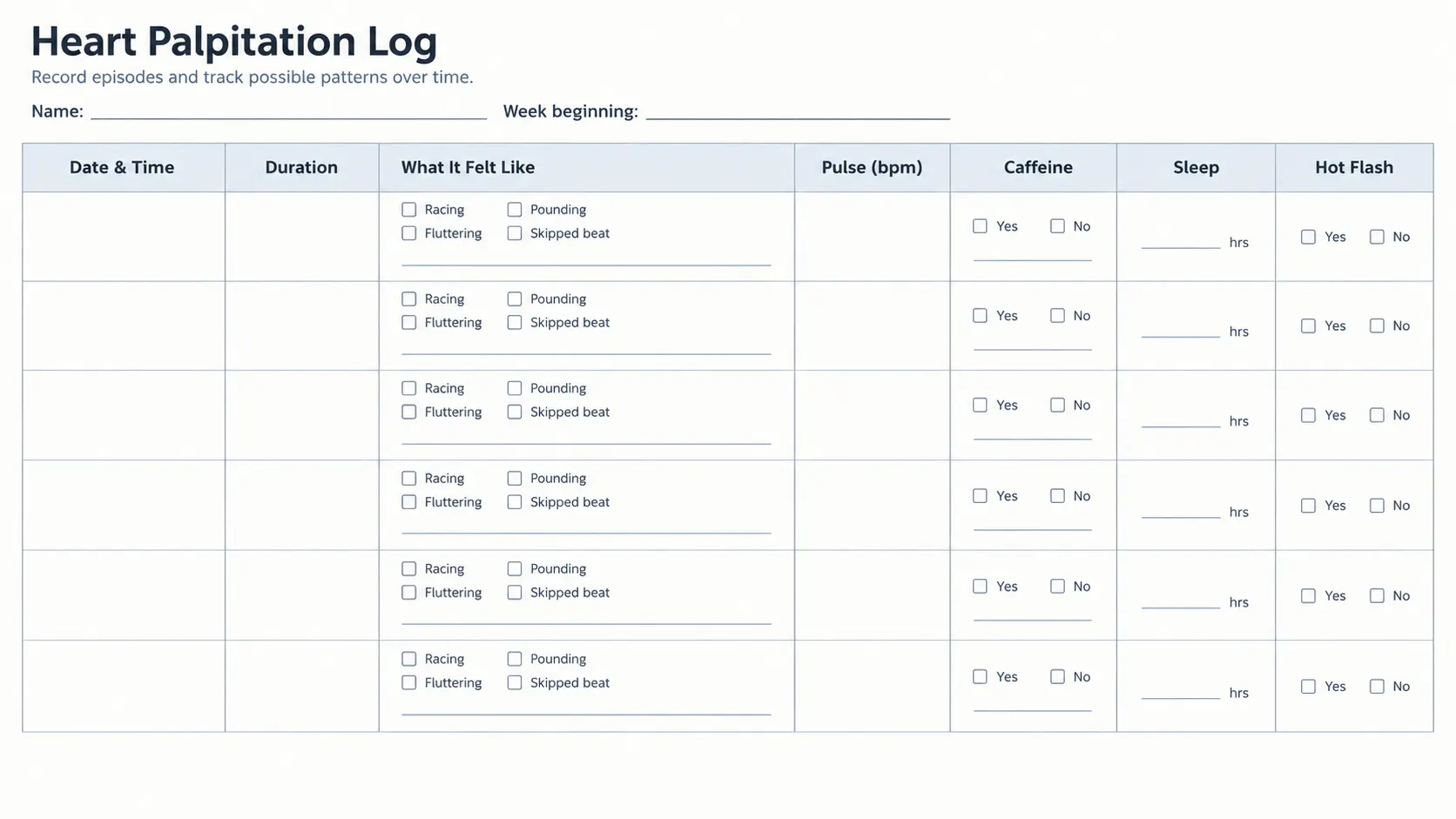
A one-page log makes that appointment far more productive, because it answers the questions the doctor will ask. For each episode, write down:
- Date, time and how long it lasted.
- What it felt like: racing, pounding, fluttering or a skipped beat.
- Your pulse during the episode, counted for a full minute, if you can.
- What you had and were doing in the previous hours: caffeine, alcohol, nicotine, any new medicine.
- Whether a hot flash or night sweat came with it, and how you slept the night before.
- Where you were in your cycle, and how the week had been.
After a few weeks the log starts to sort itself. These patterns are questions to bring to your clinician:
| If the log shows | Question to raise | Source of the link |
|---|---|---|
| Episodes arrive with hot flashes or night sweats | Is this tied to hot flashes, and are they worth treating on their own? | Scoping review; nocturnal hot flash study |
| Episodes come with sweating, shakiness, heat intolerance or weight loss | Should a thyroid panel be run now? | NIDDK |
| Episodes follow caffeine, alcohol, nicotine or a decongestant | Does removing the trigger change the pattern? | MedlinePlus; American Heart Association |
| Episodes cluster in stressful weeks or after poor sleep | Is the stress response part of the picture? | SWAN |
| Any episode with chest pain, fainting, dizziness or shortness of breath | Call 911 | MedlinePlus |
When the Heart Workup Comes Back Normal
A normal ECG and thyroid panel mean no dangerous rhythm or thyroid disease was found on that day, and the palpitations can still be real. Dr. Goldstein says: “Standard labs measure diseases, not function. They’re checking to see if your engine is completely broken, not whether it’s running at 40% capacity.”
For some women a clear workup closes the question. For others the palpitations keep going.
One patient, Eileen, wrote in her Google review that Dr. Goldstein “has modalities that she uses to detect and determine what’s going on in your body, it’s not just about your bloodwork.” Dr. Goldstein describes her approach as looking for the underlying driver instead of managing symptoms in isolation, with a full-picture read of labs and history. That means reading the thyroid, the stress response and the sex hormones together, after your heart has been cleared.
Our article on why a normal panel can still miss a struggling system explains the gap.
The practice’s page on perimenopause and hormone care shows how the work is done.
Treatment evidence for menopausal palpitations is still limited. A 2022 systematic review in Climacteric covered 37 articles and found that no therapy could be fully recommended. Only some hormonal agents, estradiol among them, could be recommended with caution, and supplements studied for this, including isoflavones and sage, could not be recommended on the existing evidence. Confirm what is driving your palpitations before treating them.
Palpitations Near You: San Juan Capistrano or Video Across California
The Natural Path sees patients in person in San Juan Capistrano and by video from anywhere in California, so the hormone, thyroid and stress side of palpitations can be worked up locally or from home. The office is open Monday, Tuesday and Thursday from 10:00am to 6:00pm, a practical drive for women in Dana Point, Laguna Niguel and Irvine, and the contact page has the details.
The telemedicine program covers patients inside or outside Orange County, and licensing limits video care to patients located in California.
The heart rhythm side, meaning the ECG and any monitor, runs through your primary care doctor or cardiologist. Neither the office nor a video visit is emergency care. In an emergency, call 911.
Frequently Asked Questions
Can perimenopause cause heart palpitations?
Yes, they are common in the transition. SWAN found that about half of women followed a moderate- or high-probability palpitation pattern across perimenopause and early postmenopause. The cause is not fully settled, and a rhythm check and thyroid test come first. Our perimenopause symptoms guide shows where palpitations sit among the other symptoms.
Are perimenopause heart palpitations dangerous?
Most are not. MedlinePlus says palpitations are not serious most of the time, and SWAN found no association with atherosclerosis or arterial stiffness after adjustment, which does not rule out an arrhythmia. Some palpitations do come from arrhythmias such as atrial fibrillation, which can raise stroke risk when untreated. A first episode, a change in pattern or any warning sign deserves an exam.
How long do perimenopause heart palpitations last?
A single episode can last seconds, minutes or longer, per the American Heart Association, and episodes lasting minutes to hours need evaluation. Across the transition, the SWAN patterns eased in late postmenopause.
Why do palpitations happen at night?
Night sweats and sleep disruption are the links the research supports best. In a study of nocturnal hot flashes, hot flashes with awakenings raised heart rate by about 20% for several minutes. Palpitations that wake you repeatedly are worth reporting to your doctor.
Can low estrogen cause heart palpitations?
Possibly, but the research has not settled it. In SWAN, the high-palpitation group did not differ from the rest in baseline estradiol, and a scoping review found too little evidence on hormone biomarkers to judge. One systematic review did find that estradiol could be recommended with caution to reduce palpitations. Hot flashes, sleep and stress show a clearer pattern, which is why a whole-system look beats chasing one hormone.
Can anxiety cause heart palpitations?
Yes. MedlinePlus lists anxiety, stress, panic attacks and fear as causes. Nervousness and trouble sleeping are also symptoms of an overactive thyroid, so anxiety that arrives with a racing heart is worth a thyroid test before it is filed under stress.
Where to Start
The most useful next step, once your heart has been checked, is understanding how the thyroid, the stress response and the sex hormones work as one system. Dr. Goldstein’s free Master Class walks through exactly that. Watch the free Master Class.
Written by The Natural Path clinical content team, based on the teaching of Dr. Angela Goldstein, ND.
This article is for general education and is not medical advice. It is not intended to diagnose or treat any disease, does not establish a doctor-patient relationship, and is not a substitute for care from your own clinician. Do not start, stop or change any prescribed medication based on what you read here. If you have an urgent medical concern, contact your physician or call 911.