

Written by The Natural Path clinical content team, based on the teaching of Dr. Angela Goldstein, ND.
The 34 symptoms of perimenopause are a popular compilation of symptoms reported across the menopausal transition, and no medical body publishes an official list of 34. The versions online do not match each other. Sorted by the three hormone systems Dr. Angela Goldstein, ND, reads together, 11 lean toward sex hormones, 5 toward the thyroid, 5 toward the stress response and 8 can come from any of the three. Five more have no clear single system. How many a woman notices varies widely. Fatigue, brain fog, mood change, weight gain and poor sleep sit in the overlap, which is why Dr. Goldstein reads the three systems as one picture.
Key Takeaways
- The number 34 is a common compilation, and the published lists differ from one another.
- Sorted by system, the symptoms fall into sex hormone (11), thyroid (5), stress response (5), shared by all three (8) and unsorted (5).
- Hot flashes and night sweats are the symptoms most specific to the transition itself.
- Fatigue, brain fog, mood swings, weight gain and poor sleep can come from any of the three systems.
- A symptom count cannot diagnose perimenopause, because staging rests on your cycle pattern.
- A simple tally by system shows which one is loudest and what to bring to an appointment.
If your labs came back normal and you still do not feel like yourself, you have probably heard one of three answers. Dr. Goldstein names them: “It’s just stress, take an antidepressant. It’s just aging, learn to live with it. Or it’s all in your head, see a therapist.”
Thirty-four symptoms is a lot to read, and a list that long can leave you feeling believed and overwhelmed at once. It is long because the symptoms come from more than one system. After 25+ years in practice, Dr. Goldstein compares the endocrine system to an orchestra: “if one instrument is out of tune, if one hormone system is off, the whole orchestra sounds terrible.” A symptom is one note, so this page asks which instrument is behind it. It sorts the 34 that way. For the body-area view, the complete perimenopause symptom guide by body system sets it out.
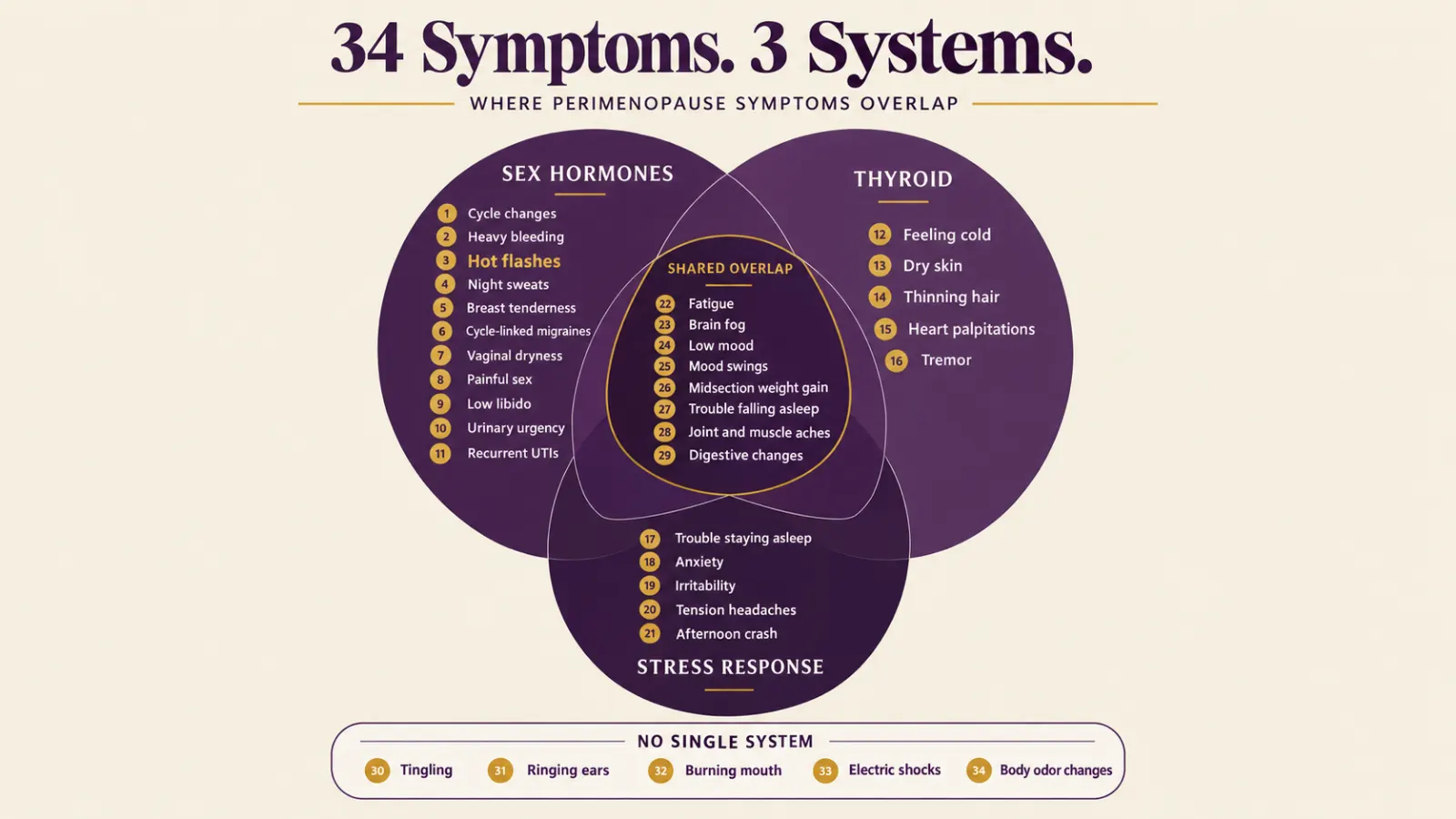
What the Number 34 Counts
The number 34 counts the symptoms that appear most often across published lists, and no medical body defines it.
Every page that ranks for this phrase carries a different 34. In the four we read in full, each includes items the others leave out: ringing in the ears on one, panic attacks and brittle nails on another, anovulation and low self-esteem on a third. One states that “the number 34 represents the most commonly documented symptoms” and cites no source. This page uses its own sort, drawn from what those lists name most often plus what the thyroid and stress references describe.
Perimenopause is the menopausal transition, the years of changing ovarian hormone output that lead up to the final menstrual period.
How many a woman notices varies widely. Jean Hailes for Women’s Health states that around 1 in 4 women will have no menopausal symptoms and around 1 in 4 will have severe ones, with the rest in between. Staging rests on cycle pattern. The STRAW+10 criteria (the Stages of Reproductive Aging Workshop staging system) define the early transition by increased variability in menstrual cycle length and the late transition by 60 days or more without a period.
A list cannot tell you when your symptoms started or what came before them. Those two answers matter more than the count, and the tally below helps you capture them.
The 34 Symptoms of Perimenopause at a Glance
All 34 symptoms sit in one table, each tagged with the system it leans toward and what else to check. Print it or copy it into your notes, and mark every symptom you have noticed in the last three months.
The “Leans toward” column is the content team’s teaching sort. It borrows the three systems Dr. Goldstein teaches (thyroid, adrenals and sex hormones) and what the published thyroid and stress references list. Use it to organize your symptoms for a conversation with a clinician.
| # | Symptom | Leans toward | Also check |
|---|---|---|---|
| 1 | Changes in cycle length | Sex hormones | Thyroid |
| 2 | Heavier or longer bleeding | Sex hormones | Thyroid |
| 3 | Hot flashes | Sex hormones | Overactive thyroid |
| 4 | Night sweats | Sex hormones | Overactive thyroid |
| 5 | Breast tenderness | Sex hormones | None named |
| 6 | Headaches or migraines that shift with the cycle | Sex hormones | Stress |
| 7 | Vaginal dryness | Sex hormones | None named |
| 8 | Painful sex | Sex hormones | None named |
| 9 | Low libido | Sex hormones | Thyroid, stress |
| 10 | Urinary urgency or frequency | Sex hormones | None named |
| 11 | Recurrent urinary tract infections | Sex hormones | None named |
| 12 | Feeling cold more often | Thyroid | None named |
| 13 | Dry skin | Thyroid | Sex hormones |
| 14 | Thinning hair | Thyroid | Sex hormones |
| 15 | Heart palpitations or a racing heart | Thyroid | Stress, sex hormones |
| 16 | Shaky hands or tremor | Thyroid | Stress |
| 17 | Trouble staying asleep | Stress | Sex hormones |
| 18 | Anxiety or feeling on edge | Stress | Thyroid, sex hormones |
| 19 | Irritability | Stress | Thyroid, sex hormones |
| 20 | Tension headaches or muscle tightness | Stress | Sex hormones |
| 21 | The afternoon crash | Stress | Thyroid |
| 22 | Fatigue | All three | Look at all three |
| 23 | Brain fog and memory lapses | All three | Look at all three |
| 24 | Low mood or depression | All three | Look at all three |
| 25 | Mood swings | All three | Look at all three |
| 26 | Weight gain, especially around the middle | All three | Look at all three |
| 27 | Trouble falling asleep | All three | Look at all three |
| 28 | Joint and muscle aches | All three | Look at all three |
| 29 | Bloating and digestive changes | All three | Look at all three |
| 30 | Tingling in the hands and feet | Unsorted | Ask a clinician if new |
| 31 | Ringing in the ears | Unsorted | Ask a clinician if new |
| 32 | Burning mouth, dry mouth or gum problems | Unsorted | Ask a clinician if new |
| 33 | Electric-shock sensations | Unsorted | Ask a clinician if new |
| 34 | Changes in body odor | Unsorted | Ask a clinician if new |
Sex Hormone Symptoms (1 to 11)
Estrogen and progesterone swing unpredictably during the transition, and these eleven follow them most directly. In Dr. Goldstein’s cascade, sex hormones are the last instrument the signal reaches, after stress and the thyroid.
Vasomotor symptoms are hot flashes and night sweats, the sudden waves of heat and the sweating that can wake you at night.
- Changes in cycle length. Cycles that run shorter, longer or unpredictable are the staging marker of the early transition.
- Heavier or longer bleeding. Flow can shift in either direction. Hypothyroidism is also associated with heavy bleeding, so heavy flow is worth raising with a clinician.
- Hot flashes. Sudden heat across the face, neck and chest. Of the 34, they are the most specific to the transition itself, as the overlap section below explains.
- Night sweats. Hot flashes during sleep, often heavy enough to wake you, and a common reason for the sleep trouble in items 17 and 27.
- Breast tenderness. Soreness or swelling that comes and goes with hormone swings.
- Headaches or migraines that shift with the cycle. Many published lists include them. Note whether yours follow your cycle.
- Vaginal dryness. Dryness, itching or burning as estrogen falls.
- Painful sex. Often follows item 7.
- Low libido. In Dr. Goldstein’s cascade, slow sex drive is one of the results of hormonal chaos.
- Urinary urgency or frequency. A sudden need to go, or going more often.
- Recurrent urinary tract infections. Repeated infections need a clinician’s evaluation, whatever the cause.
Thyroid Symptoms (12 to 16)
The thyroid sets your metabolic pace, and trouble with it is common in this age band.
TSH (thyroid-stimulating hormone) is the pituitary signal that tells the thyroid how hard to work, and it is the standard first blood test for thyroid function.
Thyroid disorders affect nearly 14% of adult women. A 2023 review in Deutsches Ärzteblatt International reported TSH elevated in 10% of women aged 45 to 54 in an iodine-replete population. The same review expects “a marked overlap of complaints and symptoms of hyperthyroidism with those of the menopause”. Blood work is the first step, and it has limits. Dr. Goldstein says: “Your thyroid can be normal while still being shut down by stress.” Our page on how to tell thyroid from perimenopause walks through the order.
- Feeling cold more often. Trouble tolerating cold is on the NIDDK’s hypothyroidism symptom list.
- Dry skin. Listed by the NIDDK for an underactive thyroid.
- Thinning hair. The NIDDK lists dry, thinning hair for hypothyroidism.
- Heart palpitations or a racing heart. The NIDDK lists a rapid or irregular heartbeat for an overactive thyroid. New palpitations deserve a check, see the attention list below.
- Shaky hands or tremor. Another overactive thyroid symptom on the same NIDDK list.
Women are much more likely than men to develop hypothyroidism, per the NIDDK. Thyroid and Hashimoto’s care at The Natural Path starts from the same three-system view.

Free 3-minute quiz from Dr. Angela Goldstein, ND
Stress, thyroid and sex hormones work as one system. Answer 22 quick questions and see which one is under the most strain for you.
What you’ll get:
- ✓A score for each system: stress, thyroid and sex hormones
- ✓Which pattern your answers fit, and how the systems pull on each other
- ✓Built on published research
- ✓A clear next step for your pattern
Free. 22 questions, about 3 minutes.
Educational content. Always talk with your doctor before changing any treatment.
Stress Response Symptoms (17 to 21)
Cortisol is the main stress hormone, released by the adrenal glands to mobilize energy when the body reads a situation as demanding.
In Dr. Goldstein’s cascade, this is where the signal starts: “when you’re under chronic stress, your adrenal pumps out cortisol constantly.”
The NIMH lists excessive worry, uneasiness, tension, headaches or body pain and loss of sleep among the symptoms of stress and anxiety. Five of the 34 lean this way.
- Trouble staying asleep. Waking in the night and not getting back to sleep. Night sweats can cause the same pattern, so note which comes first.
- Anxiety or feeling on edge. Worry that arrives without a trigger.
- Irritability. A shorter fuse than you remember.
- Tension headaches or muscle tightness. Headaches and body pain appear on the NIMH list above.
- The afternoon crash. Energy that holds until midday and then drops. This page files it with the stress response because Dr. Goldstein ties fatigue to the adrenals, and it can overlap with the thyroid.
When anxiety or low mood leads the picture, our page on mood, anxiety and depression explains how the practice approaches it.
Eight Symptoms Any of the Three Systems Can Produce (22 to 29)
These eight overlap the most, which makes them the least useful for telling the systems apart. They are also the symptoms most often treated one at a time. Dr. Goldstein says most practitioners, even natural ones, “treat symptoms, not systems.”
A 2023 review of thyroid dysfunction in midlife women summarizes a Germany-wide survey. It found that only vasomotor symptoms can be specifically attributed to the menopause, while other complaints such as sleep disorders and joint pain increased with age. So everything below is shared ground.
- Fatigue. Dr. Goldstein ties fatigue to the adrenals in her cascade. A slower thyroid and interrupted sleep can produce it too, so it sits with all three.
- Brain fog and memory lapses. Losing the thread of a sentence or the name of a word. All three systems can contribute.
- Low mood or depression. Depression is on the NIDDK list for hypothyroidism, and hormone shifts and stress can also lower mood. Persistent low mood deserves care, see the attention list below.
- Mood swings. Dr. Goldstein lists mood swings among the results of hormonal chaos.
- Weight gain, especially around the middle. In Dr. Goldstein’s cascade, weight gain comes from a slower thyroid. In the SWAN cohort, the rate of fat gain doubled at the start of the transition while the pace of weight gain held steady, so body shape can change before the scale does. Published sources do not separate it by system, so it sits with all three. Our page on perimenopause weight gain covers the mechanism.
- Trouble falling asleep. Trouble sleeping is on the NIDDK overactive thyroid list, and stress and night sweats add to it.
- Joint and muscle aches. The NIDDK lists joint and muscle pain for an underactive thyroid.
- Bloating and digestive changes. Common on published lists, with many non-hormonal causes, so a persistent change merits its own look.
Five Less Common Symptoms With No Single Clear System (30 to 34)
Published lists include these five. This page found no source tying any of them to a single hormone system, so it files them as unsorted.
- Tingling in the hands and feet.
- Ringing in the ears.
- Burning mouth, dry mouth or gum problems.
- Electric-shock sensations. Brief jolts under the skin.
- Changes in body odor.
Several of these have non-hormonal causes. A new or one-sided version, such as ringing in one ear or persistent tingling, deserves an evaluation. Restless legs, brittle nails and itchy skin appear on other lists and are left off this one. If one of these is new for you, write down when it started and what was happening in your life just before.
How the Three Systems Push on Each Other
One problem in one system can produce symptoms in the other two, which is why a symptom can have two or three authors.
Dr. Goldstein describes it this way: “I found three systems break down most often. Thyroid, adrenals, and sex hormones. And here’s the key. These three systems are interconnected.” She walks through the cascade:
“High cortisol tells your thyroid to slow down because your body thinks there’s a famine. Your thyroid slowing down disrupts your sex hormones because your body thinks it’s not safe to reproduce.” Dr. Angela Goldstein, ND
She compares the signal to the game of telephone: “You start with one message. By the time it gets through 10 people, it’s completely corrupted.” Her summary: “One problem, three systems affected, multiple symptoms.” That is why hormone and perimenopause care at The Natural Path reads the three together.
The published physiology points the same direction:
- Stress to thyroid. A 2026 review reports that cortisol inhibits TRH and TSH secretion and raises deiodinase D3 activity, which leads to more rT3. Our page on how cortisol and thyroid affect each other goes deeper.
- Thyroid to sex hormones. A 2023 review reports that thyroid hormones regulate the secretion of kisspeptin and GnRH, the signals that drive the reproductive axis.
- Stress to sex hormones. A review of glucocorticoids and fertility reports that stress and elevated glucocorticoids can inhibit reproduction, acting at the hypothalamus and the pituitary.
- Stress and hot flashes. In SWAN, greater perceived stress and higher anxiety at first report were related to longer-lasting hot flashes and night sweats. This is an association from an observational cohort.
Which System Is Loudest? Tally Before You Test
A tally turns 34 symptoms into one clear question for your appointment.
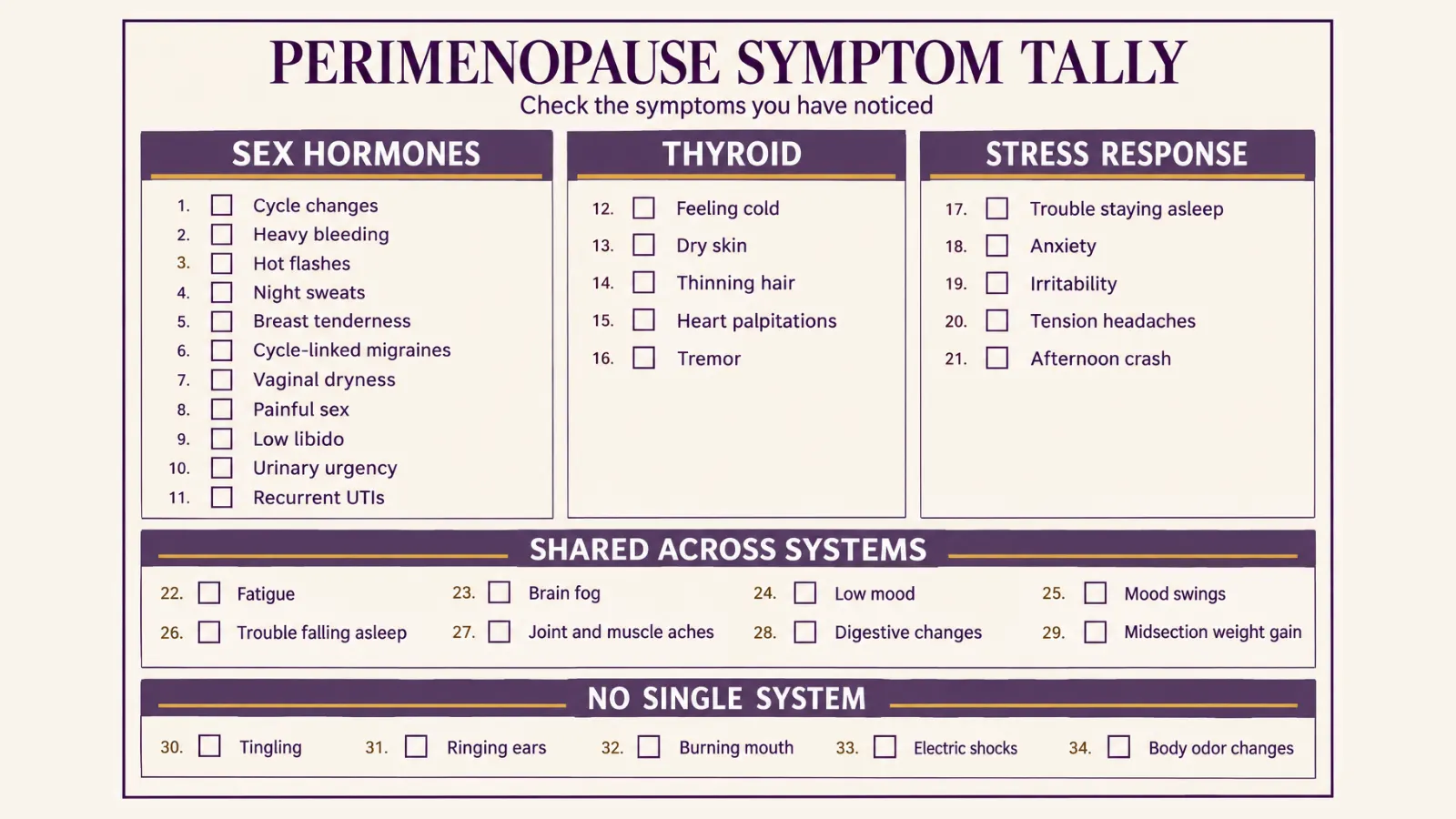
- Mark the table. Check every symptom you noticed in the last three months.
- Count by column. Add up the marks that lean toward sex hormones, thyroid and stress. Rows 22 to 29 count for all three, so they add no signal on their own.
- Note the timing. Which symptoms follow your cycle, and which run flat through the month? Add when each one started and what came before it, such as a stressful year, an illness or a stretch of poor sleep.
- Bring it. Take the marked table, three to six months of cycle dates and your prior lab results with the reference ranges printed.
The system with the most marks is where to look first, and the shared rows are the reason to look at all three. The Natural Path’s hormone quiz walks through the same sort and shows which system is loudest.
A tally organizes your notes, and only testing and history settle the cause. During the late transition, STRAW+10 notes that FSH is sometimes in the menopausal range and sometimes in the range of the earlier reproductive years, so a single draw can mislead. Our guide to what a perimenopause hormone panel shows explains how to read the numbers.
Dr. Goldstein’s framing of why normal results can still leave you unwell: “Standard labs measure diseases, not function. They’re checking to see if your engine is completely broken, not whether it’s running at 40% capacity.” Eileen, a patient, described the difference in her Google review: “it’s not just about your bloodwork.”
When a Symptom Needs Attention Sooner
Most of this page is about patterns over time. A few symptoms are different and need prompt care. Contact your physician the same day, or emergency services if severe, for:
- chest pain, fainting, or a racing heartbeat with shortness of breath
- bleeding between periods, after sex, or unusually heavy bleeding
- any bleeding after 12 months with no period
- a new lump or swelling in the neck, or trouble swallowing
- unexplained weight loss
- thoughts of harming yourself, in which case call or text 988 in the United States
Frequently Asked Questions
Are there really 34 symptoms of perimenopause?
The number is a popular compilation that no medical body publishes, and the published versions differ. A woman may have a few of them, and any symptom on this page can have a non-hormonal cause.
What are the first symptoms of perimenopause?
The staging marker is a change in cycle length variability, per STRAW+10. Hot flashes and night sweats can begin early: in SWAN, women who were premenopausal or early perimenopausal when frequent hot flashes started had the longest duration. Our complete perimenopause symptom guide covers staging and diagnosis in full.
How many of the 34 symptoms does a woman usually have?
The number varies widely. Jean Hailes for Women’s Health states that around 1 in 4 women will have no menopausal symptoms and around 1 in 4 will have severe ones, with the other half in between.
How long do perimenopause symptoms last?
For hot flashes and night sweats, the SWAN median total duration was 7.4 years. The other symptoms vary by person.
Can a thyroid problem cause the same symptoms?
Yes. A 2023 review recommends that thyroid evaluation come before diagnosing perimenopause when symptoms such as mood disturbance or irregular bleeding could be thyroid in origin. Our page on hormone imbalance symptoms in women covers when the cause may not be perimenopause at all.
Does a blood test confirm perimenopause?
Perimenopause is staged on cycle pattern, and hormone values move during the transition, so one result rarely settles it. Our article on why normal labs can still miss a struggling system explains the gap.
Where to Start
The most useful next step is seeing the three systems as one picture before anyone treats a single one.
Dr. Goldstein’s free Master Class walks through how thyroid, the stress response and sex hormones connect. If you want a one-hour, one-on-one conversation about your own pattern, the Comprehensive Wellness Evaluation is how that starts. The Natural Path sees patients in person in San Juan Capistrano, Orange County, and by video visit across California.
Watch the free Master Class, then bring your marked table to your next appointment, or book the Comprehensive Wellness Evaluation.
Written by The Natural Path clinical content team, based on the teaching of Dr. Angela Goldstein, ND.
This article is for general education and is not medical advice. It is not intended to diagnose or treat any disease, does not establish a doctor-patient relationship, and is not a substitute for care from your own clinician. Do not start, stop or change any prescribed medication based on what you read here. If you have an urgent medical concern, contact your physician or emergency services.