

Written by The Natural Path clinical content team, based on the teaching of Dr. Angela Goldstein, ND.
To choose a functional medicine doctor, verify the state license first. Then ask how they use labs, how they work with your other doctors, what the first visit and the plan include, and what they will not treat. A good practitioner answers all ten questions below plainly and without pressure. A poor fit shows up in the answers. Look for a promise in place of a plan, supplements in place of a history, or tests ordered before anyone has asked you a question. Use these questions on every practitioner you are considering, including Dr. Goldstein.
Key Takeaways
- Start with the license. California boards publish a public lookup showing whether a license is current, expired or disciplined.
- ND, MD and DO are different licenses with different training paths. None of them is a stand-in for a good fit.
- A sound practice takes your history before it orders tests and tells you why each test is being run.
- Your functional medicine doctor should work alongside your primary care physician.
- Miracle claims, one product for everything, quick fixes and pressure to stop your medications are red flags.
- A strong sign is a clinician who tells you what they do not treat.
The label “functional medicine” describes an approach and not a license, so anyone can use the phrase. What you are really vetting is the person: their license, their method and their honesty about what they can and cannot do. The ten questions below are in the order we would ask them.

How to Choose a Functional Medicine Doctor: Check the License First (Questions 1 and 2)
The first two questions confirm that the person is licensed and tell you what the letters after the name mean.
1. What is your license, and what is the number?
Ask for the license type and number, then look it up yourself. The California Department of Consumer Affairs runs a license search that, in its words, shows whether a license is current, expired or has been subject to disciplinary action such as suspension or revocation. The Medical Board of California keeps its own physician profiles and notifies users when a doctor is suspended, revoked or placed on probation. The Osteopathic Medical Board of California offers its own license verification. The California Board of Naturopathic Medicine’s consumer page points to the same DCA lookup, and to a complaint form for licensed and unlicensed practitioners alike.
A practitioner who hesitates to give you a license number has answered question 1.
2. What do the letters after your name mean, and what training sits behind them?
The letters tell you which board licenses the person, and the boards are different. WebMD notes that not all functional medicine practitioners are MDs. Some are DOs, and others hold different licenses entirely. Naturopathic doctors (NDs) are licensed in California by the Board of Naturopathic Medicine, and a licensed ND is not a physician and surgeon. That is a real difference in training and scope, and our guide to naturopathic doctor versus MD lays it out in a table so we do not repeat it here.
Be careful with that same WebMD page, which also says to look for MD or DO credentials. That is one view. The more practical rule is to know which license you are looking at and to ask what it does and does not allow.
Then ask about training that goes beyond the license. A certificate in functional medicine and a state license are separate things. The board lookup shows license status and discipline, so ask the practitioner about anything else on the wall and what it took to earn it.
Dr. Goldstein’s own path is public: nursing school and a cardiosurgical intensive care unit in Russia, four years studying naturopathic medicine, a California ND license, and 25+ years in practice. You can read more on her about page and check the license for yourself the same way you would check anyone’s.
How They Think About Testing (Questions 3, 4 and 5)
Three questions show whether a practitioner reads labs to understand you or to fill a protocol.
3. Do you take my history before you order tests?
A sound answer is yes, and the history is long. A practice that orders a standard panel for everyone before meeting you is working from a template. Dr. Goldstein’s version of this principle is that “protocols are designed for populations, not individuals.” Your biochemistry, stress patterns and history make a specific system, and the tests should come from that system.
4. What will you do with the labs I already have?
You should expect a clinician to want your previous results, including the ones you were told were normal. Normal has a specific meaning. MedlinePlus explains that reference ranges are drawn from large groups of healthy people. A result inside the range is not always a guarantee of good health, and different labs often use different ranges. So the follow-up question matters: normal compared with what, and what does the pattern across markers show?
Dr. Goldstein puts the gap this way: standard labs measure diseases, not function. They check whether your engine is completely broken, not whether it is running at 40% capacity. In her words, “Your thyroid can be normal while still being shut down by stress.” A practitioner who looks only at whether each number is in range will miss that. If this is your situation, normal labs with symptoms that persist covers what standard tests leave out.
5. For each test you suggest, what question does it answer and what will you do with the result?
This question reveals a testing philosophy faster than any other. A good answer is specific: this marker, because of that part of your history, and here is what changes in the plan depending on the result. A weak answer is a long list of tests with no stated purpose. If you cannot tell why a test is being ordered, ask before it is.
How They Work With Your Other Doctors (Question 6)
6. How will you coordinate with my primary care doctor and my specialists?
The answer should be that they will, with your permission. Functional medicine does not replace your physician. The Cleveland Clinic describes its own functional medicine program as working with, and not replacing, conventional medicine clinicians. This practice’s FAQ says its naturopathic care does not replace your primary care doctor and that it coordinates with your existing providers when appropriate.
Two details deserve a direct question. First, list every supplement and medication you take. The National Center for Complementary and Integrative Health asks patients to tell all their health care providers, conventional and complementary, about every approach they use, because supplements can interact with medicines. Second, ask what the practitioner does if a symptom needs a physician. Chest pain, sudden weakness and anything urgent belong with an emergency room or your doctor today.
Never stop or change a prescribed medication without the clinician who prescribed it.
Dr. Goldstein describes the broader problem as a system built for single, billable problems, which is why she asks what is producing the symptoms.
What the First Visit and the Plan Include (Questions 7 and 8)
7. What happens at the first visit, and how long is it?
You should hear a concrete description. At this practice the first evaluation is a full hour, in person or by video. It is built on a complete history from childhood forward, a timeline of when things changed, and a review of your medications, supplements and prior labs. Our guide to what happens at a first functional medicine appointment shows the whole hour, which is a useful yardstick when you compare other practices.
The length matters for a reason that is arithmetic. A study of primary care office visits found a median visit of 15.7 minutes covering an average of 6.5 topics. The topics after the longest one got about 1.1 minutes each (Tai-Seale, McGuire and Zhang, Health Services Research, 2007). Symptoms that span several systems cannot be read in a minute apiece. If a first visit is short, ask where the history gets taken.
8. What does a plan include, and what is my part in it?
A plan has parts you can name: what is being investigated, what is being changed, in what order, how progress is measured and when it is reviewed. Ask what you are expected to do between visits, and ask how the practice is billed and what the visit includes before you book. For how fees and insurance work in this kind of practice, see functional medicine and insurance, and ask any office to explain its own arrangements in writing.
Look at the role supplements play. Dr. Goldstein compares supplements taken without finding the root cause to scooping water out of a sinking boat. Supplements can belong in a plan. They should not be the whole plan, and a clinician who answers every question with a product is selling.
What They Will Not Do (Questions 9 and 10)
9. What do you not treat, and when do you send people elsewhere?
This is the most revealing question on the list. A trustworthy clinician has limits and names them: emergencies, conditions outside their license, a problem that needs imaging or surgery, a symptom that should be worked up by a physician first. A practitioner who treats everything is telling you something. The FDA’s consumer guidance on health fraud lists “one product does it all” as the first of its tip-offs, and a clinic that claims to handle every condition has the same shape.
Dr. Goldstein tells audiences that natural medicine fails when it treats symptoms instead of systems, and she says even natural practitioners often do it. A clinician willing to say that about her own field is worth listening to.
10. What is the evidence for what you are recommending, and how will we know if it is working?
Ask for the reasoning and then ask how progress is measured. The same NCCIH page suggests asking whether there is scientific evidence, and not just personal stories, behind the statements being made. WebMD is candid that some foundational principles of functional medicine are not yet scientifically proven, so a practitioner who claims otherwise deserves a second question. A good answer separates what is well supported from what is a clinical judgment, and it comes with a date for review.
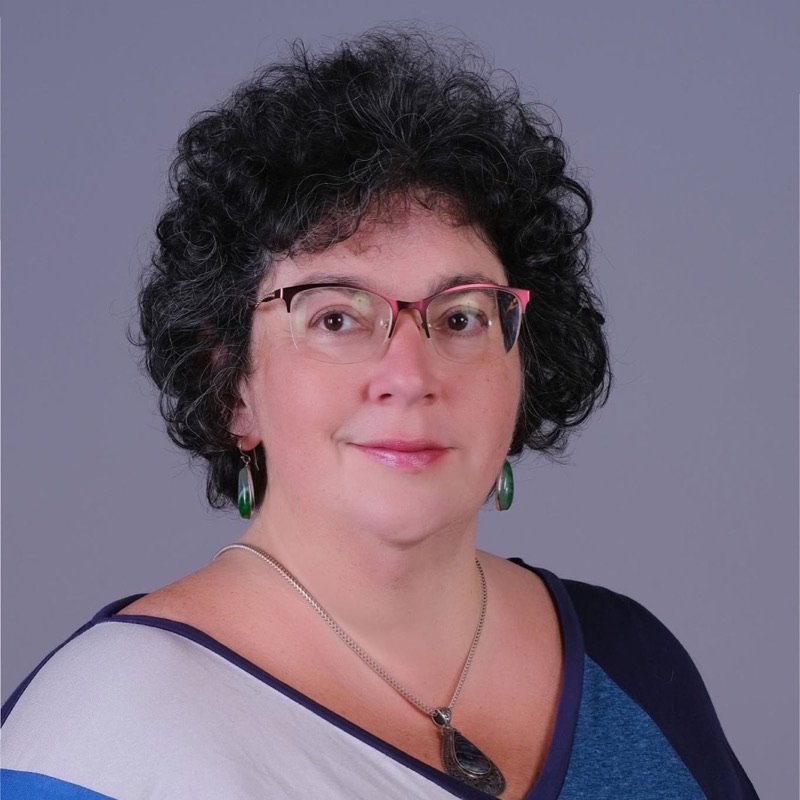
Free training from Dr. Angela Goldstein, ND
If your labs keep coming back normal and you still do not feel right, this free training shows how stress, thyroid and sex hormones pull on each other. Dr. Goldstein walks you through it.
When you watch today, you’ll learn:
- ✓Why “normal” labs can miss what is actually wrong
- ✓The three systems that break down together, and why treating one at a time rarely lasts
- ✓Why even natural approaches fall short when they treat symptoms instead of systems
- ✓Real patient stories from 25+ years of practice
Free, instant access. Start watching right now.
Educational content. Always talk with your doctor before changing any treatment.
Red Flags When Choosing a Functional Medicine Doctor
Six patterns should slow you down, and the first four come straight from the FDA’s list of health fraud tip-offs.
- Miracle or secret-breakthrough language. The FDA says miracle cures do not exist.
- One product or protocol for everything. A clinic that treats every complaint with the same product is selling it.
- Quick fixes. The FDA notes that few diseases or conditions can be treated quickly, even with legitimate products.
- Success stories in place of evidence. The FDA says personal testimonials are easy to make up and are not a substitute for scientific evidence. A patient story shows what happened to one person.
- No clinical history. If nobody asks when this started and what came before it, nobody is reading your case.
- Pressure to stop your medications or leave your doctor. A sound practice never asks you to.
One more habit to watch: the word “natural” is not a safety claim. The FDA warns that such terms do not necessarily mean a product is safe.
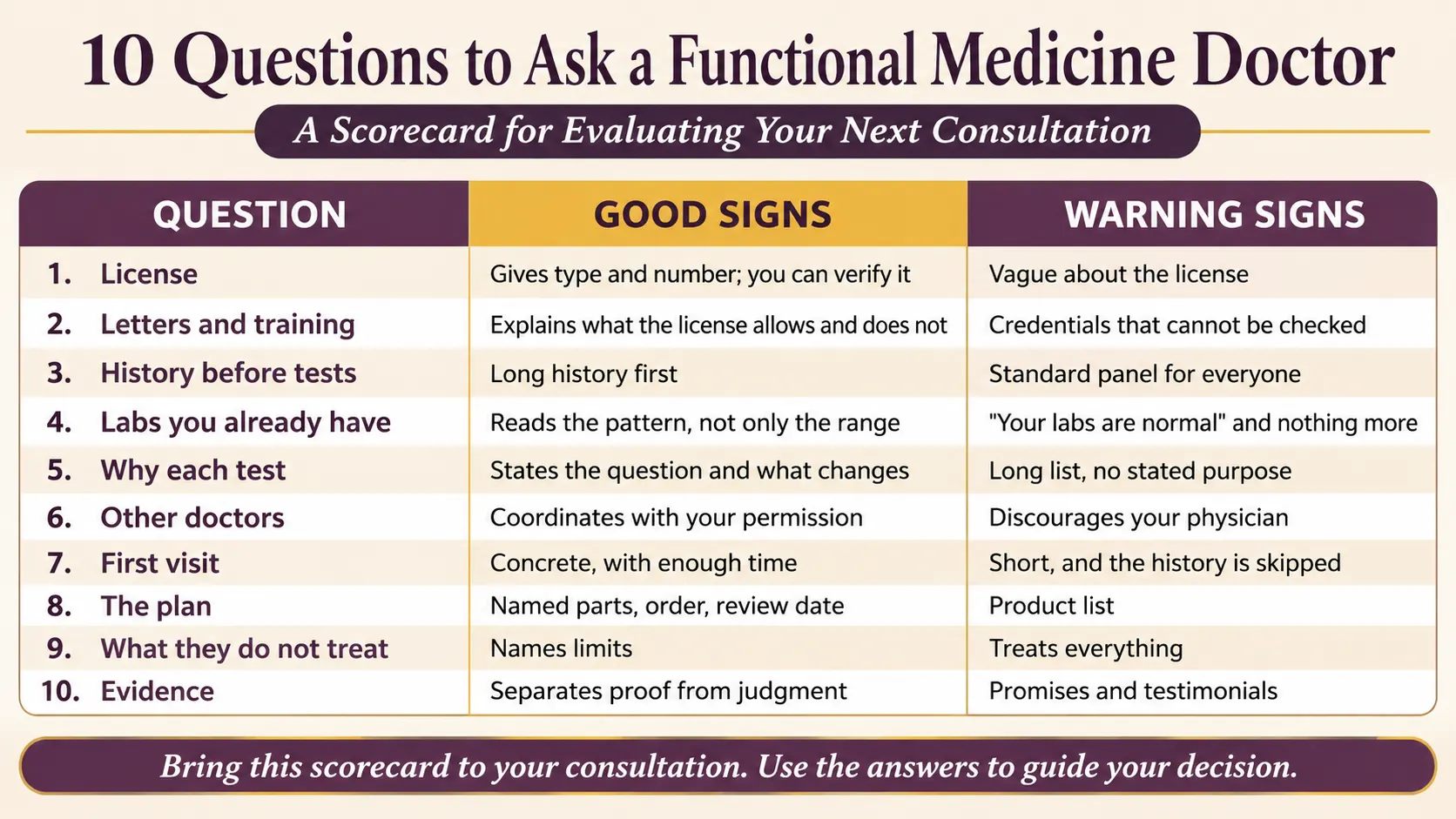
The table below turns the ten questions into a one-page scorecard you can take to any consultation.
| Question | A good sign | A warning sign |
|---|---|---|
| 1. License | Gives type and number; you can verify it | Vague about the license |
| 2. Letters and training | Explains what the license allows and does not | Credentials that cannot be checked |
| 3. History before tests | Long history first | Standard panel for everyone |
| 4. Labs you already have | Reads the pattern, not only the range | “Your labs are normal” and nothing more |
| 5. Why each test | States the question and what changes | Long list, no stated purpose |
| 6. Other doctors | Coordinates with your permission | Discourages your physician |
| 7. First visit | Concrete, with enough time | Short, and the history is skipped |
| 8. The plan | Named parts, order, review date | Product list |
| 9. What they do not treat | Names limits | Treats everything |
| 10. Evidence | Separates proof from judgment | Promises and testimonials |
Choosing a Functional Medicine Doctor in Orange County or Anywhere in California
If you live in Orange County, Dr. Goldstein sees patients in person at the San Juan Capistrano office. If you live elsewhere in California, she sees patients by secure video, and the license she holds is a California license, so her telemedicine reach is the state. According to the practice’s FAQ, consultations, lab interpretation, plan building and follow-up visits all happen by video, blood draws are arranged near you, and specialty test kits are shipped to your home. The in-office therapies require a visit to San Juan Capistrano.
Where you live changes two of the ten questions. Ask whether the clinician is licensed in your state, because a California license covers California patients. Ask what happens if you need something in person. Details are on the telemedicine page.
Questions about the practice itself go through the contact page.
Frequently Asked Questions
Does a functional medicine doctor have to be an MD?
No. WebMD notes that not all functional medicine practitioners are MDs. Some are DOs, and some hold other licenses. What matters is that the license is real, current and appropriate to what the practitioner is doing. Check it on the state lookup.
Is functional medicine a license or a specialty?
It is an approach. This is why a state license lookup tells you who someone is and a functional medicine certificate does not. Ask about both.
How do I know a functional medicine doctor is legitimate?
Verify the license, ask the ten questions and watch for the red flags. Legitimate practices answer plainly, take a history first, explain their tests and name what they do not treat.
Should I keep my primary care doctor?
Yes. Keep your physician, keep your screenings and bring your records to each visit. Tell every provider about every supplement and medication you take.
Can I ask these questions of Dr. Goldstein?
Yes, and we hope you will. The questions are built to vet anyone, and the practice would rather you choose with full information.
Where to Start
A useful next step is to hear the whole explanation before comparing anyone. Dr. Goldstein, a naturopathic doctor with 25+ years in practice, has seen 3,700+ patients. In her free Master Class she walks through the three connected systems that most often break down: thyroid, adrenals and sex hormones. She also explains why treating one of them alone can leave you slightly better and still short of well.
Watch the free Master Class, then take your ten questions to whoever you are considering.
Written by The Natural Path clinical content team, based on the teaching of Dr. Angela Goldstein, ND.
This article is for general education and is not medical advice. It is not intended to diagnose or treat any disease, does not establish a doctor-patient relationship, and is not a substitute for care from your own clinician. Licensing rules change, so confirm current status with the relevant California board. Do not start, stop or change any prescribed medication based on what you read here. If you have an urgent medical concern, contact your physician or emergency services.