
Written by The Natural Path clinical content team, based on the teaching of Dr. Angela Goldstein, ND.
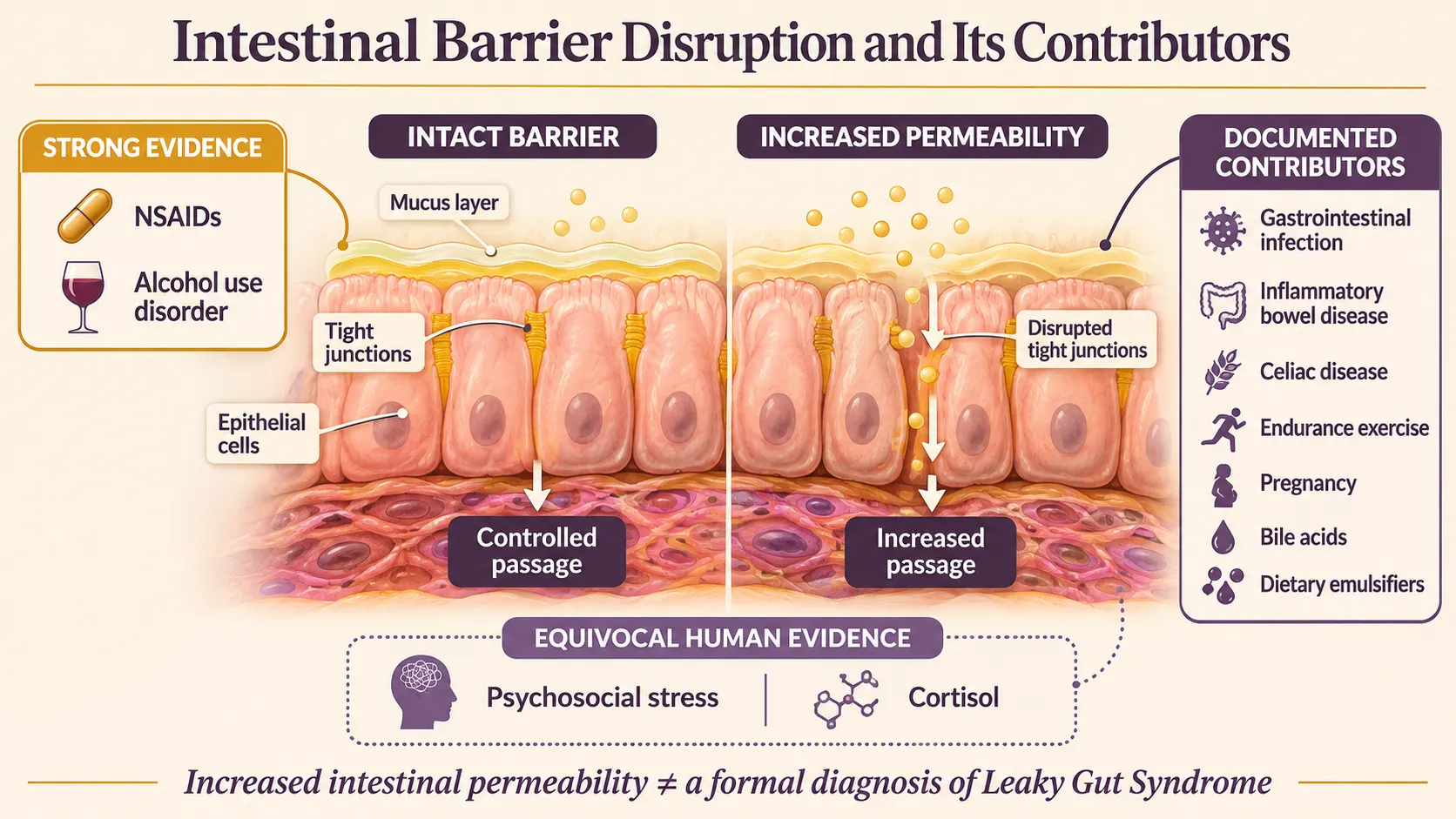
What causes leaky gut? The honest answer has two parts. Increased intestinal permeability, the measurable change behind the term, has documented contributors: NSAID use, alcohol use disorder, gastrointestinal infection, inflammatory bowel disease, celiac disease and some other medications and physical stressors. “Leaky gut syndrome” as a stand-alone diagnosis with its own single cause is something else. A Mayo Clinic review states plainly that it “is not currently accepted as a formal medical diagnosis.”
Increased intestinal permeability is a measurable change in how easily material passes between the cells lining the intestine. Leaky gut is the popular name for it.
This page sorts the contributors by how strong the evidence is, so you can see which causes are established, which are plausible and which are still being argued.
Key Takeaways
- Leaky gut is popular shorthand for increased intestinal permeability, which researchers can measure.
- The best-documented contributors are NSAIDs, alcohol use disorder, gastrointestinal infection, inflammatory bowel disease and celiac disease.
- Chronic stress and cortisol raise permeability in cell and animal studies. In humans the results are mixed.
- No validated clinical test confirms a leaky gut, and commercial zonulin tests have a specificity problem.
- Dr. Goldstein reads gut health as one system alongside stress, hormones and inflammation, and this page follows that order.
You may have arrived here after being told your gut is “leaky” by a supplement label, a social media post or a practitioner. Or after a long list of normal tests. Either way, the useful question is not whether the phrase is fashionable. It is what, in a real body, makes the gut lining more permeable, and what can be said with confidence.
What “Leaky” Means: Tight Junctions and Zonulin
The lining of your intestine is a single layer of cells. Between those cells sit tight junctions. A 2019 review in Gut by Mayo Clinic gastroenterologist Michael Camilleri names three junction types, including the tight junction (also called zonula occludens). Together they “regulates epithelial barrier function and intercellular transport.”
Permeability is how readily material passes between those cells. Some passage is normal, because the gut is meant to be selective, not sealed.
Zonulin is a protein proposed to loosen tight junctions between intestinal cells.
Zonulin is the protein most often named in leaky gut marketing. Alessio Fasano’s 2011 review in Physiological Reviews calls it “the only physiological modulator of intercellular tight junctions described so far that is involved in trafficking of macromolecules.” That is a research hypothesis in a respected journal. It is the origin of the zonulin story.
The practical problem is the commercial tests built on it. A paper in Frontiers in Endocrinology (Scheffler and colleagues, 2018) found that a widely used commercial zonulin ELISA “does not recognize pre-haptoglobin2.” It detects related proteins instead, with properdin the most likely candidate. A 2026 systematic review of zonulin in irritable bowel syndrome (Marginean and colleagues, Biomedicines) reached a similar verdict. The commercial-kit literature “cannot determine whether pre-HP2/zonulin is altered in IBS.”
So a zonulin number is not a reliable measure of how leaky anyone’s gut is. Camilleri makes the broader point: “there are no validated clinical diagnostic tests.”
For the symptom side of the question, including what people report and what to rule out, see our page on leaky gut symptoms. This page stays on causes.
What Causes Leaky Gut: The Contributors, Ranked by Evidence
| Contributor | Strength of evidence | What the sources say |
|---|---|---|
| NSAIDs | Strong | Ulceration from NSAIDs causes structural damage to the epithelium, and NSAID administration increases permeability (Camilleri 2019) |
| Alcohol | Strong in people with alcohol use disorder | A subset of people with alcohol use disorder have increased permeability (Bishehsari 2017) |
| Gastrointestinal infection, inflammatory bowel disease, celiac disease | Documented; infection and medications are called relevant “in some patients” | Barrier dysfunction is well described in these conditions (Camilleri 2019; Lacy 2024) |
| Endurance exercise, pregnancy, bile acids, dietary emulsifiers | Documented | Listed as “stress” states that increase permeability (Camilleri 2019) |
| Psychosocial stress and cortisol | Mechanism shown in cells and animals, equivocal in humans | La Torre 2023 |
| A single “leaky gut syndrome” cause | Not established | Not accepted as a formal diagnosis (Lacy 2024) |

Free training from Dr. Angela Goldstein, ND
If your labs keep coming back normal and you still do not feel right, this free training shows how stress, thyroid and sex hormones pull on each other. Dr. Goldstein walks you through it.
When you watch today, you’ll learn:
- ✓Why “normal” labs can miss what is actually wrong
- ✓The three systems that break down together, and why treating one at a time rarely lasts
- ✓Why even natural approaches fall short when they treat symptoms instead of systems
- ✓Real patient stories from 25+ years of practice
Free, instant access. Start watching right now.
Educational content. Always talk with your doctor before changing any treatment.
NSAIDs: The Clearest Example
Of everything on the list, anti-inflammatory pain relievers have the most direct evidence. Camilleri writes that there is “no controversy regarding barrier dysfunction” in diseases causing intestinal inflammation and damage. The same holds for “ulceration from nonsteroidal anti-inflammatory drugs (NSAIDs) resulting in structural abnormalities of the epithelium.”
Regular use is a real, documented variable. Keep taking what a clinician prescribed and bring the full medication list to your visit, since several medications are named in the literature as relevant in some patients.
Alcohol
A review in Alcohol Research: Current Reviews (Bishehsari and colleagues, 2017) states that alcohol “disrupts the intestinal barrier, increasing its permeability,” by damaging cells directly and by acting on the junctions between them. In humans, the review reports that “a subset of people with alcohol use disorder (AUD) in fact have increased intestinal permeability.”
The wording matters. The evidence is for people with alcohol use disorder, a subset of them. It does not show that a glass of wine with dinner makes a gut leaky.
Infection, Inflammatory Disease and Medications
The Mayo Clinic review by Brian Lacy and colleagues (Gastroenterology & Hepatology, 2024) calls the cause of leaky gut syndrome multifactorial. It adds that “a preceding gastrointestinal infection, inflammatory bowel disease, and certain medications may be relevant factors in some patients.”
Camilleri adds that abnormal barrier function is well described in inflammatory bowel disease, celiac disease and gluten sensitivity without overt celiac disease in people with the HLA-DQ2/8 genotype, and with enteric infections. These are conditions with their own tests and treatments, which is why they come before any leaky gut label.
Diet, Exercise and Other Physical Stressors
Camilleri’s review groups endurance exercise, NSAIDs, pregnancy and “surfactants (such as bile acids and dietary factors such as emulsifiers)” as states that increase permeability. He explains that dietary emulsifiers “may compromise the ability of human mucus to prevent contact between microorganisms and intestinal epithelial cells.”
Two cautions follow. First, these are documented effects on permeability, and the same review says it is unclear how such changes lead to clinical consequences. Second, the review does not support a food list. It says information on “healthy” or “leaky” gut in the public domain requires confirmation before endorsing dietary exclusions or supplements.
Chronic Stress and Cortisol: Plausible, With a Real Gap in the Human Data
This is the contributor Dr. Goldstein’s teaching emphasizes, so it deserves the most careful reading.
In the Master Class, Dr. Goldstein describes the chain this way: “when you’re under chronic stress, your adrenal pumps out cortisol constantly. High cortisol tells your thyroid to slow down because your body thinks there’s a famine.” Asked what drives inflammation, she answers: “Could be stress, poor diet, toxins, gut dysfunction, hormonal imbalances.” Her point is that those items feed one another. A symptom in the gut can start somewhere else in the system.
The permeability research agrees with part of that and holds back on the rest. A 2023 narrative review in Neurobiology of Stress (La Torre and colleagues) reports that “in vitro and animal studies strongly suggest that psychosocial stress is one of the factors that can increase intestinal permeability.” The review then adds that “evidence from experimental studies in humans is limited and the results are equivocal.”
Some human findings point in the expected direction. In one study the review describes, permeability rose after acute psychosocial stress only in subjects whose stress-induced cortisol exceeded the 90th percentile. High-intensity military combat training, which combines psychological and physical stress, increased colon permeability in male soldiers. A skydiving study found no significant effect on gastroduodenal, small intestinal or colonic permeability even though cortisol rose.
So the accurate statement is this. Stress is a plausible contributor, the mechanism has been shown in cells and animals, and in people it appears to depend on how intense the stress is and how the body responds to it. That is a reason to take your stress load seriously as part of a workup.
Dr. Goldstein’s reason for caring is wider than the gut. In her teaching, the same stress response that keeps cortisol high is the one that slows the thyroid and disturbs the sex hormones, so a gut complaint is one possible place the load shows up. Our article on cortisol and thyroid walks through that sequence.
Why One Cause Rarely Explains One Person
A single contributor on the table above seldom accounts for a person’s whole picture. A woman in her forties may have taken NSAIDs for years, been under months of strain and had a stomach infection once. All of those sit in the literature as relevant, and no permeability test can sort them out. Dr. Goldstein’s teaching on this is direct: “most practitioners, even natural ones, treat symptoms, not systems.” Her example is the gut healing protocol. Her reason is that “protocols are designed for populations, not individuals.”
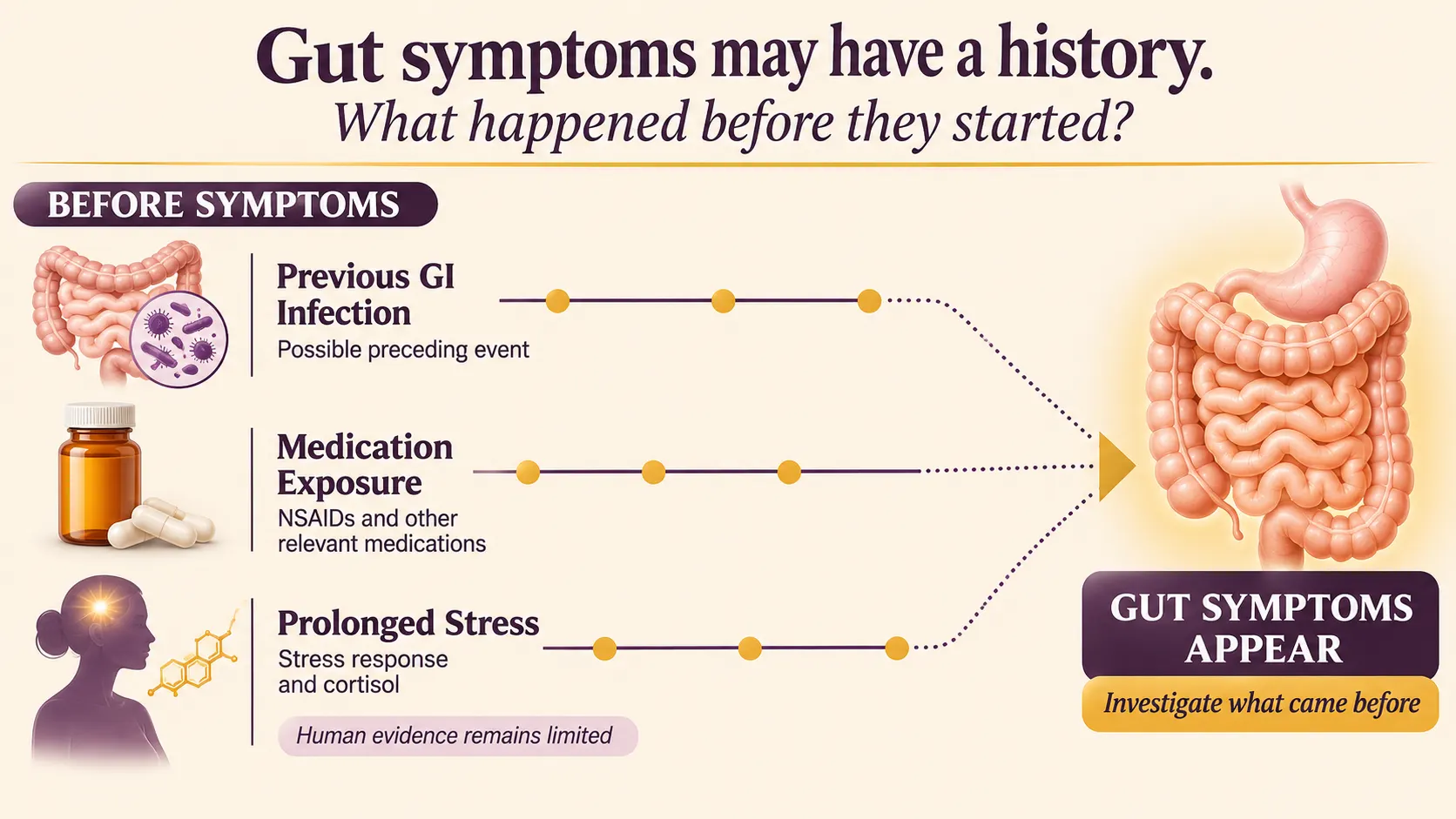
Her questions follow from that: when did it start, and what came before it? An infection, a course of medication, a stretch of heavy stress, a change in hormones. The timeline often points to the contributor better than a zonulin result can.
On lab testing in general, she says: “Standard labs measure diseases, not function.” The same gap applies here. A normal routine panel does not rule out a functional problem in the gut, and no single permeability result confirms one. This is the reasoning behind functional lab testing used as one input next to a full history of your leaky gut concerns.
What Is Not Established
- That leaky gut syndrome is a diagnosis on its own. The Mayo review says it is not currently accepted as one.
- That increased permeability causes fatigue, brain fog, allergies or other whole-body complaints. Camilleri calls altered permeability possibly “an epiphenomenon,” a finding that travels with a problem without driving it, and notes that increased permeability “is not necessarily deleterious.”
- That restoring barrier function changes the course of disease. Camilleri states there is “no convincing evidence” that it does in humans.
- That a blood or stool test can confirm it.
These limits point the work toward the contributors that can be identified and addressed one at a time: medications, alcohol, infection history, celiac disease and inflammatory bowel disease, and the stress load. If your concern is autoimmune disease specifically, our page on what causes autoimmune disease covers that question separately.
Seeing a Clinician About This in Orange County and Across California
The Natural Path sees patients in person at the San Juan Capistrano office and by video visit anywhere in California. For gut and digestive concerns, the clinical team reads the gut alongside hormones, thyroid and stress instead of treating it in isolation. Dr. Goldstein has 25+ years in practice, which informs how the team sequences a workup.
Our gut and digestive health page explains the approach in detail.
If you live outside Orange County, the telemedicine page covers how video visits work across California.
The contact page has the office details.
Frequently Asked Questions
Can stress cause leaky gut?
Stress increases intestinal permeability in cell and animal studies. In humans the evidence is limited and mixed, and it appears to depend on how intense the stress is. Stress is a reasonable factor to examine, and the research stops short of calling it a proven cause.
Is leaky gut a real diagnosis?
Increased intestinal permeability is a real, measurable finding. “Leaky gut syndrome” is not currently accepted as a formal medical diagnosis, according to a 2024 Mayo Clinic review.
Is there a test for leaky gut?
No validated clinical test exists, per Camilleri’s 2019 review. Commercial zonulin tests have a documented specificity problem, so a result should not be read as confirming or ruling out a leaky gut.
Where This Leaves You
The most useful reading of the evidence: permeability is real, a handful of contributors are well documented, and stress is plausible but unsettled in humans. Dr. Goldstein’s approach is to look at the whole system, find what came first and treat what is producing the symptom.
If you want to hear that approach from her directly, the free Master Class is the place to start: watch the free Master Class.
Written by The Natural Path clinical content team, based on the teaching of Dr. Angela Goldstein, ND.
This article is for general education and is not medical advice. It is not intended to diagnose or treat any disease, does not establish a doctor-patient relationship, and is not a substitute for care from your own clinician. Do not start, stop or change any prescribed medication based on what you read here. If you have an urgent medical concern, contact your physician or emergency services.
Sources
- Camilleri M. The leaky gut: mechanisms, measurement and clinical implications in humans. Gut. 2019. https://pmc.ncbi.nlm.nih.gov/articles/PMC6790068/
- Lacy BE, Wise JL, Cangemi DJ. Leaky gut syndrome: myths and management. Gastroenterol Hepatol (N Y). 2024;20(5):264-272. https://pmc.ncbi.nlm.nih.gov/articles/PMC11345991/
- Bishehsari F, et al. Alcohol and gut-derived inflammation. Alcohol Res. 2017;38(2):163-171. https://pmc.ncbi.nlm.nih.gov/articles/PMC5513683/
- La Torre D, et al. Psychosocial stress-induced intestinal permeability in healthy humans: what is the evidence? Neurobiol Stress. 2023;27:100579. https://pmc.ncbi.nlm.nih.gov/articles/PMC10569989/
- Fasano A. Zonulin and its regulation of intestinal barrier function. Physiol Rev. 2011;91:151-175. https://pubmed.ncbi.nlm.nih.gov/21248165/
- Scheffler L, et al. Widely used commercial ELISA does not detect precursor of haptoglobin2. Front Endocrinol. 2018;9:22. https://pubmed.ncbi.nlm.nih.gov/29459849/
- Marginean IC, et al. Circulating zonulin in irritable bowel syndrome: a systematic review. Biomedicines. 2026;14. https://pubmed.ncbi.nlm.nih.gov/42940160/