

Written by The Natural Path clinical content team, medically reviewed by Dr. Angela Goldstein, ND. Last reviewed: 2026-09-27.
Hormone imbalance symptoms in women most often include fatigue, weight change, irregular or heavy periods, poor sleep, acne or hair changes, low libido, brain fog and mood shifts. Each symptom tends to point toward one of four hormone systems: thyroid hormones, stress hormones such as cortisol, sex hormones (estrogen, progesterone and testosterone) and blood-sugar hormones such as insulin. Dr. Angela Goldstein, ND, compares them to instruments in an orchestra: when one is out of tune, the whole piece sounds wrong. The catch is overlap. Fatigue, weight gain and sleep trouble can come from any of the four, and the systems push on each other. A symptom list can suggest where to look. Only testing, read together with your history, shows which system is actually off.
Key Takeaways
- Most hormone imbalance symptoms in women trace to four systems: thyroid, stress, sex and blood-sugar hormones.
- A few symptoms lean one way, such as feeling cold (thyroid) or acne with excess facial hair (androgens).
- Fatigue, weight gain, poor sleep and low mood overlap across all four.
- Insulin resistance usually has no symptoms and is rarely tested directly.
- Standard labs are built to detect disease thresholds, so results can read normal while you feel unwell.
- A useful evaluation reads the systems together, alongside your history.
If you have been told “it’s just stress,” “it’s just aging” or “it’s all in your head,” and you still do not feel like yourself, your symptoms deserve a real explanation. Many women arrive at The Natural Path “after seeing doctors for years that never changed anything,” as one patient put it. The map below is where that explanation starts.
Why One Out-of-Tune Instrument Changes the Whole Sound
A hormone imbalance means one hormone system is producing, sending or receiving its signal poorly, and the other systems react to that change.
A hormone imbalance is a state in which one or more hormones are too high, too low or poorly received by the cells they are meant to reach, enough to change how the body functions.
Dr. Goldstein describes the endocrine system as an orchestra. “You have thyroid hormones, sex hormones, stress hormones, blood sugar hormones, and dozens more,” she explains. “When they’re all playing together in harmony, you feel great.” That model shapes hormone care at The Natural Path.
The signal travels a chain from brain to gland to cell. When that chain breaks down, she compares it to the game of telephone: a clear message leaves the brain and arrives garbled. Environmental chemicals can make it worse by acting like “someone jamming the wrong key in your lock, so the right key can’t get in.”
Thyroid disorders alone affect nearly 14% of adult women, according to a 2023 review in the International Journal of Molecular Sciences.
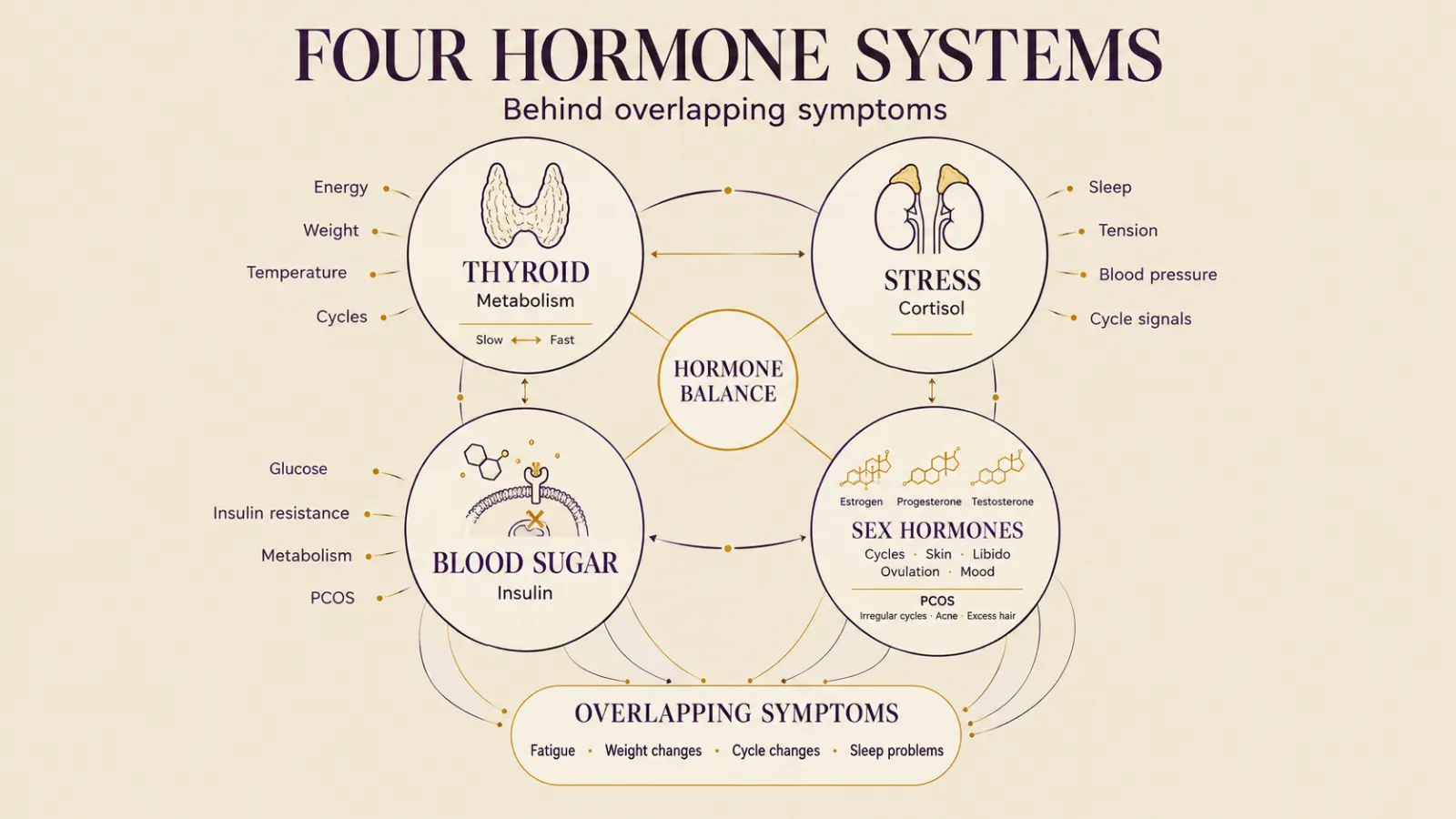
Hormone Imbalance Symptoms in Women, Mapped to Four Systems
Each common symptom leans toward one system, and most also appear with at least one more.
| Symptom | Most often points to | Also shows up with |
|---|---|---|
| Fatigue | Thyroid (low) | Stress hormones, sex hormones, blood sugar |
| Weight gain or trouble losing weight | Thyroid (low), PCOS | Stress hormones, insulin resistance |
| Weight loss with a bigger appetite | Thyroid (high) | High blood sugar (diabetes can cause strong hunger); get checked promptly |
| Feeling cold when others are comfortable | Thyroid (low) | Other, non-hormonal causes |
| Sweating, heat intolerance, racing heart, shaky hands | Thyroid (high) | Stress hormones |
| Irregular, missed or heavy periods | Sex hormones, PCOS | Thyroid (low or high) |
| Acne on the face, chest or back; excess facial hair; scalp thinning | Androgens (PCOS) | Thyroid (low) for dry, thinning hair |
| Dark, velvety patches of skin | Insulin resistance | PCOS |
| Poor sleep | Stress hormones, thyroid (high) | Sex hormones |
| Headaches, tension, body pain | Stress hormones | Sex hormones (cycle-linked) |
| Joint and muscle pain | Thyroid (low) | Inflammation from several sources |
| Low mood, irritability, nervousness | Thyroid (low or high) | Stress hormones, sex hormones |
Sources: NIDDK (thyroid, diabetes, insulin resistance), Office on Women’s Health and NICHD (PCOS), NIMH (stress).
Only two rows point cleanly in one direction. That overlap is why a checklist can open the question and only testing closes it.
Thyroid Hormones: The Pace-Setter
Thyroid hormones set the pace of your metabolism, so a thyroid running slow or fast changes energy, weight, temperature and cycles at the same time.
According to the NIH’s diabetes and digestive institute, common symptoms of an underactive thyroid include:
- fatigue and weight gain
- trouble tolerating cold
- joint and muscle pain
- dry skin or dry, thinning hair
- heavy or irregular periods, or fertility problems
- depression
An overactive thyroid tends to run the other way: weight loss even with a bigger appetite, a rapid heartbeat, nervousness, trouble sleeping and heat intolerance. Women are much more likely than men to develop hypothyroidism, and clinicians usually check TSH first. If you are in your 40s and wondering whether it is your thyroid or perimenopause, that comparison has its own guide.
Stress Hormones: The Alarm That Stays On
Stress hormones such as cortisol are built for short emergencies, and when the alarm stays on for months, the effects spread into sleep, the thyroid and the cycle.
The National Institute of Mental Health lists headaches or body pain, tension, high blood pressure and loss of sleep among the ways stress shows up in the body.
Dr. Goldstein’s explanation runs in two steps. “High cortisol tells your thyroid to slow down because your body thinks there’s a famine.” Then, “your thyroid slowing down disrupts your sex hormones because your body thinks it’s not safe to reproduce.” Research supports a direct route too: glucocorticoids such as cortisol inhibit the release of GnRH, the brain signal at the top of the reproductive axis. The full physiology of how cortisol and thyroid hormones interact is covered separately.
Sex Hormones: Estrogen, Progesterone and Testosterone
Sex hormone shifts show up most clearly in the cycle, the skin and libido, at any adult age.
One of the most common causes in younger women is polycystic ovary syndrome.
PCOS (polycystic ovary syndrome) is a hormone condition in which higher androgen levels can stop regular ovulation, causing irregular periods, acne and excess hair.
Between 5% and 10% of women aged 15 to 44 have PCOS, according to the federal Office on Women’s Health. Its signs include:
- missed or irregular periods
- acne on the face, chest and upper back
- excess hair on the face or body
- thinning hair on the scalp
- weight gain or difficulty losing weight
Low libido and cycle-linked mood changes belong here too, as do hot flashes, most often during the menopausal transition. Women in their 40s can find perimenopause symptoms by body system in a dedicated guide.
Blood-Sugar Hormones: The Instrument You Cannot Hear
Insulin can drift out of tune silently, because early insulin resistance rarely produces noticeable symptoms.
Insulin resistance is a state in which cells in the muscles, fat and liver respond poorly to insulin, so the body must produce more of it to keep blood sugar in range.
The NIDDK states it plainly: people with insulin resistance and prediabetes usually have no symptoms. About 97.6 million US adults had prediabetes in 2021. The same page notes that clinicians may not test for insulin resistance at all, because the direct test is used mainly in research.
One visible trace can be thickened, dark, velvety skin, which the NICHD links to insulin resistance. It also sits close to the sex hormones: many women with PCOS have insulin resistance.
Why this matters: a routine screen looks for prediabetes, the disease threshold, rather than rising insulin itself.

Free 3-minute quiz from Dr. Angela Goldstein, ND
Stress, thyroid and sex hormones work as one system. Answer 22 quick questions and see which one is under the most strain for you.
What you’ll get:
- ✓A score for each system: stress, thyroid and sex hormones
- ✓Which pattern your answers fit, and how the systems pull on each other
- ✓Built on published research
- ✓A clear next step for your pattern
Free. 22 questions, about 3 minutes.
Educational content. Always talk with your doctor before changing any treatment.
When the Symptom Is Mood
Low mood, anxiety and irritability can come from any of the four instruments, which is why mood alone cannot point to a single hormone.
The NIDDK lists depression among the symptoms of an underactive thyroid and nervousness and irritability among the symptoms of an overactive one. Stress hormones and cycle shifts add their own swings. If mood is the loudest symptom you have, our article on hormone imbalance behind depression and anxiety covers that side in depth.
Why Hormone Imbalance Symptoms in Women Rarely Come Alone
Hormone imbalance symptoms in women tend to arrive in clusters because the systems feed each other, so a problem in one instrument often pulls a second or third out of tune.
Across 25+ years of practice, Dr. Goldstein has seen the same pattern:
“I found three systems break down most often. Thyroid, adrenals, and sex hormones. And here’s the key. These three systems are interconnected. You cannot fix one without addressing the others.”
Dr. Angela Goldstein, ND
In her model, the pattern usually builds in layers:
- One system shifts. Chronic stress, a thyroid change or a cycle change starts it.
- The others adjust. Each system reads the others’ signals and responds.
- Amplifiers join in. Nutritional gaps, environmental chemicals and inflammation add noise. “Everything feeds into everything else,” she says.
- Symptoms spread into what looks like several unrelated problems.
Sometimes the symptom does not look hormonal at all. Tricia came to Dr. Goldstein with painful knees and red, itchy eyes. The driver turned out to be a hormonal imbalance plus a nutritional deficiency, together fueling inflammation, and both symptoms settled once those were addressed.
Individual results vary. This account reflects one patient’s experience and is not a guarantee of any outcome.
What Blood Tests Are Built to Find
Blood tests are the main tool for sorting out hormone imbalance symptoms, and their value depends on which markers are ordered and how they are read together.
“Standard labs measure diseases, not function. They’re checking to see if your engine is completely broken, not whether it’s running at 40% capacity.”
Reference ranges are designed to catch disease. In her words, “your hormones can be in range while being completely out of balance as a system.” One test is often not enough, and timing matters for hormones that move across the day or the cycle.
Time is the other limit. Primary care visits run a median of 15.7 minutes, with roughly 1.1 minutes for each topic after the main one. Four interacting systems need more room than that. As one Natural Path patient put it, “it’s not just about your bloodwork.” If your results keep coming back clean, here is why normal labs can still miss a struggling system.

When to See a Doctor Promptly
Some overlapping symptoms need same-day care. Contact your physician or emergency services for:
- a racing or irregular heartbeat, chest pain or fainting
- sudden, very heavy bleeding, or any bleeding after menopause
- unexplained weight loss, or a new swelling or lump in the neck
- severe weakness, confusion or vomiting
- thoughts of harming yourself (call or text 988 in the US)
Frequently Asked Questions
What are the first signs of hormonal imbalance in a woman?
Cycle changes, new fatigue, poorer sleep and unexplained weight change are often first. Track when they happen relative to your cycle and bring the notes to your appointment.
Can a blood test detect a hormone imbalance?
Yes. Blood tests are most useful when the right markers are ordered, timed correctly and read with your history.
Can hormone imbalance cause weight gain?
It can, and often through more than one system, so a normal thyroid panel does not rule out insulin resistance or sustained stress as the driver.
Can a hormone imbalance happen in your 20s or 30s?
Yes. PCOS affects an estimated 5% to 10% of women aged 15 to 44, and thyroid disorders and stress-related changes can begin at any adult age.
How do I know which hormone is off?
Testing confirms it. TSH is usually the first thyroid test; a fuller read adds sex hormones, cortisol and blood-sugar markers, timed to your cycle where relevant.
Should I start supplements or hormones on my own?
No. Self-treating one hormone can mask another problem, and because the systems interact, it can shift the others too. Keep any prescribed medications as directed and make changes only with the clinician who prescribed them.
Where to Start
The most useful next step is understanding all four instruments before anyone treats one of them.
Dr. Goldstein’s free Master Class walks through the connected hormone systems. The Natural Path sees patients in person in San Juan Capistrano, Orange County, and by telemedicine across California. For women who want their full picture read, a one-hour evaluation with Dr. Goldstein is the next step after that.
Watch the free Master Class, and bring the questions it raises to your next appointment.
Written by The Natural Path clinical content team, medically reviewed by Dr. Angela Goldstein, ND. Last reviewed: 2026-09-27.
This article is for general education and is not medical advice. It is not intended to diagnose or treat any disease, does not establish a doctor-patient relationship, and is not a substitute for care from your own clinician. Do not start, stop or change any prescribed medication based on what you read here. If you have an urgent medical concern, contact your physician or emergency services.