

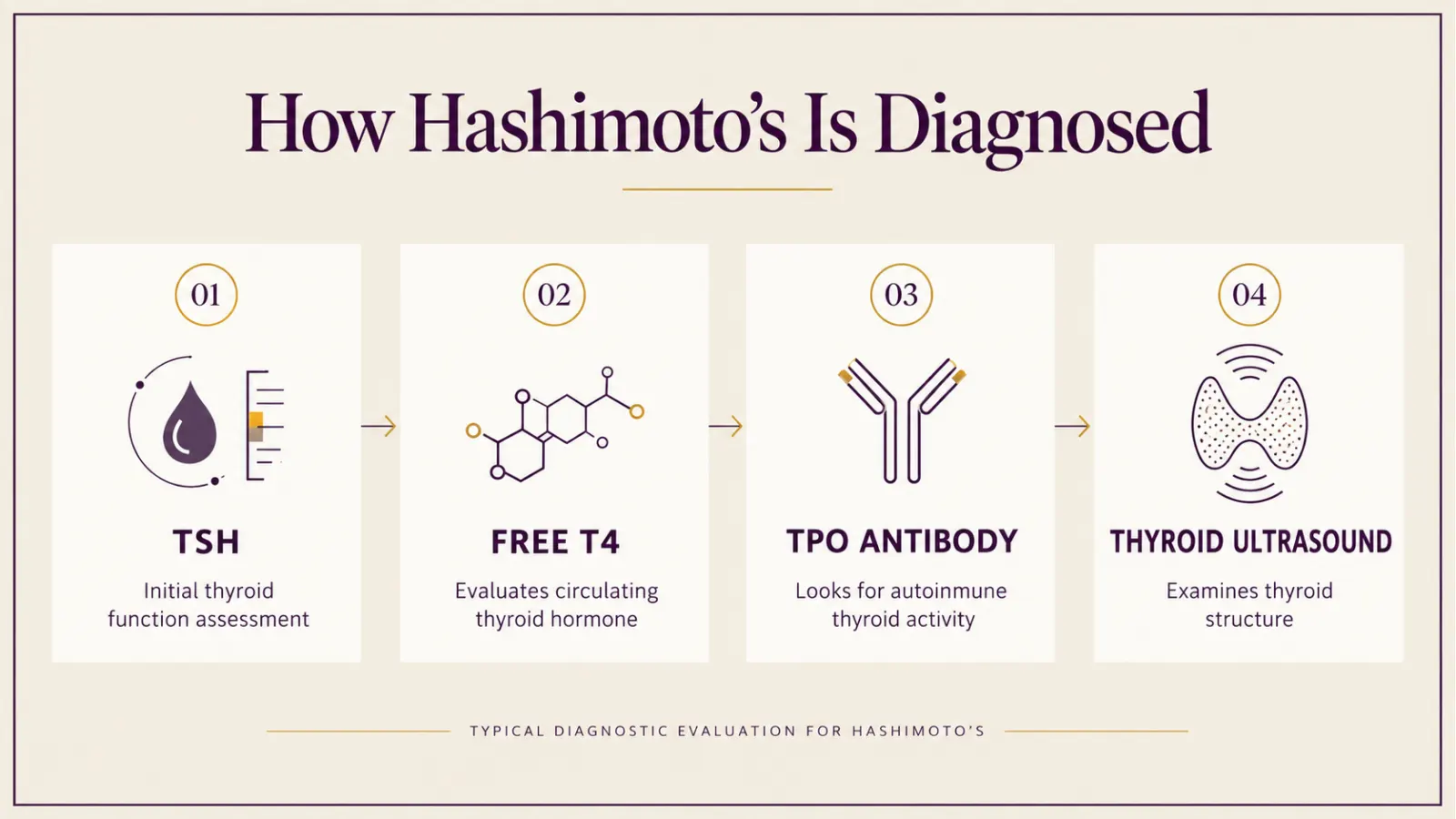
Hashimoto’s is diagnosed with blood tests read alongside your symptoms and a neck exam. A TSH test usually comes first, with free T4 to show whether thyroid hormone output has dropped. Thyroid peroxidase (TPO) antibodies, found in over 90% of people with Hashimoto’s, identify an immune attack on the thyroid as the cause. When Hashimoto’s is suspected but antibodies are negative, a thyroid ultrasound can show its features. Antibodies can also be present while TSH and free T4 are still normal, and the American Thyroid Association says the diagnosis can be made in that situation even without symptoms. Because antibody tests are usually ordered after hormone tests look abnormal, someone with a normal TSH may never have had them checked.
Key Takeaways
- A TSH blood test is usually the first thyroid test ordered, followed by free T4.
- TPO antibodies are found in over 90% of people with Hashimoto’s and point to the immune system as the cause.
- Hashimoto’s can be diagnosed while thyroid hormone levels are still normal, if antibodies are elevated.
- Antibody tests usually follow an abnormal hormone result, so a normal TSH can mean antibodies were never measured.
- A thyroid ultrasound is used mainly when Hashimoto’s is suspected and antibodies come back negative.
If you have been told your thyroid is fine and you still feel that something is off, start with one practical question. Which thyroid tests were run? A Hashimoto’s diagnosis rests on more than one number, which is also why thyroid and Hashimoto’s care at The Natural Path begins with the full set of results.
Contents: Four parts of a diagnosis · TSH · TPO antibodies · Why antibodies come second · Normal TSH · Ultrasound · Dr. Goldstein’s view · What to bring · FAQ
The Four Parts of a Hashimoto’s Diagnosis
A Hashimoto’s diagnosis combines four pieces of information: your history, a physical exam, blood tests, and sometimes imaging.
Hashimoto’s disease is an autoimmune condition in which the immune system makes antibodies that attack the thyroid gland. It is the most common cause of hypothyroidism in the United States.
According to the National Institute of Diabetes and Digestive and Kidney Diseases (NIDDK), the process usually runs in this order:
- Medical history. Your doctor asks about symptoms and family history. Hashimoto’s is 4 to 10 times more common in women than men and most often develops in women ages 30 to 50.
- Physical exam. The neck is checked for a goiter, an enlarged thyroid that some people with Hashimoto’s develop.
- Blood tests. These include TSH, the thyroid hormones T4 and T3, and TPO antibodies.
- Ultrasound, if needed. NIDDK notes most people will not need other tests to confirm Hashimoto’s.
How Is Hashimoto’s Diagnosed With a TSH Test?
TSH is the first thyroid blood test in most workups, and a high TSH is usually the first sign that the thyroid is underperforming.
TSH (thyroid-stimulating hormone) is a hormone made by the pituitary gland in the brain. It tells the thyroid how much T4 and T3 to produce.
NIDDK’s guide to thyroid tests states that health care professionals usually check TSH first. When the thyroid slows down, the pituitary pushes harder, so TSH rises. A free T4 test then shows whether hormone output has fallen.
StatPearls, a peer-reviewed clinical reference hosted by the National Library of Medicine, describes two stages:
- Subclinical hypothyroidism: TSH is elevated, usually below 10 mIU/L, while T4 and T3 remain normal.
- Overt hypothyroidism: symptoms appear alongside a TSH above 10 mIU/L or a low T4.
Reference ranges for TSH vary by laboratory. A TSH inside its range answers one question well: whether hypothyroidism is present at that moment. It does not identify the cause. That gap is part of why normal labs and real symptoms often arrive together.
TPO Antibodies: The Test That Identifies the Cause
Thyroid antibody tests show whether the immune system is attacking the thyroid, which is what separates Hashimoto’s from other causes of an underactive thyroid.
Thyroid peroxidase (TPO) antibodies are proteins the immune system makes against thyroid peroxidase, an enzyme the thyroid uses to produce hormone. Thyroglobulin (Tg) antibodies target thyroglobulin, the protein the thyroid stores hormone in.
| Antibody finding | Published figure | Source |
|---|---|---|
| TPO antibodies in people with Hashimoto’s | over 90% | StatPearls |
| Thyroglobulin antibodies in people with Hashimoto’s | 50% to 80% | StatPearls |
| US population with thyroid antibody positivity | approximately 10% | StatPearls |
According to MedlinePlus, a positive TPO or Tg antibody test may mean Hashimoto’s disease. A negative result means thyroid symptoms are probably not caused by an autoimmune disease.
Why Antibody Tests Often Come Second
Antibody testing usually follows an abnormal hormone result, so a person whose TSH looks normal may never have had antibodies measured.
MedlinePlus describes the typical sequence plainly. A provider will first order blood tests of thyroid hormone levels. If those show the thyroid is not working properly, the provider may then order antibody tests. The American Thyroid Association (ATA) lists elevated antibodies as a diagnostic finding with a telling qualifier: “if measured.”
The sequence works well for screening large numbers of people. For one person with persistent symptoms and a normal TSH, it can leave the cause unexamined.
Time matters too. A Health Services Research study found the median primary care visit lasted 15.7 minutes, with about 1.1 minutes for each topic after the main concern. Physicians want to help, yet a thyroid question with several symptoms rarely fits inside that window.

Free 3-minute quiz from Dr. Angela Goldstein, ND
Stress, thyroid and sex hormones work as one system. Answer 22 quick questions and see which one is under the most strain for you.
What you’ll get:
- ✓A score for each system: stress, thyroid and sex hormones
- ✓Which pattern your answers fit, and how the systems pull on each other
- ✓Built on published research
- ✓A clear next step for your pattern
Free. 22 questions, about 3 minutes.
Educational content. Always talk with your doctor before changing any treatment.
Hashimoto’s With a Normal TSH: What Your Results Mean
Hashimoto’s can be diagnosed while TSH and free T4 are still normal, when thyroid antibodies are elevated.
The ATA states that Hashimoto’s thyroiditis can be diagnosed even without symptoms, when antibody levels are high and thyroid hormone levels are normal. StatPearls adds that most people with Hashimoto’s have normal thyroid function tests, and about 20% to 30% go on to develop hypothyroidism.
The table below maps common result combinations to what these sources say. Use it as a reading guide for a conversation with your clinician.
| TSH | Free T4 | Antibodies | What published guidance says |
|---|---|---|---|
| Normal | Normal | Elevated | Hashimoto’s can be diagnosed with normal hormone levels. The ATA says thyroid hormone treatment is not required, and TSH should be monitored over time. |
| Elevated (usually under 10) | Normal | Elevated | Subclinical hypothyroidism with an autoimmune cause. StatPearls notes antibody-positive people have a high probability of progressing to overt hypothyroidism. |
| Elevated | Low | Elevated | Overt hypothyroidism caused by Hashimoto’s, the most common cause of hypothyroidism in the US (NIDDK). |
| Elevated or normal | Normal or low | Negative | Hashimoto’s is less likely but still possible. NIDDK says an ultrasound may be used when it is suspected and antibodies are absent. |
When a Thyroid Ultrasound Is Used
A thyroid ultrasound is mainly used when Hashimoto’s is suspected and antibody tests come back negative.
A thyroid ultrasound uses sound waves passed over the neck to create images of the thyroid gland’s size and texture.
NIDDK explains that the images can show the size of the thyroid and other features of Hashimoto’s. The scan can also rule out other causes of an enlarged thyroid, such as nodules. The ATA adds that an ultrasound may or may not be needed. When one is done, it can show signs of inflammation even while hormone levels are still normal.
Antibody-negative presentations do occur. StatPearls notes that people with negative antibodies are more likely to present with subclinical hypothyroidism. That is one situation where imaging can help.
How Dr. Goldstein Reads Thyroid Results
This section describes Dr. Angela Goldstein’s clinical perspective, drawn from her own teaching. It is her framing, separate from the diagnostic criteria above.
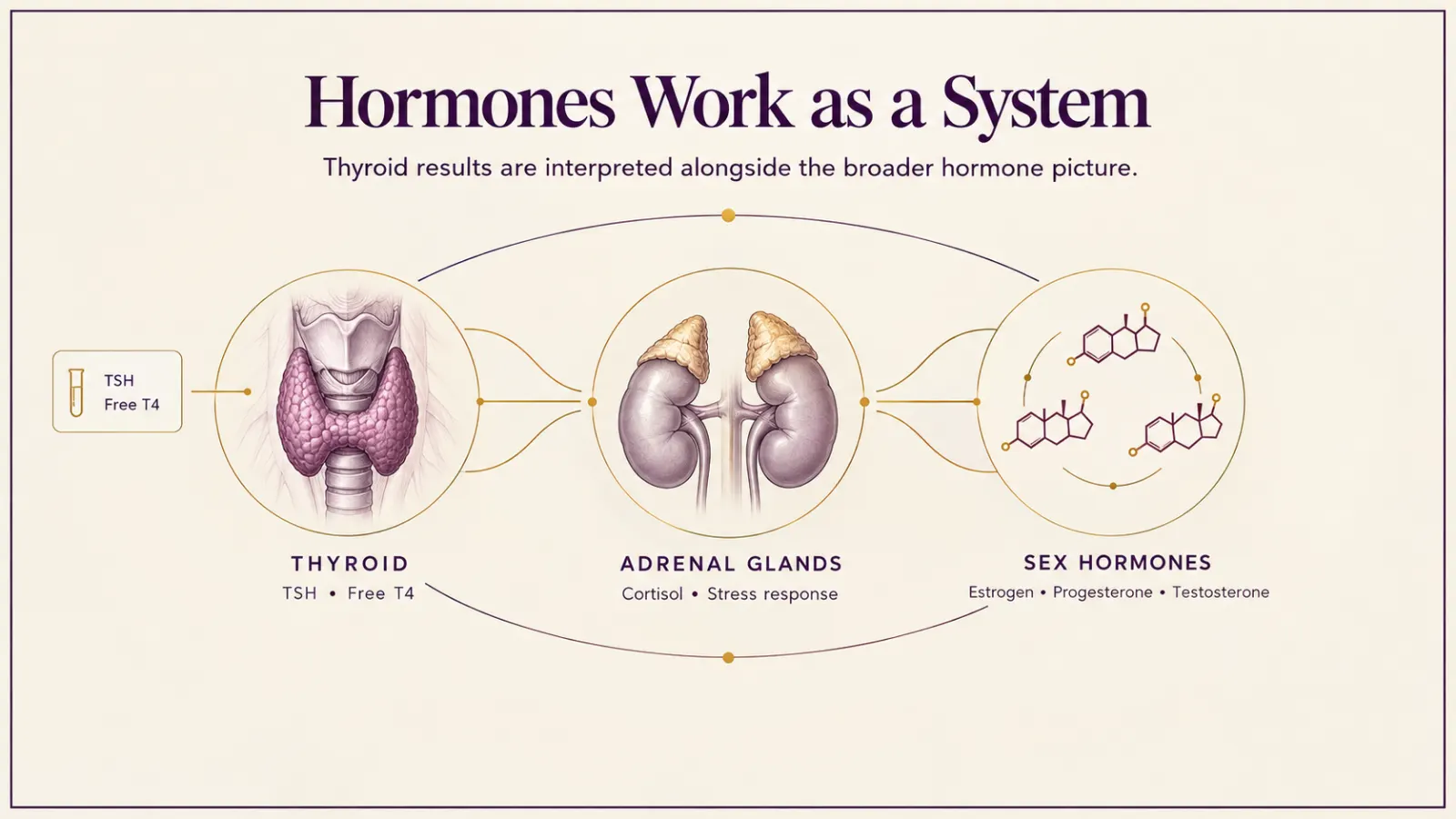
Dr. Goldstein reads a thyroid result as one part of a larger system. In her words: “Standard labs measure diseases, not function. They’re checking to see if your engine is completely broken, not whether it’s running at 40% capacity.”
Her view of the thyroid follows from that. “Your thyroid can be normal while still being shut down by stress,” she teaches. The mechanism she describes runs through cortisol: “High cortisol tells your thyroid to slow down because your body thinks there’s a famine. Your thyroid slowing down disrupts your sex hormones because your body thinks it’s not safe to reproduce.”
For that reason she reads thyroid, adrenal and sex hormone findings against each other rather than one at a time. “In my 25 years of practice, I found three systems break down most often: thyroid, adrenals, and sex hormones,” she says. “These three systems are interconnected.” The overlap is especially visible with hormone changes in perimenopause, when thyroid and sex hormone symptoms can look alike.
This is a way of interpreting results once they exist, alongside the published criteria. One Google reviewer wrote that Dr. Goldstein “gets to the root of your problem,” adding, “it’s not just about your bloodwork.” Another wrote, “She does very thorough testing.”
More on how results get read together is on the functional lab testing page.
What to Bring to a Thyroid Appointment
Bringing your actual results and a symptom timeline makes any thyroid appointment more productive than starting from a summary.
- Your lab reports with values and dates. The number and its trend tell you more than a “normal” flag.
- A note on whether antibodies were ever measured. Look for “TPO antibodies” or “thyroid peroxidase antibodies” on past reports.
- A symptom timeline, such as when fatigue, weight change or hair changes began.
- Family history of thyroid or autoimmune conditions.
- A complete medication and supplement list, including doses.
Knowing what a first root-cause appointment covers helps you prepare questions.
The Natural Path sees patients in person in San Juan Capistrano, serving Orange County, and through telemedicine visits across California.
Frequently Asked Questions
Can you have Hashimoto’s with a normal TSH?
Yes. The American Thyroid Association states that Hashimoto’s can be diagnosed when antibodies are elevated and thyroid hormone levels are normal, even without symptoms.
Can you have Hashimoto’s without TPO antibodies?
It is possible but less common, since TPO antibodies appear in over 90% of cases. NIDDK notes a thyroid ultrasound may be used when antibodies are negative.
Do thyroid antibodies need to be retested?
According to the ATA, repeating antibody levels is not needed. TSH is the value to keep monitoring, since it shows whether thyroid function is changing.
Is Hashimoto’s the same as hypothyroidism?
No. Hashimoto’s is an autoimmune condition, and hypothyroidism is low thyroid function. It is the most common cause of hypothyroidism in the US, yet many people with it have normal thyroid function for years.
How often should thyroid function be checked after a diagnosis?
StatPearls recommends annual thyroid function testing after diagnosis.
Where to Start
If your thyroid results came back normal and your symptoms have not changed, gather your reports and check whether antibodies were ever tested. Dr. Goldstein’s free Master Class explains how she reads these results as one picture.
By Dr. Angela Goldstein, ND, licensed naturopathic doctor, 25+ years in practice. Last reviewed: 2026-09-16.
This article is for general education and is not medical advice. It does not establish a doctor-patient relationship and is not a substitute for care from your own clinician. Do not delay seeking care, and do not stop or change any prescribed medication, based on what you read here. If you have an urgent medical concern, contact your physician or emergency services.