
Written by The Natural Path clinical content team, based on the teaching of Dr. Angela Goldstein, ND.
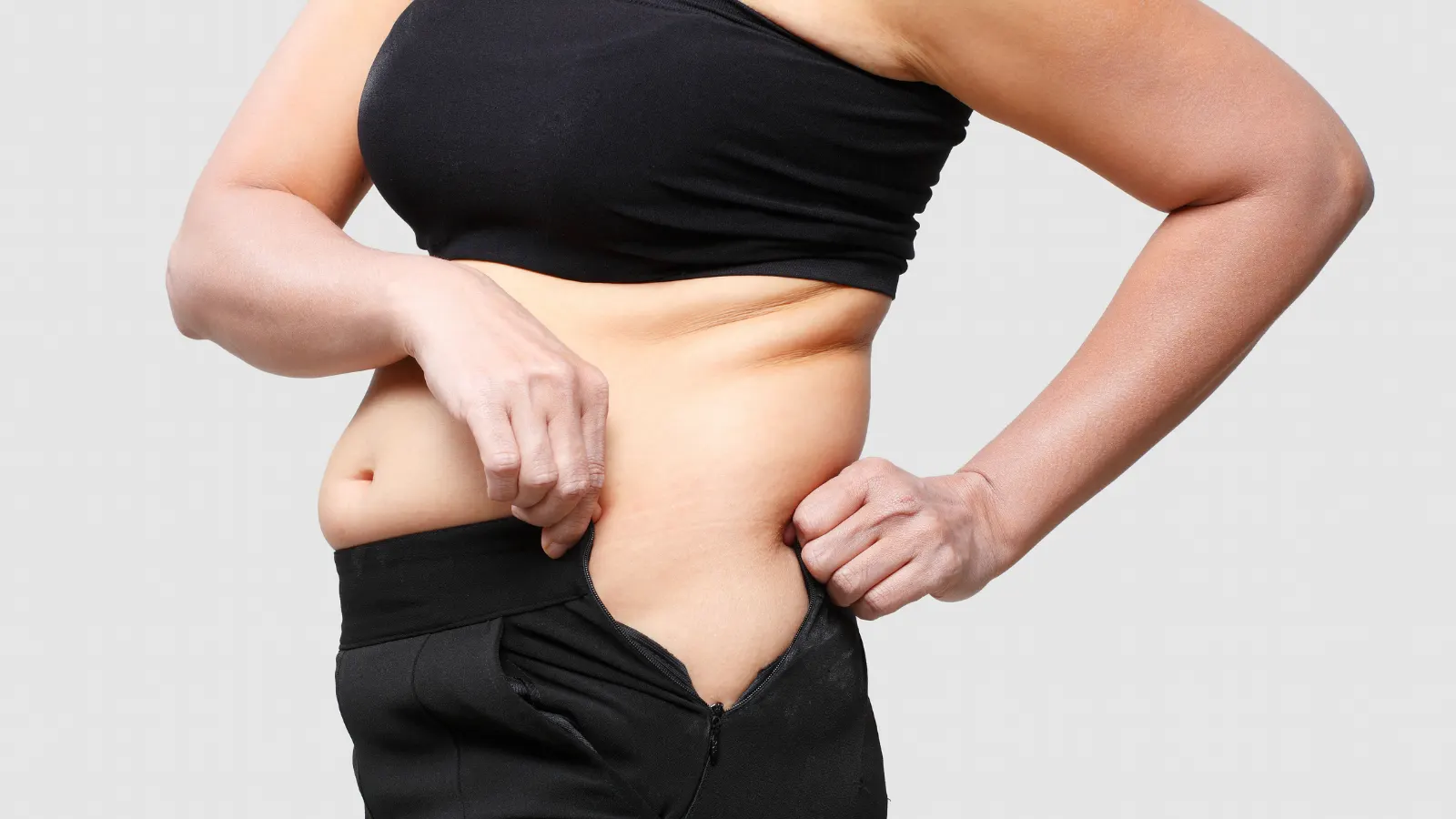
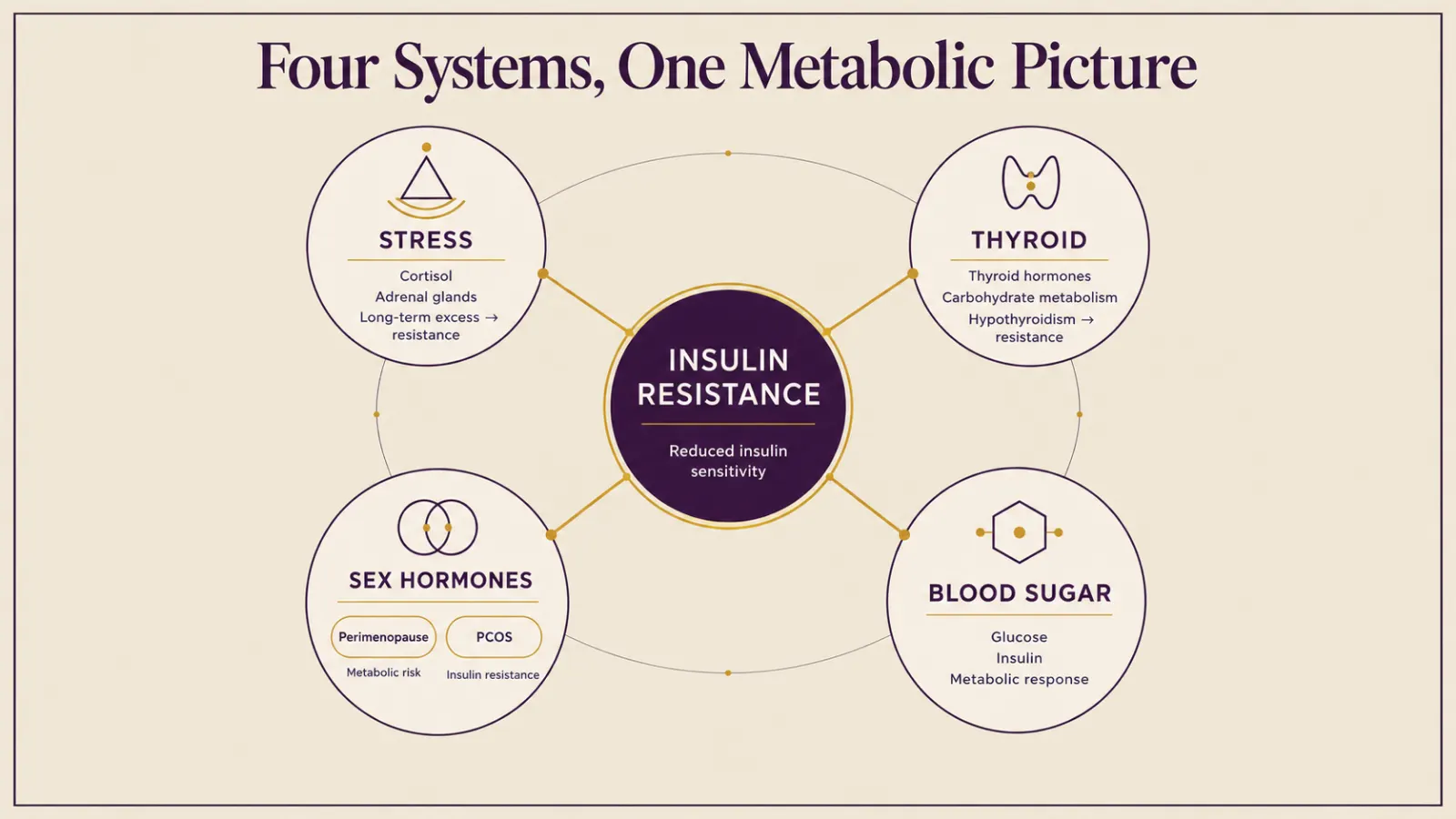
Insulin resistance in women is a state in which the body’s cells respond poorly to insulin, so the pancreas releases more of it to keep blood sugar in range. It usually causes no symptoms, which is why it can go unnoticed. The visible clues are a larger waist, dark velvety skin patches and, with PCOS, irregular periods, acne and extra hair. Women face added pressure points because insulin does not act alone. Cortisol, thyroid hormones and sex hormones each interact with it, and perimenopause and PCOS add to the load. Dr. Angela Goldstein, ND, places the blood sugar hormones in her orchestra of the endocrine system, next to thyroid, sex and stress hormones, and reads them together.
Key Takeaways
- Insulin resistance usually has no symptoms, according to the NIDDK, so visible clues such as waist size, dark velvety skin patches and cycle changes matter.
- Women have two added pressure points: the menopause transition and PCOS, both linked to insulin resistance or its close relative, metabolic syndrome.
- Insulin interacts with three other hormone systems: cortisol, thyroid and sex hormones.
- Long-term excess of glucocorticoids, the steroid family that includes cortisol, is shown to lead to insulin resistance. Whether everyday stress does the same is less settled.
- Dr. Goldstein teaches treating systems, not symptoms, so the first job is finding the underlying driver before choosing any plan.
“It’s just stress, take an antidepressant.” “It’s just aging, learn to live with it.” Dr. Goldstein lists these among the answers patients hear when tests come back normal. A third: “it’s all in your head, see a therapist.” If your waist has changed, your cycle has shifted and your energy fades by midday, none of those answers asks what your insulin is doing. This guide covers the signs, the causes specific to women and the hormone links behind them. Our test guide covers the lab side: how to test for insulin resistance.
What Insulin Resistance Means for Women
Insulin resistance in women means the body’s cells respond poorly to insulin, so the pancreas has to release more of it to keep blood sugar in range.
Insulin resistance is, in the NIDDK’s words, “a condition in which your body doesn’t respond to insulin the way it should.”
The CDC describes the sequence: “Your pancreas makes more insulin to try to get cells to respond. Eventually your pancreas can’t keep up, and your blood sugar rises.” Prediabetes means blood glucose is higher than normal but not high enough for a type 2 diabetes diagnosis.
Insulin is a blood sugar hormone, and Dr. Goldstein names the blood sugar hormones as one instrument in the endocrine orchestra. She says it plainly in her Master Class:
“Think of your endocrine system like an orchestra. You have thyroid hormones, sex hormones, stress hormones, blood sugar hormones, and dozens more. When they’re all playing together in harmony, you feel great. But if one instrument is out of tune, if one hormone system is off, the whole orchestra sounds terrible.”
Dr. Angela Goldstein, ND
Her Hormone Orchestra Quiz compares three of those instruments: stress response, thyroid and sex hormones. This guide adds blood sugar to that picture and shows how each of the other three meets insulin. The research is our reading of published studies. The orchestra is hers.
Insulin Resistance Symptoms in Women
Insulin resistance symptoms in women are usually absent, so the first clues are often visible changes rather than how you feel.
The NIDDK says it plainly: “People with insulin resistance and prediabetes usually have no symptoms.” The signs that federal health sources connect to it:
- A larger waist. The NIDDK lists overweight, obesity or a large waist size among its risk factors.
- Dark, velvety skin patches. The NICHD states that patches of thickened, dark, velvety skin, called acanthosis nigricans, “are associated with insulin resistance.”
- Trouble losing weight around the waist. The NICHD lists it among PCOS symptoms, and it states that more than one-half of women with PCOS have insulin resistance.
- Irregular periods, acne, extra facial or body hair, thinning scalp hair and skin tags. The Office on Women’s Health lists these as PCOS signs.
Fatigue, weight gain and cravings are easy to blame on one cause. Dr. Goldstein teaches the opposite. Her example is the stress chain: “One problem, three systems affected, multiple symptoms.” The same symptom can come from different systems, which is why what each hormone symptom points to sorts symptoms by system before blaming any one of them.
Why Women Develop Insulin Resistance
Insulin resistance in women usually has more than one driver, because insulin responds to cortisol, thyroid hormones and sex hormones.
In 25+ years of practice, Dr. Goldstein has found that three systems break down most often: thyroid, adrenals and sex hormones. “These three systems are interconnected. You cannot fix one without addressing the others,” she says. This guide adds insulin, the blood sugar instrument, beside them. The three sections below follow how insulin meets each one. The links between them come from published studies, not from her teaching.
Cortisol and Insulin: What the Stress Link Shows
Long-term glucocorticoid excess, from treatment or Cushing’s syndrome, is shown to lead to insulin resistance, and in one study women with more central fat released more cortisol under stress.
Cortisol is the main stress hormone made by the adrenal glands. It is meant to rise and fall across the day.
A 2021 review found that “long-term GC exposure arising from treatment or Cushing’s syndrome, progressively leads to insulin resistance” (Beaupere et al., International Journal of Molecular Sciences). GC stands for glucocorticoids, the steroid family that includes cortisol.
Those findings involve treatment-level or disease-level cortisol. Whether the everyday stress response has the same effect is less settled. In a study of 59 healthy premenopausal women, stress-induced cortisol secretion was greater among women with central fat (Epel et al., Psychosomatic Medicine, 2000). It measured both at one point in time, so it shows an association and cannot establish cause.
Dr. Goldstein teaches the chain in order:
“When you’re under chronic stress, your adrenal pumps out cortisol constantly. High cortisol tells your thyroid to slow down because your body thinks there’s a famine. Your thyroid slowing down disrupts your sex hormones because your body thinks it’s not safe to reproduce.”
Dr. Angela Goldstein, ND
The glucocorticoid research above adds one more place that signal can land: insulin response, at least when cortisol-family hormones stay high for a long time.
Thyroid and Insulin: Where a Slower Thyroid Meets Blood Sugar
Thyroid disease is linked to disorders of carbohydrate metabolism, and in hypothyroidism a review reported that the available data suggest “the insulin resistance of peripheral tissues prevails.”
That review found that disorders of carbohydrate metabolism have been demonstrated in overt hypothyroidism and overt hyperthyroidism (Gierach et al., Endokrynologia Polska, 2014). The review defines insulin resistance as reduced sensitivity of muscle, fat, liver and other tissues to insulin. The effect of subclinical thyroid problems, the milder form, “is still under discussion.”
The thyroid also sits downstream of cortisol. A 2026 review reports that cortisol suppresses TRH and TSH secretion, the brain signals that drive the thyroid (Gierach and Junik, Endokrynologia Polska, 2026). The same review describes a shift toward lower active T3 and more of the inactive form, rT3. Each paper covers one link, so the full chain is two published findings joined together. The signal path is laid out in how cortisol and thyroid hormones interact.
It echoes what Dr. Goldstein says about normal labs: “Your thyroid can be normal while still being shut down by stress.”
The NIDDK lists fatigue, weight gain and trouble tolerating cold among common hypothyroidism symptoms, and notes that fatigue and weight gain are common and do not necessarily mean a thyroid problem. Sorting thyroid from perimenopause is covered in whether it is your thyroid or perimenopause.

Free 3-minute quiz from Dr. Angela Goldstein, ND
Stress, thyroid and sex hormones work as one system. Answer 22 quick questions and see which one is under the most strain for you.
What you’ll get:
- ✓A score for each system: stress, thyroid and sex hormones
- ✓Which pattern your answers fit, and how the systems pull on each other
- ✓Built on published research
- ✓A clear next step for your pattern
Free. 22 questions, about 3 minutes.
Educational content. Always talk with your doctor before changing any treatment.
Sex Hormones and Insulin: Perimenopause and PCOS
Sex hormones are the third step in Dr. Goldstein’s chain, and they add the two pressure points specific to women: the menopause transition and PCOS.
Perimenopause and Insulin Resistance
In the Study of Women’s Health Across the Nation (SWAN), the odds of developing metabolic syndrome were 1.45 per year in perimenopause and 1.24 per year after menopause. Those figures were adjusted for age, body mass index and other factors (Janssen et al., Archives of Internal Medicine, 2008). The study followed 949 women for nine years. The authors reported that an increase in bioavailable testosterone or a decrease in sex hormone-binding globulin increased the odds.
Metabolic syndrome is a cluster of findings that includes a larger waist, high triglycerides, low HDL cholesterol, raised fasting glucose and raised blood pressure.
The study measured metabolic syndrome, a related cluster, so it supports the transition as a pressure point without measuring insulin resistance itself. The NIDDK also lists age 35 or older among its risk factors. Our perimenopause weight gain guide covers the fat-storage side of the transition.
PCOS and Insulin Resistance
PCOS (polycystic ovary syndrome) is a hormone condition that can cause irregular periods, acne and excess facial and body hair.
Between 5% and 10% of women ages 15 to 44 have PCOS, according to the Office on Women’s Health. The NICHD states that more than one-half of women with PCOS have insulin resistance, and the NIDDK lists PCOS among the conditions that raise the risk of it. If PCOS signs are on your list, a fair question for your clinician is whether insulin was measured alongside glucose.
Our hormone imbalance and perimenopause page describes care for sex hormone shifts.
How Insulin Meets Each Hormone System at a Glance
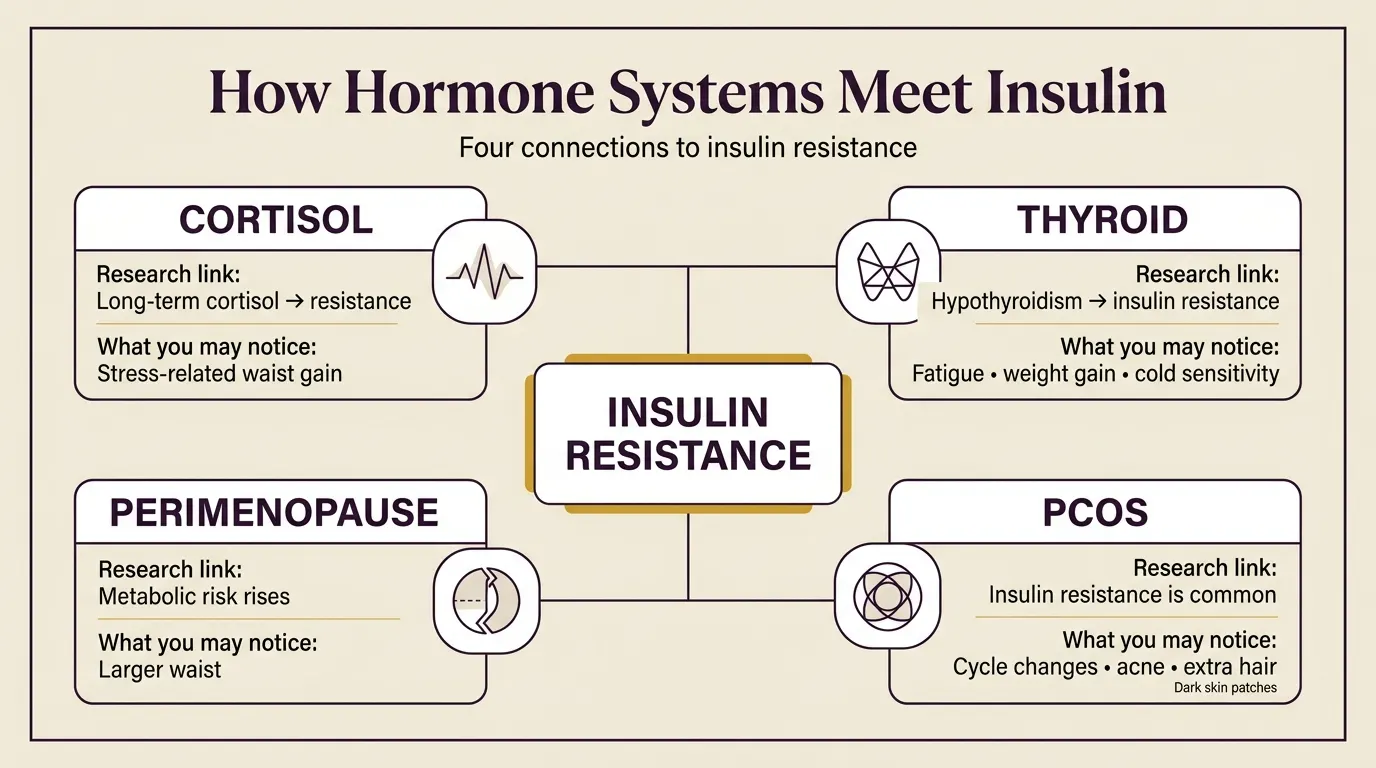
Each hormone system has at least one published link to insulin response, and the table shows the finding and its source.
| Hormone system | What the research shows | What you may notice | Source |
|---|---|---|---|
| Cortisol | Long-term glucocorticoid exposure leads to insulin resistance. Women with central fat released more cortisol under stress. | Weight around the waist during stressful stretches | Beaupere et al., 2021; Epel et al., 2000 |
| Thyroid | Carbohydrate metabolism disorders documented in thyroid disease. In hypothyroidism, peripheral insulin resistance prevails. | Fatigue, weight gain, trouble tolerating cold | Gierach et al., 2014; NIDDK |
| Perimenopause | Metabolic syndrome odds of 1.45 per year in perimenopause, with rising testosterone or falling SHBG raising the odds | A larger waist | Janssen et al., 2008 |
| PCOS | More than one-half of women with PCOS have insulin resistance | Cycle changes, acne, extra hair, dark velvety skin patches | NICHD; Office on Women’s Health |
Four systems, four published links to insulin response. That is the case for reading them together.
Why Insulin Resistance in Women Often Goes Unmeasured
Insulin resistance in women often goes unmeasured because, as the NIDDK notes, “health care professionals may not test for insulin resistance.”
The NIDDK adds that the test for insulin resistance is primarily used only for research studies. What clinicians usually order are blood tests for prediabetes. The test guide covers which labs can show insulin itself and how reliable each one is.
Dr. Goldstein explains the gap this way: “Standard labs measure diseases, not function. They’re checking to see if your engine is completely broken, not whether it’s running at 40% capacity.” One patient wrote in a Google review that she had been “seeing doctors for years that never changed anything,” and that with Dr. Goldstein “it’s not just about your bloodwork.”
What to Bring to an Appointment About Insulin Resistance in Women
The most useful preparation is a short record that shows which of the four systems is pressing on insulin.
- Waist, as well as weight. The NIDDK lists a large waist size among its risk factors, so a tape measure adds information.
- Timeline. When each change started and what came before it, such as a stressful stretch or a new medication.
- Cycle history. Dates and flow, any dark velvety skin patches, and any PCOS diagnosis.
- Thyroid results. Ask which markers were measured, not only TSH.
- Medication list. Include any glucocorticoid, a steroid medicine such as prednisone.
- Earlier results. Ask whether insulin was measured alongside glucose.
That record is what a root-cause evaluation reads, as described in what to expect at your first functional medicine appointment.
What Helps Insulin Resistance in Women, and What Depends on the Driver
The NIDDK lists four lifestyle steps for insulin resistance in women and men alike, and for prediabetes: healthy foods and drinks, physical activity, managing weight and getting enough sleep.
How far those steps go depends on the person. In Dr. Goldstein’s words, “Protocols are designed for populations, not individuals.” Her teaching is to treat systems, not symptoms, which means a plan for a stress-driven pattern differs from one for thyroid or PCOS. That is the logic behind metabolic health and weight resistance care at The Natural Path, where the plan starts with the underlying driver. No result is promised for any individual.
When to See a Doctor Promptly
Some symptoms need medical attention, whatever your insulin picture looks like.
The NIDDK lists these common diabetes symptoms: increased urination, feeling very thirsty, feeling very hungry even after eating, blurred vision, fatigue, sores that do not heal and frequent infections. Tell your clinician if you have them.
The same NIDDK page calls diabetic ketoacidosis a medical emergency that needs to be treated right away. Its symptoms may include trouble breathing, fruity-smelling breath, fainting from dehydration, and abdominal pain, nausea or vomiting. If you have these, call emergency services.
Frequently Asked Questions
What are the first signs of insulin resistance in women?
Often there are none, according to the NIDDK. Visible clues include a larger waist and dark, velvety skin patches, and with PCOS, cycle changes, acne and extra hair.
Does perimenopause cause insulin resistance?
Perimenopause is linked to a rising risk of metabolic syndrome, a related cluster, with odds of 1.45 per year in SWAN. Age and other factors also contribute, so the transition is one pressure point among several.
Does PCOS cause insulin resistance?
More than one-half of women with PCOS have insulin resistance, according to the NICHD. The sources reviewed here do not settle which comes first.
Can stress cause insulin resistance?
Long-term glucocorticoid excess, from treatment or Cushing’s syndrome, leads to insulin resistance. Whether everyday stress has the same effect is less settled.
Can a thyroid problem cause insulin resistance?
Disorders of carbohydrate metabolism are documented in overt hypothyroidism and hyperthyroidism. The role of subclinical thyroid problems is still under discussion.
Can women improve insulin resistance?
The NIDDK lists healthy foods and drinks, physical activity, weight management and enough sleep. Results vary by person and depend on the driver. Keep taking prescribed medications as directed, and bring any change to the clinician who prescribed them.
Where to Start
The most useful next step with insulin resistance in women is seeing insulin as one instrument in the whole orchestra, with the driver identified before anyone adjusts one part.
The Natural Path sees patients in person in San Juan Capistrano, in Orange County, and by telemedicine across California.
The Comprehensive Wellness Evaluation is a one-hour visit with Dr. Goldstein, by video or in person, that starts with your complete health history. Book the Comprehensive Wellness Evaluation.
Dr. Goldstein’s free Master Class walks through the connected systems. Watch the free Master Class.
Bring the questions it raises to your next appointment, with your waist measurement, cycle dates and medication list in hand.
Written by The Natural Path clinical content team, based on the teaching of Dr. Angela Goldstein, ND.
This article is for general education and is not medical advice. It is not intended to diagnose or treat any disease, does not establish a doctor-patient relationship, and is not a substitute for care from your own clinician. Do not start, stop or change any prescribed medication based on what you read here. If you have an urgent medical concern, contact your physician or emergency services.