
Written by The Natural Path clinical content team, based on the teaching of Dr. Angela Goldstein, ND.
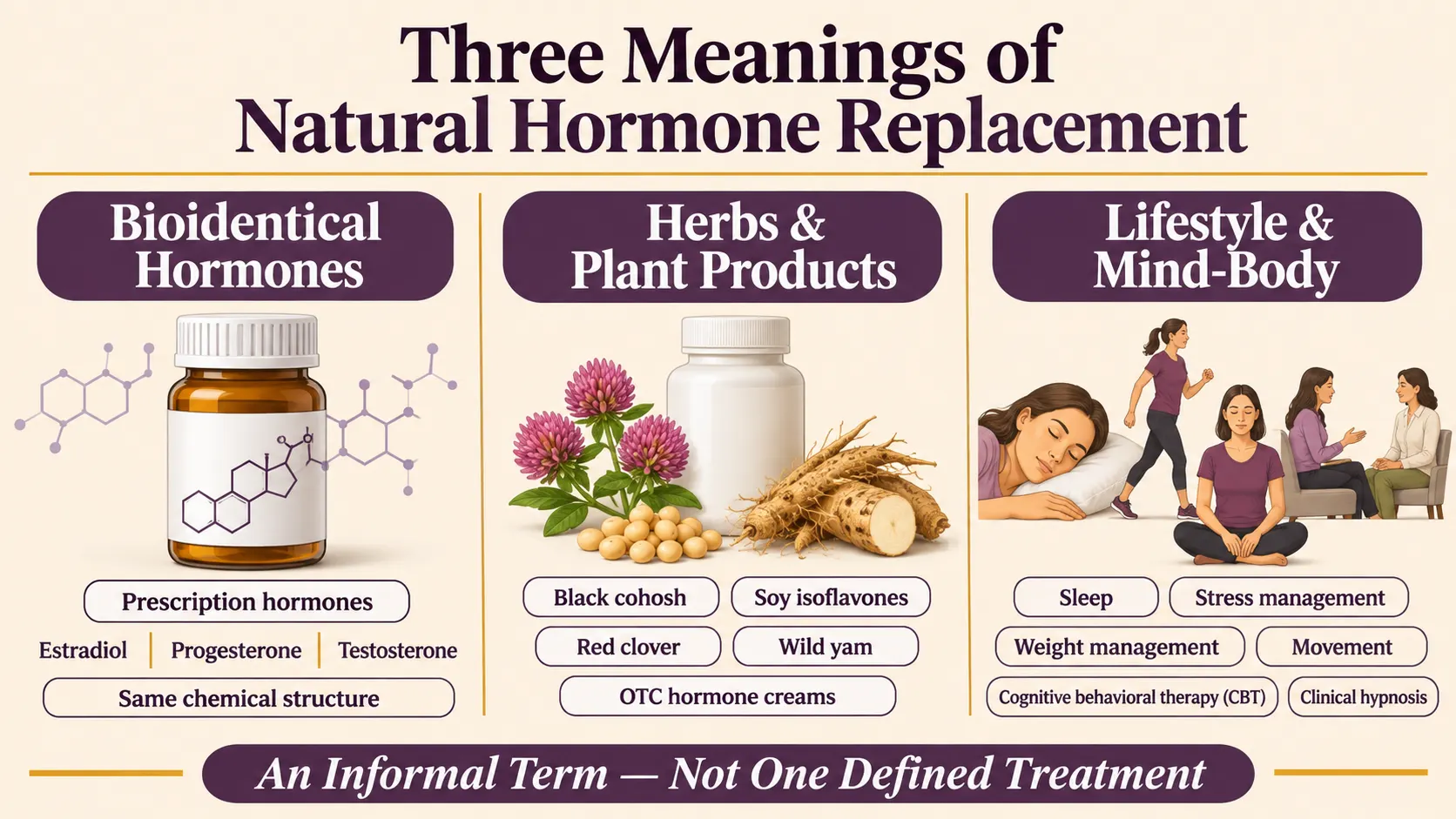
Natural hormone replacement therapy has no single medical definition. People use the phrase for three things. The first is bioidentical hormones, prescription hormones made in a lab to match the structure of your own. The second is herbs and plant products sold as supplements, and the third is lifestyle and mind-body change.
The evidence behind each one is very different. The Menopause Society’s 2023 guidance calls hormone therapy the most effective treatment for hot flashes, and it does not recommend herbal remedies or supplements for them. The FDA’s plain advice for women in menopause is that “natural doesn’t always mean safe.” This guide sorts the three meanings, shows what the research supports for each, and explains when natural steps are not enough.
Key Takeaways
- “Natural hormone replacement” can mean bioidentical hormones, herbal supplements or lifestyle change. Ask which one is being offered.
- Bioidentical hormones match your body’s hormones in structure, but they are lab-made prescription medicines, and some are FDA-approved.
- The Menopause Society (2023) does not recommend supplements or herbal remedies for hot flashes. It does recommend cognitive behavioral therapy and clinical hypnosis.
- Hormone therapy remains the most effective treatment for hot flashes and vaginal dryness, and it helps prevent bone loss (The Menopause Society, 2022).
- Dr. Goldstein reads stress, thyroid and sex hormones together, because a swap aimed at one hormone can miss what is driving it.
On this page: What it means · Natural vs HRT · Bioidentical · Herbs · Lifestyle · The whole system · When natural is not enough · When hormones fall short · California care · FAQ
If you typed “natural hormone replacement” into a search bar, you probably want relief that feels gentler than a prescription. Maybe the hot flashes and broken sleep are wearing you down, and maybe you have heard frightening things about hormones. That instinct is reasonable. The trouble is that the word “natural” is doing a lot of work on the labels and websites you are reading, and it can point to very different products.
What “Natural Hormone Replacement” Means
“Natural hormone replacement” is a marketing phrase, and it usually means one of three things.
Natural hormone replacement therapy is an informal term for relieving menopause symptoms with bioidentical hormones, plant-based supplements or lifestyle change, rather than a defined medical treatment.
- Bioidentical hormones. Prescription estradiol, progesterone or testosterone with the same chemical structure as the hormones your ovaries make, explained in full in our guide to what bioidentical hormones are and how they are made.
- Herbs and plant products. Supplements such as black cohosh, soy isoflavones, red clover or wild yam, plus over-the-counter “natural” hormone creams, all sold without a prescription.
- Lifestyle and mind-body approaches. Changes to sleep, stress, weight and movement, plus therapies such as cognitive behavioral therapy (CBT) and clinical hypnosis.
The American College of Obstetricians and Gynecologists (ACOG) has flagged the language itself. Its 2023 Clinical Consensus on compounded bioidentical hormone therapy says many compounding pharmacies use “bioidentical hormone” as a marketing term. The goal, per ACOG, is “to imply that these preparations are natural and, thus, safer and more effective.” ACOG adds that evidence for those claims is lacking.
Natural Hormone Replacement vs HRT
Hormone therapy remains the most effective treatment for hot flashes, and The Menopause Society’s 2023 nonhormone guidance grades the herbal and lifestyle options against it. It rates cognitive behavioral therapy and clinical hypnosis as recommended for hot flashes (Level I, its strongest evidence). It rates supplements and herbal remedies as not recommended (Levels I to II). That single fact separates the “natural” options more clearly than any label does.
| Option | What it is | Prescription? | FDA-approved as a drug? | What the evidence shows |
|---|---|---|---|---|
| FDA-approved bioidentical hormones | Lab-made hormones identical in structure to yours | Yes | Yes | Part of hormone therapy, the most effective treatment for hot flashes |
| Compounded bioidentical hormones | Pharmacy-mixed versions for one prescription | Yes | No | ACOG (2023): marketing claims of safety and effectiveness lack evidence |
| Herbs and plant supplements | Black cohosh, soy, red clover, wild yam and others | No | No | Not recommended for hot flashes (Menopause Society, 2023) |
| Lifestyle and mind-body | CBT, clinical hypnosis, weight loss, sleep, stress | No (CBT and hypnosis need a trained provider) | Not applicable | CBT and hypnosis recommended, Level I; weight loss, Levels II to III |
Conventional hormone replacement therapy (HRT), also called menopausal hormone therapy, is the comparison point. The Menopause Society’s 2022 hormone therapy statement says hormone therapy “remains the most effective treatment for vasomotor symptoms (VMS) and the genitourinary syndrome of menopause and has been shown to prevent bone loss and fracture.” The same statement says its risks differ by type, dose, duration, route, timing and whether a progestogen is used.
So “natural vs HRT” is partly a false choice. FDA-approved bioidentical estradiol and progesterone are hormone therapy. The real question is which meaning of natural you are weighing.
Bioidentical Hormones: Natural in Structure
Bioidentical hormones are natural in their shape, and they are still manufactured medicines.
The FDA’s menopause page states that the agency “has approved drugs containing hormones that are identical to the hormones made naturally by women in their reproductive years.” Those products go through FDA review. Pharmacies also mix compounded versions. For those, the FDA says it “does not have evidence that compounded ‘bioidentical hormones’ are safe and effective, or safer or more effective than FDA-approved hormone therapy,” per its Office of Women’s Health menopause page.
ACOG’s 2023 consensus goes further: compounded bioidentical hormone therapy “should not be prescribed routinely when FDA-approved formulations exist.” Every bioidentical hormone, approved or compounded, requires a prescription and a clinician who monitors it.
Plain takeaway: “bioidentical” describes the molecule. It tells you nothing about whether a hormone is right for you, or whether something upstream is lowering your own hormones.
One hormone gets its own page: our guide to bioidentical progesterone and when it is used covers forms, research and who should avoid it.
If the question on your mind is budget rather than biology, what drives the cost of bioidentical hormones is covered separately.
Free 3-minute quiz from Dr. Angela Goldstein, ND
Stress, thyroid and sex hormones work as one system. Answer 22 quick questions and see which one is under the most strain for you.
What you’ll get:
- ✓A score for each system: stress, thyroid and sex hormones
- ✓Which pattern your answers fit, and how the systems pull on each other
- ✓Built on published research
- ✓A clear next step for your pattern
Free. 22 questions, about 3 minutes.
Educational content. Always talk with your doctor before changing any treatment.
Herbs and Plant-Based Products: What the Evidence Shows
Herbs and plant supplements are the meaning of “natural” with the weakest evidence for hot flashes.
The Menopause Society’s 2023 nonhormone therapy position statement lists “supplements/herbal remedies” under not recommended, and also does not recommend soy foods, soy extracts or the soy metabolite equol for hot flashes. The National Center for Complementary and Integrative Health (NCCIH) reaches a similar place. Its 4 Things To Know about menopause and complementary health says black cohosh, soy isoflavone supplements and DHEA have been studied, “but scientists have found little evidence that they are helpful.”
| Product | What NCCIH reports | Safety note from NCCIH |
|---|---|---|
| Black cohosh | A 2023 review of 22 studies found extracts “potentially beneficial for overall menopause symptoms,” with improvement in hot flashes but not anxiety or depressive symptoms | Rare liver damage cases; some products contained the wrong herb |
| Soy and red clover isoflavones | Inconsistent results | Phytoestrogens “may not be safe for women who shouldn’t take estrogen” |
| DHEA | Little evidence it helps | Converted in the body to hormones, which carry risks |
| Kava and dong quai | No conclusive evidence they reduce hot flashes | Kava linked to a risk of severe liver disease; dong quai may interact with warfarin |
| Wild yam | Very little research, so no conclusions can be reached | NCCIH gives no product-specific safety note |
The black cohosh figures come from NCCIH’s black cohosh fact sheet, which adds that liver problems are rare and “it’s uncertain whether black cohosh was responsible for them.” The phytoestrogen, wild yam and dong quai notes come from NCCIH’s In Depth menopause page, last updated in May 2017.
Herbs act on the body, which is exactly why they can interact with medicines and with each other. NCCIH says natural products “can interact with other botanicals or supplements or with medications,” and asks women to tell every provider what they take. The FDA’s advice is short: “Also ask about the herbs or supplements you take.”
Lifestyle and Mind-Body Approaches
Two mind-body therapies, CBT and clinical hypnosis, carry The Menopause Society’s strongest recommendation for hot flashes in 2023.
Here is how the 2023 statement grades common lifestyle and mind-body options for hot flashes specifically:
| Option | 2023 grade for hot flashes |
|---|---|
| Cognitive behavioral therapy | Recommended, Level I |
| Clinical hypnosis | Recommended, Level I |
| Weight loss | Recommended, Levels II to III |
| Exercise, yoga, mindfulness, relaxation | Not recommended for hot flashes, Level II |
| Cooling techniques, avoiding triggers | Not recommended, Level II |
| Dietary modification | Not recommended, Level III |
That grading is about hot flashes, and menopause is more than hot flashes. A 2018 evaluation of 13 studies, with more than 1,300 participants, is summarized on NCCIH’s Menopausal Symptoms: In Depth page. It found yoga reduced physical symptoms such as hot flashes and psychological symptoms such as anxiety or depression. Its tips page adds that tai chi and meditation-based programs may help with sleep, mood, stress and muscle and joint pain.
Sleep, stress, food and movement also shape the systems that sit underneath your hormones, which is where Dr. Goldstein’s teaching comes in. She is direct that this is not a lecture about eating better: “People already know that.”
Why Dr. Goldstein Reads Stress, Thyroid and Sex Hormones Together
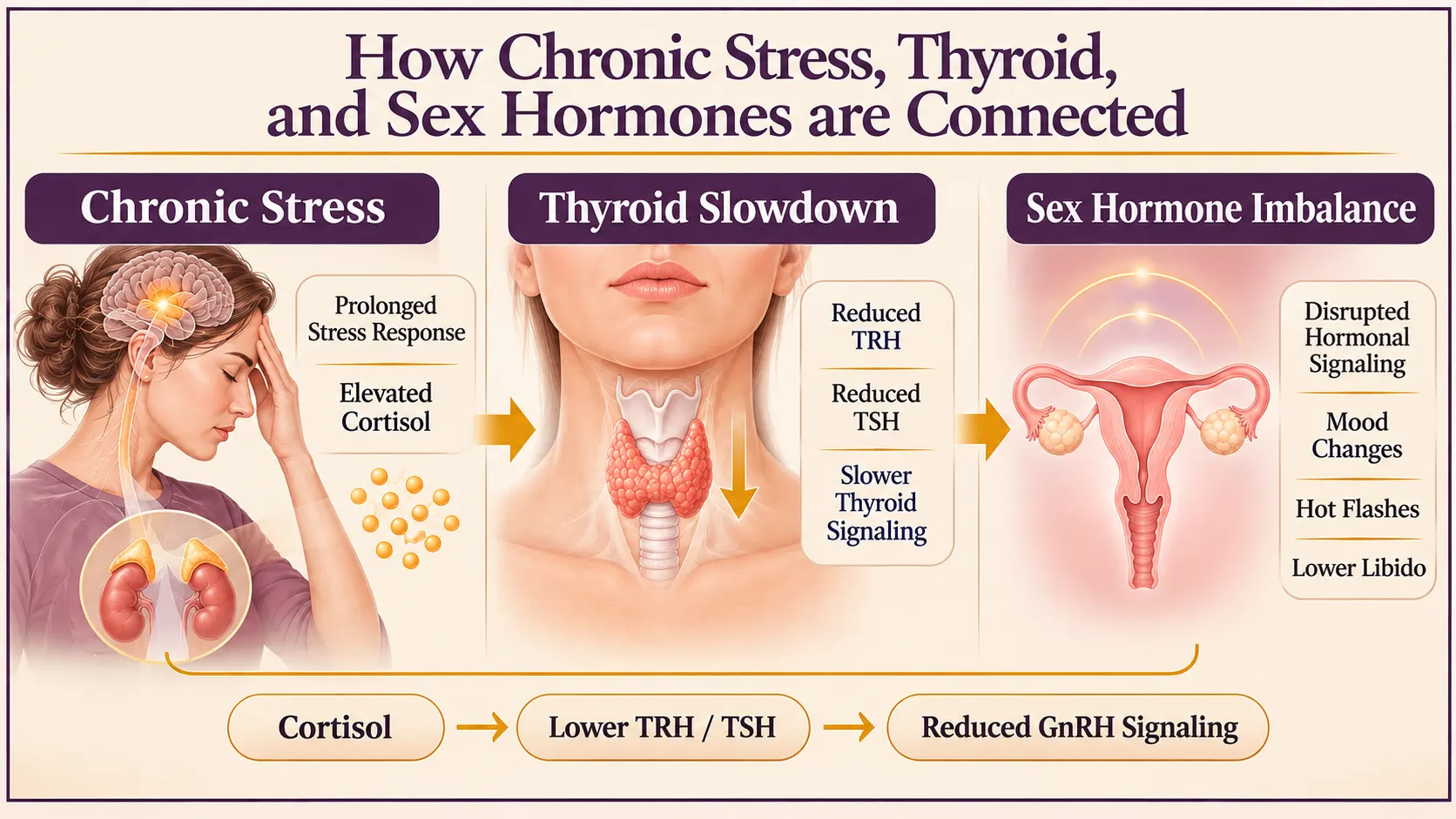
Cortisol, the main stress hormone, inhibits the brain signals that run both the thyroid and the ovaries, so a natural swap aimed at one hormone can miss the driver above it. A 2026 review in Endokrynologia Polska states that cortisol inhibits the secretion of TRH in the hypothalamus and TSH in the pituitary gland, the two signals that tell the thyroid to work. A 2010 review reports that at the hypothalamus, glucocorticoids such as cortisol inhibit the release of gonadotropin-releasing hormone (GnRH), the signal upstream of ovulation and progesterone.
Dr. Goldstein explains the same chain in plain words:
“High cortisol tells your thyroid to slow down because your body thinks there’s a famine. Your thyroid slowing down disrupts your sex hormones because your body thinks it’s not safe to reproduce.”
- Stress runs long. Cortisol stays high.
- The thyroid slows. Energy and metabolism drop.
- Sex hormones lose their footing. Hot flashes, mood swings and low sex drive follow.
Our article on how cortisol and the thyroid affect each other walks through the research in more depth.
This is why she is wary of “natural” care that only changes the product. She calls this substitution medicine, and at a 2025 seminar she explained it:
“If you have high blood pressure, instead of a prescription I give you an herb… we’re just substituting a pharmaceutical for a natural substance, but that does not address the underlying reason.”
In her Master Class she adds that “most practitioners, even natural ones, treat symptoms, not systems. They’re just using supplements instead of drugs,” and that “protocols are designed for populations, not individuals.”
Labs can hide this pattern too. “Standard labs measure diseases, not function,” she says, and “your hormones can be in range while being completely out of balance as a system.” Patients notice the difference; one wrote that her care was “not just about your bloodwork.” The practice’s page on hormone and perimenopause care explains how that full read is done.
When Lifestyle and Herbs Are Not Enough
Lifestyle and herbs are not enough when symptoms keep interfering with daily life, or when bones, bleeding or the vaginal tissues are involved. The FDA tells women to talk with a provider about treatment “if your menopause symptoms are interfering with your usual activities or get worse.”
Signals that it is time for a fuller medical conversation:
- [ ] Hot flashes or night sweats still disrupt sleep or work after honest lifestyle changes. Hormone therapy is the most effective treatment for them (Menopause Society, 2022).
- [ ] Vaginal dryness or painful sex is not relieved by over-the-counter products. The 2022 statement recommends low-dose vaginal estrogen or other prescription therapies here.
- [ ] You have bone-loss risk. Hormone therapy “has been shown to prevent bone loss and fracture.”
- [ ] Your periods or bleeding change. The FDA says to speak with a provider about any change.
- [ ] You take several herbs alongside prescription medicines and have not reviewed them for interactions.
Bleeding deserves its own check. Our guide to perimenopausal bleeding and when to worry lists the patterns that need prompt care.
Timing matters as well.
For women younger than 60 or within 10 years of menopause onset with no contraindications, The Menopause Society calls the benefit-risk ratio favorable for bothersome hot flashes and bone protection. In November 2025 the FDA began removing the boxed warnings for cardiovascular disease, breast cancer and probable dementia from menopausal hormone therapy labels. Its labeled recommendation is to start systemic therapy within 10 years of menopause onset or before age 60, per its press announcement. The endometrial cancer warning stays on systemic estrogen-alone products.
If you cannot take estrogen, for example after an estrogen-dependent cancer, the 2023 guidance points to evidence-based nonhormone options, including CBT, clinical hypnosis and several prescription medicines. A hormone level alone will not settle any of these questions; our guide to hormone testing for women explains what a panel can and cannot show.
When Hormones Alone Fall Short
More hormone poured into a system stuck in survival mode can overflood it, Dr. Goldstein teaches, which is why some women conclude that hormones do not work for them. At a 2025 seminar she described environmental toxins binding to hormone receptors:
“Somebody, an impostor, already came in and took the hormone spot. Just putting more hormones in the system is not going to do the trick.”
And on stress: “You can keep putting hormones in, but if the system is in fight or flight, it’s not going to respond. You’ll just overflood it.”
She tells the story of a patient named Patty, who came in with hot flashes, weight gain and anxiety and depression she had kept hidden. Patty had been given hormones she did not need. Her care centered on nutrition and detoxification instead, and her symptoms resolved. Individual results vary.
The thyroid is one reason to look first. Thyroid disorders affect nearly 14% of adult women, according to a 2023 review in the International Journal of Molecular Sciences. The hypothyroidism symptoms listed by the NIDDK, such as fatigue, weight gain and heavy or irregular periods, overlap with perimenopause. That is why, at The Natural Path, bioidentical hormone therapy is a clinical decision made after the full picture: thyroid, adrenal, metabolic and sex hormone function are read together before anything is prescribed.
Natural Hormone Care in San Juan Capistrano and Across California
The Natural Path sees women in person at its San Juan Capistrano office, an easy drive for many women in Aliso Viejo and Lake Forest, and by video visit anywhere in California. Dr. Goldstein has 25+ years in practice, and as a licensed California naturopathic doctor she can prescribe bioidentical hormones when it is clinically appropriate. Creams, oral and injectable forms are used; pellets are not.
Women outside Orange County can start with telemedicine across California, where the evaluation, lab review and care plan all work over video.
Directions, hours and the office address are on the contact page.
Frequently Asked Questions
Is natural hormone replacement safer than HRT?
There is no evidence that “natural” versions are safer as a group. The FDA says it has no evidence that compounded bioidentical hormones are safer than FDA-approved hormone therapy, and herbal supplements carry their own risks, including rare liver injury and drug interactions. Safety depends on the specific product and your history.
What is the most natural form of hormone replacement?
FDA-approved bioidentical estradiol and progesterone are the closest match to the hormones your body makes, because they share the same structure. They are still lab-made prescription medicines. Herbs are plant-derived, but they are not hormones and they work differently.
Can herbs replace hormone therapy?
For hot flashes, the evidence says no. The Menopause Society’s 2023 statement does not recommend supplements or herbal remedies for hot flashes, and calls hormone therapy the most effective treatment. Some women still use herbs, so tell every provider what you take.
Do natural hormones need a prescription?
FDA-approved and compounded bioidentical hormones do. Herbs, supplements and over-the-counter “natural” hormone creams are sold without one, and the FDA says it does not know if herbs or other “natural” products are helpful or safe. NCCIH adds there is little information on the long-term safety of dietary supplements.
What are natural options if I can’t take estrogen?
The Menopause Society’s 2023 guidance rates CBT and clinical hypnosis as recommended at its strongest evidence level, alongside several nonhormone prescriptions. NCCIH cautions that plant phytoestrogens may not be safe for women who should not take estrogen, so check them with your oncologist or clinician first.
Where to Start
Before you choose any kind of “natural,” it helps to know which system is most likely driving your symptoms. The free Hormone Orchestra Quiz scores stress, thyroid and sex hormones together in about 3 minutes. Take the free hormone quiz.
Written by The Natural Path clinical content team, based on the teaching of Dr. Angela Goldstein, ND.
This article is for general education and is not medical advice. It does not establish a doctor-patient relationship and is not a substitute for care from your own clinician. Do not start, stop or change any hormone, supplement or prescribed medication based on what you read here. If you have an urgent medical concern, contact your physician or emergency services.