
Written by The Natural Path clinical content team, based on the teaching of Dr. Angela Goldstein, ND.
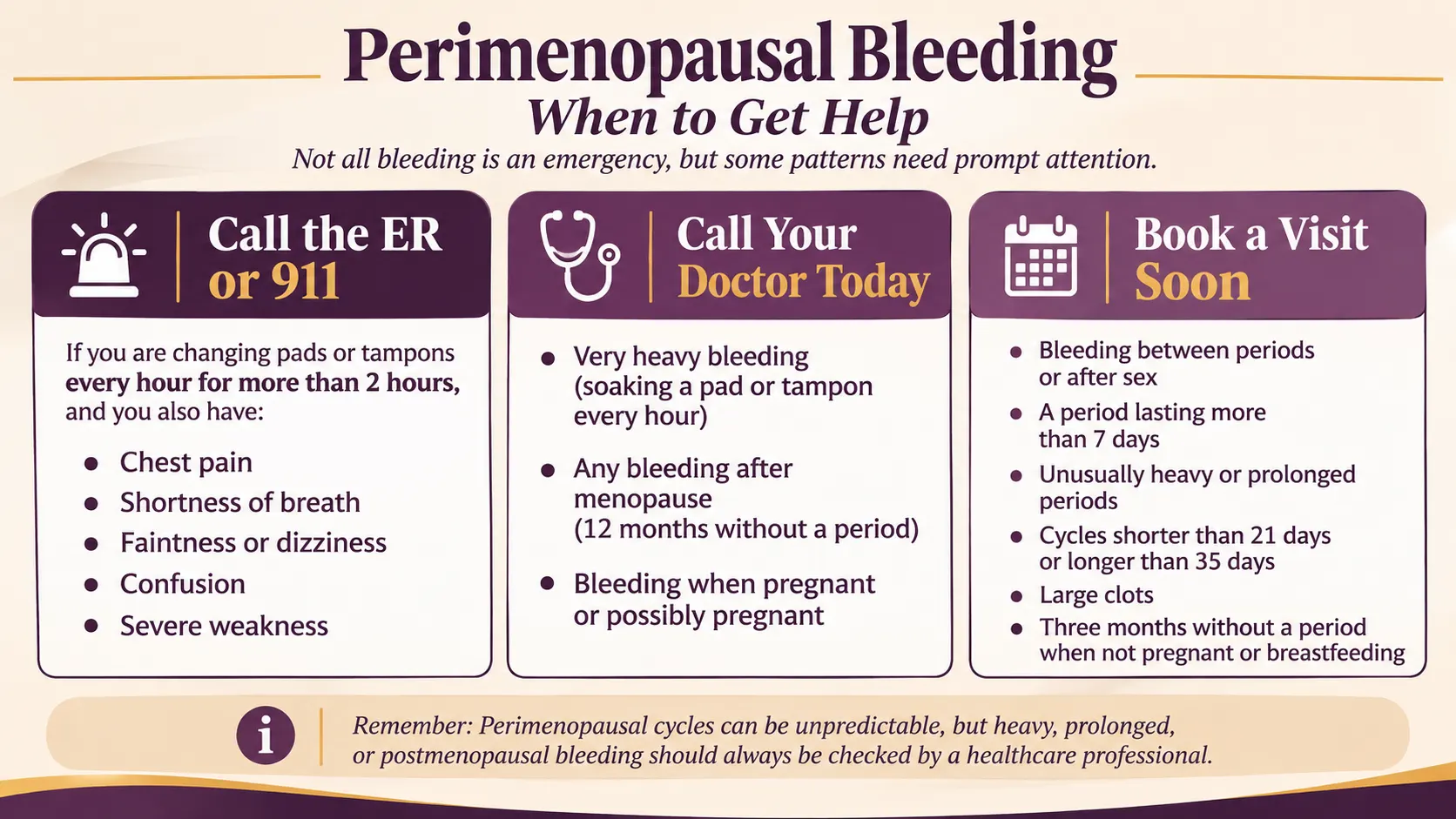
When to worry about perimenopausal bleeding comes down to a short list. Periods that run shorter, longer, lighter or heavier, or that skip a month, are common in your forties, as our perimenopause symptoms guide explains. The American College of Obstetricians and Gynecologists (ACOG) still lists several patterns as abnormal and worth a call to your ob-gyn. They include soaking a pad or tampon every hour, bleeding between periods or after sex, and any bleeding after menopause. Thyroid problems and chronic stress can shift a cycle, but a doctor should check the uterus first. Heavy bleeding with chest pain, shortness of breath or dizziness is an emergency, as the block below explains.
Call your doctor now or go to the ER if any of these are true. The three tiers are our sorting of thresholds published by ACOG, MedlinePlus and the Office on Women’s Health.
- Go to the ER or call 911. You are changing pads or tampons every hour for more than 2 hours in a row, and you also have chest pain, shortness of breath, and lightheadedness or dizziness. ACOG says to seek emergency medical care right away in that situation. Our own safety advice is wider than ACOG’s wording: if heavy bleeding comes with chest pain, trouble breathing, or you feel faint, confused or too weak to stand, call 911 and do not drive yourself. The Office on Women’s Health also lists dizziness, weakness, chest pain or trouble breathing with heavy bleeding as reasons to call a doctor.
- Call your ob-gyn or doctor today. Your bleeding is very heavy (MedlinePlus: contact your provider right away). You are soaking through a pad or tampon every hour, which ACOG counts as abnormal bleeding. You have any bleeding after menopause, meaning 12 months or more after your last period (ACOG: go directly to your ob-gyn). You are bleeding and are or could be pregnant (MedlinePlus lists pregnancy among the reasons to contact your provider).
- Book a visit soon. ACOG lists bleeding or spotting between periods, bleeding or spotting after sex, a period that lasts more than 7 days, heavy bleeding during your period, and cycles shorter than 21 days or longer than 35 days (ACOG). It also lists bleeding that is heavier or longer than your usual during perimenopause (ACOG). The Office on Women’s Health adds a period more often than every 24 days or less often than every 38 days, clots larger than a quarter, and three months without a period when you are not pregnant or breastfeeding.
Our advice: make these calls before a hormone test, a supplement trial or a thyroid result. Bleeding is a question for an ob-gyn exam first, and the sections below show how the thyroid, stress and hormone side fits in afterward.
Key Takeaways
- Cycle changes in the forties are expected, and ACOG still asks you to talk with your ob-gyn about bleeding changes.
- In the Study of Women’s Health Across the Nation (SWAN), two thirds of women reported spotting for 6 or more days at least three times during the transition, and ACOG still lists spotting between periods as abnormal.
- Any bleeding after 12 months without a period needs an ob-gyn visit. Cancer is the least likely cause, yet about 10% of women with postmenopausal bleeding have it.
- An underactive thyroid is linked to heavy and frequent bleeding, and chronic stress is linked to irregular periods, but both come after the uterus has been checked.
- A two-cycle bleeding log turns “something is off” into dates, amounts and questions a clinician can use.
Your period ran like clockwork for thirty years. Now it arrives twice in one month, or vanishes for two, then comes back heavy enough to cancel your plans. You search for answers late at night and find page after page that says “it’s probably hormones.” Maybe it is. Dr. Goldstein names the three answers women hear when their tests come back normal: “It’s just stress, take an antidepressant. It’s just aging, learn to live with it. Or it’s all in your head, see a therapist.” With bleeding, “just aging” skips a step. Someone has to check the uterus, the lining and the blood count before anyone says hormones. This page sorts what can wait for a regular appointment from what cannot.
What Cycle Changes Are Common in Your Forties
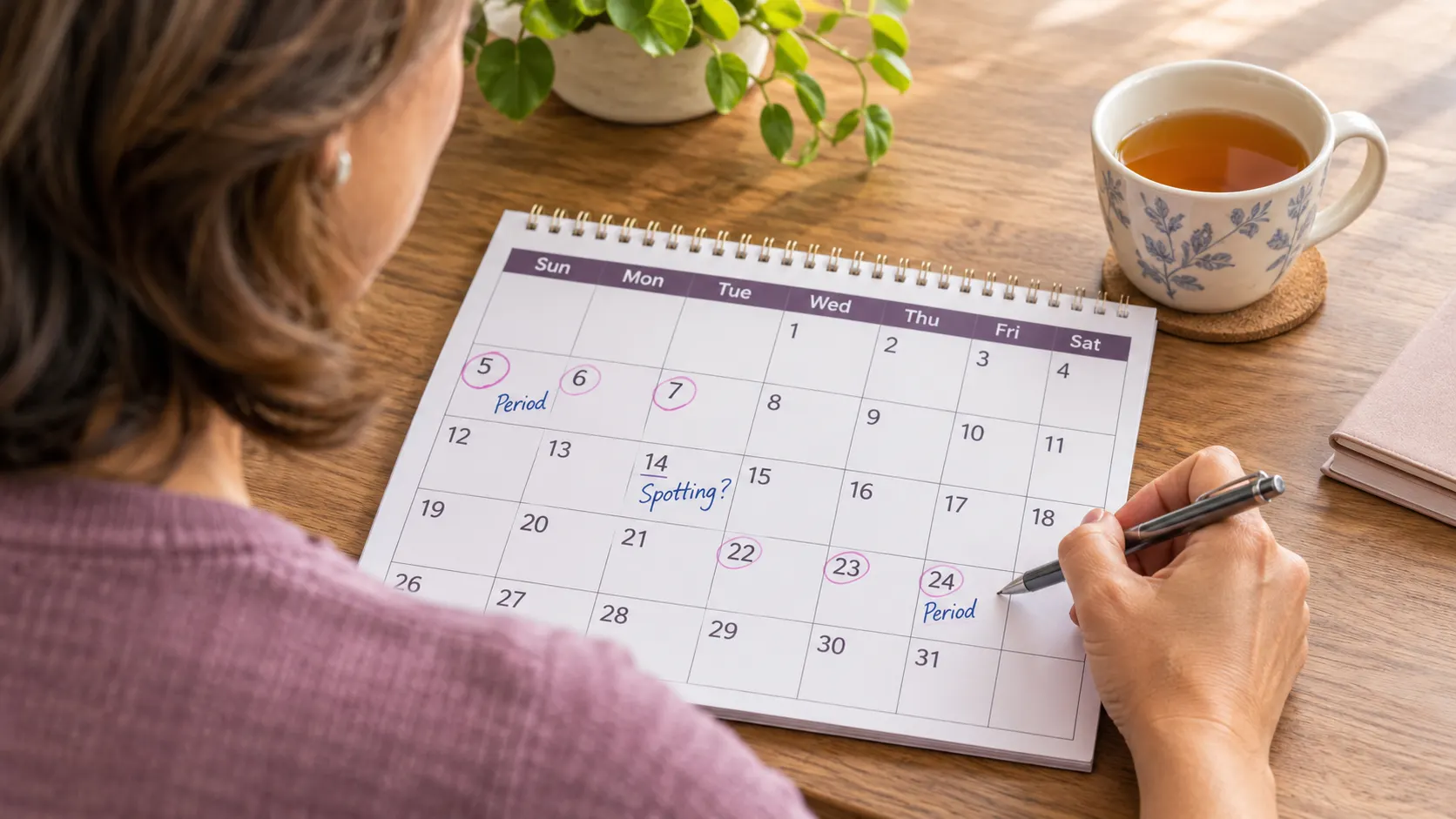
Periods commonly change in the forties: the days between them shift, flow gets heavier or lighter, and some months are skipped.
Perimenopause is the menopause transition, the years of changing cycles before periods stop. Menopause is confirmed after 12 months without a period, and the average age of the last period in the United States is 51, according to ACOG.
Abnormal uterine bleeding is bleeding from the uterus that lasts longer than usual or happens at an irregular time, according to MedlinePlus. It includes spotting between periods, bleeding after sex, heavier or longer periods, and bleeding after menopause.
The cause is the ovaries. ACOG explains that during perimenopause the ovaries make less estrogen, and some months they release an egg while other months they do not. Clinicians stage the transition by cycle pattern, and the STRAW+10 criteria in the table below show where the stages begin. Our guide to how long the menopause transition lasts walks through the stages.
Sources draw the lines slightly differently, so treat the numbers as prompts to call, not as a diagnosis.
| Source | What it counts as a usual cycle | What it flags |
|---|---|---|
| ACOG, abnormal uterine bleeding | 21 to 35 days; a period up to 7 days | Soaking a pad or tampon every hour; bleeding over 7 days; cycles under 21 or over 35 days; spotting between periods; bleeding after sex; no period for 3 to 6 months; bleeding after menopause |
| ACOG, perimenopausal bleeding | 24 to 38 days; a period up to 8 days | Bleeding or spotting between periods or after sex; heavy bleeding; bleeding heavier or longer than usual; bleeding after menopause |
| Office on Women’s Health | Not defined | A period more often than every 24 days or less often than every 38 days; 3 months without a period when not pregnant; any unusual bleeding |
| STRAW+10 staging | Not defined | Early transition: 7 or more days of difference between cycles. Late transition: 60 days or more without a period |
How common is trouble? In SWAN, 1,320 midlife women kept daily menstrual calendars from 1996 to 2006. At least three occurrences of 6 or more days of spotting were reported by 66.8% of them, and at least three occurrences of 3 or more days of heavy bleeding by 34.5%. The authors wrote that these figures show how often such bleeding is expected, which helps clinicians decide what to do. Expected still leaves a clinician’s exam on the table, because ACOG lists several of these same patterns as abnormal. Our 34 symptoms of perimenopause list places heavier or longer bleeding among the body-system patterns of the transition.
Perimenopause does not end the chance of pregnancy. The Menopause Society says women in perimenopause can still get pregnant, and that women who do not want a pregnancy should keep using birth control until menopause is confirmed. A skipped period can mean a lot of things, and a pregnancy test is one of them.
Free 3-minute quiz from Dr. Angela Goldstein, ND
Stress, thyroid and sex hormones work as one system. Answer 22 quick questions and see which one is under the most strain for you.
What you’ll get:
- ✓A score for each system: stress, thyroid and sex hormones
- ✓Which pattern your answers fit, and how the systems pull on each other
- ✓Built on published research
- ✓A clear next step for your pattern
Free. 22 questions, about 3 minutes.
Educational content. Always talk with your doctor before changing any treatment.
Perimenopausal Bleeding That Needs a Visit, and What the Doctor Is Looking For
Bleeding that falls outside the usual changes needs an ob-gyn visit because the possible causes range from harmless to serious, and only an exam sorts them.
Most causes are benign. ACOG lists problems with ovulation, fibroids and polyps, adenomyosis, bleeding disorders, medications and, less often, cancer. The pattern of bleeding hints at the likely suspect, and only an exam confirms it.
| What you notice | Causes a doctor checks | Source |
|---|---|---|
| Spotting or bleeding between periods | Hormone changes, polyps or fibroids, infection of the cervix or uterus, an underactive thyroid, stress, and less often cancer or precancer | MedlinePlus |
| Bleeding after sex | Polyps on the cervix; after menopause, thinner vaginal tissue; infection or inflammation | ACOG; ACOG, bleeding after menopause |
| Heavy or long periods | No ovulation (which can thicken the lining), fibroids, polyps, adenomyosis, a bleeding disorder, blood thinners or aspirin, a copper IUD, hypothyroidism | ACOG |
| Any bleeding after menopause | Thin or dry tissue, polyps, a thickened lining (endometrial hyperplasia), a change in hormone therapy, uterine cancer | Cleveland Clinic |
Timing matters here. When ovulation stops for several cycles, ACOG says, areas of the endometrium (the uterine lining) can become too thick. Endometrial hyperplasia, a thickened lining that is not cancer but sometimes leads to it, most often follows too much estrogen and not enough progesterone. Our piece on estrogen dominance symptoms covers the symptom side of that balance, and a bleeding pattern gets a lining check before any supplement. Early treatment of hyperplasia may reduce the risk of cancer developing.
ACOG says abnormal bleeding can be an early sign of endometrial cancer. It adds that most cases occur in women in their mid-60s who are past menopause and that bleeding is the most common sign in postmenopausal women. When cancer is found early, most cases can be treated successfully. In ACOG’s patient article on bleeding after menopause, an ob-gyn calls cancer the most serious but least likely cause. MedlinePlus puts the cancer risk at about 10% in women with postmenopausal bleeding, and Cleveland Clinic gives the same figure. Most women will have a benign cause, and one in ten is enough that nobody should wait.
Heavy bleeding also has a body-wide cost. ACOG notes that a complete blood count can show anemia, and MedlinePlus says you may feel tired if you lose too much blood over time. Deepening tiredness is a reason to ask about iron and blood count, not only hormones.
Thyroid and Bleeding: What the Research Supports
An underactive thyroid is linked to heavy or irregular periods, so a thyroid blood test belongs in the workup after the uterus has been checked.
The National Institute of Diabetes and Digestive and Kidney Diseases (NIDDK) lists heavy or irregular menstrual periods among the symptoms of hypothyroidism. The list also includes tiredness, weight gain, trouble tolerating cold, dry skin and thinning hair. ACOG names hypothyroidism among the medical conditions that can come with a lack of ovulation, and MedlinePlus lists an underactive thyroid among the causes of bleeding between periods.
A 2023 review in the International Journal of Molecular Sciences by Brown and colleagues puts numbers around the problem. Thyroid disorders affect nearly 14% of adult women, and women are 3 to 5 times more likely than men to be treated for one. The review links hypothyroidism to heavy bleeding and polymenorrhea (frequent periods), and hyperthyroidism to oligomenorrhea (infrequent periods) and amenorrhea (no periods).
| Thyroid state | Menstrual pattern reported | Source |
|---|---|---|
| Underactive (hypothyroidism) | Heavy or irregular periods; heavy bleeding and frequent periods | NIDDK; Brown 2023 |
| Overactive (hyperthyroidism) | Infrequent or absent periods | Brown 2023 |
The same review adds a limit: recent studies found significant differences in menstrual disturbance only in severe thyroid disease. That suggests a mildly high TSH is an unlikely single explanation for dramatic bleeding. A thyroid result is not a reason to skip an exam for a pattern that needs one. Our page on telling thyroid trouble from perimenopause covers the overlap in more depth.
How is it checked? NIDDK says health care professionals usually check TSH first, and that abnormal results call for at least one more test to find the cause. NIDDK also states that a hypothyroidism diagnosis cannot be based on symptoms alone, since many symptoms overlap with other diseases. A borderline result sits in the gray zone we cover in our page on subclinical hypothyroidism.
Dr. Goldstein reads the thyroid inside the larger system: “Your thyroid can be normal while still being shut down by stress.” Once bleeding has been evaluated, she asks what the thyroid, the stress response and the sex hormones are doing together.
Chronic Stress and the Cycle
Chronic stress is linked to irregular periods, and one NIH-led study tied high daily stress to a higher chance of skipped ovulation.
The Office on Women’s Health says that studies show high levels of chronic stress can lead to irregular periods. The strongest direct evidence comes from the BioCycle Study. Researchers at the National Institute of Child Health and Human Development followed 259 healthy women ages 18 to 44 for two cycles. High versus low daily stress was associated with lower estradiol, lower luteal progesterone (the hormone made after ovulation) and higher odds of anovulation, with an adjusted odds ratio of 2.2.
Read that study for what it is. The women were healthy and of reproductive age, and none was described as perimenopausal. It supports a link between stress and ovulation, and it does not show that stress causes heavy bleeding at 47. It also lines up with a pattern our low progesterone symptoms page describes, because ovulation is the main source of progesterone.
Dr. Goldstein describes the chain she sees in practice: “So when you’re under chronic stress, your adrenal pumps out cortisol constantly. High cortisol tells your thyroid to slow down because your body thinks there’s a famine. Your thyroid slowing down disrupts your sex hormones because your body thinks it’s not safe to reproduce.” The first link has published support. A 2026 paper by Gierach and Junik in Endokrynologia Polska states that cortisol inhibits the secretion of TRH and TSH, the signals that run the thyroid. Our article on how cortisol and thyroid interact lays out the circuit.
None of this changes the order of operations. A stressed woman with heavy bleeding can also have a polyp.
What the Workup Looks Like, and Where Hormone Testing Fits
A bleeding workup starts with your history and a pelvic exam, and hormone testing comes after the structural questions are answered.
The visit starts with your history. ACOG says it should cover your health history, medications including over-the-counter ones, and when the bleeding occurs and how much. A physical and pelvic exam, a complete blood count and a pregnancy test come next. Depending on age and symptoms, the list grows to include ultrasound, hysteroscopy (a thin scope that views the inside of the uterus) and endometrial biopsy (a small tissue sample of the lining). MedlinePlus adds that thyroid function tests may be ordered. Treatment depends on the cause. Hormonal birth control methods and hormone therapy can help heavy bleeding during perimenopause, according to ACOG, and prescription options such as tranexamic acid are also used. A clinician should weigh benefits and risks against your history.
Where do hormone labs fit? Later, and with caution. Dr. Goldstein puts the limit this way: “Standard labs measure diseases, not function.” In the transition the numbers also move. STRAW+10 describes follicle-stimulating hormone (FSH) in the early transition as elevated but variable, and in the late transition as sometimes in the menopausal range and sometimes not. A single draw on a single day can mislead in either direction. Our guide to hormone testing for women explains what each test shows and why timing matters.
Dr. Goldstein compares the endocrine system to an orchestra, where one instrument out of tune makes the whole sound wrong. The ob-gyn exam checks the instrument that is bleeding. The whole-system workup then asks whether the thyroid, the stress response and the sex hormones are playing together. Our piece on what perimenopause labs can and cannot show explains what each lab can tell you.
Keep a Bleeding Log for Two Cycles
ACOG recommends tracking your bleeding for several weeks before a visit, noting dates, length and type (light, medium, heavy or spotting). A one-page log makes the appointment productive. For each day of bleeding, write down:
- The date and whether it was spotting, light, medium or heavy.
- How many pads or tampons you used, and whether you changed one overnight.
- Clots, and roughly how large.
- Pain, dizziness, a racing heart or unusual tiredness.
- Bleeding after sex.
- How you slept and how stressful the week was.
- Any new medication, supplement or change in birth control or hormone therapy.
After two cycles the log sorts itself into questions:
| If the log shows | Question to bring to the visit |
|---|---|
| Spotting between periods or after sex | Could this be a polyp or a change at the cervix, and what exam do I need? |
| Heavy flow, clots, changing protection overnight, growing tiredness | Should my blood count and iron be checked? |
| Cycles getting shorter than 21 days | Is ovulation changing, and do I need an ultrasound? |
| Three months with no period | Do I need a pregnancy test and a thyroid test? |
| Any bleeding after 12 months with no period | Do I need a pelvic exam, an ultrasound or a biopsy? |
| Fatigue, feeling cold, dry skin and thinning hair along with heavy periods | Can we check TSH? |
| The heaviest weeks follow the most stressful or sleepless weeks | Once the uterus is checked, can we look at the stress response too? |
Perimenopausal Bleeding Care in San Juan Capistrano or by Video Across California
Heavy, sudden or postmenopausal bleeding belongs with an ob-gyn, urgent care or the ER first. The Natural Path office is not an emergency service.
Once an ob-gyn has examined the uterus, the practice works up the thyroid, stress and hormone side alongside that care. Patients are seen in person at the San Juan Capistrano office, a practical drive for women in Dana Point, Laguna Niguel and Lake Forest. Office hours are Monday, Tuesday and Thursday from 10:00am to 6:00pm. Women anywhere in California can be seen by video, and licensing limits video care to patients located in California.
Our perimenopause and hormone care in Orange County page explains how the evaluation reads the whole picture.
The telemedicine program covers patients inside or outside Orange County.
Hours and directions are on the contact page.
Frequently Asked Questions
Is spotting normal in perimenopause?
Spotting is common in the transition and still worth mentioning. ACOG lists spotting between periods as abnormal and advises talking with your ob-gyn about it, even though two thirds of women in SWAN had repeated spotting episodes.
How long can a perimenopausal period last before I should worry?
ACOG’s abnormal bleeding page says a period lasting more than 7 days is abnormal, and its perimenopause page describes a normal period as lasting up to 8 days. A period that runs longer or heavier than your own usual is a reason to call.
Can stress cause heavy periods in perimenopause?
Chronic stress is linked to irregular periods, and in the BioCycle Study high daily stress was tied to higher odds of anovulation. Evidence that stress causes heavy bleeding in perimenopause itself is thin, so heavy bleeding still gets an exam.
Can a thyroid problem cause bleeding in perimenopause?
It can contribute. NIDDK lists heavy or irregular periods among the symptoms of an underactive thyroid, and a TSH test is usually the first step. Brown and colleagues found significant menstrual disturbance mainly in severe thyroid disease.
Can I still get pregnant, and could that explain the bleeding?
Yes. The Menopause Society says women in perimenopause can still get pregnant, and a pregnancy test is part of ACOG’s list of tests for abnormal bleeding.
Does bleeding after menopause mean cancer?
ACOG calls cancer the least likely cause of bleeding after menopause, and Cleveland Clinic and MedlinePlus both put the figure near 10%. That is enough to make every episode worth an ob-gyn visit, from light spotting to a full period.
Should I get hormone tests before seeing my doctor about bleeding?
See the doctor first. Hormone levels swing during the transition, so one result can mislead, and the exam checks for causes that hormone labs cannot show.
Where to Start
Once your bleeding has been checked, watch Dr. Goldstein’s free Master Class to see how the thyroid, the stress response and the sex hormones work as one system.
Written by The Natural Path clinical content team, based on the teaching of Dr. Angela Goldstein, ND.
This article is for general education and is not medical advice. It is not intended to diagnose or treat any disease, does not establish a doctor-patient relationship, and is not a substitute for care from your own clinician. Abnormal bleeding can have serious causes. If you are bleeding heavily or feel faint, call 911 or go to the nearest emergency room. Do not start, stop or change any prescribed medication based on what you read here.