

Written by The Natural Path clinical content team, based on the teaching of Dr. Angela Goldstein, ND.
Estrogen dominance symptoms are a pattern of heavy or irregular periods, breast tenderness, worse premenstrual symptoms, mood changes and weight gain around the waist and hips. Some clinicians trace the pattern to estrogen running high relative to progesterone. “Estrogen dominance” is a functional medicine term, not a formal diagnosis, and the sources behind this page give no lab cutoff for it. The idea has real support in one place: in perimenopause, studies measured higher estrogen in some cycles and lower progesterone after ovulation. Heavy bleeding, fibroids, endometriosis, thyroid disease and polycystic ovary syndrome can produce the same symptoms, and they need a doctor’s workup first. Dr. Angela Goldstein, ND reads estrogen together with progesterone, the thyroid and the stress response.
Key Takeaways
- Estrogen dominance describes estrogen that is high relative to progesterone. It is an informal term, and a normal estradiol result does not settle the question either way.
- The research behind it comes mostly from perimenopause, where some cycles show higher estrogen and lower progesterone. The pattern varies a lot from woman to woman.
- Soaking a pad or tampon every hour for 2 to 3 hours, large clots or bleeding past 7 days need a clinician’s visit before any other step.
- Every symptom on the usual list has other causes, including an underactive thyroid, fibroids, endometriosis and anemia from blood loss.
- In Dr. Goldstein’s model, the stress response, thyroid and sex hormones are connected, so one hormone ratio is rarely the whole story.
Maybe your periods turned heavy in your early 40s, your breasts ache the week before, and your waistline changed without a reason you can find. Maybe a video told you it was estrogen dominance while your doctor said the labs look normal. Both can hold some truth. This page separates what the research supports from what gets repeated online, and it lists what to rule out with a doctor. For how the practice reads these hormones together, see its hormones and perimenopause care.
What “Estrogen Dominance” Means
Estrogen dominance means estrogen is high relative to progesterone. Medical News Today defines it as high estrogen relative to progesterone in females. Cleveland Clinic says some healthcare providers call this “estrogen dominance” and ties it to a physical effect called unopposed estrogen.
Estrogen dominance is an informal term for estrogen that is high relative to progesterone. Neither Cleveland Clinic nor Medical News Today gives a lab cutoff for it.
Unopposed estrogen is estrogen acting on the lining of the uterus without enough progesterone to balance it. Cleveland Clinic says this can cause cell overgrowth in the lining.
The ratio can tilt in two ways. Progesterone can fall, and the usual reason is that ovulation does not happen in a given cycle. MedlinePlus explains that estrogen and progesterone are released as part of the process of ovulation and that abnormal bleeding can occur when the ovaries do not release an egg. Or estrogen can rise, and Cleveland Clinic lists medications, overweight or obesity, stress, alcohol, liver problems and xenoestrogens (chemicals that act like estrogen) among the factors.
The term does one thing well: it names a ratio. It does one thing badly: it suggests that a single hormone number or a single supplement explains a long list of symptoms. The next sections show what the evidence can and cannot carry.
Estrogen Dominance Symptoms: What the Sources List
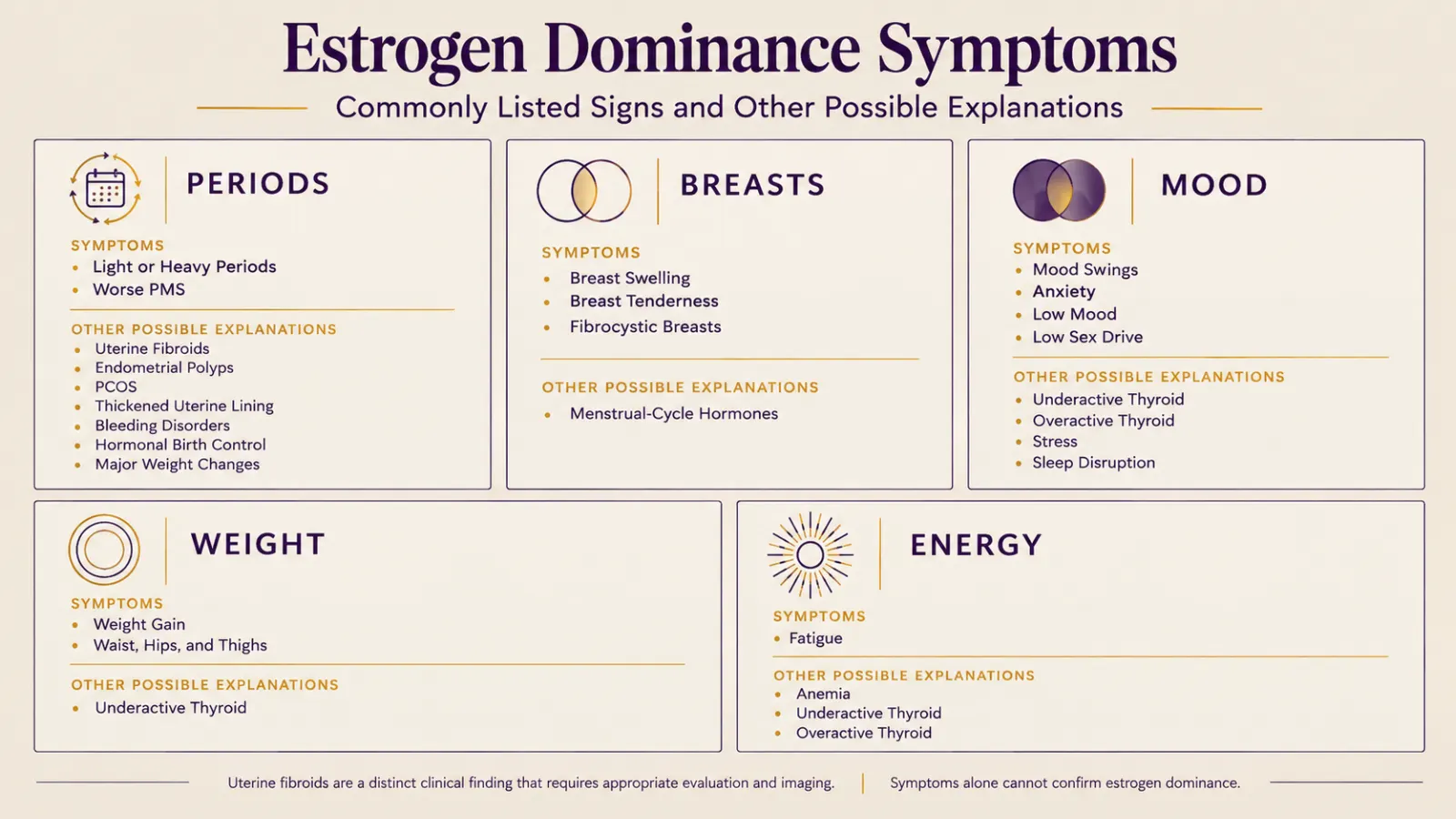
Cleveland Clinic lists ten symptoms for females, and Medical News Today lists a similar set. These lists describe a pattern that clinicians report. The sources do not say how often each symptom occurs, and none of the symptoms belongs to estrogen alone.
| Symptom | Listed by | Other explanations to rule out |
|---|---|---|
| Light or heavy periods | Cleveland Clinic; Medical News Today | Fibroids, polyps, polycystic ovary syndrome, thickening of the uterine lining, bleeding disorders, hormonal birth control and big weight changes (MedlinePlus); underactive thyroid (NIDDK) |
| Worse PMS, mood swings, anxiety, low mood, low sex drive | Cleveland Clinic; Medical News Today | Underactive thyroid lists depression (NIDDK); overactive thyroid lists nervousness, irritability and trouble sleeping (NIDDK); stress lists loss of sleep (NIMH) |
| Breast swelling and tenderness, fibrocystic breasts | Cleveland Clinic; Medical News Today | Cycle-related changes: MedlinePlus says hormone changes during the menstrual cycle may lead to breast swelling |
| Weight gain at the waist, hips and thighs | Cleveland Clinic; Medical News Today | Underactive thyroid lists weight gain (NIDDK); see perimenopause weight gain |
| Fatigue | Cleveland Clinic; Medical News Today | Anemia from heavy bleeding (MedlinePlus); underactive and overactive thyroid both list fatigue (NIDDK) |
| Uterine fibroids | Cleveland Clinic; Medical News Today | A finding that needs imaging, covered in the next section |
Medical News Today adds bloating, headaches, disrupted sleep and hair loss as possible additional symptoms. Each has a long list of causes, and NIDDK notes that even fatigue and weight gain are common and do not necessarily mean a thyroid problem.
Rule Out These First
Several conditions that cause “estrogen dominance” symptoms have their own workups, and they come before any hormone-balancing step. A clinician can check each one.
Heavy bleeding. MedlinePlus describes heavy bleeding as passing large clots, soaking through a pad or tampon every hour for 2 to 3 hours in a row, or bleeding that lasts more than 7 days. It adds that losing too much blood over time can cause fatigue from anemia. If any of that sounds like your cycle, call your clinician. If you are or might be pregnant, any bleeding goes to your OB.
The uterine lining. A 2022 review states that chronic exposure to unopposed estrogen is the most important risk factor for endometrial hyperplasia. Hyperplasia is a thickening of the lining and the precursor lesion for endometrioid endometrial cancer, the most common cancer of the female reproductive tract in industrialized countries. The review describes management that ranges from surveillance or progestin therapy through to hysterectomy, depending on risk. MedlinePlus lists long, heavy or frequent bleeding after age 40 among the symptoms of endometrial cancer. This is why heavy or frequent bleeding after 40 earns an exam and testing rather than a supplement.
Fibroids. The Office on Women’s Health says about 20% to 80% of women develop uterine fibroids by age 50, and they are most common in the 40s and early 50s. Symptoms can include heavy or painful periods, sometimes heavy enough to cause anemia. The same page says researchers think hormones play a role and that no one knows for sure what causes fibroids.
Endometriosis. The Office on Women’s Health says at least 11% of women have endometriosis and that it is more common in women in their 30s and 40s. The same page says estrogen appears to promote it. Severe cramps, pelvic pain and spotting between periods are common symptoms.
Underactive thyroid. NIDDK lists heavy or irregular menstrual periods, fatigue, weight gain and depression among its symptoms. A 2023 review of the thyroid axis and female reproduction found that hypothyroidism has been associated with heavy bleeding and polymenorrhea (frequent periods). For how to tell the two apart, see thyroid or perimenopause.
Polycystic ovary syndrome. MedlinePlus lists it among the causes of abnormal uterine bleeding, along with significant weight changes and hormonal birth control.
A new breast lump. MedlinePlus says to contact a provider for new, unusual or changing breast lumps, one-sided lumps, or nipple discharge, particularly bloody or brown discharge.
Free 3-minute quiz from Dr. Angela Goldstein, ND
Stress, thyroid and sex hormones work as one system. Answer 22 quick questions and see which one is under the most strain for you.
What you’ll get:
- ✓A score for each system: stress, thyroid and sex hormones
- ✓Which pattern your answers fit, and how the systems pull on each other
- ✓Built on published research
- ✓A clear next step for your pattern
Free. 22 questions, about 3 minutes.
Educational content. Always talk with your doctor before changing any treatment.
What Research Supports in Perimenopause
The idea of a relative estrogen excess has its best support in the late 30s to 50s, when ovulation becomes less reliable. Three studies and one review give the picture.
- Santoro 1996. A small study followed 6 women aged 47 and older for 6 months with daily urine samples, and added 5 women aged 43 to 47 for one cycle. Perimenopausal women had higher estrone conjugate excretion and lower luteal phase pregnanediol excretion (pregnanediol is a breakdown product of progesterone) than younger women. The authors described hyperestrogenism with decreased luteal phase progesterone excretion and saw these changes as early as age 43.
- Hale 2007. A study of 76 healthy women who gave blood samples across one cycle found that ovulatory cycle estradiol rose and luteal phase progesterone fell as women moved through the stages of reproductive aging. Nine anovulatory cycles appeared in the late menopause transition group, against one in the early transition group.
- Prior 2011. J.C. Prior argues that perimenopause is characterized by erratically higher estradiol and decreased progesterone rather than a simple decline in estrogen. Prior reports that about a third of perimenopausal cycles show a major estradiol surge during the luteal phase. In a companion review, Prior reports that about 25% of perimenopausal women have heavy menstrual bleeding and about 10% have breast pain. These are one research group’s interpretations in review papers, so treat them as a leading hypothesis.
- Swiss Perimenopause Study 2021. A study of 127 women aged 40 to 56 over 13 months found highly individual fluctuations of estradiol and progesterone and no continuous decline during the observed period.
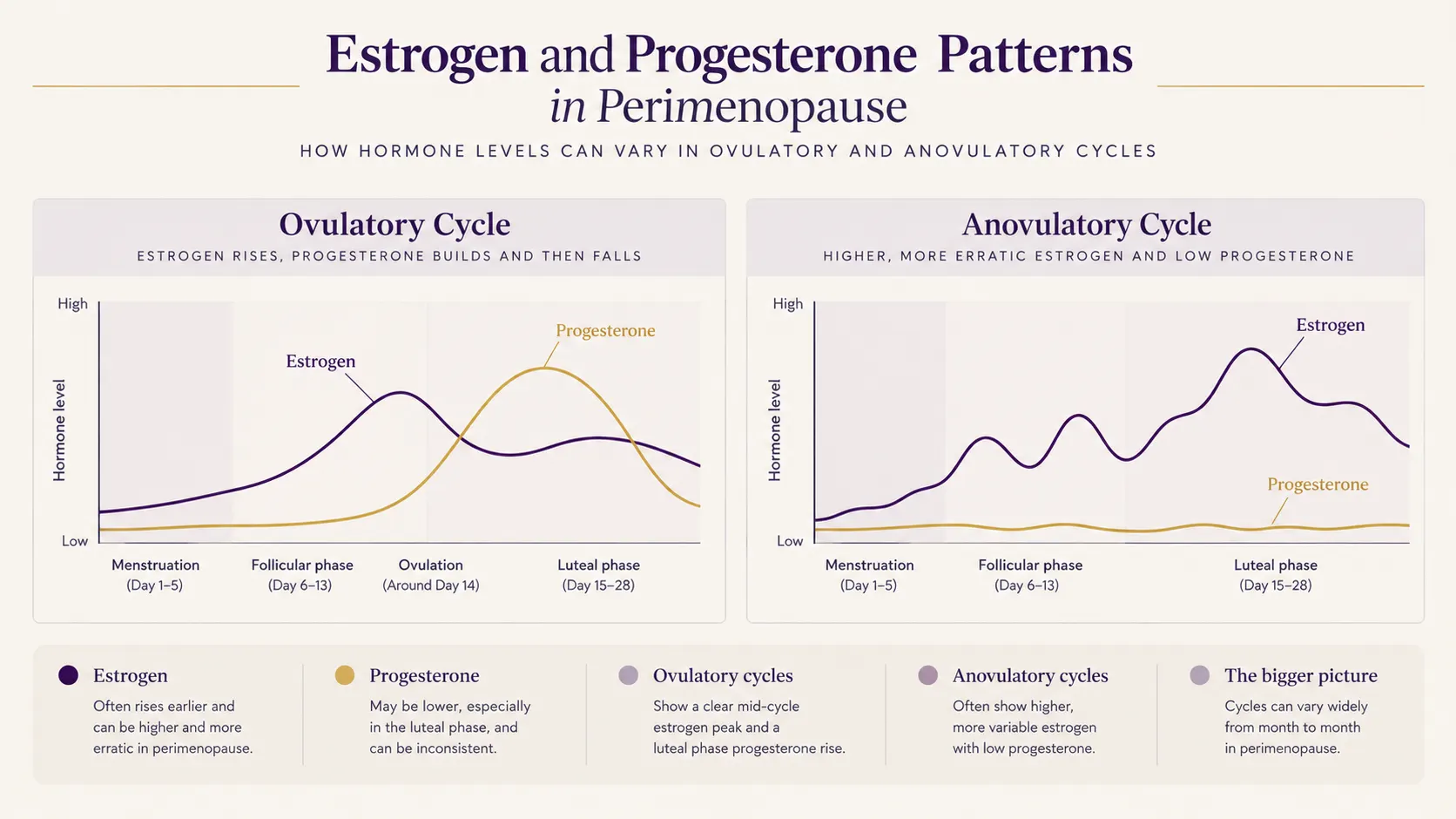
Read together, the studies show that higher estrogen and lower progesterone do occur in some women in some cycles. Several samples are small, the methods differ (urine, blood and saliva), and the Swiss study found large differences between women. So the pattern is real for some women and unpredictable for any one woman, and a single test taken on one day is unlikely to show which cycle you are in. For symptoms that arrive in waves, this is the likely reason.
Estrogen Dominance, Low Estrogen or Low Progesterone?
These are three different questions, and each has its own page. If your main symptoms are hot flashes, night sweats, vaginal dryness or stopped periods, start with low estrogen symptoms.
If you are mostly dealing with short or skipped cycles, trouble sleeping and anxiety, low progesterone symptoms goes through them.
This page covers the ratio idea and the heavy, tender, bloated cycle pattern attached to it.
Because hormones fluctuate in perimenopause, the same woman can fit more than one of those pages within a year. The perimenopause symptoms guide covers the transition as a whole.
Same Symptom, Different System
A symptom list sorted by one hormone leaves out the systems that move it. Dr. Goldstein describes the whole endocrine system with an orchestra.
“When they’re all playing together in harmony, you feel great. But if one instrument is out of tune, if one hormone system is off, the whole orchestra sounds terrible.”
Dr. Angela Goldstein, ND, Master Class
She teaches that three systems break down most often, and that they are connected:
“In my 25 years of practice, I found three systems break down most often. Thyroid, adrenals, and sex hormones. And here’s the key. These three systems are interconnected. You cannot fix one without addressing the others.”
Dr. Angela Goldstein, ND, Master Class
Her cascade runs like this: under chronic stress, “your adrenal pumps out cortisol constantly,” and “high cortisol tells your thyroid to slow down because your body thinks there’s a famine.” Then “your thyroid slowing down disrupts your sex hormones.” The research literature supports each direction of travel as a mechanism. A 2026 review in Endokrynologia Polska found that cortisol inhibits the secretion of TRH and TSH, the brain signals that drive the thyroid. The 2023 thyroid and reproduction review reports that thyroid hormones regulate the secretion of kisspeptin and GnRH, which sit upstream of the ovaries. The same review notes that thyroxine-binding globulin, the main carrier of thyroid hormone, doubles during pregnancy because of elevated estrogen. Another review reports that glucocorticoids inhibit the release of GnRH at the hypothalamus. These are mechanism findings. For the thyroid side in depth, see how cortisol and thyroid interact. The findings show why a heavy, tender or moody cycle can have more than one place to look.
The Natural Path’s free Hormone Orchestra Quiz asks 22 quick questions in about 3 minutes and scores three systems: your stress response, your thyroid and your sex hormones. Each system lands in one of four levels, from in tune to loudly out of tune. The score describes symptoms, not lab values, and it is educational rather than a diagnosis. Take the free Hormone Orchestra Quiz.
What Can Push Estrogen Higher
Cleveland Clinic lists six factors linked to high estrogen: medications, overweight or obesity, stress, alcohol, liver problems and xenoestrogens. Medical News Today adds gut dysbiosis, insulin resistance, polycystic ovary syndrome, fibroids and endometriosis to its causes list. These are associations, and which ones apply to you is a history question.
Dr. Goldstein points to two more inputs in her Master Class. On environmental chemicals in food, water, air and personal care products, she says, “They act like hormonal imposters.” On nutrition, she says, “Your hormones need specific nutrients to function.” The questions she asks keep returning to timing: when did this start, and what came before it? A heavy cycle that began after a stressful year, a medication change or a weight shift points to a different place than one that has been heavy since your teens.
Medical News Today adds a caution worth repeating: do not change or stop a medication without talking to your doctor, even if you suspect it raises estrogen.
Why One Hormone Number Can Mislead
A single estradiol result shows one moment in a cycle that changes by the week. Cleveland Clinic says that if you still have periods, blood tests may not be accurate because of the natural fluctuations of estrogen across the menstrual cycle. MedlinePlus says that because estrogen levels change so often, you may need to be tested more than once to look for a trend, and it lists blood, 24-hour urine and saliva as sample types. Medical News Today notes that females with signs of estrogen dominance may not need tests to show the ratio is off.
Dr. Goldstein adds a second reason in the Master Class: “Standard labs measure diseases, not function.” She continues, “Your hormones can be in range while being completely out of balance as a system.” In her telling, a normal result opens a different question: how the system is running. Her approach reads thyroid markers, stress-response patterns, cycle timing and symptoms alongside the sex hormones. The page on hormone testing for women goes through which test answers which question.
Timing matters as much as the test. What perimenopause labs can and cannot show covers when to draw and what a single result means.
What a First Visit Looks Like
The Natural Path’s first visit is about an hour, in person in San Juan Capistrano or by video. According to the practice’s description of the first appointment, it covers your health history from well before the symptoms started and a timeline of when things changed. It also includes a review of every medication and supplement and a read of your existing labs together as a pattern. Testing is chosen after that conversation, and results usually return in one to three weeks.
What helps most to bring:
- Your cycle dates for the last 3 to 6 months, with the heavy days marked
- Labs and any pelvic ultrasound from the past two to three years
- A list of every medication and supplement, with doses
- A short timeline: when the symptoms started and what was happening just before
The practice reads estrogen, progesterone and testosterone in relation to each other and to your stage of transition. If hormone therapy is part of your question, the page on bioidentical hormone therapy explains how those visits work.
For a walkthrough of the hour itself, see what to expect at a first functional medicine appointment.
Heavy bleeding, bleeding between periods or a suspected fibroid call for an exam and imaging. Your OB-GYN or primary care clinician can order those.
Estrogen Dominance Symptoms Care in Orange County and Across California
Women in Aliso Viejo, Laguna Hills and nearby towns can come to the San Juan Capistrano office, and women anywhere in California can start by video. The Natural Path’s telemedicine page says you have to be located in California at the time of the visit. Blood draws are ordered to a lab near you, and specialty kits for stool, urine or saliva ship to your home. The California telemedicine page explains the remote steps.
The contact page has the office hours and the phone number.
Frequently Asked Questions
What are the main estrogen dominance symptoms?
Cleveland Clinic lists breast swelling and tenderness, light or heavy periods, worse PMS, mood swings, anxiety or low mood and fatigue. Its list also includes low sex drive, fibrocystic breasts, uterine fibroids and weight gain at the waist, hips and thighs. Each has other possible causes, so a doctor’s workup comes first.
Is estrogen dominance a real diagnosis?
It is a descriptive term some clinicians use for estrogen that is high relative to progesterone. Higher estrogen and lower progesterone in some cycles is documented in perimenopause, and the label has no lab cutoff in the sources used here.
Can I have estrogen dominance if my estradiol is normal?
The term describes a ratio over time, and a single estradiol result shows one moment. MedlinePlus notes that repeat tests may be needed to see a trend. If your results keep coming back normal, read why normal labs can miss a struggling system.
Does estrogen dominance cause weight gain?
Cleveland Clinic lists weight gain mainly in the waist, hips and thighs among the symptoms. NIDDK also lists weight gain among the symptoms of an underactive thyroid, so the cause deserves a full look. See perimenopause weight gain.
Can stress cause estrogen dominance?
Cleveland Clinic lists stress among the factors linked to high estrogen. In Dr. Goldstein’s model, chronic stress raises cortisol, which slows the thyroid and disrupts sex hormones, so stress is where she starts looking.
Should I take progesterone cream or a supplement for it?
The sources opened for this page do not support a specific cream or supplement, so none is recommended here. Bring the names and doses of anything you take to your clinician, and do not start, stop or change a hormone or medication on your own.
Can men have estrogen dominance?
Medical News Today describes high estrogen in men, with enlarged breasts, erectile dysfunction and infertility among the symptoms. This page is written for women, so men with those symptoms should see a doctor.
Can I see you if I live outside Orange County?
Yes, if you are in California at the time of the visit. Video visits are available across the state, and the contact page shows how to reach the office.
Where to Start
Dr. Goldstein, who has practiced for 25+ years, walks through the three connected systems in her free Master Class, including how stress, thyroid and sex hormones affect one another. The practice describes the Master Class as the first step for every new patient. Watch the free Master Class.
Written by The Natural Path clinical content team, based on the teaching of Dr. Angela Goldstein, ND.
This article is for general education and is not medical advice. It does not establish a doctor-patient relationship and is not a substitute for care from your own clinician. Do not start, stop or change any hormone or prescribed medication based on what you read here. If you have an urgent medical concern, contact your physician or emergency services. Testimonials reflect individual experiences and results vary.