
Written by The Natural Path clinical content team, based on the teaching of Dr. Angela Goldstein, ND.
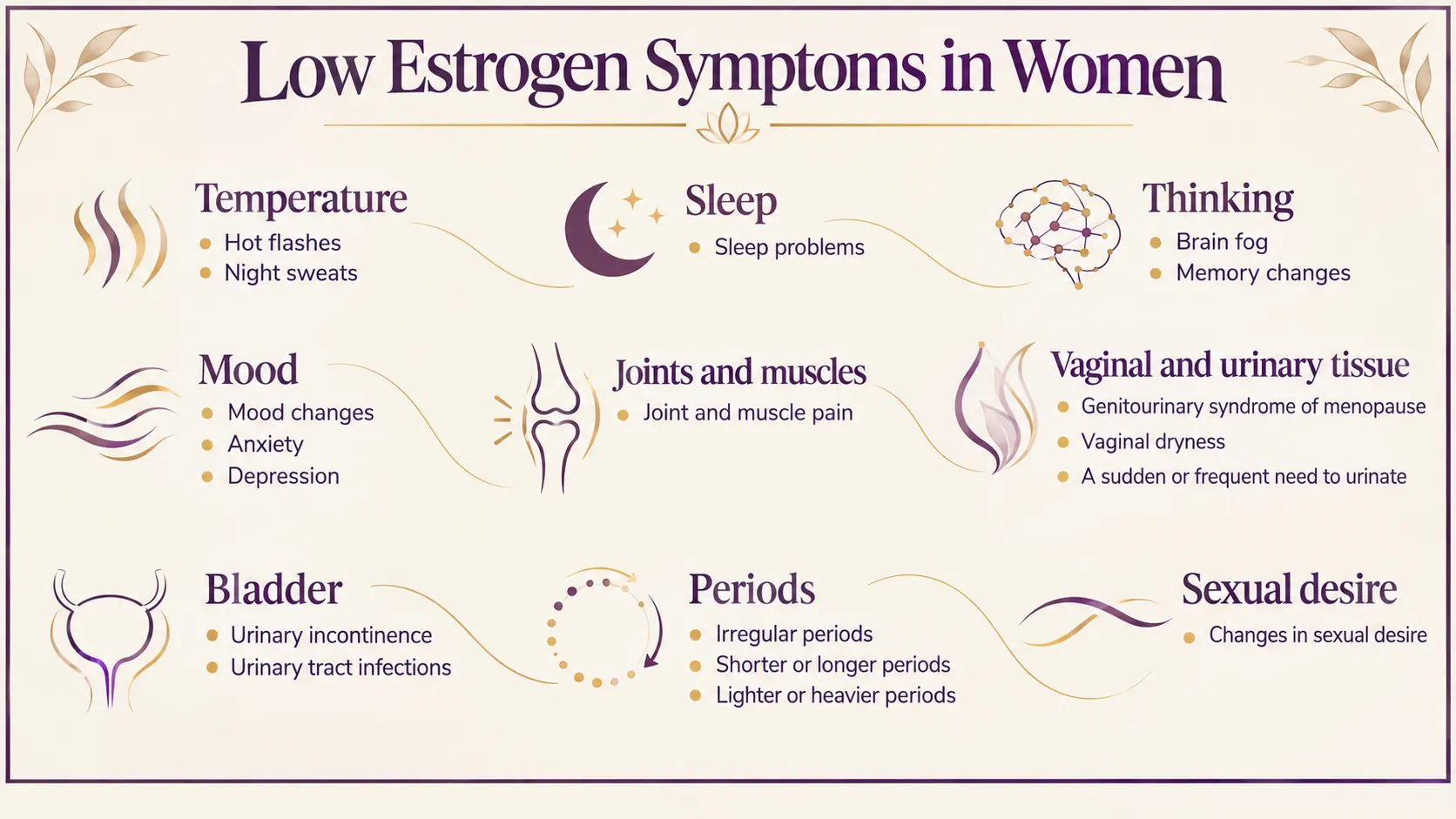
Low estrogen symptoms in women show up most often in perimenopause and menopause. They include hot flashes and night sweats, sleep problems, mood changes, brain fog, joint and muscle pain, vaginal dryness, urinary changes, shifting periods and lower sexual desire. In perimenopause, estradiol levels can swing from month to month instead of falling in a straight line, which is why symptoms come and go. Several of these symptoms are also listed for an overactive or underactive thyroid and for chronic stress, so one symptom list can point to three different systems. A woman under 40 whose periods have stopped should see a doctor first, because primary ovarian insufficiency needs a medical workup. The same goes for stopped periods after an eating disorder, hard athletic training or a recent pregnancy. Dr. Angela Goldstein, ND reads estrogen together with the thyroid and the stress response.
Key Takeaways
- Low estrogen symptoms in women are most often tied to the menopausal transition, which usually happens between ages 45 and 55.
- In perimenopause, estradiol tends to fluctuate, so a list of low estrogen symptoms is a better guide than a single lab number.
- Hot flashes, poor sleep, mood changes and irregular periods are also listed for thyroid problems and chronic stress.
- Missed periods before age 40, or after an eating disorder, hard athletic training or a recent pregnancy, call for a doctor’s visit first, not a supplement.
- In Dr. Goldstein’s model, the stress response, thyroid and sex hormones are interconnected, so estrogen is one instrument in the orchestra.
Maybe the night sweats came first, or the sleep went, or the words stopped coming when you needed them. Maybe someone told you it was stress, or aging, or that you should learn to live with it. A symptom list that long deserves a careful read, because the same symptom can come from more than one place. This page sorts the low estrogen symptoms by system.
What Low Estrogen Means in Women
Low estrogen means the ovaries are making less estrogen than the body has been used to, and the usual reason in midlife is the menopausal transition. Estrogen is one instrument in what Dr. Goldstein calls the endocrine orchestra, so the first question is whether this instrument is the one out of tune. Progesterone follows its own pattern and has its own page on low progesterone symptoms.
Estrogen is a sex hormone made by the ovaries. Estradiol and estrone are the forms measured on an estrogen levels test, according to MedlinePlus.
Perimenopause is the time before menopause when your hormone levels change, according to the Office on Women’s Health.
The Office on Women’s Health says the transition into menopause usually happens between ages 45 and 55, with an average age of 52 in the United States. It also says perimenopause lasts about four years on average but can last up to 10 years. Natural Path’s approach to hormone changes in perimenopause starts with reading the whole pattern. Menopause is reached after 12 months in a row with no period, and after that, per the same source, the ovaries make very little estrogen and progesterone. MedlinePlus puts it this way: during the menopausal transition, your ovaries start to make less of the estrogen and progesterone hormones.
Low Estrogen Symptoms in Women
The Office on Women’s Health lists these symptoms as ones that can begin in perimenopause and continue after menopause. Many women have only a few of them, and the mix differs from one woman to the next.
| Symptom group | What the source lists | Source |
|---|---|---|
| Temperature | Hot flashes and night sweats | Office on Women’s Health |
| Sleep | Sleep problems | Office on Women’s Health |
| Thinking | Brain fog and memory changes | Office on Women’s Health |
| Mood | Mood changes, anxiety and depression | Office on Women’s Health |
| Joints and muscles | Joint and muscle pain | Office on Women’s Health |
| Vaginal and urinary tissue | Genitourinary syndrome of menopause: vaginal dryness and a sudden or frequent need to urinate | Office on Women’s Health |
| Bladder | Urinary incontinence and urinary tract infections | MedlinePlus |
| Periods | Changes that may be irregular, shorter or longer, or lighter or heavier | MedlinePlus |
| Sexual desire | Changes in sexual desire | Office on Women’s Health |
The Office on Women’s Health explains the tissue symptoms directly: lower levels of estrogen can affect the tissues of your vagina, vulva, bladder and urinary tract. It also advises seeing your health care provider right away for vaginal bleeding after 12 months with no period.
One effect of low estrogen gives no warning. The National Institute of Arthritis and Musculoskeletal and Skin Diseases lists low estrogen levels in women after menopause as a risk factor for osteoporosis. It says the disease begins to develop a year or two before menopause for many women, and it describes the disease as silent until a bone breaks. Bone loss is not a symptom you can feel, so ask your clinician whether bone density screening makes sense for you.
Under 40 or Missing Periods: See a Doctor First
A woman younger than 40 whose periods have stopped or become irregular needs a medical workup, and that comes before any other step on this page. Low estrogen at that age has different causes, and some of them need prompt diagnosis.
The Endocrine Society defines primary ovarian insufficiency as a decrease in estrogen production and ovulation before a woman turns 40. It names irregular or missed periods as the most common sign and lists hot flashes, night sweats and vaginal dryness among the others. In most cases the cause is unknown, and known links include certain genetic disorders, chemotherapy or radiation, and autoimmune disease. Diagnosis uses blood tests to check hormone levels and see whether the ovaries are working properly. The same source states that low levels of estrogen increase the risk of bone loss and fractures, which is one reason the workup should not wait.
Other causes of missed periods are on MedlinePlus’s list for absent menstrual periods. They include low body fat (less than 15% to 17%), exercising too much for long periods, severe anxiety or emotional distress, an overactive thyroid and reduced function of the ovaries. MedlinePlus advises seeing a primary care or women’s health provider if you have missed more than one period.
The same applies if you have an eating disorder, restrict food, train at an athletic level or recently had a baby or are breastfeeding. Start with your OB, your primary care doctor or a clinician who treats eating disorders or sports medicine. Low estrogen in those situations has a medical cause that comes before anything on this page. NIAMS lists the abnormal absence of periods and extreme levels of physical activity among the reasons for low estrogen in premenopausal women. The rest of this page is written for women in the menopausal transition.

Free 3-minute quiz from Dr. Angela Goldstein, ND
Stress, thyroid and sex hormones work as one system. Answer 22 quick questions and see which one is under the most strain for you.
What you’ll get:
- ✓A score for each system: stress, thyroid and sex hormones
- ✓Which pattern your answers fit, and how the systems pull on each other
- ✓Built on published research
- ✓A clear next step for your pattern
Free. 22 questions, about 3 minutes.
Educational content. Always talk with your doctor before changing any treatment.
Low Estrogen or Swinging Estrogen? What Perimenopause Does
In perimenopause, estradiol can swing rather than slide, and that is why symptoms often arrive in waves. A Swiss study that followed 127 women aged 40 to 56 for 13 months measured estradiol, progesterone and cortisol in saliva. The authors reported highly individual fluctuations of estradiol and progesterone and did not find a continuous decline during the observed transition. Cortisol was measured in the same women, which is the same pairing Dr. Goldstein’s model puts at the center.
How long symptoms last is also worth knowing. The Study of Women’s Health Across the Nation followed 3,302 women at 7 US sites, with 1,449 women who had frequent hot flashes or night sweats in the analysis. It found a median total duration of 7.4 years for frequent vasomotor symptoms, with a median of 4.5 years of persistence after the final period among the 881 women with an observable final period. Women who were premenopausal or early perimenopausal when frequent symptoms began had the longest duration, with a median above 11.8 years. Greater perceived stress at first report was among the factors linked to longer duration.
Two plain conclusions follow. A symptom that fades for three weeks and returns has not left, and a long course is common enough that it deserves a plan. For the full perimenopause symptom list, see the perimenopause symptoms guide.
Same Symptom, Different System
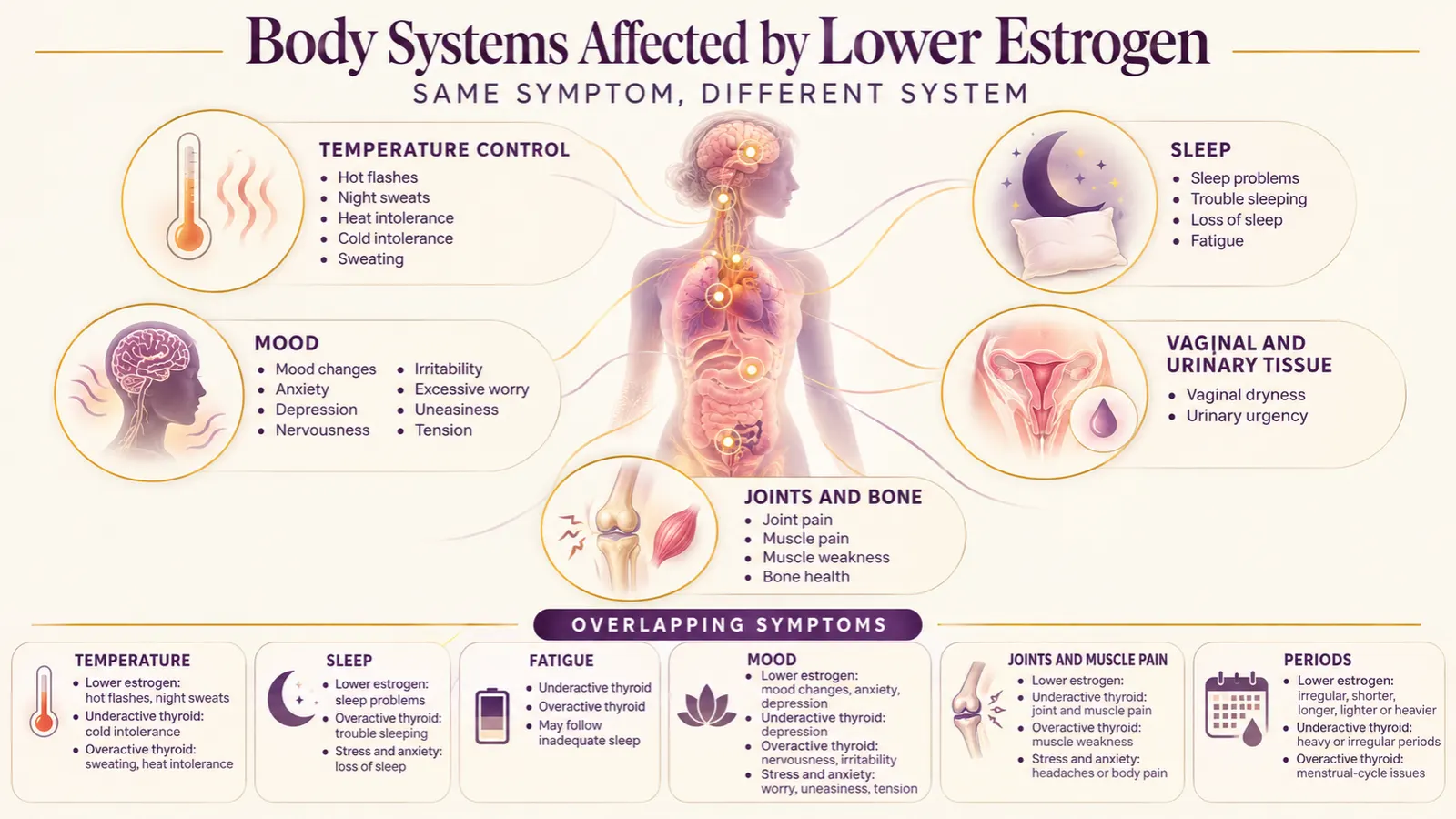
Hot flashes, poor sleep, low mood and period changes are listed for more than one system, so a low estrogen label can be wrong or incomplete. Sorting the symptom to its system comes before treating it.
Dr. Goldstein teaches that three systems break down most often and that they are connected.
“In my 25 years of practice, I found three systems break down most often. Thyroid, adrenals, and sex hormones. And here’s the key. These three systems are interconnected. You cannot fix one without addressing the others.”
Dr. Angela Goldstein, ND, Master Class
She describes the cascade this way: under chronic stress, “your adrenal pumps out cortisol constantly.” Then “high cortisol tells your thyroid to slow down because your body thinks there’s a famine,” and “your thyroid slowing down disrupts your sex hormones because your body thinks it’s not safe to reproduce.” Her list of what that produces includes “hot flushes, mood swings, slow sex drive.”
Research supports the direction of each link. A 2026 review in Endokrynologia Polska found that cortisol suppresses TRH and TSH secretion, the brain signals that drive the thyroid. A review of the thyroid axis and female reproduction links disrupted thyroid function to menstrual irregularity. A review of glucocorticoids and fertility reports that stress and elevated glucocorticoids can inhibit reproduction at the hypothalamus, the pituitary and the ovary. These are mechanism findings from the research literature. For the physiology behind the first two steps, see how cortisol and thyroid interact.
The table shows why a single symptom does not name its system. “Listed” means the named source includes it.
| Symptom | Low estrogen / menopausal transition | Underactive thyroid | Overactive thyroid | Stress and anxiety |
|---|---|---|---|---|
| Hot flashes, sweating, heat | Hot flashes and night sweats | Trouble tolerating cold | Sweating or trouble tolerating heat | Not listed |
| Sleep | Sleep problems | Not listed | Trouble sleeping | Loss of sleep |
| Fatigue | Not listed as a symptom (MedlinePlus ties lack of sleep to fatigue) | Fatigue | Fatigue | Not listed |
| Mood | Mood changes, anxiety, depression | Depression | Nervousness, irritability | Excessive worry, uneasiness, tension |
| Joint and muscle pain | Joint and muscle pain | Joint and muscle pain | Muscle weakness | Headaches or body pain |
| Periods | Irregular, shorter, longer, lighter or heavier | Heavy or irregular periods | Menstrual cycle issues (listed as a complication) | Not listed |
| Vaginal dryness, urinary urgency | Listed | Not listed | Not listed | Not listed |
Sources: Office on Women’s Health, MedlinePlus, NIDDK on hypothyroidism, NIDDK on hyperthyroidism and NIMH on stress.
Vaginal dryness and urinary urgency are listed only in the estrogen column, so they point most directly at low estrogen. Hot flashes sit beside heat intolerance in the overactive thyroid column, and fatigue is listed for both thyroid conditions. Read together with the thyroid or perimenopause comparison, the table shows why one system alone rarely explains the whole picture.
The Natural Path’s free Hormone Orchestra Quiz asks 22 questions in about 3 minutes and scores the three systems Dr. Goldstein reads together: your stress response, your thyroid and your sex hormones. A score is a conversation starter to bring to your clinician. Take the free Hormone Orchestra Quiz.
Why One Estradiol Number Can Mislead
A single estradiol result tells you about one moment, so it cannot settle whether your symptoms come from low estrogen. MedlinePlus says you may need to be tested more than once to look for a trend in your estrogen levels over time. Menopause itself is defined by time: 12 months in a row with no period. What perimenopause labs can and cannot show goes deeper on timing.
This is where Dr. Goldstein’s teaching on labs applies. In the Master Class she says, “Standard labs measure diseases, not function.” She adds, “Your hormones can be in range while being completely out of balance as a system.” In her telling, a normal-looking number does not close the question. It starts a different one: what came before the symptoms, and when did they begin? If your results keep coming back normal, read why normal labs can miss a struggling system.
Her approach looks at the surrounding picture, such as thyroid markers and stress-response patterns, along with timing and symptoms. Because standard labs are built to find disease, a woman can have clear symptoms and a lab result that reads fine. The page on hormone testing for women goes through which tests answer which questions.
Low Estrogen Symptoms in Orange County: In Person or by Video
The Natural Path sees patients in person at its San Juan Capistrano office and by video visit across California, and the evaluation can start either way. Women from San Clemente and Lake Forest are within reach of the office. Women farther away can join by video from anywhere in the state.
You must be located in California at the time of the visit, because licensing requires it. Blood draws are ordered to a lab near you, and specialty kits can be mailed to your home. The California telemedicine page explains the remote steps.
The contact page has the office hours and the way to arrange an in-person or video evaluation.
Frequently Asked Questions
What are the first signs of low estrogen?
In midlife, changes in your periods are usually first, and the Office on Women’s Health lists hot flashes, night sweats and sleep problems among the symptoms that can begin in perimenopause. Before age 40, irregular or missed periods are the most common sign of primary ovarian insufficiency, and that calls for a doctor’s visit. So do stopped periods after an eating disorder, heavy athletic training or a recent pregnancy.
Can low estrogen cause anxiety and brain fog?
The Office on Women’s Health lists brain fog, memory changes, anxiety and depression among menopause symptoms. Chronic stress and thyroid problems are listed for similar symptoms, so the cause deserves a full read.
What causes low estrogen in women?
In midlife the usual cause is the menopausal transition, when the ovaries make less estrogen. Under 40, causes include primary ovarian insufficiency, low body fat, heavy exercise, severe distress and thyroid problems, per the sources above. A clinician works out which one applies.
Can a blood test confirm low estrogen?
A test shows your level at one moment, and MedlinePlus notes you may need repeat testing to see a trend. In the menopausal transition, a diagnosis rests on your symptoms and cycle history alongside any labs.
Is low estrogen the same as low progesterone?
No. They are different hormones with different symptom patterns, and progesterone is a separate topic from this page.
How long do low estrogen symptoms last?
It varies. In the SWAN study, the median duration of frequent hot flashes and night sweats was 7.4 years, and some women had them longer. Other symptoms follow their own timelines.
Can I see you if I live outside Orange County?
Yes, if you are in California at the time of the visit. Video evaluations are available across the state, and the contact page shows how to book.
Where to Start
Dr. Goldstein, who has practiced for 25+ years, walks through the three connected systems in her free Master Class, including how stress, thyroid and sex hormones affect one another. Watch the free Master Class, or book the one-hour evaluation and bring your symptom timeline and any prior lab results.
Written by The Natural Path clinical content team, based on the teaching of Dr. Angela Goldstein, ND.
This article is for general education and is not medical advice. It does not establish a doctor-patient relationship and is not a substitute for care from your own clinician. Do not start, stop or change any hormone or prescribed medication based on what you read here. If you have an urgent medical concern, contact your physician or emergency services. Testimonials reflect individual experiences and results vary.