

Written by The Natural Path clinical content team, based on the teaching of Dr. Angela Goldstein, ND.
Subclinical hypothyroidism means your TSH is above your lab’s reference range while your free T4 is still normal. It is usually mild: according to the European Thyroid Association, about 90% of cases fall between 4.0 and 10.0 mIU/L. One borderline result is a reason to look again, not a diagnosis, because TSH shifts with time of day, recent illness, sleep and weight. Guidelines advise repeating TSH and free T4 with thyroid peroxidase (TPO) antibodies after 2 to 3 months. Treatment is more clearly indicated above 10 mIU/L. Below 10 it depends on age, antibodies and symptoms, and the guidelines disagree. If you are pregnant or trying to conceive, different rules apply and your prescriber should see the result now.
Key Takeaways
- Subclinical hypothyroidism is a TSH above the lab range with a normal free T4. A JAMA review puts it at up to 10% of adults, and it is more common in women.
- A first borderline TSH is usually rechecked in 2 to 3 months with free T4 and TPO antibodies, because TSH moves for reasons unrelated to a failing thyroid.
- Positive TPO antibodies carry the most weight. Progression to overt hypothyroidism ran 4.3% per year with them and 2.6% per year without them.
- Guidelines agree treatment is more clearly indicated above 10 mIU/L and disagree below it. The table in this guide lines up ATA/AACE, ETA, JAMA and BMJ side by side.
- A TSH number is one signal about one system. Dr. Goldstein reads it alongside stress, sleep, weight and sex hormones.
Your TSH came back a little high. Your free T4 came back normal. Your doctor said, “Let’s wait and recheck,” and you left with a number, a lab slip and no explanation. That is a common way to meet subclinical hypothyroidism, and the wait is often sound medicine. It still leaves a gap. What is the number telling you, what should the recheck include, and what do you do about the tiredness in the meantime?
What Subclinical Hypothyroidism Means
Subclinical hypothyroidism is a laboratory finding, not a symptom list: the pituitary is asking the thyroid for more hormone, and the thyroid is still keeping up.
Subclinical hypothyroidism is a state of raised TSH with circulating T4 and T3 inside the population reference range, as the European Thyroid Association (ETA) 2013 guideline defines it.
TSH (thyroid-stimulating hormone) is made by the pituitary gland and tells the thyroid how much T4 and T3 to produce. Free T4 is the thyroid hormone circulating in the blood that your cells can use.
A JAMA review says the condition affects up to 10% of adults and is most often caused by autoimmune Hashimoto’s thyroiditis. The ETA reports it in 8% of women, rising to 10% of women over 55, compared with 3% of men. If the cause is autoimmune, thyroid and Hashimoto’s care at The Natural Path starts from the same question the guidelines ask first: is there an antibody signal behind the number?
The reference range comes from your lab, so the slip you hold decides what counts as high. The ETA gives a general adult range of 0.4 to 4.0 mIU/L, and the JAMA review describes a traditional upper limit of 4 to 5.
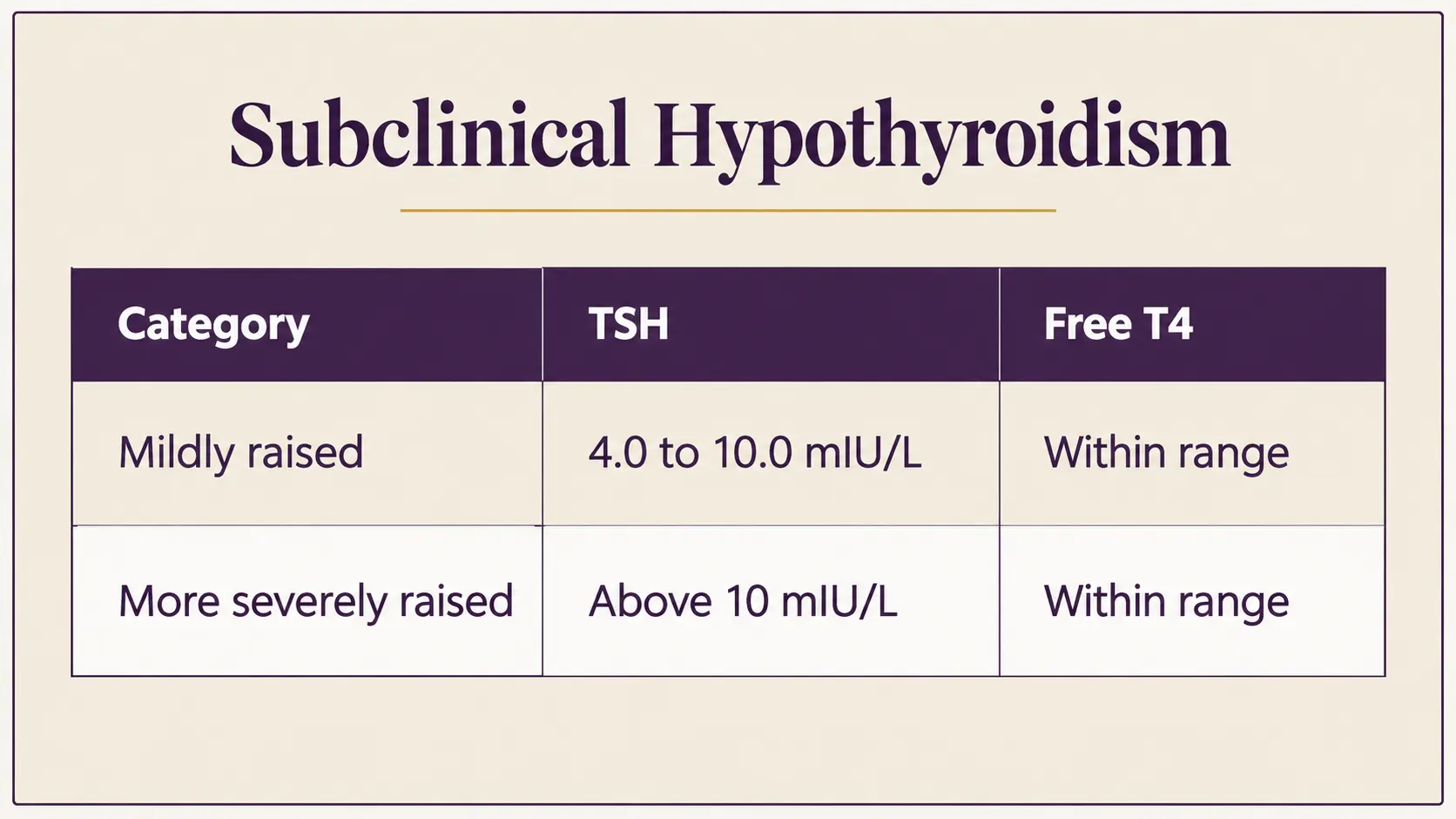
| Category (ETA) | TSH | Share of cases | Free T4 |
|---|---|---|---|
| Mildly raised | 4.0 to 10.0 mIU/L | Around 90% | Within range |
| More severely raised | Above 10 mIU/L | The remainder | Within range |
When free T4 is low as well, the label changes to overt hypothyroidism, which the ATA/AACE guideline describes as an elevated TSH, usually above 10, with a subnormal free T4. Our guide to hypothyroidism vs. Hashimoto’s explains how the state and the cause fit together.
Why Wait and Recheck Is a Reasonable First Step
A single raised TSH does not establish subclinical hypothyroidism, which is why the ETA recommends repeating TSH and free T4, along with TPO antibodies, preferably after 2 to 3 months (recommendation 2). The ATA/AACE guideline adds that the label applies only when thyroid function has been stable for weeks, with no recent or ongoing severe illness.
TSH moves for many reasons that have nothing to do with a failing thyroid. The ETA lists several:
- Time of day. TSH is lowest in the early afternoon and about 30% higher in the evening and at night.
- Recovery from illness. TSH can rise temporarily while you recover from a significant non-thyroidal illness.
- Thyroiditis and medicines. Subacute or painless thyroiditis, stopping thyroid hormone, and drugs such as lithium and amiodarone can all raise it.
- Sleep and mood. The nighttime peak can shift in shift workers, with irregular sleep, after vigorous exercise and in depression.
- Weight and insulin. TSH correlates with body mass index and markers of insulin resistance, and the ETA notes observational studies showing TSH returning toward normal with weight loss. Our guide to insulin resistance in women covers that side of the picture.
Real-world follow-up fits this. An observational study of 346,549 outpatients not taking thyroid medication followed first TSH results for five years. Of those whose first TSH was elevated (above 5.5 up to 10 mIU/L), 62.1% had a normal TSH on later testing. For those whose first result was above 10, the figure was 27.2%. The study measured TSH, not free T4.
A useful recheck, step by step
1. Draw the blood at about the same time of day as the first test.
2. Wait until a cold, flu or other illness has fully passed, as the ETA advises.
3. Ask for TSH, free T4 and TPO antibodies together. The ATA/AACE guideline says TPO antibody testing should be considered (recommendation 1, Grade B).
4. Bring a list of every medicine and supplement you take.
5. Ask your prescriber which result would change the plan.
If the numbers return to normal, the ETA says no further testing is required in people who are asymptomatic, have negative thyroid antibodies or do not have a goiter (recommendation 24). If the TSH stays high and you are not treated, it advises testing every 6 months for the first 2 years and yearly after that (recommendation 25).
Free 3-minute quiz from Dr. Angela Goldstein, ND
Stress, thyroid and sex hormones work as one system. Answer 22 quick questions and see which one is under the most strain for you.
What you’ll get:
- ✓A score for each system: stress, thyroid and sex hormones
- ✓Which pattern your answers fit, and how the systems pull on each other
- ✓Built on published research
- ✓A clear next step for your pattern
Free. 22 questions, about 3 minutes.
Educational content. Always talk with your doctor before changing any treatment.
What Thyroid Antibodies Add
Positive TPO antibodies mark the group most likely to move from subclinical to overt hypothyroidism, and they usually point to Hashimoto’s as the cause.
The ETA and the ATA/AACE guideline report the same figures: hypothyroidism developed at 4.3% per year in people with positive antibodies and 2.6% per year in those with negative antibodies. The ATA/AACE authors graded their antibody recommendation B because the evidence is predictive, and they note a positive result “may or may not influence the decision to treat.”
An antibody-negative result leaves some questions open. The ETA reports that in about 20% of people with subclinical hypothyroidism no TPO or thyroglobulin antibodies are detected, and a thyroid ultrasound pattern can show autoimmunity before antibodies appear. An ultrasound is not routine without another reason, such as a goiter. How the antibody tests fit with imaging is laid out in our guide to how Hashimoto’s is diagnosed.
Does a Borderline TSH Explain How You Feel?
Sometimes in part, and the research is more mixed than most women are told.
The symptoms people attach to a high TSH are familiar. NIDDK lists fatigue, weight gain, trouble tolerating cold, joint and muscle pain, dry skin, thinning hair, heavy or irregular periods and depression as common in hypothyroidism. Whether a mildly raised TSH produces them is less settled:
- The ETA notes that few people with subclinical hypothyroidism have typical hypothyroid symptoms. A Colorado survey of 25,862 people found small but real differences, including greater tiredness and poorer memory, while a Norwegian study found only tiredness differed.
- In a randomized crossover trial of 100 people with a mean TSH of 6.6, tiredness improved on levothyroxine compared with placebo, which the ETA calls the best evidence that treatment can change symptoms.
- The 2019 BMJ guideline pooled 21 trials with 2,192 participants and found no clinically relevant benefit from thyroid hormones on quality of life, fatigue or body mass index.
- The ETA found no evidence that levothyroxine changes body weight in people with obesity when TSH is below 10 and free T4 is normal (recommendation 8).
- The JAMA review notes that middle-aged adults with subclinical hypothyroidism may have nonspecific symptoms such as fatigue, altered mood and cognitive impairment.
Midlife makes the picture harder to read, because fatigue, weight change, mood shifts and irregular periods also belong to perimenopause. Our guide to telling thyroid from perimenopause sorts the overlap.
One in-range or borderline result rarely settles the question, and why normal labs and real symptoms often arrive together explains the gap.
Dr. Goldstein teaches that “Standard labs measure diseases, not function. They’re checking to see if your engine is completely broken, not whether it’s running at 40% capacity.” A mildly raised TSH with a normal free T4 is a result of that kind: outside the lab range, yet not enough to name a disease.
If you want a starting map before any appointment, the free Hormone Orchestra Quiz takes about 3 minutes and scores your stress response, thyroid and sex hormones. A score is a conversation starter to bring to your clinician.
What the Guidelines Say About Treating Subclinical Hypothyroidism
Guidelines agree that a TSH above 10 mIU/L is where treatment is most clearly indicated, and they disagree about what to do below it. That disagreement is why a doctor who says “let’s recheck” has defensible company.
| Source | TSH above 10 | Above the lab range, up to 10 | Older adults |
|---|---|---|---|
| ATA/AACE 2012 (Garber et al., Endocrine Practice) | Recommendation 15 (Grade B): risk of heart failure and cardiovascular death is higher, so treatment with levothyroxine should be considered | Recommendation 16 (Grade B): treatment based on individual factors should be considered, particularly with symptoms, positive TPO antibodies or cardiovascular disease or its risk factors. The decision “should be tailored to the individual patient” | The reference range may widen with age, so not every mild elevation needs treatment |
| ETA 2013 (Pearce et al.) | Recommendation 13: levothyroxine is recommended under age 65, even without symptoms | Recommendation 4: under 65 with symptoms, a trial should be considered. Recommendation 23: review 3 to 4 months after TSH reaches range and generally stop if symptoms did not improve | Age-specific reference ranges (recommendation 14). Over 80 to 85 with TSH up to 10: watchful waiting (recommendation 15) |
| JAMA review 2019 (Biondi et al.) | Treatment might be indicated at 10 or higher | Most people can be observed. Treatment might be indicated for young and middle-aged adults with symptoms of mild hypothyroidism | No evidence of benefit at 65 or older, and a risk of iatrogenic thyrotoxicosis |
| BMJ guideline 2019 (Bekkering et al.) | Strong recommendation against thyroid hormones in adults with subclinical hypothyroidism, excluding TSH above 20 | Same recommendation. May not apply to severe symptoms or people 30 and younger | The abstract gives no separate advice for older adults |
If a prescriber does start levothyroxine, the ETA advises rechecking TSH after 2 months (recommendation 20) and monitoring at least yearly afterward (recommendation 26). Do not start, stop or change any medication based on a table. Your prescriber has your full history.
If You Are Pregnant or Planning a Pregnancy
Pregnancy changes the rules, so this page stops here and sends you to your prescriber. The ETA guideline states that pregnancy is outside its scope. The BMJ guideline excludes women who are trying to become pregnant. The ATA/AACE guideline sets trimester-specific TSH targets for treated hypothyroidism in pregnancy, and the 2017 ATA pregnancy guideline covers this subject on its own.
If you are pregnant or trying to conceive and your TSH is high, tell your obstetric provider or prescriber now rather than waiting for a routine 3-month recheck.
Reading the TSH Number With the Rest of the System
This section describes Dr. Angela Goldstein’s clinical perspective, drawn from her teaching. It is her framing, separate from the published guidelines above.
Dr. Goldstein reads TSH as one report from one system. “Your thyroid can be normal while still being shut down by stress,” she teaches. The mechanism she describes runs through cortisol: “High cortisol tells your thyroid to slow down because your body thinks there’s a famine. Your thyroid slowing down disrupts your sex hormones because your body thinks it’s not safe to reproduce.”
Published research points the same way. A 2026 review in Endokrynologia Polska reports that cortisol suppresses TRH and TSH secretion and disrupts the circadian rhythm of TSH secretion. That may help explain why TSH can move with stress, and why one value rarely shows how the thyroid is performing. Our guide to cortisol and thyroid goes deeper.
The link to sex hormones runs in both directions. A 2023 review in the International Journal of Molecular Sciences reports that thyroid hormones regulate the secretion of kisspeptin and GnRH, and that hypothyroidism has been associated with heavy bleeding and frequent periods. A woman in her forties with a borderline TSH and changing cycles is looking at overlapping systems. This is why hormone testing for women at The Natural Path reads thyroid, sex hormone and cortisol results against each other.
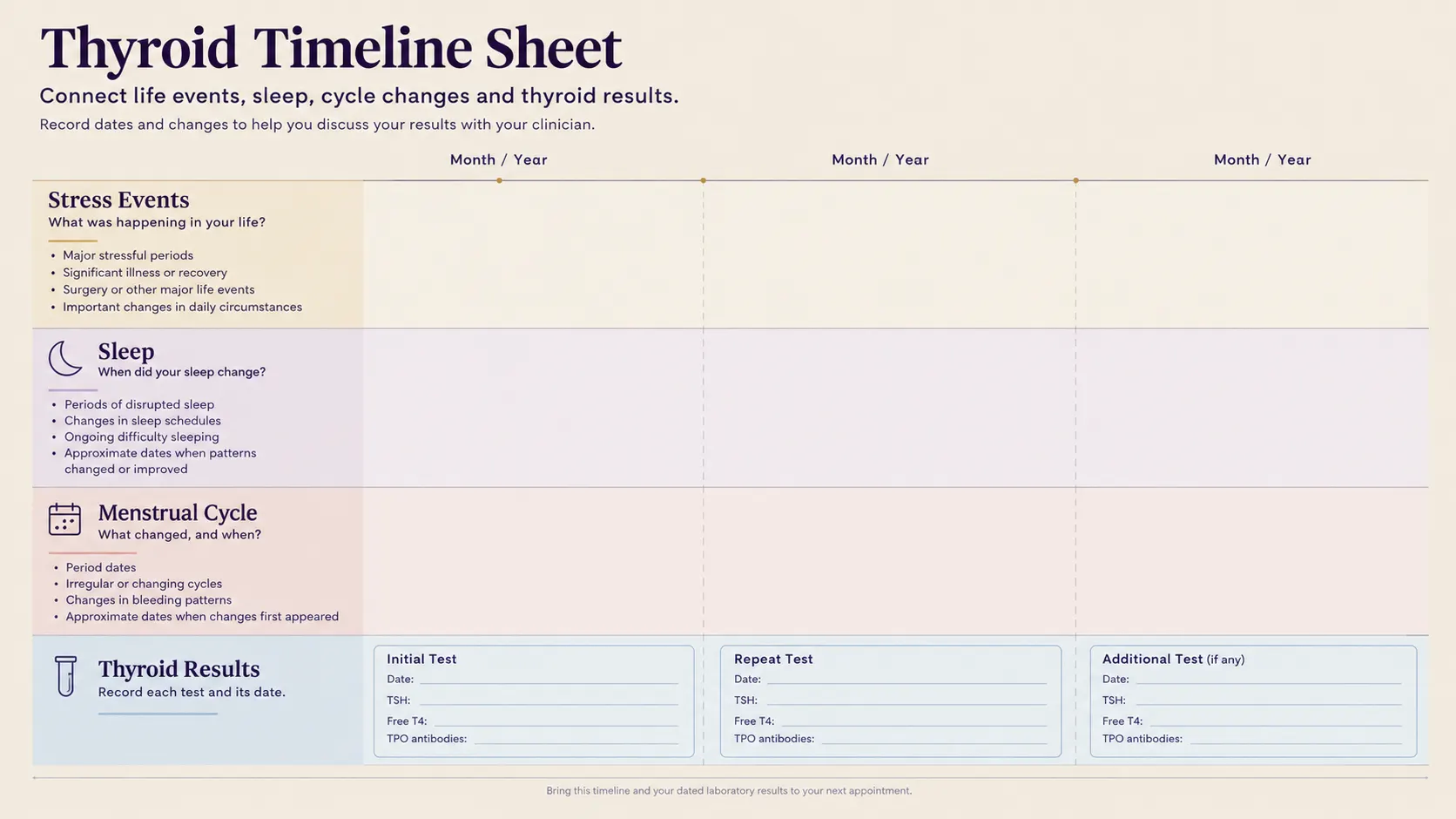
For a borderline result, that approach adds a timeline to the lab numbers. When did the tiredness start? What came before it: an illness, a hard year, a surgery, a pregnancy, a change in periods? One Google reviewer wrote that Dr. Goldstein “gets to the root of your problem” and that “it’s not just about your bloodwork.” Individual experiences vary.
Care in Orange County and Across California
The Natural Path sees patients in person at its San Juan Capistrano office and by video visit anywhere in California. The office is open Monday, Tuesday and Thursday from 10:00am to 6:00pm, a practical drive for women in Laguna Niguel and Irvine. Video visits require you to be in California at the time of the visit, and the telemedicine page explains the remote steps.
To arrange either kind of visit, start on the contact page.
Bring your TSH, free T4 and antibody results with their dates, plus your medicine list and a short timeline. The practice does not bill insurance.
Frequently Asked Questions
Is subclinical hypothyroidism serious?
For most people subclinical hypothyroidism is mild. The JAMA review concludes that most individuals can be observed without treatment, and it notes that the condition may be associated with heart failure and coronary events. Positive TPO antibodies and a TSH above 10 raise the level of attention.
Can subclinical hypothyroidism go away on its own?
Often, a raised TSH does settle. In the large outpatient study above, 62.1% of people with an initially elevated TSH between 5.5 and 10 had a normal result later, though that study did not check free T4. That is why the first step is a repeat test rather than a prescription.
What TSH level is subclinical hypothyroidism?
It is a TSH above your lab’s upper limit with a normal free T4. The ETA splits it into 4.0 to 10.0 mIU/L and above 10. Reference ranges differ by lab, so use the range printed on your own report.
Can subclinical hypothyroidism cause weight gain and fatigue?
Subclinical hypothyroidism may contribute to fatigue in some people, and trial evidence is mixed. The ETA found no evidence that levothyroxine changes body weight in people with obesity when TSH is below 10 and free T4 is normal. Sleep, stress, insulin resistance and sex hormones deserve a look too.
Do I need levothyroxine if my TSH is 5 or 6?
Guidelines give no single answer in that range. The ATA/AACE guideline says to fit the decision to the individual patient, the ETA suggests considering a trial under age 65 when symptoms are present, and the BMJ panel recommends against treatment for most adults. Your prescriber can weigh your age, antibodies, symptoms and cardiovascular risk.
Can I be seen if I do not live in Orange County?
Yes, if you are in California at the time of the visit. The contact page explains how to arrange an in-person or video visit.
Where to Start
Take your TSH, free T4 and TPO antibody results with their dates, and write down when the symptoms began and what was happening just before. Dr. Goldstein explains how stress, thyroid and sex hormones affect each other in her free Master Class. Watch the free Master Class.
Written by The Natural Path clinical content team, based on the teaching of Dr. Angela Goldstein, ND.
This article is for general education and is not medical advice. It is not intended to diagnose or treat any disease, does not establish a doctor-patient relationship, and is not a substitute for care from your own clinician. Do not start, stop or change any prescribed medication based on what you read here. If you have an urgent medical concern, contact your physician or emergency services.