
Written by The Natural Path clinical content team, medically reviewed by Dr. Angela Goldstein, ND. Last reviewed: 2026-09-27.
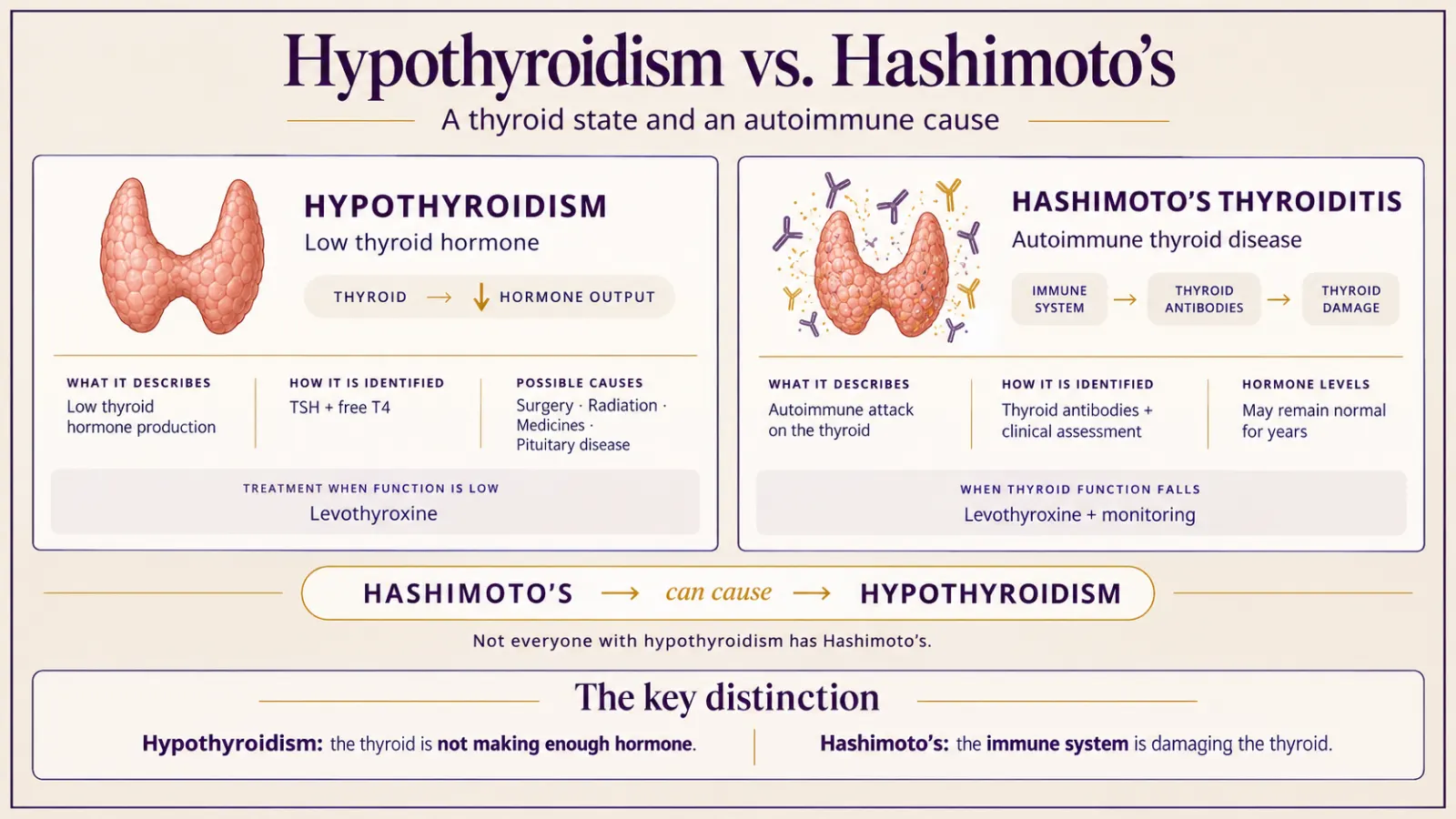
Hypothyroidism vs. Hashimoto’s comes down to a state and a cause. Hypothyroidism means the thyroid is not making enough hormone for the body’s needs, for any reason. Hashimoto’s thyroiditis is an autoimmune disease in which the immune system attacks the thyroid, and according to the American Thyroid Association (ATA), it is the most common cause of hypothyroidism in the United States. The two overlap in both directions.
Many people with Hashimoto’s still have normal thyroid function, and hypothyroidism can also follow thyroid surgery, radioactive iodine, thyroiditis, some medicines or a pituitary problem. Thyroid antibodies usually separate them. Once either leaves the thyroid underactive, the standard treatment is the same hormone replacement.
Key Takeaways
- Hypothyroidism describes low thyroid hormone output. Hashimoto’s names one cause of it: an immune attack on the thyroid.
- In the United States, Hashimoto’s is the most common cause of hypothyroidism.
- Hashimoto’s antibodies can be present for years while hormone levels stay normal.
- Surgery, radioactive iodine, thyroiditis, medicines and pituitary disorders also cause hypothyroidism.
- Once the thyroid is underactive, treatment is the same, and dose changes belong with the prescriber.
If one chart says hypothyroidism and the next says Hashimoto’s, your diagnosis probably did not change. Two different questions got answered, and knowing which is which changes what you watch for.
Hypothyroidism vs. Hashimoto’s: A State and a Cause
Hypothyroidism describes how the thyroid is performing, and Hashimoto’s is one explanation for why. That is why thyroid and Hashimoto’s care at The Natural Path asks the two questions separately.
Hypothyroidism is a condition in which the thyroid gland does not make enough thyroid hormone to meet the body’s needs, so many body functions slow down.
Hashimoto’s thyroiditis is an autoimmune disorder in which the immune system makes antibodies against the thyroid and the damaged gland can lose its ability to make enough hormone. It is also called chronic lymphocytic thyroiditis.
Nearly 5 in 100 Americans ages 12 and older have hypothyroidism, per the National Institute of Diabetes and Digestive and Kidney Diseases (NIDDK). Hashimoto’s is 4 to 10 times more common in women, usually appearing between 30 and 50, and a 2026 review calls it a leading cause of hypothyroidism wherever iodine intake is adequate.
| Hypothyroidism | Hashimoto’s thyroiditis | |
|---|---|---|
| What it is | Low thyroid hormone output | An autoimmune disease of the thyroid |
| How it is identified | TSH and free T4 blood tests | Thyroid antibodies, plus history and exam |
| Can it exist alone? | Yes, after surgery, radiation, medicines or pituitary disease | Yes, with normal hormone levels for years |
| Standard treatment | Levothyroxine | Levothyroxine once function is low, monitoring before that |
Can You Have Hashimoto’s Without Hypothyroidism? Four Combinations
Yes. Antibodies and thyroid function are separate measurements, so Hashimoto’s and hypothyroidism can appear together, apart or in sequence.
The ATA states that Hashimoto’s can be diagnosed without symptoms, when antibodies are high and hormone levels are normal. A 2022 evidence-based guide by NIH researchers estimates antibody positivity at 15% to 25%, much higher than the rate of Hashimoto’s hypothyroidism.
| Combination | What it looks like | What usually happens |
|---|---|---|
| Hashimoto’s, thyroid keeping up (euthyroid) | Antibodies present, TSH and free T4 normal | No thyroid hormone needed (ATA); TSH checked over time |
| Hashimoto’s with hypothyroidism | Antibodies present, thyroid underactive | Levothyroxine, lifelong for most people (ATA) |
| Hypothyroidism from another cause | Thyroid underactive, antibodies usually negative | Same replacement; the other cause is identified |
| Hashimoto’s, temporary overactive phase | Damaged cells release stored hormone | Settles within 3 to 24 months, usually followed by permanent hypothyroidism |
Hashitoxicosis is a temporary phase of Hashimoto’s in which stored thyroid hormone leaks from damaged tissue. NIDDK notes that Hashimoto’s causes an overactive thyroid only rarely.
What Else Causes Hypothyroidism Besides Hashimoto’s
Negative antibodies with a low thyroid usually point away from Hashimoto’s and toward one of several other causes.
| Cause | How it lowers thyroid hormone | Source |
|---|---|---|
| Thyroid surgery | Removing the entire thyroid always causes hypothyroidism | NIDDK |
| Radioactive iodine | Gradually destroys thyroid cells; most people treated eventually become hypothyroid | NIDDK |
| Thyroiditis | Inflammation releases stored hormone first, then function can fall, sometimes permanently | NIDDK |
| Medicines | Lithium, amiodarone and certain cancer drugs can affect the thyroid | ATA |
| Congenital | Some babies are born without a working thyroid | ATA |
| Iodine | Too little or too much; deficiency is extremely rare in the US | NIDDK |
| Pituitary or hypothalamus | The brain’s signal to the thyroid is weak or missing | ATA |
The pituitary row changes how results are read. Dr. Angela Goldstein, ND, compares the brain-to-gland-to-cell chain with the game of telephone: “Maybe the signal from your brain is weak.” The ATA notes that when the pituitary is damaged, the TSH test may not help, so clinicians also measure free T4, the hormone the body can actually use.
How Thyroid Antibodies Tell Hashimoto’s Apart
Thyroid antibodies are the main laboratory marker that separates Hashimoto’s from the other causes of hypothyroidism.
Thyroid peroxidase (TPO) antibodies are immune proteins aimed at an enzyme the thyroid uses to make hormone. Thyroglobulin (Tg) antibodies target the protein the thyroid uses to store it.
| Marker | How often it is positive | Source |
|---|---|---|
| TPO antibodies | About 95% of people with Hashimoto’s | NIH guide, 2022 |
| Thyroglobulin antibodies | 60% to 80% of people with Hashimoto’s | NIH guide, 2022 |
| Neither (seronegative) | 5% to 10% of Hashimoto’s | NIH guide, 2022 |
| Either, in the population | 15% to 25%, far above the rate of disease | NIH guide, 2022 |
A positive result often comes with a thyroid still keeping up. In antibody-negative cases, ultrasound can support the diagnosis, per the 2026 review. The full sequence is laid out in how a Hashimoto’s diagnosis is made, test by test.

Free 3-minute quiz from Dr. Angela Goldstein, ND
Stress, thyroid and sex hormones work as one system. Answer 22 quick questions and see which one is under the most strain for you.
What you’ll get:
- ✓A score for each system: stress, thyroid and sex hormones
- ✓Which pattern your answers fit, and how the systems pull on each other
- ✓Built on published research
- ✓A clear next step for your pattern
Free. 22 questions, about 3 minutes.
Educational content. Always talk with your doctor before changing any treatment.
Is Treatment for Hypothyroidism and Hashimoto’s Different?
Treatment for hypothyroidism is the same whether Hashimoto’s or another cause produced it: thyroid hormone replacement, most often levothyroxine.
NIDDK describes levothyroxine as identical to natural thyroxine (T4) and the recommended treatment, with doses adjusted using TSH. What differs is the stage before the thyroid runs low. According to the ATA:
- High antibodies with normal TSH and free T4 do not require thyroid hormone.
- A slightly elevated TSH may or may not need medication right away, and is often rechecked once or twice a year.
- Repeating antibody tests is not needed, while TSH monitoring continues.
Subclinical hypothyroidism is a slightly elevated TSH that the ATA also calls mild hypothyroidism.
Medication safety: Keep taking thyroid medication exactly as prescribed. Dose changes belong with the clinician who prescribed it, guided by repeat blood tests.
Why the Cause Behind Hypothyroidism Still Matters
Even when the prescription is identical, knowing whether it is hypothyroidism vs. Hashimoto’s changes what to watch for.
- Pregnancy. TPO antibodies are associated with a 2- to 4-fold higher risk of recurrent miscarriage and preterm birth, per the NIH guide. Women treated for hypothyroidism typically need a 20% to 30% dose increase early in the first trimester, made by the prescriber.
- Other autoimmune conditions. NIDDK lists celiac disease, lupus, rheumatoid arthritis, Sjögren’s syndrome and type 1 diabetes as raising the likelihood of Hashimoto’s. Knowing the early signs of autoimmune disease helps you report new symptoms sooner.
- Family history. The chance of Hashimoto’s rises when relatives have it, per NIDDK.

When Thyroid Results Look Normal and You Do Not Feel Normal
Many people sit between these labels: antibodies never checked, TSH in range, and still exhausted and foggy. That experience is real and deserves an answer.
Most have heard one of the three answers Dr. Goldstein says patients eventually get told: “It’s just stress, take an antidepressant. It’s just aging, learn to live with it. Or it’s all in your head, see a therapist.”
“Standard labs measure diseases, not function. They’re checking to see if your engine is completely broken, not whether it’s running at 40% capacity.”
Dr. Angela Goldstein, ND
In 25+ years of practice, she has found that thyroid, adrenal and sex hormone systems break down together more often than any others. “Your thyroid can be normal while still being shut down by stress,” she says. Like an orchestra, one instrument out of tune changes the whole sound. The mechanism is explained in how cortisol slows the thyroid.
This view works alongside standard thyroid testing. As one patient put it, “it’s not just about your bloodwork.” For the wider pattern, see why normal labs can miss a struggling system.
When to See a Doctor Promptly
Contact your physician the same day, or emergency services if severe, for:
- a racing or pounding heartbeat, tremor or heat intolerance
- a swelling neck (goiter), pressure or trouble swallowing
- pregnancy, or planning one, with known thyroid disease or antibodies
- severe fatigue with confusion or feeling unusually cold
Frequently Asked Questions
Is Hashimoto’s the same as hypothyroidism?
No. Hypothyroidism is low thyroid hormone output, while Hashimoto’s is an autoimmune disease of the thyroid. Hashimoto’s is the most common US cause of hypothyroidism, and each can exist without the other.
Can you have hypothyroidism without Hashimoto’s?
Yes. Surgery, radioactive iodine, thyroiditis, medicines such as lithium or amiodarone and pituitary disorders can all cause it.
Do Hashimoto’s and hypothyroidism have different symptoms?
Once Hashimoto’s lowers thyroid function, the symptoms are those of hypothyroidism: fatigue, weight gain, feeling cold, dry skin, constipation and depression, per the ATA. Earlier, many people with Hashimoto’s have no symptoms.
Can Hashimoto’s cause hyperthyroid symptoms?
Occasionally, during the temporary Hashitoxicosis phase described above, which usually settles within 3 to 24 months.
Could my symptoms be perimenopause instead of my thyroid?
They overlap, and both can be present at once. Our guide to telling thyroid or perimenopause apart walks through the difference.
Where to Start
Which question have your results answered: whether the thyroid is low, what is causing it, or both? Sorting that out is the most useful first step with hypothyroidism vs. Hashimoto’s.
Dr. Goldstein’s free Master Class walks through how thyroid, stress and sex hormones affect each other. The Natural Path sees patients in person in San Juan Capistrano, Orange County, and by telemedicine across California.
Watch the free Master Class, and bring your antibody and TSH results to your next appointment.
Written by The Natural Path clinical content team, medically reviewed by Dr. Angela Goldstein, ND. Last reviewed: 2026-09-27.
This article is for general education and is not medical advice. It is not intended to diagnose or treat any disease, does not establish a doctor-patient relationship, and is not a substitute for care from your own clinician. Do not start, stop or change any prescribed medication based on what you read here. If you have an urgent medical concern, contact your physician or emergency services.