
Written by The Natural Path clinical content team, medically reviewed by Dr. Angela Goldstein, ND. Last reviewed: 2026-09-27.
The most direct way to test for insulin resistance is to measure insulin, not just blood sugar. That means fasting insulin paired with fasting glucose, which together produce a HOMA-IR score, or an oral glucose tolerance test with insulin drawn at each time point. A triglyceride to HDL ratio from a standard lipid panel adds a useful clue. Fasting glucose and A1c are built to diagnose prediabetes and diabetes. Because the pancreas can hold blood sugar in range by making more insulin, both can read normal while insulin is already climbing. The research reference standard, the glucose clamp, is rarely used outside studies. No single insulin resistance test is perfect, which is why the results are read together.
Key Takeaways
- Fasting glucose and A1c measure blood sugar. Insulin resistance shows up first as rising insulin.
- Fasting insulin and HOMA-IR are the most common blood estimates of insulin resistance.
- A triglyceride to HDL ratio of 3.0 or higher flagged insulin resistance in a Stanford study, with moderate accuracy.
- An oral glucose tolerance test with insulin found high insulin in just over half of people whose glucose response was normal.
- Insulin assays are not standardized between labs, so one “normal” range does not travel everywhere.
- Every test has blind spots, and the pattern across them says more than any single value.
Your fasting glucose came back normal. So did your A1c. Yet the weight will not move, the energy crashes after lunch, and the cravings arrive on schedule every afternoon. Maybe you were told “it’s just stress” or “it’s just aging.” Both answers skip a question: was insulin ever measured? That question sits at the center of insulin resistance and weight resistance care, and it starts with the right insulin resistance test.
Why Fasting Glucose and A1c Can Read Normal
Fasting glucose and A1c can read normal in insulin resistance because the pancreas compensates for years before blood sugar rises.
Insulin resistance is a state in which the body’s cells respond poorly to insulin, so the pancreas has to release more insulin to move the same amount of glucose out of the blood.
The CDC describes the sequence plainly: the cells stop responding normally, and “your pancreas makes more insulin to try to get cells to respond. Eventually your pancreas can’t keep up, and your blood sugar rises.” In order:
- Cells respond less to insulin.
- The pancreas raises insulin output to compensate.
- Blood sugar stays in range while insulin runs high.
- Blood sugar rises only when the pancreas can no longer keep up.
Standard blood sugar tests are designed to catch step 4. The NIDDK defines prediabetes as an A1C of 5.7% to 6.4%, a fasting glucose of 100 to 125 mg/dL, or a two-hour glucose tolerance result of 140 to 199 mg/dL. The same page notes that health care professionals “may not test for insulin resistance,” and that the formal test is used mainly in research.
Dr. Angela Goldstein, ND, puts it this way after 25+ years in practice:
“Standard labs measure diseases, not function. They’re checking to see if your engine is completely broken, not whether it’s running at 40% capacity.”
Glucose and A1c tell you whether the engine has broken. Insulin tells you how hard it is working to stay running.
The same gap across thyroid, iron and hormones is covered in why normal labs can miss a struggling system.
How to Test for Insulin Resistance: The Tests Compared
Six blood tests are used to test for insulin resistance, and a seventh, the clamp, is reserved for research.
| Test | What it measures | What it can miss | Where it is used |
|---|---|---|---|
| Fasting glucose | Blood sugar after an overnight fast | Years of compensation while glucose stays in range | Routine screening |
| A1c | Average blood sugar over about 3 months | Early insulin resistance; distorted by some blood conditions | Routine screening |
| Fasting insulin | Insulin after an overnight fast | People whose insulin rises only after eating | Ordered on request |
| HOMA-IR | Fasting insulin and glucose combined in one score | Same blind spot as fasting insulin; lab-to-lab variation | Clinical and research |
| Triglyceride to HDL ratio | A lipid pattern linked to insulin resistance | About a third of cases at the studied cut-point | Any standard lipid panel |
| Glucose tolerance test with insulin | Glucose and insulin over several hours after a sugar drink | Less practical; not routinely ordered | Specialty ordering |
| Glucose clamp | How much glucose the body clears under steady insulin | Impractical outside a research unit | Research only |
Fasting Insulin
Measured after an overnight fast, insulin shows how hard the pancreas works just to hold blood sugar steady.
Fasting insulin is the concentration of insulin in the blood after at least 8 hours without food.
In a Stanford study of 258 overweight adults without diabetes, a fasting insulin cut-point of 109 pmol/L identified insulin resistance with 57% sensitivity and 85% specificity. It rarely flagged people who were fine, and it missed many who were not.
The authors also noted the absence of “a standardized insulin assay.” Different labs can report different values for the same blood, so one report’s reference range does not transfer cleanly to another.
Fasting insulin appears among the markers listed on The Natural Path’s functional lab testing page. On its own, it is a starting point, not a verdict.
HOMA-IR
One fasting blood draw can produce a HOMA-IR score, which combines fasting insulin and fasting glucose into a single estimate.
HOMA-IR (homeostasis model assessment of insulin resistance) multiplies fasting insulin by fasting glucose and divides by a fixed constant. A higher score suggests more insulin resistance.
Introduced in Diabetologia in 1985, the HOMA estimate correlated closely with the glucose clamp (Rs = 0.88). Its authors also reported a 31% coefficient of variation and wrote that this low precision “limits its use.”
Because HOMA-IR inherits the insulin assay problem, this article prints no single “normal” number. Hormone testing works the same way, as our guide to what a single hormone blood test can show explains.
The Triglyceride to HDL Ratio
Many adults already have the cheapest insulin resistance clue on file: the triglyceride to HDL ratio from a routine lipid panel.
The triglyceride to HDL ratio is triglycerides divided by HDL cholesterol, both measured in mg/dL.
By the numbers: in the same Stanford study, a ratio of 3.0 identified insulin-resistant adults with 64% sensitivity and 68% specificity. Triglycerides of 130 mg/dL scored 67% and 71%. (McLaughlin et al., Annals of Internal Medicine, 2003)
The authors suggested these lipid cut-points as the most practical screen. At about two in three, the ratio is a reason to look closer, not a diagnosis.
Oral Glucose Tolerance Test With Insulin
Adding insulin to a glucose tolerance test reveals how hard the pancreas works after a sugar load, which a glucose-only test cannot see.
An oral glucose tolerance test (OGTT) measures blood sugar before and after a standard glucose drink. Drawing insulin at each time point shows the insulin response pattern too.
The Kraft database holds thousands of these tests from the 1970s to the 1990s. A 2016 analysis in Diabetes Research and Clinical Practice found:
- 4,185 participants, 54% of the cohort, had normal glucose tolerance.
- Just over half of them (2,079) had hyperinsulinemia, meaning high insulin, anyway.
- 93% of people with impaired glucose tolerance or diabetes also had high insulin.
- Fasting insulin “had limited value” in identifying the problem.
Some people only show the problem after eating, so a fasting test alone can miss them. The tradeoff is time: this test takes hours and is rarely ordered.
The Glucose Clamp, the Research Reference Standard
Researchers treat the glucose clamp as the reference standard for insulin resistance, and patients almost never receive one.
The hyperinsulinemic euglycemic glucose clamp infuses insulin at a steady rate while adjusting glucose to hold blood sugar constant. The glucose needed shows how well the body responds.
A review from the National Institutes of Health calls such direct methods “labor and time intensive.” That is why simpler surrogate indexes, including HOMA, QUICKI and the Matsuda index, exist.

Free 3-minute quiz from Dr. Angela Goldstein, ND
Stress, thyroid and sex hormones work as one system. Answer 22 quick questions and see which one is under the most strain for you.
What you’ll get:
- ✓A score for each system: stress, thyroid and sex hormones
- ✓Which pattern your answers fit, and how the systems pull on each other
- ✓Built on published research
- ✓A clear next step for your pattern
Free. 22 questions, about 3 minutes.
Educational content. Always talk with your doctor before changing any treatment.
Why the Results Get Read Together
The results of an insulin resistance test mean more together than apart, because each one covers a different blind spot of the others.
Dr. Goldstein describes the endocrine system as an orchestra:
“Think of your endocrine system like an orchestra. You have thyroid hormones, sex hormones, stress hormones, blood sugar hormones, and dozens more… if one instrument is out of tune, if one hormone system is off, the whole orchestra sounds terrible.”
Insulin is one of those instruments. Sustained stress, for instance, reshapes thyroid signaling, as covered in how cortisol and thyroid hormones interact.
A useful way to read a metabolic workup:
- Start with glucose and A1c to rule prediabetes or type 2 diabetes in or out.
- Add insulin to see whether normal glucose is being bought with high insulin.
- Check the lipid pattern for a supporting or conflicting clue.
- Question any value that does not fit. A1c reflects about 3 months of blood sugar. The NIDDK notes it can be skewed by iron-deficiency anemia, recent blood loss, kidney or liver disease, and some hemoglobin variants.
Patients describe the difference simply: “it’s not just about your bloodwork.”

What to Ask For When You Test for Insulin Resistance
When you test for insulin resistance, ask for insulin to be measured alongside glucose, and ask to see the numbers themselves.
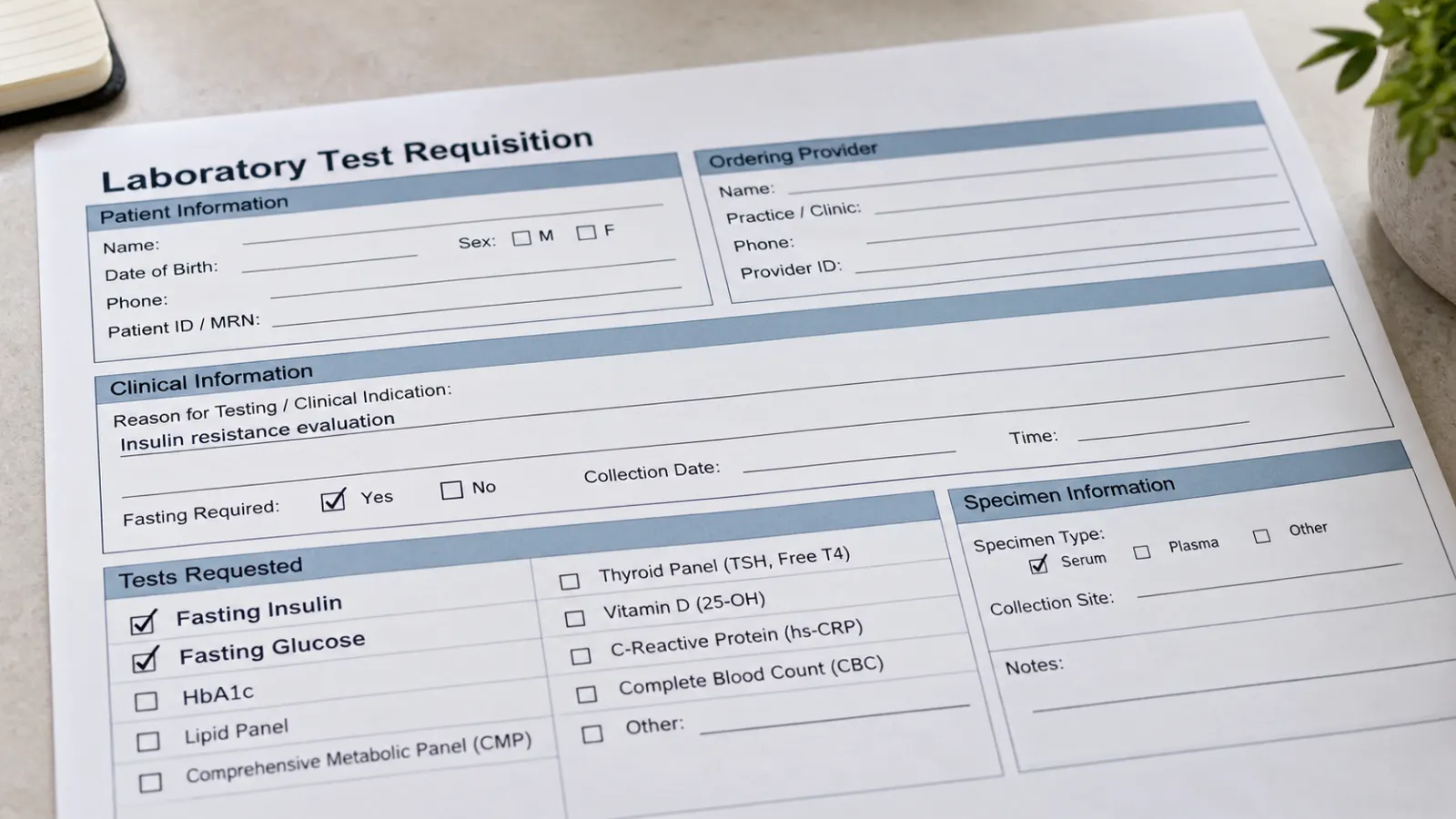
- Ask for fasting insulin with fasting glucose on the same draw, so HOMA-IR can be calculated.
- Ask for a full lipid panel so the triglyceride to HDL ratio can be worked out.
- Bring earlier results, including any “normal” ones. Trends often say more than one snapshot.
- Ask for the values, not the verdict. A reference range shows where a value sits against a population, not how hard your pancreas is working.
- Keep taking prescribed medications unless the clinician who prescribed them says otherwise.
For a longer visit, our guide to your first functional medicine appointment walks through what to bring.
What Comes After an Insulin Resistance Test
An insulin resistance test answers one question: is insulin working harder than it should?
The next thing most people search is how to reverse insulin resistance. The NIDDK points to a healthy lifestyle and weight management, and with 97.6 million US adults living with prediabetes in 2021, the question is common. How far one person’s numbers move depends on what is driving them. A result is the starting point for an individualized plan.
When to See a Doctor Promptly
Some blood sugar symptoms need prompt medical care rather than a longer workup.
Contact your physician the same day for:
- extreme thirst with frequent urination
- blurred vision or unexplained weight loss
- confusion, fainting, or vomiting with high blood sugar readings
- a glucose meter reading far outside your usual range
If symptoms are severe, call emergency services.
Frequently Asked Questions
Can you have insulin resistance with a normal A1c?
Yes. The pancreas can keep blood sugar in range by producing more insulin, so A1c may stay normal while insulin is high. In the Kraft database, just over half of people with normal glucose tolerance had high insulin.
What is a normal HOMA-IR score?
There is no single cutoff that fits every lab, because insulin assays are not standardized. Lower scores indicate better insulin sensitivity, and a HOMA-IR result is best read against the reporting lab and your other results.
Do I need to fast for an insulin resistance test?
For fasting insulin, fasting glucose and HOMA-IR, yes. The NIDDK describes glucose testing after a fast of at least 8 hours. Follow the instructions from the lab or clinician ordering the test.
Can I test for insulin resistance at home?
Some labs sell fasting insulin panels directly to consumers. A home glucose meter shows blood sugar only. Either way, the numbers need interpretation alongside your history.
Is a fasting insulin test the same as an insulin resistance test?
Fasting insulin is one insulin resistance test, not the whole picture. It can miss people whose insulin rises only after meals, which an OGTT with insulin can catch.
Where to Start
The most useful next step is seeing why insulin, thyroid, stress and sex hormones are read as one system. The Natural Path sees patients in person in San Juan Capistrano, Orange County, and by telemedicine across California.
Dr. Goldstein’s free Master Class walks through the connected systems. Watch the free Master Class, and bring the questions it raises to your next appointment.
Written by The Natural Path clinical content team, medically reviewed by Dr. Angela Goldstein, ND. Last reviewed: 2026-09-27.
This article is for general education and is not medical advice. It is not intended to diagnose or treat any disease, does not establish a doctor-patient relationship, and is not a substitute for care from your own clinician. Do not start, stop or change any prescribed medication based on what you read here. If you have an urgent medical concern, contact your physician or emergency services.