
Written by The Natural Path clinical content team, medically reviewed by Dr. Angela Goldstein, ND. Last reviewed: 2026-09-27.
What causes autoimmune disease is, for most people, a combination of factors. Researchers describe a convergence: an inherited genetic susceptibility, an environmental trigger such as an infection, smoking or certain exposures, and a breakdown in the immune system’s own regulation. The National Institute of Environmental Health Sciences says these diseases “likely result from interactions between genetic and environmental factors.” Genes set the stage without deciding the outcome. Identical twins share a diagnosis less than half the time, and nearly 80 percent of people affected are women. A few triggers are well established, such as Epstein-Barr virus for multiple sclerosis and smoking for rheumatoid arthritis. For most autoimmune diseases, the exact first event is still unknown.
Key Takeaways
- Autoimmune disease usually needs genetic susceptibility, a trigger and failed immune regulation at once.
- Identical twins share an autoimmune diagnosis less than 50 percent of the time.
- Epstein-Barr virus infection raised multiple sclerosis risk 32-fold in a cohort of more than 10 million people.
- Smoking is an established risk factor for rheumatoid arthritis.
- Stress-related disorders carry a 36 percent higher rate of later autoimmune disease.
- Whether a leaky gut causes autoimmunity is still unresolved.
If you have been diagnosed, the next question is almost always why. Maybe you have been told it’s just stress, take an antidepressant. Maybe you heard it’s just aging, learn to live with it, or it’s all in your head. None of those answers explain anything. The research below does better, including where its answers stop.
Autoimmune Disease Starts When Immune Tolerance Breaks
Autoimmune disease begins when the immune system loses its ability to tell your own tissue from a threat.
Autoimmune disease is a condition in which the immune system “mistakenly attacks healthy cells, tissues, and organs,” in the words of the National Institute of Environmental Health Sciences.
Immune tolerance is the set of controls that keeps the immune system from reacting to the body’s own proteins.
NIEHS counts more than 80 autoimmune diseases. So the precise question is what breaks tolerance, and in whom. Warning signs are covered in our guide to the early signs of autoimmune disease.
What Causes Autoimmune Disease: Susceptibility Plus a Trigger
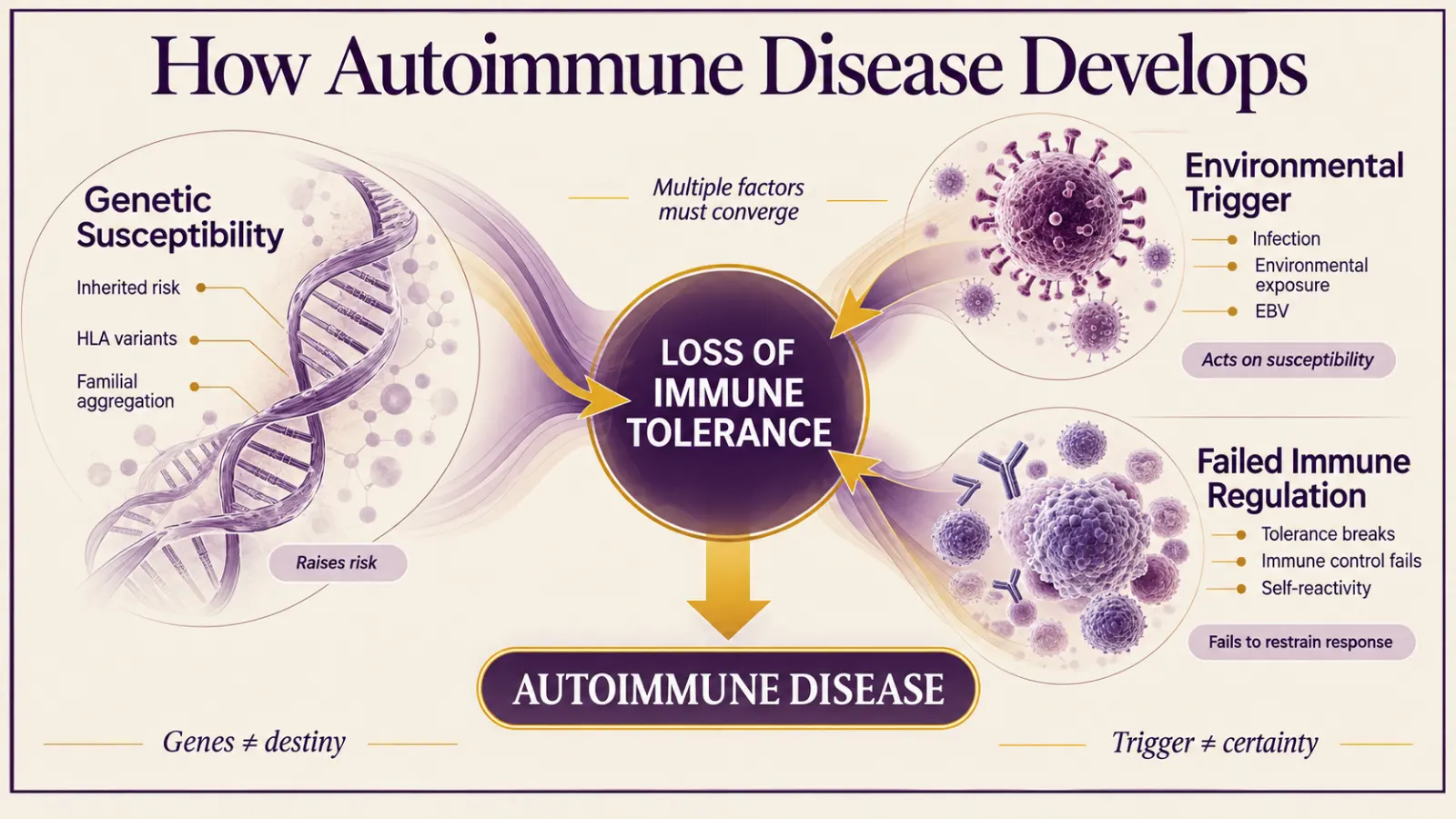
What causes autoimmune disease, in the current research model, is three factors meeting in one person.
A 2025 Stanford review in Frontiers in Immunology says disease “arises when three critical factors converge: genetic predisposition, exposure to an environmental trigger, and defects in immune regulation.” The same review adds that “numerous mechanisms remain poorly understood.”
- Susceptibility. Inherited genes raise or lower the odds.
- A trigger. An infection or exposure acts on that susceptibility.
- Failed regulation. The controls that should shut the reaction down do not hold.
Each factor alone is common. In other words, disease appears where they overlap.
Genes Load the Risk
Genetic susceptibility is real and measurable, but it is only one part of the picture.
HLA genes are the genes that shape how the immune system presents proteins for inspection, and they carry the strongest autoimmune risk signals.
For example, HLA-DRB1 variants are linked to rheumatoid arthritis, and HLA-DR3 and HLA-DR4 raise type 1 diabetes risk, per the Kumar review. Autoimmune conditions also cluster in families, which the review calls “familial aggregation.”
Twin studies show the limit. Identical twins share nearly all their DNA, yet their concordance for autoimmune disease is “typically less than 50%.” That gap, the authors write, highlights “the essential contribution of environmental and epigenetic factors.” A family history raises the odds, and the environment decides much of the rest.
Infections as Triggers
Infections are among the best documented autoimmune triggers, and one virus stands out.
A 2022 study in Science followed more than 10 million young US military members, 955 of whom developed multiple sclerosis. Risk of MS increased 32-fold after infection with Epstein-Barr virus, and did not rise after other viruses. The authors concluded the findings suggest EBV as the leading cause of MS. Still, EBV infection is “nearly ubiquitous and often asymptomatic,” the Kumar review notes, so the virus acts on susceptibility rather than replacing it.
Molecular mimicry is when part of a microbe closely resembles a protein in the body, so immune cells trained against the microbe also react to the body’s own tissue.
Mimicry is one of several mechanisms that can cause viral-induced autoimmunity, per a 2023 review in Viruses. Researchers have also tied EBV to lupus. People who later developed lupus showed elevated EBV antibodies years before diagnosis, the Kumar review reports.
Why Women Are Affected More Often
Women account for nearly 80 percent of autoimmune cases, and the reasons are partly hormonal and partly genetic.
NIEHS puts it at “as many as four out of every five.” The Kumar review offers two mechanisms. First, estrogens “support autoreactive B cell survival, while androgens generally suppress immune activation.” Second, several immune genes sit on the X chromosome, and some escape the process that normally silences the second copy in women.
Dr. Goldstein describes hormones as an orchestra: “if one instrument is out of tune, if one hormone system is off, the whole orchestra sounds terrible.” Sex hormones help set how strongly the immune system responds. Thyroid disease shows the same sex gap: women are 3 to 5 times more likely to be treated for thyroid disorders, per a 2023 review.
Autoimmune thyroid disease falls in that group, and our guide on how Hashimoto’s is diagnosed covers its testing.
Smoking, Medications and Other Exposures
Some exposures are proven triggers for specific diseases, while others are early associations.
- Smoking (established for rheumatoid arthritis). A meta-analysis of 16 studies in Annals of the Rheumatic Diseases found men who had ever smoked had 1.89 times the odds of rheumatoid arthritis, and 3.91 among current smokers with rheumatoid factor-positive disease. For women, the odds ratio was 1.27.
- Medications (established). Drug-induced lupus “is caused by a reaction to a medicine,” per MedlinePlus. Hydralazine, procainamide and isoniazid are the most common causes, and any change belongs to the prescribing physician.
- Other exposures (associated). NIEHS reports that methylmercury “may be linked” to autoimmune antibodies in women, and that sunlight may be connected to juvenile dermatomyositis.
Dr. Goldstein describes some chemical exposures as hormonal imposters that bind hormone receptors, like someone jamming the wrong key in a lock so the right key can’t get in. Researchers are still studying whether that interference contributes to autoimmunity.
Stress and Autoimmune Disease
Stress is linked to autoimmune disease, and the relationship runs in both directions.
A Swedish study in JAMA compared 106,464 people with stress-related disorders against more than a million matched people. Those with stress-related disorders had a 36 percent higher rate of later autoimmune disease, a hazard ratio of 1.36, and 1.46 for post-traumatic stress disorder.
Sibling comparisons showed the same pattern, so shared family background alone is an unlikely explanation. The study’s authors still call for more research on mechanisms.
A 2008 review in Autoimmunity Reviews adds the reverse arrow: autoimmune disease itself “causes significant stress in the patients, creating a vicious cycle.” So “it’s just stress” is the wrong conclusion, and stress still belongs in the history. Our article on how cortisol and thyroid hormones interact explains what stress hormones do to the glands.
The Gut and Intestinal Permeability
The gut is a plausible part of the picture, but its causal role is unsettled.
Intestinal permeability is how easily substances pass through the lining of the gut into the body.
Gut dysbiosis “can compromise regulatory T cell (Treg) function, disrupt intestinal barrier integrity, and promote systemic inflammation,” per the Kumar review. Research has not shown whether a more permeable barrier starts autoimmune disease or follows it, a question covered in what the research shows on leaky gut.

Free training from Dr. Angela Goldstein, ND
If you want to understand what is actually driving your immune system, this free training shows how inflammation, hormones, stress and the gut feed into each other.
When you watch today, you’ll learn:
- ✓Why “normal” labs can miss what is actually wrong
- ✓The three systems that break down together, and why treating one at a time rarely lasts
- ✓Why even natural approaches fall short when they treat symptoms instead of systems
- ✓Real patient stories from 25+ years of practice
Free, instant access. Start watching right now.
Educational content. Always talk with your doctor before changing any treatment.
What Causes Autoimmune Disease, Ranked by Evidence Strength
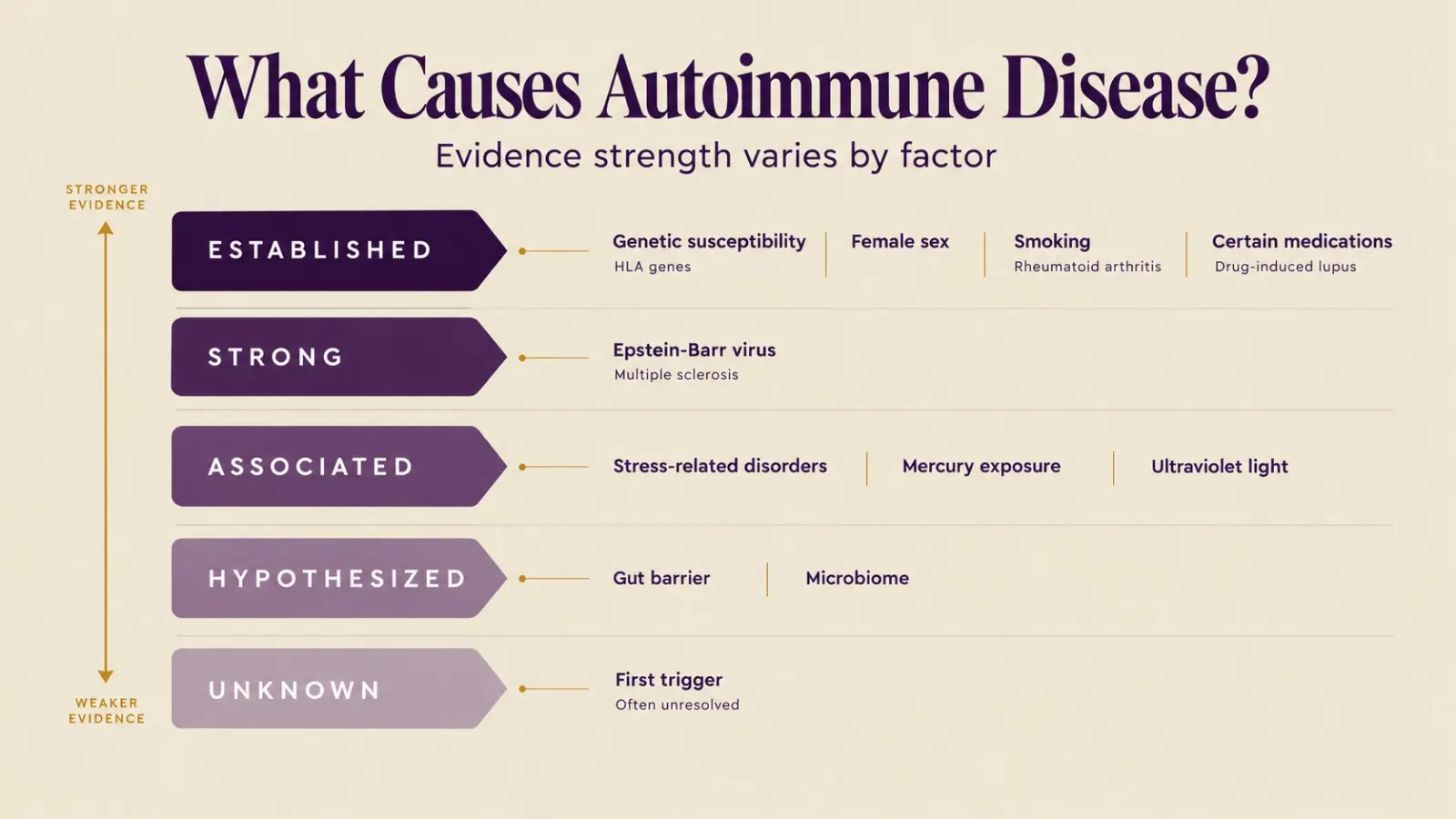
This table sorts each cause of autoimmune disease by the strength of its evidence.
| Factor | Evidence strength | Best current evidence | Source |
|---|---|---|---|
| Genetic susceptibility (HLA genes) | Established contributor | Identical-twin concordance typically under 50% | Kumar et al., Front Immunol, 2025 |
| Female sex | Established | Nearly 80% of cases are women | Kumar et al., 2025; NIEHS |
| Epstein-Barr virus and MS | Strong | MS risk up 32-fold after EBV infection | Bjornevik et al., Science, 2022 |
| Smoking and rheumatoid arthritis | Established | Odds ratio 1.89 in men, 3.91 for RF-positive current smokers | Sugiyama et al., Ann Rheum Dis, 2010 |
| Certain medications and lupus | Established | Hydralazine, procainamide, isoniazid | MedlinePlus |
| Stress-related disorders | Associated | Hazard ratio 1.36, held in sibling comparison | Song et al., JAMA, 2018 |
| Mercury, ultraviolet light | Associated, early | “May be linked” / “may be connected” | NIEHS |
| Gut barrier and microbiome | Hypothesized cause | Direction unresolved | Kumar et al., 2025 |
| First trigger in most people | Unknown | At least 50% of onsets from unknown triggers | Stojanovich, Autoimmun Rev, 2008 |
Read down the middle column: only a few causes are proven, and only for specific diseases.
Why the Root Cause of Autoimmune Disease Is Rarely Single
The root cause of autoimmune disease is rarely one thing, because the risk factors act on the same immune system at once.
In the convergence model, susceptibility, a trigger and weak regulation have to line up. Also, several risk factors touch each other: stress hormones can alter immune regulation, sex hormones shape immune responses, and gut microbes influence immune tolerance.
Dr. Goldstein reached the same view in 25+ years of practice. Listing what drives inflammation, she names “stress, poor diet, toxins, gut dysfunction, hormonal imbalances,” then adds:
“See how it’s all connected? Everything feeds into everything else.”
Dr. Angela Goldstein, ND
One patient found care that “gets to the root of your problem” only “after seeing doctors for years that never changed anything.” That thinking sits behind autoimmune and inflammatory conditions care at The Natural Path, which works alongside the physician managing the diagnosis.
Why a Trigger Is Different From Blame
A trigger is something that acted on an existing susceptibility, which makes it a clue rather than a verdict on how you lived.
You did not choose your genes, your sex or the viruses you met as a child. The 2008 review notes that the onset of at least 50 percent of autoimmune disorders has been attributed to “unknown trigger factors.” Even established triggers raise odds without deciding who develops disease. The useful question is what still acts on your immune system now, because that part can be investigated.
What to Do With This Information
The practical use of this research is a better conversation with your physician.
- Get a physician evaluation. Physicians, often rheumatologists, diagnose and manage autoimmune disease.
- Write down your family history. Include extended family and different autoimmune conditions.
- List exposures and events. Note infections, smoking, medications and major stressors around onset.
- Keep taking prescribed medications. Never stop or change one based on an article.
- Ask what is still active. Stress, gut and hormonal changes are fair questions.
A longer visit gives those questions room, which is what a first functional medicine appointment is built around.
Frequently Asked Questions
Can stress cause autoimmune disease?
Stress is linked with it. In a Swedish JAMA cohort, stress-related disorders carried a 36 percent higher rate of later autoimmune disease. The arrow also runs the other way.
Is autoimmune disease genetic?
Partly. HLA genes and family history raise risk, but identical twins share an autoimmune diagnosis less than half the time.
Can a virus cause autoimmune disease?
Some can, in susceptible people. Epstein-Barr virus raised multiple sclerosis risk 32-fold in a study of more than 10 million people, and is also tied to lupus.
Does leaky gut cause autoimmune disease?
Increased intestinal permeability appears in several autoimmune conditions, but researchers have not shown whether it comes first or follows.
Can autoimmune disease be prevented?
No approach has been proven to prevent autoimmune disease in general. Avoiding tobacco removes one established risk factor for rheumatoid arthritis.
Why are autoimmune diseases more common in women?
Nearly 80 percent of patients are women. Estrogens support self-reactive B cells, and X-chromosome immune genes may heighten reactivity.
Where to Start
The most useful next step is reviewing your own history against this research, with a physician.
Dr. Goldstein’s free Master Class explains how she reads inflammation, hormones, the gut and stress as one connected system. The Natural Path sees patients in person in San Juan Capistrano, Orange County, and by telemedicine across California, alongside the physicians already involved in a patient’s care.
Watch the free Master Class, and bring the questions it raises to your next appointment.
Written by The Natural Path clinical content team, medically reviewed by Dr. Angela Goldstein, ND. Last reviewed: 2026-09-27.
This article is for general education and is not medical advice. It is not intended to diagnose or treat any disease, does not establish a doctor-patient relationship, and is not a substitute for care from your own clinician. Autoimmune disease requires evaluation, diagnosis and ongoing management by a physician. Do not start, stop or change any prescribed medication based on what you read here. If you have an urgent medical concern, contact your physician or emergency services.