

Written by The Natural Path clinical content team, based on the teaching of Dr. Angela Goldstein, ND.
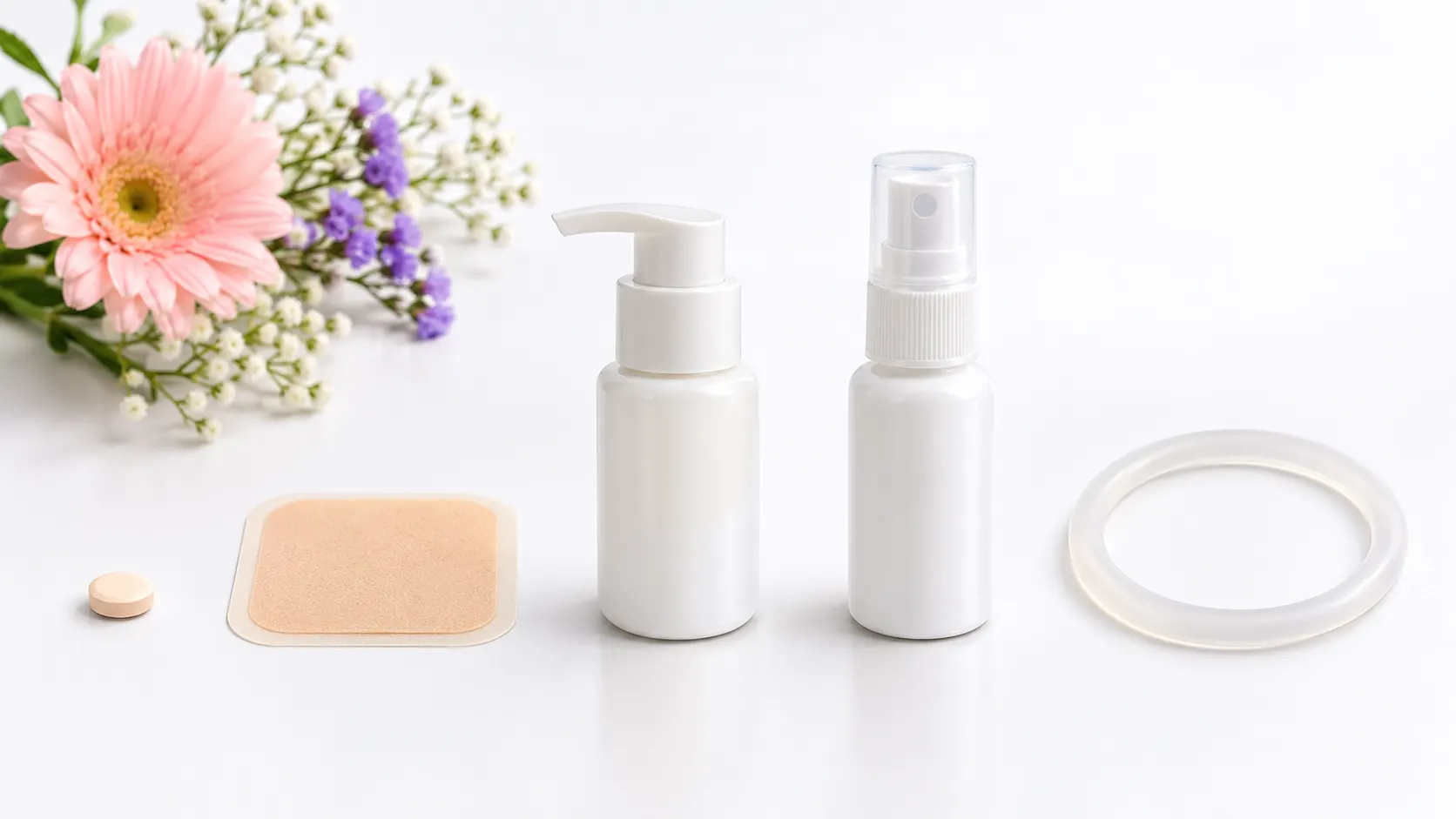
Bioidentical estrogen almost always means estradiol, specifically 17β-estradiol, the estrogen your ovaries make before menopause. Prescription estradiol has the same structure as the estradiol your body produces. It comes as FDA-approved tablets, skin patches, gels and sprays, and as vaginal creams, tablets, inserts and rings. Pharmacies also compound it. A woman who still has her uterus and takes estradiol for whole-body symptoms needs a progestogen as well, to protect the uterine lining. This page covers what estradiol is, approved versus compounded products, how each form reaches the body, the current FDA label picture, and who should not take it.
Key Takeaways
- “Bioidentical estrogen” usually refers to 17β-estradiol, which The Menopause Society describes as identical in structure to the estradiol produced by the ovaries.
- FDA-approved estradiol exists in oral, skin and vaginal forms. Compounded estradiol is not FDA-approved.
- The Menopause Society and ACOG both favor FDA-approved products when a suitable one exists.
- Women with an intact uterus who use systemic estrogen should also receive an adequate progestogen.
- In November 2025 the FDA began removing several boxed warnings from estrogen-containing menopausal hormone therapy. The endometrial cancer warning stays on systemic estrogen-alone products.
- Unexplained vaginal bleeding, liver disease, a history of breast cancer, and a history of stroke, heart attack or blood clots are listed contraindications.
On this page: What it is · Estradiol vs other estrogens · FDA-approved vs compounded · Forms · Pairing with progesterone · FDA label · Who should not take it · Thyroid and stress · California · FAQ
If you searched this phrase, you probably want to know whether the estrogen you might be prescribed is the same as your own, whether compounded is better, and whether it is safe for you. This page answers those questions from The Menopause Society’s 2022 position statement, the American College of Obstetricians and Gynecologists (ACOG) and the FDA. For the broader definition across all hormones, read our guide to what bioidentical hormones are.
Its sister page on bioidentical progesterone covers the other half of most estrogen plans.
What Bioidentical Estrogen Is
Bioidentical estrogen is estradiol made in a laboratory with the same structure as the estradiol your ovaries release.
17β-estradiol is the main estrogen of a woman’s reproductive years. The North American Menopause Society is now called The Menopause Society. Its 2022 hormone therapy position statement states that estradiol is “the predominant estrogen in premenopausal and perimenopausal women” and that prescription micronized 17β-estradiol is “identical to the structure of estradiol that is produced by the ovaries.”
The same statement notes that estradiol is reversibly converted to estrone, a weaker estrogen. Prescription estradiol takes part in that same conversion.
What estradiol is used for follows from what falling estrogen does. The symptoms themselves are covered on our low estrogen symptoms page. The Menopause Society calls hormone therapy the most effective treatment for hot flashes and night sweats and for the genitourinary syndrome of menopause, and says it has been shown to prevent bone loss and fracture.
Estradiol vs Other Estrogens
Several different estrogen molecules are sold as prescriptions, and only one of them matches the ovaries’ main hormone.
| Estrogen | What it is | Matches ovarian estradiol? |
|---|---|---|
| Micronized 17β-estradiol | Prescription estradiol in tablets, patches, gels, sprays and vaginal products | Yes |
| Conjugated equine estrogens (CEE) | A mixture purified from the urine of pregnant mares, used in the Women’s Health Initiative (WHI) trials | No, a mixture of several estrogens |
| Synthetic conjugated estrogens | A blend of synthetic estrogen substances | No |
| Ethinyl estradiol | A synthetic estrogen used mainly in birth control pills | No |
The descriptions come from The Menopause Society’s position statement. The WHI row matters most. The large trials behind decades of headlines used CEE, so their findings were gathered with a different estrogen from estradiol.
Estriol, which some compounded blends contain, is not on The Menopause Society’s list of FDA-approved bioidentical hormones (estradiol, estrone and micronized progesterone). Our bioidentical hormones guide covers that in its hormone table.
FDA-Approved Estradiol vs Compounded Estradiol
Two estradiol products can contain the identical molecule and still differ in how they are made, tested and labeled.
Compounded estradiol is estradiol a compounding pharmacist prepares from one provider’s prescription, sometimes blended with other hormones. The FDA states: “Compounded drugs are not FDA-approved,” and that the agency does not verify the safety, effectiveness or quality of compounded drugs before they are marketed.
The Menopause Society says the term “bioidentical” can be misleading, because both approved and compounded products use it. It says FDA-approved bioidentical hormones, including estradiol, are regulated and monitored for purity and efficacy, and are dispensed with package inserts that carry extensive product information. Compounded preparations may combine estradiol with estrone, estriol, DHEA, testosterone or progesterone in untested combinations, or use untested routes such as pellets.
| FDA-approved estradiol | Compounded estradiol | |
|---|---|---|
| FDA approval | Yes | No |
| Safety, effectiveness and quality verified before marketing | Yes | No, per the FDA |
| Package insert describing risks | Yes | The Menopause Society lists “lack of a label outlining risks” as a safety concern |
| Forms | Tablets, patches, gels, sprays, vaginal creams, tablets, inserts and rings | Blends of several hormones, and nonstandard routes such as troches, pellets and implants |
| Strengths | Set, labeled strengths | Custom strengths; The Menopause Society lists overdosing and underdosing among the safety concerns |
ACOG reached the same place in its 2023 Clinical Consensus No. 6. It states that “compounded bioidentical menopausal hormone therapy should not be prescribed routinely when FDA-approved formulations exist.” It adds that evidence to support marketing claims of safety and effectiveness for compounded products is lacking.
There are documented reasons to compound. The Menopause Society names two: an allergy to an ingredient in an approved product, or a dose or formulation that no approved product offers. It also says patient preference alone should not justify a compounded hormone, and that prescribers should document the medical reason.
Plain takeaway: if a compounded estradiol is offered, ask what the documented reason is. An allergy or a dose that does not exist as an approved product is a clear reason. “It is more natural” is not one, because approved estradiol is already the same molecule.
The Menopause Society also states that salivary and urine hormone testing used to set doses are unreliable and not recommended, and that serum testing is rarely needed. Our guide to hormone testing for women explains what each kind of test can and cannot tell you.
For the cost side of this choice, see what bioidentical hormones cost.

Free 3-minute quiz from Dr. Angela Goldstein, ND
Stress, thyroid and sex hormones work as one system. Answer 22 quick questions and see which one is under the most strain for you.
What you’ll get:
- ✓A score for each system: stress, thyroid and sex hormones
- ✓Which pattern your answers fit, and how the systems pull on each other
- ✓Built on published research
- ✓A clear next step for your pattern
Free. 22 questions, about 3 minutes.
Educational content. Always talk with your doctor before changing any treatment.
Forms of Bioidentical Estradiol
The form decides how much estradiol reaches the whole body and which organs it passes through first.
The Menopause Society divides estradiol into two groups. Systemic products treat the whole body, including hot flashes and night sweats. Low-dose vaginal products treat the vagina, vulva and bladder.
Systemic estradiol
- Oral tablet. Swallowed and absorbed through the gut, then passes through the liver before reaching the rest of the body.
- Skin patch. Worn on the skin and replaced on a schedule.
- Gel and spray. Applied to the skin, where the estradiol absorbs.
- Systemic vaginal ring. The Menopause Society notes that one estradiol ring is designed to provide whole-body estradiol levels.
Low-dose vaginal estradiol
- Creams, tablets, a softgel insert and a low-dose ring. The Menopause Society says these all contain estradiol except one cream made with CEE, and that low-dose vaginal estradiol products “result in minimal systemic absorption.”
| Question | What The Menopause Society says |
|---|---|
| Do oral and skin forms differ for hot flashes? | A meta-analysis found no significant difference between transdermal and oral estrogen-plus-progestogen for relieving hot flashes and night sweats |
| Why might skin or vaginal forms be chosen? | Nonoral routes bypass the first pass through the liver |
| Are skin forms proven safer? | Unknown. Trials were not designed to compare routes for clots, breast cancer or heart outcomes. Observational studies have not shown an increased clot risk with transdermal estrogen, and comparative trial data are lacking |
| When is a vaginal product preferred? | When estrogen is used only for genitourinary symptoms, low-dose vaginal estrogen is preferred over systemic therapy |
Each of these forms has FDA-labeled estradiol products, such as Divigel gel, Evamist spray, Vagifem and Imvexxy vaginal inserts, Estrace vaginal cream and the Femring ring (estradiol acetate). Their current labels are searchable on DailyMed, the National Library of Medicine’s drug label database.
The Natural Path states on its hormone pages that creams, oral and injectable forms are used, and that pellets are not offered. That is a practice statement about forms in general. Our bioidentical hormone therapy page explains the clinical approach around it.
Why Estradiol Is Paired With Progesterone When You Have a Uterus
Estrogen on its own thickens the lining of the uterus, and that is the reason estradiol and progesterone usually travel together.
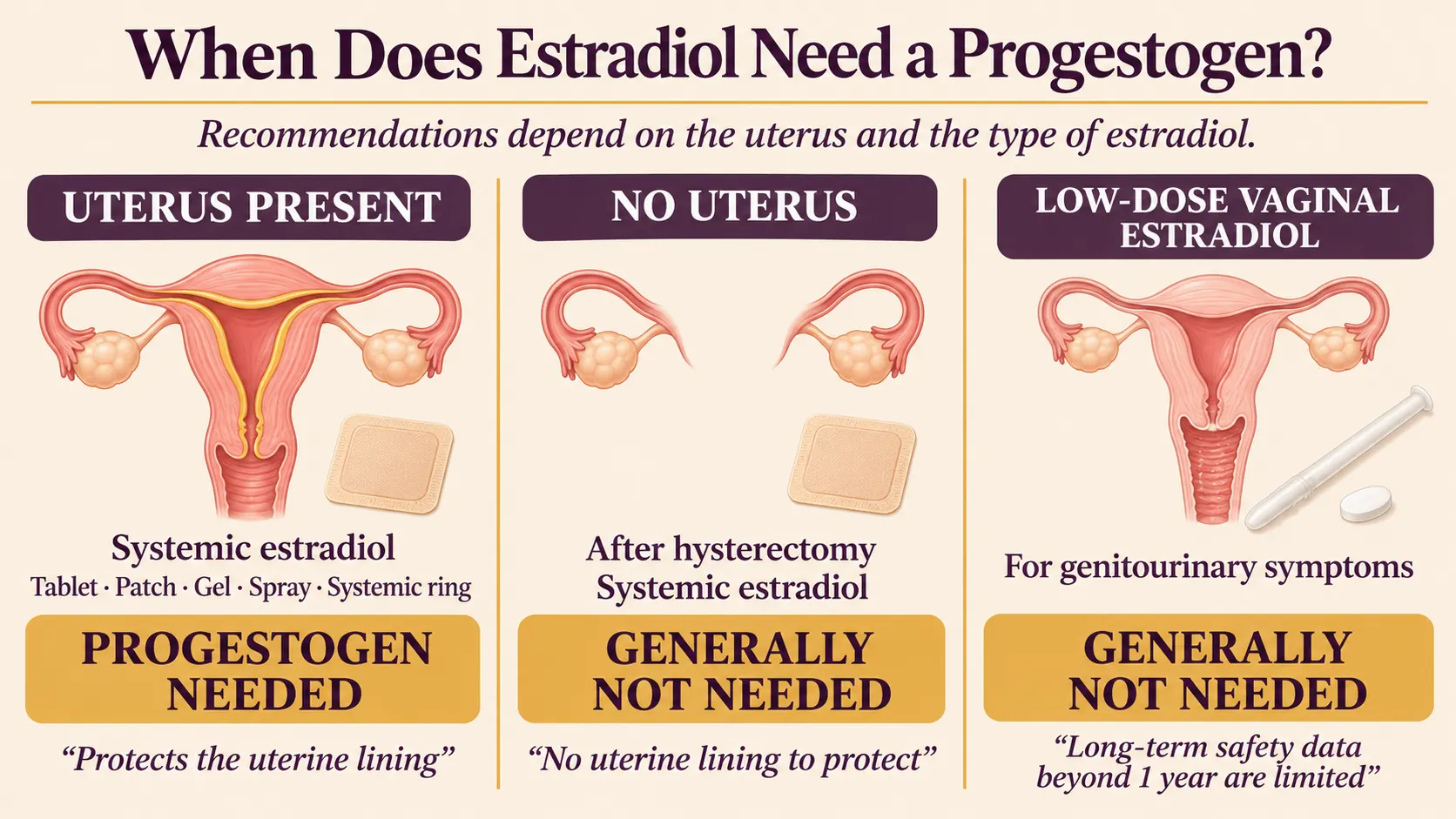
The Menopause Society states that “chronic unopposed endometrial exposure to estrogen increases the risk for endometrial hyperplasia or cancer.” It defines the menopause-related reason for a progestogen as preventing that overgrowth during estrogen use, and says women with an intact uterus using systemic estrogen should receive adequate progestogen. The one exception it lists is a combination product built on CEE, which is not estradiol.
| Your situation | What the sources say |
|---|---|
| Uterus present, systemic estradiol (tablet, patch, gel, spray, systemic ring) | Adequate progestogen is needed to protect the lining |
| No uterus (after hysterectomy), systemic estradiol | The progestogen indication is endometrial protection, so this reason does not apply |
| Low-dose vaginal estradiol for genitourinary symptoms | A progestogen is generally not indicated, although trial data on endometrial safety beyond 1 year are lacking |
Progestogen is the umbrella word. It includes synthetic progestins and micronized progesterone, which The Menopause Society describes as structurally identical to the progesterone made by the corpus luteum. Our bioidentical progesterone page walks through the label trial behind that protection, dose and duration, and the choice between progesterone and progestins.
Any vaginal bleeding after menopause needs a workup. In its section on vaginal estrogen, The Menopause Society states that vaginal bleeding in a postmenopausal woman requires thorough evaluation.
What the Current FDA Label Says
The FDA changed the labels on estrogen-containing menopausal hormone therapy in late 2025, and the change has limits worth knowing.
In November 2025 the FDA began removing the boxed warnings for cardiovascular disease, breast cancer and probable dementia from estrogen-containing menopausal hormone therapy, with labels rewritten to note benefit when therapy starts within 10 years of menopause onset.
Scope: per the FDA announcement of November 10, 2025, the boxed warning for endometrial cancer stays on systemic estrogen-alone products. The FDA’s labeled timing is to start within 10 years of menopause onset or before age 60. The FDA also says the starting time and duration of use are decisions made between the prescriber and the individual patient.
The change has now reached approved estradiol labels. The current label for Divigel estradiol gel lists the boxed warnings for cardiovascular disorders, breast cancer and probable dementia as removed in February 2026. It keeps a boxed warning for endometrial cancer with unopposed estrogen in women with a uterus, and advises considering starting it in women under 60 or within 10 years of menopause onset. For low-dose vaginal estrogen, the FDA’s labeling request removes the endometrial cancer language from the boxed warning as well.
Two practical points follow for estradiol:
- The endometrial warning is the pairing rule in label form. Systemic estradiol taken alone by a woman with a uterus still carries it, which is the same reason the progestogen section above exists.
- Labels belong to approved products. The Menopause Society lists “lack of a label outlining risks” among its safety concerns for compounded hormones, so a woman using compounded estradiol may never see the updated wording in print.
The Menopause Society’s 2022 statement agrees on timing. It rates the benefit-risk balance as favorable for women younger than 60, or within 10 years of menopause onset, who have no contraindications, for bothersome hot flashes and prevention of bone loss. It describes the balance as less favorable for women who start later. The label change describes products. It does not decide whether estradiol suits one particular woman.
Who Should Not Take Estradiol
The Menopause Society lists contraindications for oral and transdermal hormone therapy, and these are the clearest rules on this page.
Contraindications listed by The Menopause Society:
- Unexplained vaginal bleeding.
- Liver disease.
- A prior estrogen-sensitive cancer, including breast cancer.
- Prior coronary heart disease, stroke or heart attack.
- Prior venous thromboembolism (a blood clot in a vein, such as the leg or lung).
- A personal history or inherited high risk of clotting disease.
For women with breast cancer who want low-dose vaginal estrogen for genitourinary symptoms, The Menopause Society says the decision should be made with their oncologist.
More common side effects. The statement lists nausea, bloating, weight gain, fluid retention, mood swings (related to the progestogen), breakthrough bleeding, headaches and breast tenderness. It names rarer risks for women under 60 as breast cancer with combined estrogen-plus-progestogen therapy, endometrial hyperplasia and cancer when estrogen is inadequately opposed, blood clots, and gallbladder disease.
When to call right away. The patient information on the Divigel estradiol gel label lists warning signs to report to a clinician right away. They include new breast lumps, unusual vaginal bleeding, changes in vision or speech, sudden new severe headaches, and severe pains in the chest or legs with or without shortness of breath, weakness and fatigue.
Estrogen Is Read With the Thyroid and the Stress Response
An estradiol prescription answers one question. Dr. Goldstein’s work starts with a different one: why did the hormone change, and what came before it?
Describing what most doctors miss, Dr. Goldstein says they “test estrogen, and if it’s low, they prescribe estrogen replacement.” Her model puts three systems in one loop: “These three systems are interconnected. You cannot fix one without addressing the others.”
The stress response sits upstream. A 2026 review in Endokrynologia Polska states that cortisol inhibits the secretion of thyrotropin-releasing hormone (TRH) in the hypothalamus and thyroid-stimulating hormone (TSH) in the pituitary gland. A separate review of stress and reproduction reports that at the hypothalamus, glucocorticoids such as cortisol inhibit the release of gonadotropin-releasing hormone (GnRH), the signal that starts the ovarian cycle. Dr. Goldstein teaches the same chain in plain words: “High cortisol tells your thyroid to slow down because your body thinks there’s a famine.”
Estradiol and the thyroid interact. The route of estradiol matters for women who take thyroid medicine:
- In a 12-week randomized trial of 20 menopausal women with hypothyroidism, oral estradiol raised total T4 and thyroxine-binding globulin, and 3 of the 10 women on tablets needed a higher levothyroxine dose. Transdermal estradiol alone did not significantly affect thyroid function.
- An earlier study in the New England Journal of Medicine concluded that in women with hypothyroidism treated with thyroxine, estrogen therapy may increase the need for thyroxine.
So a thyroid that is quietly slowing, or a thyroid dose that no longer fits after a new estrogen tablet, can look like an estrogen problem. Our page on cortisol and thyroid goes deeper on the stress side.
Dr. Goldstein also teaches that “standard labs measure diseases, not function,” which is why one estradiol number rarely settles the question.
What perimenopause labs can and cannot show explains the timing problem.
For women with a thyroid diagnosis, Hashimoto’s and menopause covers how the two overlap.
Bioidentical Estrogen Care in Orange County and Across California
The Natural Path sees women in person at its San Juan Capistrano office, an easy drive for many women in San Clemente and Mission Viejo, and by video visit anywhere in California. According to the practice’s hormone page, hormone support is considered after thyroid, adrenal, metabolic and sex hormone function have been read together, and prescribing requires an evaluation and ongoing monitoring. Dosing is individualized and adjusted based on response and repeat testing.
The practice’s approach to perimenopause care is on the hormones and perimenopause page.
Thyroid care is described on the thyroid and Hashimoto’s page.
Details on video care are on the telemedicine page.
Directions and hours are on the contact page.
Frequently Asked Questions
Is bioidentical estrogen the same as estradiol?
In most uses, yes. The term usually refers to 17β-estradiol, which The Menopause Society describes as identical in structure to the estradiol produced by the ovaries. Compounded blends may also contain estriol or estrone, so ask which estrogen a product contains.
Is bioidentical estrogen FDA-approved?
FDA-approved estradiol exists as tablets, patches, gels, sprays and vaginal products. Compounded estradiol is not FDA-approved, and the FDA does not verify its safety, effectiveness or quality before it is marketed.
Is compounded estradiol safer than FDA-approved estradiol?
The evidence does not show that. ACOG states that evidence to support marketing claims of safety and effectiveness for compounded bioidentical hormones is lacking, and that compounded products should not be prescribed routinely when FDA-approved formulations exist.
Do I need progesterone if I take estradiol?
If you have a uterus and use systemic estradiol, The Menopause Society says you should receive adequate progestogen to protect the uterine lining. Women without a uterus and women using low-dose vaginal estradiol for genitourinary symptoms generally do not need one for that reason.
Is an estradiol patch different from a pill?
Both relieve hot flashes and night sweats, and a meta-analysis found no significant difference between them for that purpose. The patch bypasses the first pass through the liver. Whether that lowers the risk of clots, breast cancer or heart events is unknown, because trials were not designed to compare routes.
Does vaginal estrogen go into the bloodstream?
The Menopause Society says low-dose vaginal estradiol products result in minimal systemic absorption. One vaginal ring is an exception, because it is designed to deliver whole-body estradiol levels.
Where to Start
An estradiol question is usually a three-system question underneath. The free hormone quiz scores stress, thyroid and sex hormones together, so you can see which one is under the most strain before anyone talks about a prescription. Take the free hormone quiz.
Written by The Natural Path clinical content team, based on the teaching of Dr. Angela Goldstein, ND.
This article is for general education and is not medical advice. It does not establish a doctor-patient relationship and is not a substitute for care from your own clinician. Do not start, stop or change any hormone or prescribed medication based on what you read here. If you have an urgent medical concern, contact your physician or emergency services.