

Written by The Natural Path clinical content team, based on the teaching of Dr. Angela Goldstein, ND.
You were diagnosed with Hashimoto’s years ago, and your levothyroxine dose has been steady. Now your sleep is broken, your periods are erratic, and you are tired in a way that your last lab report does not explain. Which one is it this time: your thyroid, or the transition?
With Hashimoto’s and menopause arriving together, the transition can change three things you may have taken for granted. Your symptoms get harder to attribute, because the two overlap heavily. Your thyroid medication needs can shift, especially if estrogen enters the picture. And the schedule for rechecking your labs matters more than it did when you were stable. This page covers all three, using only what the sources say. If you do not have a diagnosis yet, our page on thyroid or perimenopause is the better starting point.
Key Takeaways
- Hashimoto’s and menopause often meet in the same woman: the disease most often develops in women ages 30 to 50, so many women arrive at the menopausal transition already diagnosed and already treated.
- The British Thyroid Foundation calls thyroid and menopause symptoms “common, non-specific and overlapping,” which is why a new symptom needs a lab check, not a guess.
- Oral estrogen raised thyroxine-binding globulin in the studies below, and some women on levothyroxine needed a higher dose. Estrogen through the skin showed little effect on thyroid function in the randomized trial covered below.
- The American Thyroid Association says thyroid antibodies do not need to be repeated. TSH is the number you monitor.
- The American Thyroid Association says to expect a blood check 6 to 8 weeks after starting or changing a thyroid hormone dose. Ask your prescriber to time a recheck around any estrogen start as well.
- A normal TSH answers one question. Dr. Goldstein asks the next one: what is your whole system doing?
Hashimoto’s and Menopause: Why the Transition Hits Differently
Women with Hashimoto’s reach the menopausal transition with a thyroid that is already being managed, and the transition adds a second hormone shift on top of it. The National Institute of Diabetes and Digestive and Kidney Diseases (NIDDK) reports that Hashimoto’s is 4 to 10 times more common in women than in men and more often develops in women ages 30 to 50. That age range runs right up to the menopausal transition. By the time perimenopause starts, a large share of women with Hashimoto’s have already been through diagnosis, dose adjustments and a long stretch of “stable” labs.
Hashimoto’s disease is an autoimmune condition in which the immune system attacks the thyroid, and over time the gland may make too little hormone.
Two systems that both set your energy, temperature, sleep and mood are changing at the same time, and either one can explain a new symptom.
A small study from Tokyo hints at the pattern. A conference abstract from Tokyo Women’s Medical University looked at 271 women at one clinic and found antithyroid antibodies in 28.8% overall, and in 45.8% of the group 1 to 5 years past menopause. Among women with Hashimoto’s disease, coldness and fatigability were reported significantly more often, and hot flashes, night sweats and irritability significantly less often, than among women without it. It is one clinic and an abstract, so treat it as a lead.
Symptom Overlap: What Could Be Hashimoto’s, What Could Be the Transition
The NIDDK lists the common hypothyroid symptoms as fatigue, weight gain, trouble tolerating cold, joint and muscle pain, dry skin, dry or thinning hair, heavy or irregular menstrual periods, a slowed heart rate and depression. Most of that list also shows up during the transition. The British Thyroid Foundation puts it plainly: both thyroid and menopause-related symptoms are “common, non-specific and overlapping.”
| What you notice | Could point to your thyroid | Could point to the transition |
|---|---|---|
| Fatigue | Dose no longer matches your need | Broken sleep, shifting hormones |
| Cold all the time | Leans toward underactive thyroid | Less typical of the transition |
| Hot flashes, night sweats | Less typical with an underactive thyroid | The hallmark of the transition |
| Heavy or irregular periods | Listed by NIDDK for hypothyroidism | Cycle changes define perimenopause |
| Low mood | Listed by NIDDK for hypothyroidism | Overlaps, per the British Thyroid Foundation |
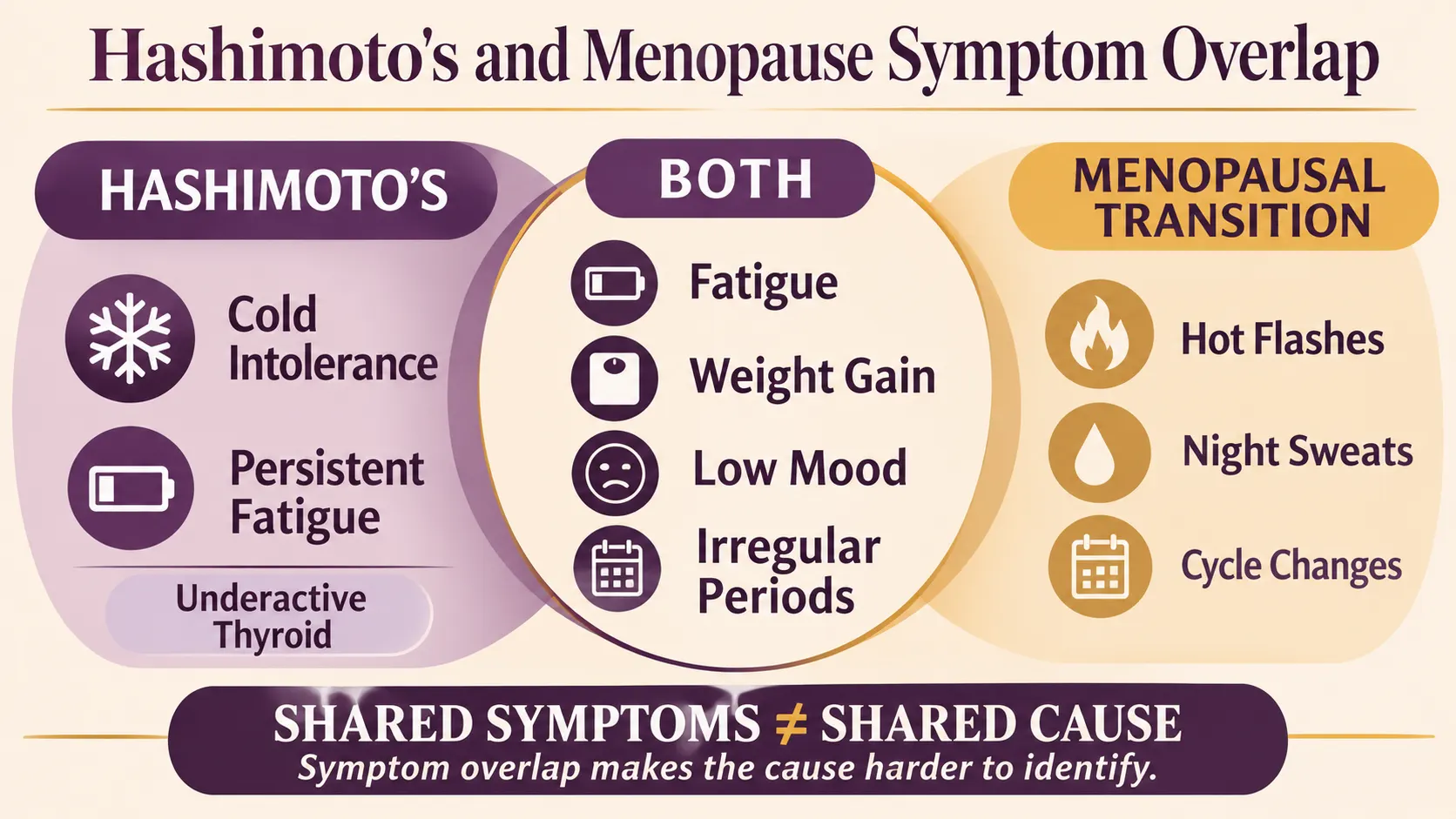
Two rows give real direction. Persistent cold intolerance leans toward the thyroid, and hot flashes and night sweats lean toward the transition. Everything else is shared, which is why a symptom list cannot settle it.
This page is for women who already know they have Hashimoto’s. If you are still working out which explanation fits, use the page above first.
Dr. Goldstein describes the endocrine system as an orchestra. When one instrument is out of tune, the whole orchestra sounds terrible, and the sound alone does not tell you which instrument it is.

Free 3-minute quiz from Dr. Angela Goldstein, ND
Stress, thyroid and sex hormones work as one system. Answer 22 quick questions and see which one is under the most strain for you.
What you’ll get:
- ✓A score for each system: stress, thyroid and sex hormones
- ✓Which pattern your answers fit, and how the systems pull on each other
- ✓Built on published research
- ✓A clear next step for your pattern
Free. 22 questions, about 3 minutes.
Educational content. Always talk with your doctor before changing any treatment.
What Your Thyroid Antibodies Can and Cannot Tell You
Hashimoto’s is usually identified by antibodies against thyroid peroxidase (TPO) or thyroglobulin. Our page on how Hashimoto’s is diagnosed walks through that workup. Here is what matters once you are already diagnosed.
- You do not need to keep repeating them. The American Thyroid Association (ATA) states that repeating and monitoring your thyroid antibody levels is not needed, and that you do need to monitor your TSH.
- A negative result does not always close the door. A 2022 review reports that seronegative Hashimoto’s can be seen in 5% to 10% of cases.
- Antibodies can exist without a dosing problem. The ATA says that if you have high antibody levels with normal thyroid function tests, you do not require treatment with thyroid hormone.
The practical point for the transition: a new symptom is a reason to check TSH and free T4, not to re-run antibodies. If you are curious about the range of what a thyroid panel can include, our page on subclinical hypothyroidism explains the in-between zone where TSH is slightly elevated.
Estrogen, Thyroid-Binding Globulin and Your Levothyroxine Dose
Oral estrogen can raise the dose of levothyroxine some women need, and estrogen through the skin showed little effect in the randomized trial below. The evidence is real but small, so the wording here is careful.
Thyroxine-binding globulin (TBG) is a protein made in the liver that carries thyroid hormone in the blood. Estrogen raises it.
The mechanism. Thyroid hormone travels in your blood partly bound to TBG. A 2023 review in the International Journal of Molecular Sciences notes that high estradiol levels stimulate TBG expression and secretion. More binding protein means more of your thyroid hormone is bound, and the free portion your cells use can fall.
What the studies found.
- Arafah, New England Journal of Medicine, 2001. The study followed 11 postmenopausal women with normal thyroid function and 25 postmenopausal women with hypothyroidism treated with thyroxine, checking labs every 6 weeks for 48 weeks after estrogen therapy began. In the women with hypothyroidism, free thyroxine fell and TSH rose, and TSH went above 7 in 7 of the 18 women on replacement therapy. The conclusion: in women with hypothyroidism treated with thyroxine, estrogen therapy may increase the need for thyroxine.
- Kaminski and colleagues, Menopause, 2021. In a randomized trial of 20 menopausal women with primary hypothyroidism, 12 weeks of oral estradiol raised total T4 and TBG, and TSH changes were clinically important in 3 of 10 women, who needed to raise their levothyroxine dose. Transdermal estradiol alone did not significantly affect thyroid function.
What the clinical guidance says. The British Thyroid Foundation states that women with pre-existing hypothyroidism may require an increase in thyroxine dose after starting oral combined HRT, and that when estrogen is given through the skin by gel, spray or patch, the dose of thyroxine should not be affected. It also says your thyroxine dose requirements may change during the menopause transition itself. The ATA’s hypothyroidism page lists estrogen among the medicines that affect thyroid pills, alongside calcium, iron, antacids and biotin.
The limits, stated honestly.
- Both studies are small. Neither one is limited to Hashimoto’s. The participants had hypothyroidism, and Hashimoto’s is the most common cause in the United States, but the studies do not break it out.
- Not every woman needed a change. In the oral estradiol group in Kaminski, 3 of 10 needed a higher dose, and Arafah’s conclusion says “may.”
- No source here gives a dose number, and this page will not either. Dosing is a decision between you and your prescriber, based on your labs.
- Whether you take estrogen at all, and in what form, is a separate decision with its own risks and benefits. This page only covers what it means for your thyroid labs.
When to Recheck Your Labs
This is the section to bring to your next appointment. Every interval below comes from a named source.
| Situation | Recheck | Source |
|---|---|---|
| You start or change your levothyroxine dose | TSH about 6 to 8 weeks later | ATA: “6 to 8 weeks after starting or changing your thyroid hormone dose” |
| You start oral combined HRT | Thyroid function tests after starting | British Thyroid Foundation |
| You start or stop any estrogen product | Tell your prescriber so a recheck can be timed to the change (no interval is given in these sources) | ATA lists starting or stopping estrogen among reasons to call your doctor |
| Your dose has been stable | Roughly every 6 months, then yearly | NIDDK; BTF also says a yearly test is usual |
| A new or returning symptom after feeling fine on levothyroxine | Check thyroid function now | BTF expert Q&A: feeling suddenly unwell is “sufficient reason to check thyroid function” |
| You lose or gain 10 pounds or more | Call your doctor | ATA |
Three habits make the schedule work:
- Tell every prescriber about every medicine. The ATA lists estrogen, antacids, calcium or iron supplements and biotin as things that can change how thyroid pills behave.
- Keep a symptom and cycle log. Dates matter. A log showing when a symptom started, relative to a dose change, a new supplement or a cycle change, is more useful than “I have been tired.”
- Do not change a prescribed dose on your own. Bring the pattern to your prescriber.
Why a Normal TSH Is Not the End of the Conversation
A normal TSH tells you the dose is meeting a target number, not whether your whole system is working well. Suppose you recheck at the right time and your TSH comes back in range, yet the fatigue, the brain fog and the 3 a.m. wake-ups continue. That happens, and it is where our practice starts.
Dr. Goldstein teaches that standard labs measure disease, not function, and that you cannot treat one hormone system without addressing the others. She says: “Your thyroid can be normal while still being shut down by stress.” Her model runs in a line: chronic stress raises cortisol, cortisol tells the thyroid to slow down, and a slower thyroid disrupts the sex hormones.
That chain has research behind its first link. A 2026 review in Endokrynologia Polska reports that cortisol suppresses TRH and TSH secretion and disrupts the circadian rhythm of TSH secretion. Our page on cortisol and thyroid walks through it.
For a woman with Hashimoto’s in the transition, that means three questions beyond the TSH:
- When did this start, and what came before it? A dose change, a stressful year, a new medicine, a missed cycle.
- Is anything else feeding the immune side? Gut, diet and inflammation are part of how we read autoimmune thyroid disease. See our page on what to eat with Hashimoto’s.
- Which system is leading? Thyroid, stress response or sex hormones. Our page on what perimenopause labs show explains what each result can and cannot tell you.
If you are comparing your Hashimoto’s with a general hypothyroid diagnosis, our page on hypothyroidism versus Hashimoto’s lays out the difference.
Hashimoto’s and Menopause Care in San Juan Capistrano or by Video Across California
Dr. Goldstein sees patients at the San Juan Capistrano office, and women come in from towns such as Laguna Niguel and Lake Forest. Telemedicine is available anywhere in California, so a woman outside Orange County can start with a video visit and bring her recent TSH results and symptom log with her.
Learn more about how we approach thyroid and Hashimoto’s care.
For the hormone side, see our page on care through perimenopause and menopause.
You can also read how a video visit works across California.
Questions about the office? Contact the practice.

Frequently Asked Questions
Can menopause make Hashimoto’s worse?
The sources reviewed here do not show that menopause makes the autoimmune process itself worse. What they show is that thyroid symptoms and menopause symptoms overlap, that your levothyroxine needs may change during the transition, and that estrogen can change how much thyroid hormone is available. That is a reason to recheck labs.
Do I need a higher levothyroxine dose in menopause?
Possibly, and only your labs can say. In the studies above, some women on levothyroxine needed a higher dose after oral estrogen began, and others did not. The British Thyroid Foundation notes that dose needs may change through the transition.
Does estrogen through the skin affect my thyroid medication?
In the one randomized trial reviewed here, transdermal estradiol alone did not significantly change thyroid function. The British Thyroid Foundation says the thyroxine dose should not be affected by gel, spray or patch estrogen. A BTF expert panel adds that whether skin-applied estrogen needs a thyroid recheck is “not that clear” and that some absorption issues may exist. Recheck your labs when you start, since your own response is what counts.
How soon after changing my thyroid medication should I get labs?
The ATA says your doctor will check your blood 6 to 8 weeks after starting or changing your thyroid hormone dose.
Should I keep testing my thyroid antibodies?
The ATA says repeating and monitoring antibody levels is not needed. TSH is what gets monitored.
I have Hashimoto’s and my labs are normal, but I still feel off. What now?
A normal TSH means the dose is matching a target number. Your symptoms are a separate data point. Bring your symptom log, the timing of the first symptoms and a full list of medicines and supplements, and ask for a full-picture review.
Your thyroid and your hormones are one system, and the transition is a good time to look at both. Dr. Goldstein walks through the full three-system model in her free Master Class: watch the Master Class.
Written by The Natural Path clinical content team, based on the teaching of Dr. Angela Goldstein, ND.
This article is for general education and is not medical advice. It is not intended to diagnose or treat any disease, does not establish a doctor-patient relationship, and is not a substitute for care from your own clinician. Do not start, stop or change any prescribed medication based on what you read here. If you have an urgent medical concern, contact your physician or emergency services.