

Written by The Natural Path clinical content team, based on the teaching of Dr. Angela Goldstein, ND.
The Hashimoto’s diet is not one diet, because none of the trials reviewed here shows an eating plan changing the course of the condition. The best-supported Hashimoto’s diet steps are narrow ones. Test for celiac disease before cutting gluten. Keep iodine near the recommended amount. Treat a documented vitamin D shortfall. Ask a clinician whether selenium fits you, since it lowers thyroid antibodies in trials but has not clearly improved how people feel. Take levothyroxine away from espresso, soy and multivitamins with iron or calcium. Studies of gluten-free and autoimmune protocol diets are small and mixed. Weight change after thyroid treatment is modest on average, so Hashimoto’s weight loss usually needs its own plan.
Key Takeaways
- Trials of Hashimoto’s diets measure antibodies, symptoms and weight. None of the trials reviewed here shows a diet changing the long-term course of the condition.
- A 2025 meta-analysis of three gluten-free trials in people without celiac disease called the effect on thyroid function “very uncertain.” Celiac screening comes first.
- Selenium lowers TPO antibodies in a 35-trial meta-analysis, yet a 412-person trial found no quality-of-life benefit over placebo.
- Iodine should be enough, not extra. Vitamin D is worth treating when a test shows a shortfall.
- Dr. Goldstein reads the thyroid together with stress and gut, so food is one input among several.
You got a Hashimoto’s diagnosis, and maybe a levothyroxine prescription. Then the advice stopped at “eat healthy,” and every page you opened told you to cut something different. This Hashimoto’s diet guide sorts what trials found from what only circulates online. It gives you an order of questions instead of a menu, because the trials did not test a single menu.
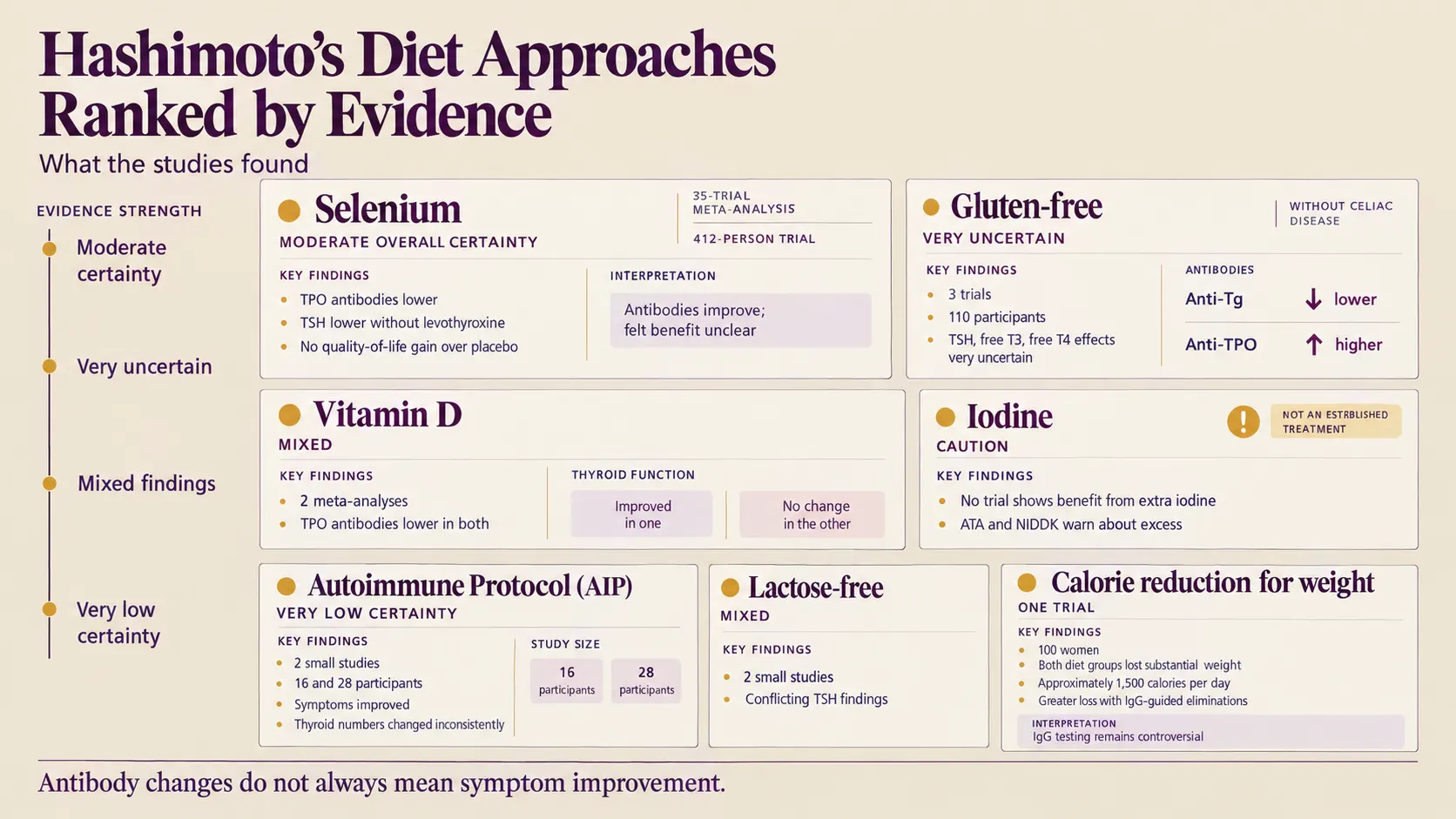
Hashimoto’s Diet: The Evidence at a Glance
Selenium and vitamin D have the most trial data, gluten-free and the autoimmune protocol have the least, and no approach below has long-term trial data on the course of the condition.
Hashimoto’s thyroiditis is an autoimmune condition in which the immune system attacks the thyroid, and the American Thyroid Association (ATA) states that it is the most common cause of hypothyroidism in the United States.
Hashimoto’s means thyroid antibodies are present, and the thyroid may keep up for years or slowly lose output. When antibodies are high but TSH and free T4 are normal, the ATA says you do not require treatment with thyroid hormone. The difference between those states is covered in hypothyroidism vs. Hashimoto’s, and it matters here because most diet studies enroll people in different states.
| Approach | What the studies found | How firm it is |
|---|---|---|
| Gluten-free (no celiac disease) | Meta-analysis of 3 trials, 110 people: effect on TSH, free T3 and free T4 “very uncertain.” Anti-Tg lower, anti-TPO higher. | Very uncertain (authors’ rating) |
| Selenium | Meta-analysis of 35 trials: TPO antibodies lower. TSH lower in people not on levothyroxine. A 412-person trial on levothyroxine: no quality-of-life gain over placebo. | Moderate overall certainty, unclear benefit for how you feel |
| Vitamin D | Two meta-analyses: TPO antibodies lower in both. Thyroid function improved in one and did not change in the other. | Mixed |
| Autoimmune protocol (AIP) | Two small studies (16 and 28 people). Symptoms improved. Thyroid numbers moved inconsistently. | Very low |
| Iodine | No trial shows a benefit from extra. ATA and NIDDK warn about excess. | Caution, not a treatment |
| Lactose-free | Two small studies disagree on TSH. | Mixed |
| Calorie reduction for weight | One 100-woman trial: large losses in both diet groups on about 1,500 calories a day, more in the group using IgG-guided eliminations. | One trial, IgG testing called controversial |
The rest of this page opens each row, in the order a reader usually asks about them.
Gluten-Free: Screen for Celiac First
Gluten-free eating has its clearest use in Hashimoto’s when celiac disease or a gluten-related reaction is present, and thin support otherwise.
Celiac disease is an autoimmune reaction to gluten that flattens the lining of the small intestine.
A 2022 review in Nutrients by Szczuko and colleagues reports that about 5% of adults and 8% of children with Hashimoto’s also have celiac disease, against roughly 1% in the general population. That overlap is the strongest reason to look. The National Institute of Diabetes and Digestive and Kidney Diseases (NIDDK) says doctors don’t recommend starting a gluten-free diet before diagnostic testing, because the diet can affect results. Test first, then decide.
Gluten is also where many people first meet the idea of leaky gut, and our leaky gut symptoms guide covers what the intestinal permeability research actually shows.
If celiac disease or a gluten-related gut problem turns up, the digestive side of the picture, covered in our gut and digestive health care, moves to the front.
For everyone else, the trials are small. A six-month pilot by Krysiak and colleagues followed 34 women with Hashimoto’s. Antibody titers fell on a gluten-free diet, but the women had incidentally positive anti-tissue transglutaminase antibodies, so some may have had unrecognized celiac-type disease, as the Szczuko review points out. That review also notes that thyroid hormone levels did not change.
The newest pooled look is a 2025 meta-analysis in Nutrients of randomized trials in people without celiac disease. Only three trials, 110 participants, qualified. TSH, free T3 and free T4 showed no clear difference, anti-Tg fell, and anti-TPO rose. The authors rated the evidence quality as having serious methodological concerns to extremely serious imprecision. Survey studies report people feeling better, mostly in digestion, but those answers were self-reported.
The Szczuko review concludes there is no basis for a gluten-free diet as standard management of Hashimoto’s. It also warns that any elimination diet carries a risk of nutrient gaps, and gluten-free substitutes can raise grocery costs by up to 30%.
Selenium: Antibodies Move, Symptoms Less Clearly
Selenium has the largest body of trial data of the supplements covered here, and it lowers TPO antibodies more reliably than it improves how people feel.
Selenium is a trace mineral the body needs to make thyroid hormone and to handle oxidative stress.
A 2024 systematic review and meta-analysis in Thyroid pooled 35 randomized trials. Selenium lowered TPO antibodies (29 cohorts, 2,358 participants) and lowered TSH in people not taking levothyroxine (7 cohorts, 869 participants). Free T4, free T3 and anti-Tg did not change significantly, and the authors rated the overall certainty as moderate. They also noted that most trials ran in populations at higher risk of low selenium, namely European and Chinese women, so results may not carry over to everyone.
Earlier reviews were more cautious. A Cochrane summary of four trials judged the evidence incomplete and not reliable enough to guide decisions. A 2017 meta-analysis found no effect on TSH, quality of life or thyroid ultrasound in people not on levothyroxine.
The sharpest test came in a 2024 Danish trial of 412 people with autoimmune thyroiditis on levothyroxine. Daily 200 mcg of selenium or placebo for 12 months improved quality of life by the same amount in both groups. TPO antibodies were lower with selenium, and levothyroxine dose did not change.
Dose limits matter. The Thyroid meta-analysis reports a European Food Safety Authority upper intake level of 255 mcg a day and acute toxicity typically at 300 to 400 mcg a day. MedlinePlus lists the adult recommended amount as 55 mcg a day and says too much can cause hair loss, nail problems, nausea, irritability, fatigue and mild nerve damage. It also calls Brazil nuts a very good source, which is one reason to count food before adding a pill. Whether selenium belongs in your plan is a clinician decision, ideally after a look at your diet and labs.

Free 3-minute quiz from Dr. Angela Goldstein, ND
Stress, thyroid and sex hormones work as one system. Answer 22 quick questions and see which one is under the most strain for you.
What you’ll get:
- ✓A score for each system: stress, thyroid and sex hormones
- ✓Which pattern your answers fit, and how the systems pull on each other
- ✓Built on published research
- ✓A clear next step for your pattern
Free. 22 questions, about 3 minutes.
Educational content. Always talk with your doctor before changing any treatment.
Iodine: Aim for Enough
Iodine is needed to make thyroid hormone, and in Hashimoto’s the target is enough, not extra.
The NIDDK says people with Hashimoto’s may be sensitive to harmful side effects from iodine. Large amounts from kelp, dulse and other seaweed, or from certain iodine-rich medicines, may cause hypothyroidism or make it worse. It also asks you to tell your health care team about any cough syrups you take that may contain iodine. During pregnancy, enough iodine is still required. The ATA’s statement on excess iodine advises against iodine and kelp supplements containing more than 500 mcg daily. It sets the recommended intake at 150 mcg for non-pregnant adults and says there is no known thyroid benefit of routine doses above that.
In practice, that means reading labels on kelp, seaweed snacks and any supplement that lists iodine.
Vitamin D: Test, Then Treat a Shortfall
Vitamin D is worth checking, and a documented low level is something to discuss correcting with your clinician.
Two recent meta-analyses reach similar and different conclusions. A 2023 analysis of 12 studies and 862 people found vitamin D lowered TPO antibodies and also lowered TSH while raising free T3 and free T4. A 2022 analysis of six trials and 258 people found lower TPO antibodies with no difference in TSH, free T3 or free T4. Both agree on antibodies. They disagree on thyroid function, which is the outcome that affects how you feel.
The NIDDK page on Hashimoto’s mentions vitamin D and selenium as areas under study and says no specific guidance is currently available. The Szczuko review recommends an anti-inflammatory diet, built on plant products, that compensates for any deficiency of vitamin D, iodine and selenium. A blood level of 25-hydroxyvitamin D gives you a number to act on, and nutrient levels are part of functional lab testing.
The Autoimmune Protocol and Other Elimination Diets
The autoimmune protocol appears on many Hashimoto’s diet pages and has a thin trial record.
The autoimmune protocol (AIP) diet is a phased elimination diet that removes many common foods and brings them back in stages.
A 2019 pilot study in Cureus enrolled 17 women with Hashimoto’s in a 10-week coaching program built around AIP. Sixteen completed it. Quality-of-life scores improved, and symptom burden on one questionnaire fell from an average of 92 to 29. Thyroid function and antibodies showed no statistically significant change, and the inflammation marker hs-CRP fell 29%. A co-author co-founded the company that ran the program.
A 2023 Polish study followed 28 people for 12 weeks. Fewer people reported symptoms of malaise. TSH, free T3 and free T4 moved but stayed in range, anti-Tg fell slightly, and TPO antibodies rose significantly. Body weight dropped, which the authors read as a calorie deficit. A 2023 systematic review of nine nutrition studies concluded it is still unclear which dietary strategy is most beneficial.
These studies change many things at once, such as food, coaching, structure and calories, so they cannot show which part helped. Dr. Goldstein makes a related point about protocols in general. She says protocols “are designed for populations, not individuals.”
Why the Thyroid Is Read With Stress and Gut
The Natural Path reads the thyroid together with stress and gut, because food is one input into a system that also responds to cortisol and digestion.
Dr. Goldstein’s view comes from her Master Class: “Your thyroid can be normal while still being shut down by stress.” She explains the chain this way: “High cortisol tells your thyroid to slow down because your body thinks there’s a famine.” Research on the first link is consistent. A 2026 review in Endokrynologia Polska by Gierach and Junik reports that cortisol suppresses TRH and TSH secretion, influences deiodinase activity, and may increase susceptibility to autoimmune thyroid diseases such as Hashimoto’s thyroiditis. Our guide to cortisol and the thyroid walks through the mechanism.
The gut link is looser. The Szczuko review proposes that an autoimmune reaction needs several factors present, including genetic predisposition, infection, food allergies, chronic stress and increased cortisol, and leaky gut. The word it uses is “assumed,” and research on intestinal permeability is still early. Dr. Goldstein describes what drives inflammation like this: “Could be stress, poor diet, toxins, gut dysfunction, hormonal imbalances. See how it’s all connected? Everything feeds into everything else.”
She also talks about what happened to her. Even eating organic and exercising, she says she was putting everyone else first. Her body responded: “I gained weight, lost energy, started experiencing the same symptoms my patients were coming to me with.” That is why a diet question at The Natural Path starts with history: when it started and what came before it. She says “Standard labs measure diseases, not function,” so a normal TSH answers one question and leaves the others open.
Not sure which system to look at first? The free Hormone Orchestra Quiz scores your stress response, thyroid and sex hormones in about three minutes, so you know where to point your questions. A quiz score is a conversation starter and not a diagnosis.
Dairy, Cruciferous Vegetables, Soy and Coffee
Most of the foods people ask about are smaller questions than the headlines suggest, and several come down to timing with medication.
Dairy. Lactose intolerance is common in Hashimoto’s, and two studies disagree on whether it matters. In a 2014 study of 83 people on levothyroxine, 75.9% were lactose intolerant, and TSH fell after eight weeks of lactose restriction. In an Italian study of 58 women, 58.6% were lactose intolerant, a share the authors say matches the global rate. Switching to a lactose-free diet and lactose-free levothyroxine changed neither TSH nor dose at 3 and 6 months. A lactose breath test gives a clearer answer than guessing.
Broccoli, cabbage and kale. A 2024 systematic review of 123 articles on brassica vegetables concluded that eating them as part of a daily diet with adequate iodine intake poses no adverse effects on thyroid function. The vegetables can stay on the plate.
Soy, coffee and supplements. The NIDDK says some foods and supplements change how well your body absorbs levothyroxine. Examples include grapefruit juice, espresso coffee, soy, and multivitamins that contain iron or calcium. Taking the medicine on an empty stomach helps. Changes to dose or timing belong with the person who prescribes it.
Diet Trials That Measured Weight
Hashimoto’s weight loss responds to the same levers as any weight loss, and thyroid treatment adds a modest average shift.
The NIDDK lists weight gain among common hypothyroidism symptoms and notes that fatigue and weight gain are common and do not necessarily mean a thyroid problem. A 2026 meta-analysis in the International Journal of Obesity pooled 23 studies and 763 adults whose hypothyroidism was brought into the normal range with levothyroxine. Average body weight fell 1.39 kg, with a confidence interval of 0.23 to 2.56 kg, and the changes were more consistent in overt hypothyroidism than in subclinical. The authors advise against using levothyroxine for weight loss alone.
The most direct diet trial is a six-month Polish study of 100 women with Hashimoto’s and obesity, supervised by a dietitian and a physician. All took levothyroxine plus 200 mcg of selenomethionine and 30 mg of zinc. Both groups ate about 1,500 calories a day. Average weight loss was 21.17 kg in the elimination-diet group and 17.03 kg in the standard reducing-diet group, and TSH fell in both. The elimination group’s food choices came from IgG food-sensitivity blood tests, which the authors themselves call controversial. The authors reported that the elimination group lost significantly more weight and had larger drops in TPO antibodies than the standard-diet group. Because the elimination choices rested on a test the authors call controversial, and both groups took selenium and zinc, the trial cannot show which part mattered. The takeaway is that supervised calorie reduction produced large losses, and the added benefit of eliminating foods remains unconfirmed.
If you are in your 40s, perimenopause is a second moving part. A large cohort study found that at the start of the menopause transition the rate of fat gain doubled and lean mass declined. Our guide to perimenopause weight gain covers that overlap.
Weight that stays put even though you are putting in good effort can also involve blood sugar. Our page on insulin resistance and weight that won’t move explains how that is evaluated.
A Practical Order for Hashimoto’s Diet Changes
The order below puts the questions with the strongest support first, and it asks you to change one thing at a time so you can tell what helped.
- Confirm your baseline. Know your TSH, free T4 and TPO antibody results. Our guide to how Hashimoto’s is diagnosed explains what each result means.
- Ask about celiac testing. Do this before you remove gluten.
- Check vitamin D and discuss selenium. Ask for a 25-hydroxyvitamin D level, and ask your clinician whether a selenium test or supplement fits.
- Keep iodine near the recommended amount. Check kelp and seaweed products and mention cough syrups.
- Time your levothyroxine. Keep it away from espresso, soy and multivitamins with iron or calcium, as your prescriber directs.
- Change one food group at a time. Several trials ran 8 to 12 weeks, so give a single change that long before judging it, and keep a plain symptom log.
- Look at sleep, stress and gut. In Dr. Goldstein’s view these sit upstream of food, so they belong in the plan too.
Hashimoto’s Care in Orange County and Across California
Dr. Goldstein sees patients in person at the San Juan Capistrano office and by video anywhere in California.
The office is a short drive from San Clemente, Dana Point and Aliso Viejo. Video visits cover the whole state, so distance does not decide whether you can be seen. Details are on the telemedicine page.
The contact page has office hours and directions.
Frequently Asked Questions
What is the best diet for Hashimoto’s?
No single Hashimoto’s diet is best. The Szczuko review points to an anti-inflammatory pattern that compensates for any shortfall of iodine, selenium and vitamin D. Celiac disease should be ruled out before gluten is removed.
Should I go gluten-free with Hashimoto’s?
Get tested for celiac disease first. Without celiac disease, the pooled trial evidence is very uncertain, and a gluten-free trial is a personal decision to make with a clinician.
Can food change the course of Hashimoto’s?
Food can change how you feel and some lab numbers. None of the trials reviewed here shows that a diet changes the underlying autoimmune condition over the long term.
How much selenium should I take for Hashimoto’s?
Many trials used 200 mcg a day. Intake limits and toxicity risks mean the right amount depends on your diet and labs, so decide with a clinician.
Does diet lower TPO antibodies?
Selenium and vitamin D lowered them in meta-analyses. The gluten-free result was mixed, with anti-TPO rising in the 2025 pooled analysis. In the 412-person selenium trial, lower antibodies did not come with better quality of life.
Why is Hashimoto’s weight loss so hard?
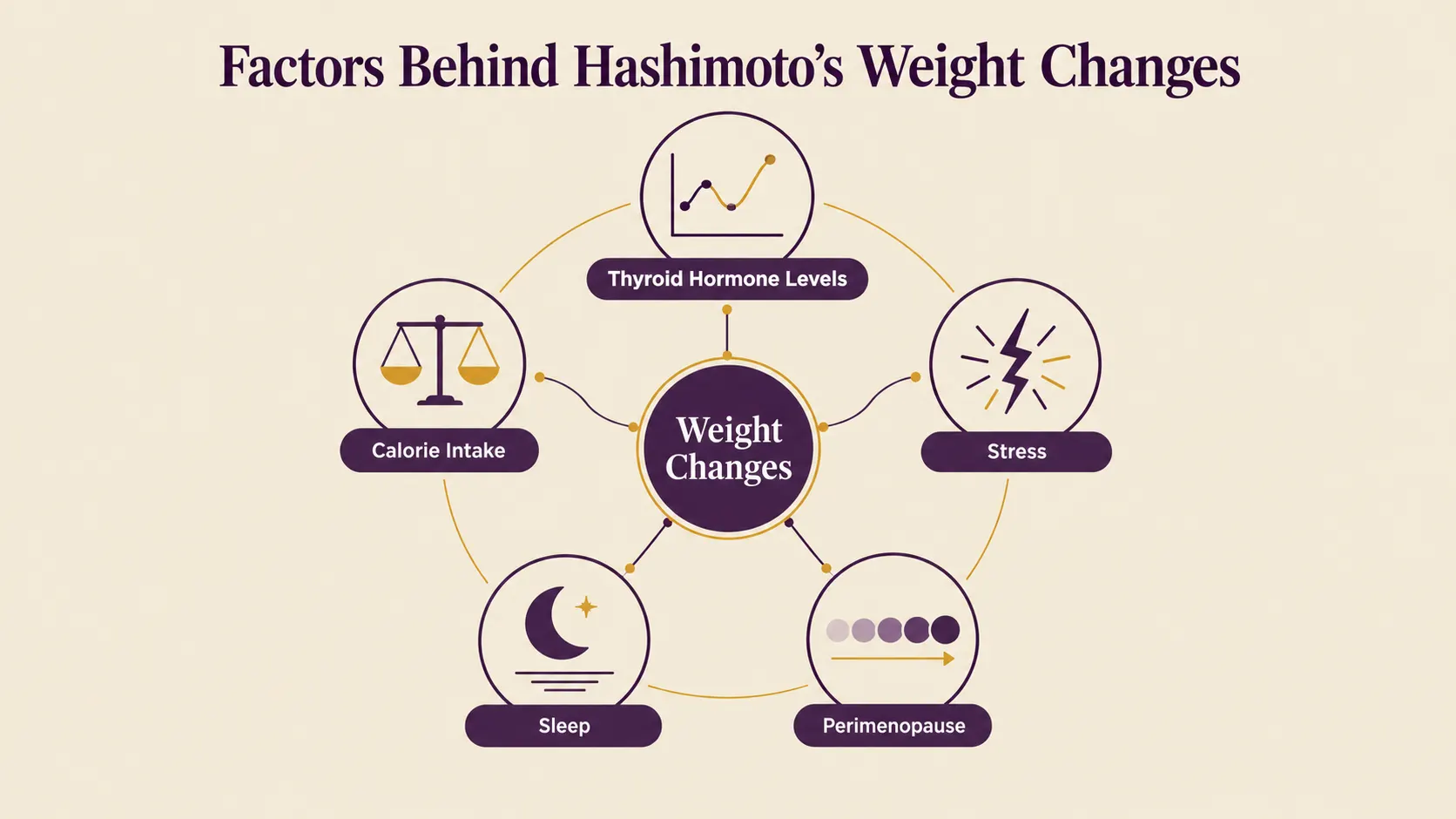
Several things overlap, including thyroid hormone level, calorie intake, stress, sleep and perimenopause. If you are in your 40s, our guide to telling thyroid from perimenopause helps sort which is which.
Where to Start
The most useful next step is hearing the whole explanation of how thyroid, stress and sex hormones affect each other. Dr. Goldstein, a naturopathic doctor with 25+ years in practice, covers it in her free Master Class.
Watch the free Master Class, then decide with the full picture.
Written by The Natural Path clinical content team, based on the teaching of Dr. Angela Goldstein, ND.
This article is for general education and is not medical advice. It is not intended to diagnose or treat any disease, does not establish a doctor-patient relationship, and is not a substitute for care from your own clinician. Do not start, stop or change any prescribed medication or supplement based on what you read here. If you have an urgent medical concern, contact your physician or emergency services.