

Written by The Natural Path clinical content team, based on the teaching of Dr. Angela Goldstein, ND.
Your period used to show up late. Now it skips whole months, and the night sweats seem worse than they were a year ago. Friends keep telling you “it’s just menopause.” What you want to know is simpler: is this the end of it, or the middle?
The clearest sign perimenopause is ending is longer gaps between periods, 60 days or more. Clinicians use a staging system called STRAW+10 to mark this late stage of the transition. Hot flashes and night sweats often get stronger in this stage. Perimenopause is over only after 12 months in a row with no period.
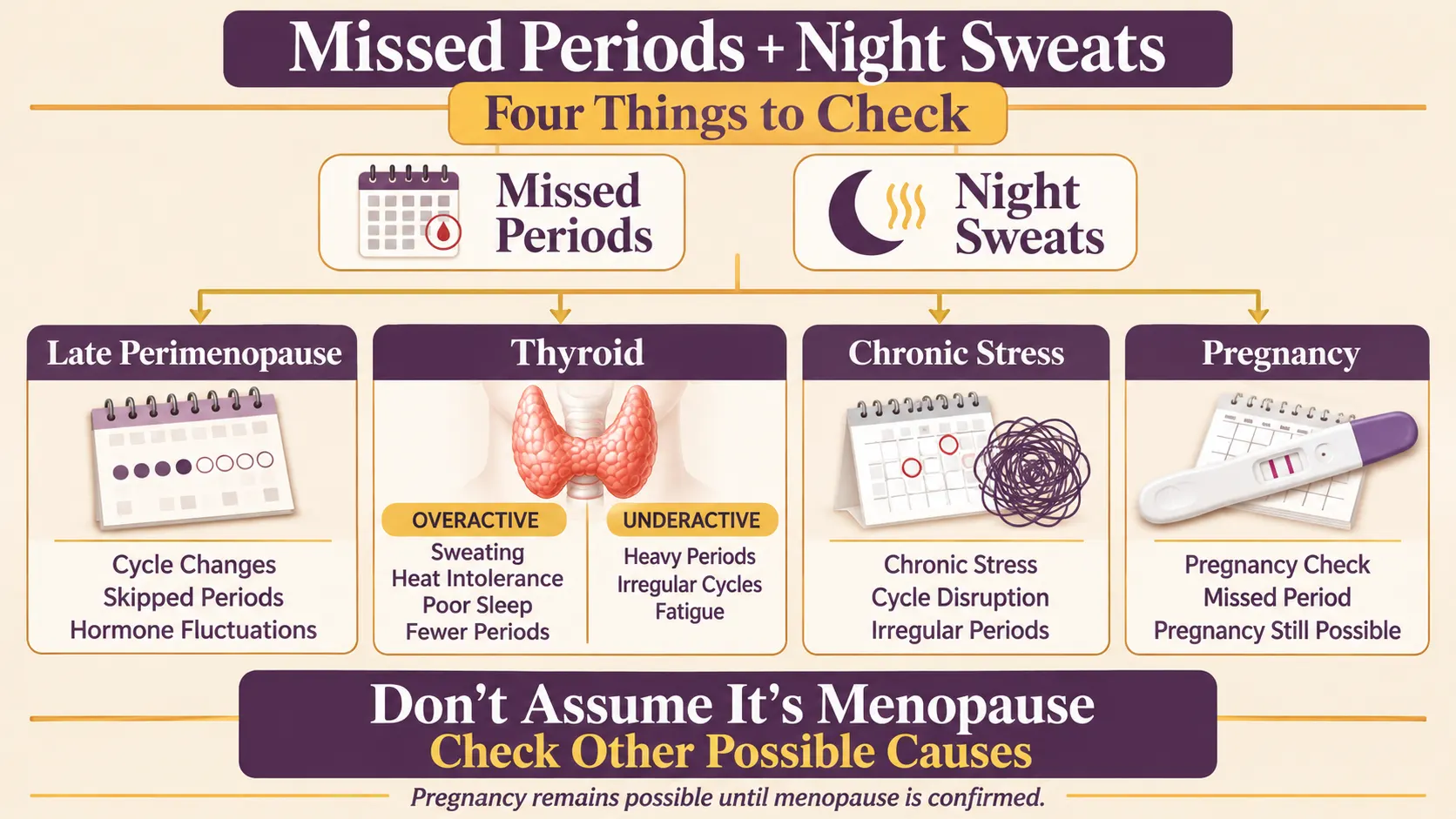
Symptoms do not switch off at that line: STRAW+10 places hot flashes as most likely in the first 2 years after the final period. Missed periods and night sweats can also come from the thyroid, chronic stress or pregnancy. So the end of the transition is a pattern you confirm over time, with the look-alikes checked along the way.
Key Takeaways
- The main sign is spacing. Gaps of 60 days or more between periods mark the late menopausal transition, according to STRAW+10, the staging system clinicians use.
- The finish line is 12 months. Menopause is confirmed at 1 year after the final menstrual period (The Menopause Society).
- The end can bring the peak. STRAW+10 says vasomotor symptoms are most likely in the first 2 years after the final period.
- A blood test does not settle it. In the late transition, FSH can read menopausal one month and premenopausal the next.
- Check the look-alikes. A 2023 review recommends thyroid evaluation before diagnosing perimenopause or menopause, and chronic stress can make periods irregular.
What “Perimenopause Is Ending” Means
“Perimenopause is ending” means you have reached the late menopausal transition, the final stage before your last period. Clinicians name it from your cycle pattern, not from how you feel on a given day. For how the transition starts and the full symptom picture, our perimenopause symptoms guide covers the beginning. This page covers the end.
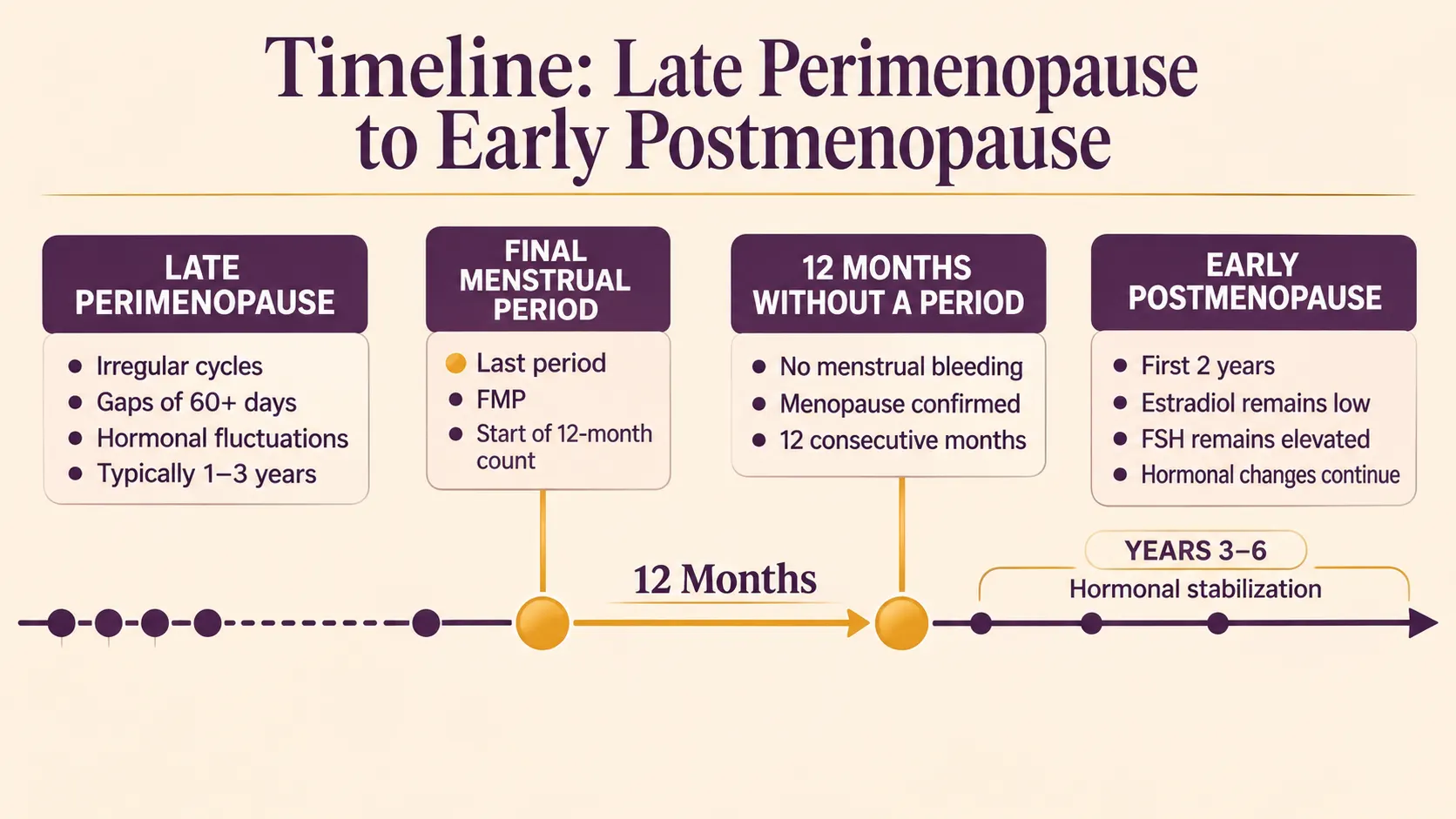
The late menopausal transition is the last stage of perimenopause, marked by a gap of 60 days or longer without a period. STRAW+10 estimates it lasts 1 to 3 years on average.
The final menstrual period is your last period. It can only be named in hindsight, once 12 months have passed without another one.
The staging comes from the Stages of Reproductive Aging Workshop + 10, known as STRAW+10. It is the system clinicians and researchers use to place a woman in the transition (Harlow et al., J Clin Endocrinol Metab 2012).
| Stage | What marks it | How long it lasts (STRAW+10) |
|---|---|---|
| Early transition | A persistent difference of 7 days or more in the length of consecutive cycles | Varies |
| Late transition | A gap of 60 days or longer without a period | 1 to 3 years on average |
| Final menstrual period | Your last period | One point in time |
| Early postmenopause, first 2 years | Ends the 12-month count, then hormones keep shifting fast | About 2 years |
| Early postmenopause, stabilization | FSH stays high, estradiol stays low | 3 to 6 years |
Sign 1: Longer Gaps Between Your Periods
The most reliable sign is a gap of 60 days or more between periods, which is two months or longer with no bleeding. Clinicians use a staging system called STRAW+10 (the Stages of Reproductive Aging Workshop + 10), and it marks the late stage of perimenopause by exactly this gap (Harlow et al., 2012). The Menopause Society puts it in everyday terms: early on you may skip a period now and then, but “in the late menopause transition women may skip 60 days or more” (The Menopause Society).
Behind the gaps, the ovaries release an egg less often. STRAW+10 describes cycles in this stage as having “extreme fluctuations in hormonal levels, and increased prevalence of anovulation.” Anovulation means a cycle with no egg released.
That chaos explains a frustrating pattern. You can go 70 days without a period, then get two close together. A gap that resets does not mean you went backward. It means the hormones are swinging, which is what late perimenopause looks like.
Why a single blood test cannot call it. STRAW+10 says FSH in the late transition is “sometimes elevated into the menopausal range and sometimes within the range characteristic of the earlier reproductive years.” One draw can catch either side.
Our guide to what perimenopause labs can and cannot show explains how to read the numbers. Dr. Goldstein puts the bigger limit plainly: “Standard labs measure diseases, not function.”
The 12-Month Rule: How You Know Perimenopause Is Over
Perimenopause is over when you have gone 12 months in a row with no period. MedlinePlus states, “Menopause is complete when you have not had a period for 1 year. This is called postmenopause” (MedlinePlus). It usually happens between ages 45 and 55.
How to apply the rule:
- Count from the first day of your last period. STRAW+10 requires 12 months without a period, so if bleeding returns before the 12 months are up, the count starts again.
- Keep using contraception until the 12 months are done if you do not want to get pregnant. Ovulation gets less regular in perimenopause, but it has not stopped. The Menopause Society notes, “Even when menstrual cycles are irregular, women in perimenopause can still get pregnant,” and advises birth control “until menopause is confirmed at 1 year after the final menstrual period.” Condoms, a copper IUD and hormonal methods all count as birth control here.
- Know when the rule does not fit. STRAW+10 states that women who have had a hysterectomy or endometrial ablation “cannot be staged by menstrual bleeding criteria.” Hormonal birth control can also change your bleeding, so you cannot count your periods the usual way. If you use the pill, patch or a hormonal IUD, ask your clinician how to confirm where you are.
- Treat bleeding after the 12 months as a call to your provider. MedlinePlus says to contact your provider if bleeding or spotting returns after 12 consecutive months without a period, even a small amount. Our page on when perimenopausal bleeding needs a visit walks through what the doctor checks.

Free 3-minute quiz from Dr. Angela Goldstein, ND
Stress, thyroid and sex hormones work as one system. Answer 22 quick questions and see which one is under the most strain for you.
What you’ll get:
- ✓A score for each system: stress, thyroid and sex hormones
- ✓Which pattern your answers fit, and how the systems pull on each other
- ✓Built on published research
- ✓A clear next step for your pattern
Free. 22 questions, about 3 minutes.
Educational content. Always talk with your doctor before changing any treatment.
Late Perimenopause Signs That Can Get Stronger
STRAW+10 says vasomotor symptoms are most likely in the first 2 years after the final period, so the end of perimenopause often brings the peak rather than relief. The same paper says hot flashes are “likely to occur” in the late transition itself. Hot flashes and night sweats are the most commonly reported symptoms of the menopause transition, according to The Menopause Society.
| Sign | What the source says | Source |
|---|---|---|
| Hot flashes and night sweats | Likely in the late transition, most likely in the first 2 years after the final period | STRAW+10, 2012 |
| Hot flashes at their worst | “usually worst during the first 1 to 2 years” | MedlinePlus |
| Sleep | “Sleeping problems (insomnia)” listed among common symptoms | MedlinePlus |
| Vaginal and urinary changes | “Vaginal dryness and painful sexual intercourse” and “Urine leakage” listed | MedlinePlus |
| Bone | “Bone loss increases during the first few years after your last period” | MedlinePlus |
| Memory and focus | “Forgetfulness (in some women)” listed among other symptoms | MedlinePlus |
MedlinePlus notes that your provider may order a bone density test to look for bone loss. Ask whether one makes sense for you.
If your question is how long all of this goes on, the duration research has its own page: how long menopause and its symptoms last. In short, MedlinePlus (reviewed 2025) notes that menopause symptoms “may last 5 or more years.”
What Tends to Ease After Your Final Period
After the final period, the monthly swings end and hormone levels settle. STRAW+10 describes a stabilization stage after the first 2 postmenopausal years, when FSH stays high and estradiol stays low, estimated to last 3 to 6 years. In plain terms, the roller coaster flattens.
What tends to change for the better:
- Cycle chaos stops. No more surprise periods after a 70-day gap, and no more guessing.
- Hot flashes fade for most women. The Menopause Society states, “In most women, hot flashes will ease over time” (The Menopause Society).
- Pregnancy is no longer possible. MedlinePlus states, “After menopause, a woman can no longer become pregnant.”
The research is less clear on other symptoms. For sleep, mood and brain fog, your own log tells you more than a population average. If those are getting worse after your periods stop, that is a reason to look at the whole system rather than wait.
When It Looks Like the End but Is Something Else
A 2023 review in the International Journal of Molecular Sciences recommends thyroid evaluation before diagnosing perimenopause or menopause. The authors wrote that “mood disturbances, oligomenorrhea, or vaginal spotting may be due to thyroid dysfunction” (Brown et al., Int J Mol Sci 2023). Oligomenorrhea means infrequent periods, the same thing you are watching as a sign of the end. The same review notes that thyroid disorders affect nearly 14% of adult women.
| What you notice | What else can produce it | Source |
|---|---|---|
| Fewer, lighter or skipped periods | An overactive thyroid (hyperthyroidism) | Office on Women’s Health; Brown 2023 |
| Night sweats, feeling hot, poor sleep | Hyperthyroidism lists “sweating or trouble tolerating heat” and “trouble sleeping” | NIDDK |
| Heavy or irregular periods, fatigue, weight gain | An underactive thyroid (hypothyroidism) | NIDDK |
| Irregular periods during a hard stretch | “high levels of chronic (long-term) stress can lead to irregular periods” | Office on Women’s Health |
| A missed period | Pregnancy, which is still possible until menopause is confirmed | The Menopause Society |
The Office on Women’s Health notes that “Hyperthyroidism can also cause fewer and lighter menstrual periods than normal” (Office on Women’s Health). The National Institute of Diabetes and Digestive and Kidney Diseases lists hyperthyroidism symptoms that overlap with this stage, and its hypothyroidism page lists “heavy or irregular menstrual periods.” One limit matters: Brown and colleagues note that recent studies found significant menstrual disturbance mainly in severe thyroid disease. A thyroid check is a reasonable step, and a mild thyroid shift may not explain everything.
Dr. Goldstein connects these pieces as one chain:
“So when you’re under chronic stress, your adrenal pumps out cortisol constantly. High cortisol tells your thyroid to slow down because your body thinks there’s a famine. Your thyroid slowing down disrupts your sex hormones because your body thinks it’s not safe to reproduce.”
That chain is why the practice reads stress, thyroid and sex hormones together. She also warns, “Your thyroid can be normal while still being shut down by stress.” To sort your symptoms between the two, our page on whether it is your thyroid or perimenopause goes through the overlap.
Our explainer on how cortisol slows the thyroid covers the research behind the chain.
A Late-Transition Log Worth Keeping
A simple log tells you when perimenopause is ending, because the stage is defined by your calendar. Keep it for 3 months, and bring it to any visit.
- [ ] First day of every period, and the number of days since the last one
- [ ] Your longest gap so far (60 days or more is the late-transition marker)
- [ ] Nights with sweats, and hours of sleep
- [ ] Hot flashes per day on a typical day
- [ ] Vaginal dryness or urinary changes
- [ ] Mood, focus and energy, scored 1 to 5
- [ ] What came before the gaps began: a move, a loss, a new job, an illness, a surgery
That last line matters as much as the dates. When did this start, and what came before it? A heavy stress season that came before the first skipped period changes how a clinician reads the rest of the log. It is the kind of history we work through in perimenopause hormone care, where stress response, thyroid and sex hormones are evaluated together.
Late Perimenopause Care in San Juan Capistrano or by Video Across California
Dr. Goldstein sees patients at the San Juan Capistrano office, and women come in from nearby towns such as Laguna Hills, Irvine and San Clemente. Video visits are available anywhere in California. Bring your late-transition log to the first visit either way.
Here is how video visits for California patients work.
Dr. Goldstein has 25+ years in practice, and the practice does not bill insurance. The address and office hours are on the contact page.
One Google reviewer, Tanya Morrison, wrote that Dr. Goldstein “eased my symptoms during menopause.” Another, Eileen Naber, wrote that “it’s not just about your bloodwork.”
Frequently Asked Questions
How do you know perimenopause is almost over?
Gaps of 60 days or more between periods are the clearest sign. STRAW+10 defines the late menopausal transition by that gap and estimates the stage lasts 1 to 3 years on average. You know it is over once 12 months pass with no period.
Do symptoms get worse before perimenopause ends?
They can. STRAW+10 says hot flashes are likely in the late transition and most likely in the first 2 years after the final period. MedlinePlus says hot flashes are usually worst during the first 1 to 2 years.
Can you still get pregnant in late perimenopause?
Yes. The Menopause Society states that women in perimenopause can still get pregnant even with irregular cycles, and advises birth control until menopause is confirmed at 1 year after the final period.
Can a blood test tell me perimenopause is ending?
Not on its own. In the late transition, STRAW+10 says FSH is sometimes in the menopausal range and sometimes in the earlier reproductive range. Your cycle calendar carries more weight than a single draw.
Will I feel better after perimenopause ends?
Many symptoms settle. The Menopause Society says hot flashes ease over time in most women, and the monthly hormone swings end after the final period. Bone loss increases in the first few years, so ask about bone health.
Can a thyroid problem make it look like perimenopause is ending?
Yes. An overactive thyroid can cause fewer and lighter periods, and a 2023 review recommends thyroid evaluation before diagnosing perimenopause or menopause. Recent studies link significant cycle changes mainly to severe thyroid disease.
Where to Start
You now know what the end of perimenopause looks like on paper. The next question is which system is driving your version of it. The free Hormone Orchestra Quiz has 22 questions, takes about 3 minutes and scores three connected systems: your stress response, your thyroid and your sex hormones.
Written by The Natural Path clinical content team, based on the teaching of Dr. Angela Goldstein, ND.
This article is for general education and is not medical advice. It does not establish a doctor-patient relationship and is not a substitute for care from your own clinician. Do not start, stop or change any hormone or prescribed medication based on what you read here. If you have an urgent medical concern, contact your physician or emergency services. Testimonials reflect individual experiences and results vary.