

Written by The Natural Path clinical content team, based on the teaching of Dr. Angela Goldstein, ND.
You have heard the term from a friend, a podcast or a clinic website, and every source seems to use it a little differently. Maybe you are asking because your labs keep coming back normal but you are still tired, and nobody can tell you why. Here is a straight answer to “what is functional medicine?”, including the parts the field is still working out.
Functional medicine is an approach to chronic illness that asks why a person is sick, then looks for the underlying processes driving the symptoms across body systems. The Institute for Functional Medicine describes it as care that “restores healthy function by treating the root causes of disease,” using each patient’s genetic, environmental and lifestyle influences to build a personalized plan. Functional medicine is an approach, not a license. It is practiced by MDs, DOs, naturopathic doctors and other licensed clinicians.
It overlaps with integrative medicine, which coordinates conventional and complementary care, and with naturopathic medicine, which is a licensed profession in California. The research base is early: one Cleveland Clinic study found modest quality-of-life gains, and a 2026 academic paper calls the evidence for it as a distinct model “limited.”
Key Takeaways
- Functional medicine asks “why.” Cleveland Clinic frames its model around one question: “Why are you ill?”
- It reads systems together. Stress, thyroid and sex hormones are treated as one connected chain, so a single normal lab does not end the search.
- It is an approach, not a license. Integrative medicine describes how care is coordinated, and a naturopathic doctor holds a state license.
- The evidence is early. A 2019 study of 7,252 patients found a small quality-of-life gain at 6 months versus primary care. A 2026 paper in the American Journal of Medicine says evidence for functional medicine as a distinct model “remains limited.”
- The history comes first. A careful practitioner orders tests because of what your story points to, and can explain why each one matters.
What Is Functional Medicine?
Functional medicine is a model of care for chronic illness that looks for the underlying drivers of symptoms instead of treating each symptom as a separate problem. In 2014, Cleveland Clinic became the first US academic medical center to open a dedicated functional medicine program. It describes its model as “a patient-centered approach to chronic disease management” that “seeks to answer the question, ‘Why are you ill?'” (Cleveland Clinic).
Functional medicine is a clinical approach that looks for the underlying processes behind chronic symptoms, using a patient’s history, genetics, environment and lifestyle to build an individual plan.
The Institute for Functional Medicine (IFM), the field’s main training body, adds that clinicians aim to “systematically identify and address the underlying processes and dysfunctions that are causing imbalance and disease in each individual” (IFM).
In practice, the word “functional” points to how well a system is working, which is a different question from whether a disease is present. Dr. Goldstein puts the gap plainly: “Standard labs measure diseases, not function.” She compares a standard panel to checking whether an engine is completely broken, when the real question is whether it is running at 40% capacity. That idea runs through everything below, including how this practice uses functional lab testing to read patterns after the history is taken.
How Functional Medicine Reads the Body as One System
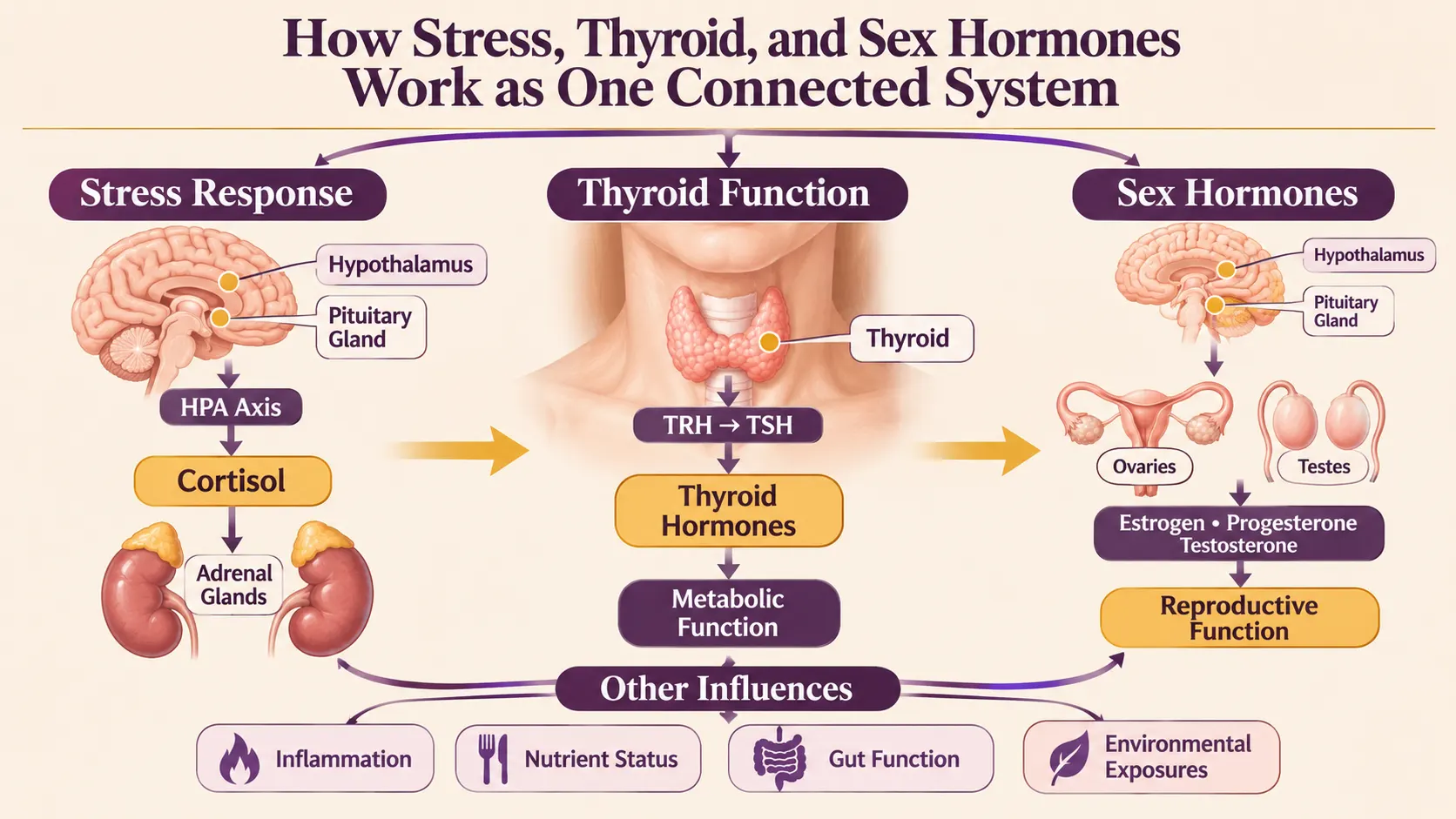
Functional medicine treats the body’s systems as connected, so a problem in one is expected to show up in others. Dr. Goldstein teaches this with an orchestra: “Think of your endocrine system like an orchestra.” When one section is out of tune, the whole piece sounds wrong, even if each player passes a solo check.
The chain she sees most often in 25+ years of practice starts with stress:
“So when you’re under chronic stress, your adrenal pumps out cortisol constantly. High cortisol tells your thyroid to slow down because your body thinks there’s a famine. Your thyroid slowing down disrupts your sex hormones because your body thinks it’s not safe to reproduce.”
Research supports the first link in that chain. A 2026 review in Endokrynologia Polska states that “cortisol inhibits the secretion of thyrotropin-releasing hormone (TRH) in the hypothalamus and thyroid-stimulating hormone (TSH) in the pituitary gland” (Gierach and Junik, 2026). Our explainer on how cortisol slows the thyroid walks through the rest of the research.
In a functional read, one normal result does not close the case. “Your thyroid can be normal while still being shut down by stress,” Dr. Goldstein says.
Inflammation, nutrient gaps, gut function and environmental exposures sit in the same web. “See how it’s all connected? Everything feeds into everything else.”
Functional Medicine vs Conventional Medicine
Conventional medicine is built to name a disease and treat it, and functional medicine is built to explain why the body drifted toward it. Both have a place. A broken bone, a heart attack or a severe infection calls for conventional care first.
The difference shows up most in time and in the question being asked. A 2007 study in Health Services Research videotaped primary care visits by older adults and found a median visit of 15.7 minutes, covering about 6 topics. After the longest topic, each remaining concern got roughly 1.1 minutes (Tai-Seale et al., 2007). That is a hard setting in which to untangle fatigue, weight change, sleep and mood at once.
| Question | Conventional model | Functional model |
|---|---|---|
| Main question | What disease is this? | Why is this happening, and what came before it? |
| Unit of care | One organ or one complaint per visit | Connected systems read together |
| Typical first visit | About 15.7 minutes (median, 2007 study of older adults) | Longer; about an hour at this practice |
| What labs are used for | Confirming or ruling out disease | Reading patterns, alongside the history |
| Typical first tools | Medication or procedure | Nutrition, sleep, stress, movement, then targeted treatment |
| Best fit | Acute illness, emergencies, clear diagnoses | Chronic, multi-system symptoms with no clear answer |
Dr. Goldstein is direct that a natural label does not fix the problem by itself. Most practitioners, she says, “even natural ones, treat symptoms, not systems. They’re just using supplements instead of drugs.” A fatigue protocol for one person and a gut protocol for the next misses the same point, because “protocols are designed for populations, not individuals.”
At The Natural Path, the work runs in a set order, from a full history and lab read to the systems underneath. You can see how functional medicine works at our San Juan Capistrano office, stage by stage.
Free training from Dr. Angela Goldstein, ND
If your labs keep coming back normal and you still do not feel right, this free training shows how stress, thyroid and sex hormones pull on each other. Dr. Goldstein walks you through it.
When you watch today, you’ll learn:
- ✓Why “normal” labs can miss what is actually wrong
- ✓The three systems that break down together, and why treating one at a time rarely lasts
- ✓Why even natural approaches fall short when they treat symptoms instead of systems
- ✓Real patient stories from 25+ years of practice
Free, instant access. Start watching right now.
Educational content. Always talk with your doctor before changing any treatment.
Functional vs Integrative vs Naturopathic Medicine
Functional medicine is an approach, integrative medicine is a way of coordinating care, and naturopathic medicine is a licensed profession. The three overlap, which is why people mix them up. A 2026 paper by authors from Yale, NYU and the Andrew Weil Center for Integrative Medicine argues they “are frequently conflated but represent fundamentally different models of care” (Soffer et al., Am J Med 2026).
| Functional medicine | Integrative medicine | Naturopathic medicine | |
|---|---|---|---|
| What it is | A model for finding the underlying drivers of chronic illness | Conventional and complementary care brought together in a coordinated way | A licensed health profession with its own medical training |
| Who practices it | MDs, DOs, NDs, nurse practitioners and other licensed clinicians | Physicians and care teams; the Am J Med authors call it an academic discipline | Naturopathic doctors (NDs) |
| Is it a license? | No. Training such as IFM certification is optional | No. It describes how care is organized | Yes, in California, under the Naturopathic Doctors Act |
| Signature tools | Detailed history, timeline, pattern reading of labs | Conventional care plus therapies such as acupuncture, yoga or nutrition | Nutrition, botanicals, lifestyle, lab testing, and therapies within the license |
What Is Integrative Medicine?
Integrative medicine combines conventional treatment with complementary approaches inside one coordinated plan. The National Center for Complementary and Integrative Health (NCCIH) states that “integrative health brings conventional and complementary approaches together in a coordinated way.” It adds “an emphasis on treating the whole person rather than, for example, one organ system” (NCCIH).
NCCIH separates this from alternative care, where a non-mainstream approach is used “in place of conventional medicine.” The American Journal of Medicine authors describe integrative medicine as an academic discipline that works “within conventional standards of diagnosis and management.”
Where Naturopathic Medicine Fits
A naturopathic doctor is defined by training and a state license, and many NDs read cases functionally. In California, the Naturopathic Doctors Act allows a licensed ND to “order and perform physical and laboratory examinations for diagnostic purposes,” including “physiological function tests” (Business and Professions Code § 3640). Our page comparing a naturopathic doctor with an MD covers training, licensing and scope in full.
Dr. Goldstein came to this work through naturopathic medicine, which she describes as “a system that looks at the whole person, that addresses underlying causes instead of just suppressing symptoms.” She is a naturopathic doctor who reads cases functionally, so at this practice the two words describe one way of working: the license, and how the case is read.
What Happens in a Functional Medicine Visit
A functional medicine visit starts with your full story, told in order, before any new test is chosen. The questions sound simple: when did this start, and what came before it?
A move, a loss, a pregnancy, a surgery or a hard year at work often sits right before the first symptom.
A careful first visit usually includes:
- Your history from the beginning, including what was going on in your life when each symptom appeared.
- A timeline that lines up symptoms, stressors, illnesses and medications.
- Your existing labs, read as a pattern, so nothing you already paid for is wasted.
- A short list of what to test next and why, tied to what the history points to.
Cleveland Clinic describes the same starting point: a one-on-one visit with a clinician, sometimes followed by group sessions with a registered dietitian or health coach. Our guide to what to expect at a first functional medicine appointment walks through the hour step by step.
One Google reviewer, Eileen Naber, put the difference in a single line: “it’s not just about your bloodwork.”
What the Research Shows So Far
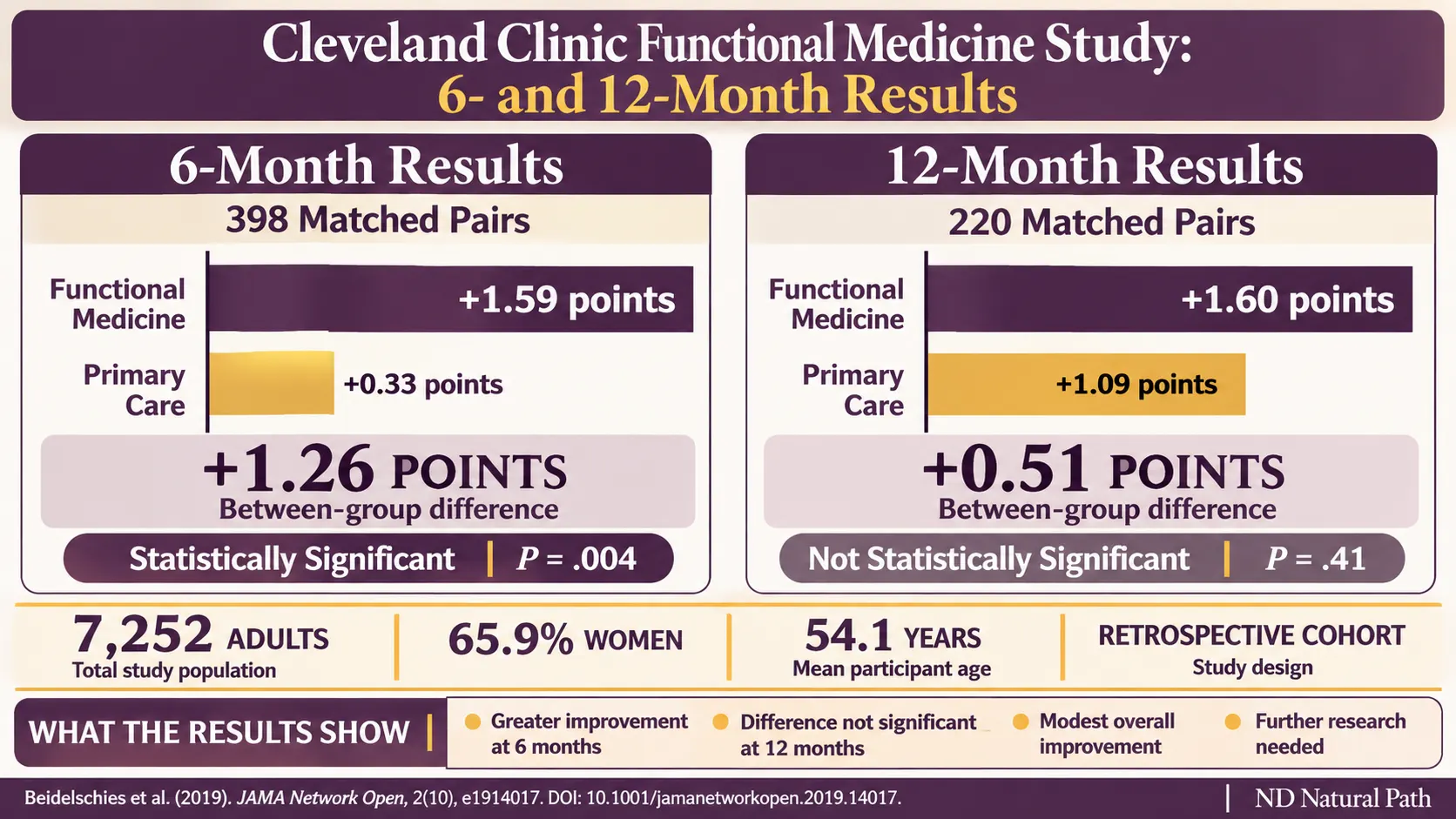
A large Cleveland Clinic comparison with primary care found a small, real improvement, and its authors called for better studies. The 2019 study followed 7,252 adults. At 6 months, in 398 matched pairs, patients at the Center for Functional Medicine gained 1.59 points on the PROMIS Global Physical Health score. Matched primary care patients gained 0.33 points (Beidelschies et al., JAMA Network Open 2019). About two-thirds of the patients were women, with an average age of 54.
The study has clear limits, and they matter:
- It was retrospective. The authors looked back at records, so patients were not randomly assigned to one type of care.
- The 12-month difference was not significant. The functional medicine group still improved, but the gap between groups at one year could have been chance.
- The gain was modest. The scale has a mean of 50, and the 6-month gap between groups was about 1.3 points.
- The authors asked for more. They concluded that “prospective studies are warranted to confirm these findings.”
Independent academics are more skeptical. The 2026 American Journal of Medicine paper notes that many tools functional medicine uses, “including nutrition, exercise, sleep, and stress management, are evidence based.” It adds that “evidence validating FM as a distinct diagnostic and therapeutic model remains limited,” and warns that some diagnostic strategies “may contribute to low-value testing” and substantial out-of-pocket costs.
That warning is fair, and it gives you a practical filter. Ask any practitioner why each test is being ordered and what result would change your plan. A good answer ties the test to your history. Our list of questions to ask before choosing a functional medicine doctor turns this into a checklist you can bring to any clinic, including ours.
Who Functional Medicine Tends to Fit
Functional medicine tends to fit people with chronic, multi-system symptoms who have been told their results are normal and want someone to look at the whole picture. That often means a woman in midlife with fatigue, weight change, poor sleep, low mood or thyroid and hormone questions that no single doctor has connected.
It is a weaker fit in a few situations:
- An emergency or acute illness, which belongs with urgent or emergency care first.
- A need for insurance-billed care, since many functional practices, including this one, do not bill insurance. Our page on functional medicine insurance and cost explains how coverage works.
- Wanting a single prescription and nothing more, because the work asks for changes in sleep, food and stress alongside any treatment.
Dr. Goldstein names the hardest part honestly: being “honest with yourself, especially around the parts of you that think you have to always just keep pushing through.” If you are weighing the time and money, our honest answer to whether functional medicine is worth it goes through the decision.
Functional Medicine in Orange County and Across California
The Natural Path offers functional, root-cause care in person at the San Juan Capistrano office and by video for patients anywhere in California. Patients come in from towns such as Laguna Niguel and Aliso Viejo, and many others start from home.
For patients outside Orange County, here is how video visits across California work.
Dr. Goldstein has 25+ years in practice, and the practice does not bill insurance. Office hours and directions are on the contact page.
Frequently Asked Questions
What is functional medicine in simple terms?
Functional medicine is care that asks why you are sick, then looks for the underlying causes across connected body systems. It uses your full history, lifestyle and targeted testing to build a plan for you as an individual.
Is functional medicine real medicine?
Functional medicine is practiced by licensed clinicians, including MDs, DOs and naturopathic doctors, and the approach itself is not a license. Many of its tools, such as nutrition, sleep and stress care, are evidence based. A 2026 paper in the American Journal of Medicine says evidence for the model as a whole remains limited.
What is the difference between functional and integrative medicine?
Functional medicine is a model for finding the underlying drivers of chronic illness. Integrative medicine brings conventional and complementary care together in a coordinated way, per NCCIH. A 2026 academic paper argues the two are often confused but are different models of care.
Is a naturopathic doctor the same as a functional medicine doctor?
No. A naturopathic doctor holds a state license in California, while “functional medicine” describes an approach any licensed clinician can use. Many NDs, including Dr. Goldstein, read cases functionally.
What conditions does functional medicine help with?
Cleveland Clinic lists autoimmune diseases, digestive disorders, thyroid disorders, metabolic syndrome, prediabetes, and men’s and women’s health among the conditions its program sees. It is used most for chronic symptoms that span more than one system.
Where to Start
Start with the free Master Class, where Dr. Goldstein applies the whole model to real cases. She walks through the three connected systems, stress response, thyroid and sex hormones, and why reading them together changes what gets found.
Written by The Natural Path clinical content team, based on the teaching of Dr. Angela Goldstein, ND.
This article is for general education and is not medical advice. It does not establish a doctor-patient relationship and is not a substitute for care from your own clinician. Do not start, stop or change any prescribed medication based on what you read here. If you have an urgent medical concern, contact your physician or emergency services. Testimonials reflect individual experiences and results vary.