

Written by The Natural Path clinical content team, based on the teaching of Dr. Angela Goldstein, ND.
If you searched for a perimenopause quiz or asked yourself “am I in perimenopause,” the honest answer starts with your cycle. The National Institute on Aging says the menopausal transition usually starts with changes in menstrual cycle patterns. The American College of Obstetricians and Gynecologists (ACOG) says it usually begins in the mid-40s. No single symptom settles it, because thyroid trouble and long-running stress can look the same. This page gives you an 18-item self-check grouped by body system and a way to read your count. It also links to a free quiz that shows which system is under the most strain.
See a doctor promptly if any of these apply. The sorting below is ours. The thresholds come from ACOG, MedlinePlus and the 988 Lifeline.
- Call 911 or go to the ER. You are changing pads or tampons every hour for more than 2 hours in a row. You also have chest pain, shortness of breath, and lightheadedness or dizziness. ACOG says to seek emergency medical care right away in that situation. If you are thinking about harming yourself, call or text 988 at any hour; the 988 Lifeline is free and confidential.
- Call your ob-gyn or doctor soon. MedlinePlus says to contact your provider for any unexplained bleeding between periods, any bleeding after menopause, or heavy bleeding with periods. It adds abnormal bleeding with other symptoms such as pelvic pain, fatigue or dizziness. ACOG also lists bleeding or spotting after sex and bleeding that lasts more than 7 days as abnormal. Our full page on this is when to worry about perimenopausal bleeding.
- Our advice, not a published threshold: if you are in your thirties and your periods are changing, see a clinician to check other causes before you assume perimenopause. The sources above describe the transition as starting in the mid-40s.
Key Takeaways
- Perimenopause is the transition before your last period. ACOG says it may last from ages 45 to 55, and menopause is confirmed only after 12 months without a period.
- Cycle changes are the clearest clue. Hot flashes, night sweats, poor sleep and mood changes are common, yet each of them also shows up with an underactive thyroid or heavy stress.
- This page sorts symptoms into three systems: stress and sleep, thyroid, and sex hormones. Where your count is highest tells you where to look first.
- A checklist, ours or anyone’s, is not a diagnosis. It helps you walk into an appointment with a pattern instead of a feeling.
You are probably here at an odd hour with a list of things that stopped making sense. Sleep is worse, your temper is shorter, your jeans fit differently, and your last lab result said “normal.” Dr. Angela Goldstein, ND, has heard that story for 25+ years. Her teaching starts with a different question than “which symptom is this?” It asks which system started the chain, and what came before it.

What Perimenopause Is and When It Usually Starts
Perimenopause is the stretch of years before your final period, when the ovaries make less estrogen and cycles begin to shift.
ACOG says women usually enter perimenopause in the mid-40s and that it may last from ages 45 to 55, with timing that varies from person to person. In your 40s, ACOG notes, periods may be shorter or longer, the days between them can change, bleeding can be heavier or lighter, and you may skip periods. The National Institute on Aging adds that most women begin the transition between 45 and 55 and that symptoms can last two to eight years. You will only know you have reached menopause after a full year with no period or spotting.
The Menopause Society says that women in perimenopause can still get pregnant even when cycles are irregular. A skipped period is a reason for a pregnancy test as well as a symptom log.
For a longer list of what the transition can feel like, read our 34 symptoms of perimenopause.
This page does something different. It helps you count, group and read your own symptoms.

Free 3-minute quiz from Dr. Angela Goldstein, ND
Stress, thyroid and sex hormones work as one system. Answer 22 quick questions and see which one is under the most strain for you.
What you’ll get:
- ✓A score for each system: stress, thyroid and sex hormones
- ✓Which pattern your answers fit, and how the systems pull on each other
- ✓Built on published research
- ✓A clear next step for your pattern
Free. 22 questions, about 3 minutes.
Educational content. Always talk with your doctor before changing any treatment.
Perimenopause Quiz: The 18-Item Self-Check, Grouped by System
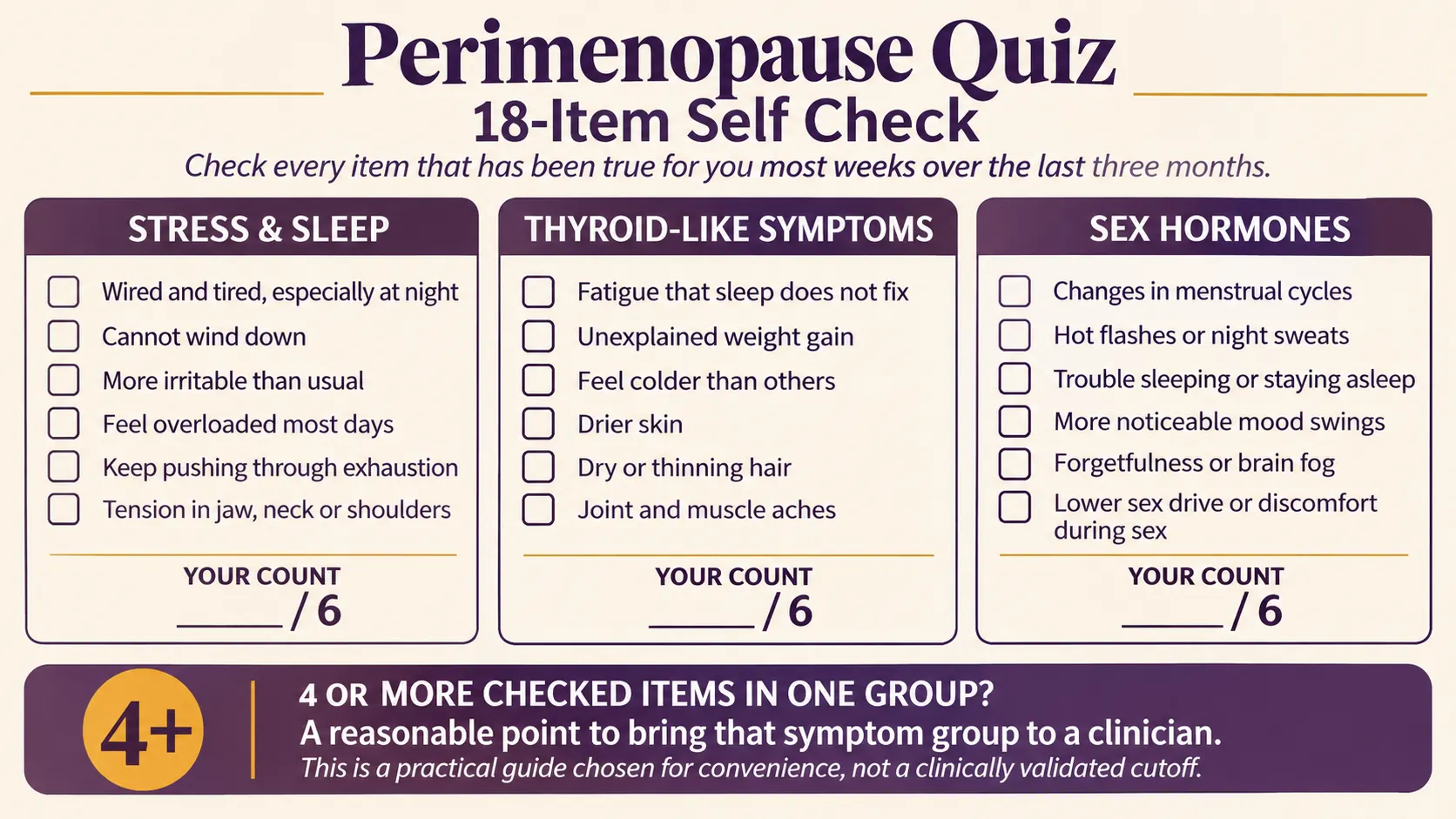
Check every item that has been true for you most weeks over the last three months. This checklist is ours, written by the clinical content team for this page. It is our own tool, not a validated medical scale.
Group 1: Stress and sleep
- I feel wired and tired at the same time, especially at night.
- I cannot wind down, even when I finally sit still.
- I am irritable or snap faster than I used to.
- I feel overloaded most days, as if I am running on empty.
- I keep pushing through while my body asks me to stop.
- I carry tension in my jaw, neck or shoulders.
Group 2: Thyroid-like
- I feel tired in a way that sleep does not fix.
- I have gained weight without changing how I eat.
- I feel cold when other people do not.
- My skin is drier than it used to be.
- My hair is dry or thinning.
- My joints and muscles ache.
The second group follows the common symptoms of an underactive thyroid listed by the National Institute of Diabetes and Digestive and Kidney Diseases (NIDDK). Those are fatigue, weight gain, trouble tolerating cold, joint and muscle pain, dry skin, and dry or thinning hair.
Group 3: Sex hormones
- My periods have changed in length, flow or timing, or I skip some.
- I have hot flashes or night sweats.
- I have trouble sleeping, or I wake up and cannot fall back asleep.
- My moods swing more than they used to.
- I forget words or lose my train of thought.
- My sex drive has dropped, or sex has become uncomfortable.
The third group draws on ACOG’s description of cycle changes above. It also draws on the National Institute on Aging. That page lists hot flashes, night sweats, trouble sleeping, joint and muscle discomfort, pain during sex, moodiness, irritability, forgetfulness and difficulty concentrating as symptoms of the transition.
How to Read Your Count
Count the checks in each group, then look at the shape of the three numbers. This reading guide is also ours.
| Your pattern | What it may point to | Where to look next |
|---|---|---|
| Group 3 is highest, and your cycle has changed in your mid-40s or later | The sex hormone shift of the transition | Our perimenopause symptoms guide and a visit that covers your cycle history |
| Group 2 is highest | Thyroid-like symptoms that perimenopause can imitate | Ask which thyroid markers were run; see thyroid or perimenopause |
| Group 1 is highest | A stress response that stays switched on | Read cortisol and the thyroid |
| Two or three groups are high together | Systems that affect each other | The cascade in the next sections |
| Every group is 0 or 1 | Few symptoms right now | Keep a short log; recheck in three months |
A count of 4 or more in a single group is a reasonable point at which to bring that group to a clinician. We chose that line for convenience, not because a study set it.
Why Three Systems and Not One Symptom List
Dr. Goldstein teaches that the body does not run its hormone systems one at a time. In her free Master Class she describes the chain this way:
“When you’re under chronic stress, your adrenal pumps out cortisol constantly. High cortisol tells your thyroid to slow down because your body thinks there’s a famine. Your thyroid slowing down disrupts your sex hormones because your body thinks it’s not safe to reproduce.”
Published research supports each link, and it is worth stating each one at its actual size.
- Stress to thyroid. A 2026 review in Endokrynologia Polska by Gierach and Junik reports that cortisol suppresses TRH and TSH secretion, the brain signals that drive the thyroid.
- Stress to sex hormones. Whirledge and Cidlowski write that glucocorticoids inhibit the release of gonadotropin-releasing hormone (GnRH) at the hypothalamus. GnRH sits at the top of the reproductive signal chain.
- Thyroid to sex hormones. A 2023 review in the International Journal of Molecular Sciences by Brown and colleagues states that thyroid hormones regulate the secretion of kisspeptin and GnRH.
Those studies describe mechanisms. They do not show that your symptoms came from this chain, and your own timeline is what tells you whether the chain fits you.
That is also why a count in one group rarely tells the whole story. Fatigue, weight change, poor sleep and low mood appear in the thyroid list and in the perimenopause list. That is how a woman can be told “it’s your thyroid” and “it’s perimenopause” and be partly right both times.
Why a Checklist, and a Lab, Cannot Settle It Alone
The National Institute on Aging says it may be difficult for you and your doctor to tell whether you are in the menopausal transition. Your doctor may ask about your age, symptoms and family history. A blood test to check hormone levels is suggested in some cases, for example when periods stopped at an early age.
The National Institute on Aging notes that estrogen and progesterone decline across the transition. A single lab reading is one moment in that decline, which is our reading of the limit. Dr. Goldstein puts the limit of standard testing this way:
“Standard labs measure diseases, not function. They’re checking to see if your engine is completely broken, not whether it’s running at 40% capacity.”
Our page on what labs show in perimenopause goes through which tests help and which add confusion. The most useful picture puts your symptom pattern, your history and your existing labs side by side. It then asks one more question: when did it start, and what came before it?
What to Do With Your Results
- Write down the dates. Note when each symptom started and what was happening in your life then. A move, a loss, a new job, a pregnancy or a long illness all belong on the list.
- Track your cycle for two to three months. Use a calendar or an app. ACOG advises keeping track of the dates, length and type of any bleeding before a visit.
- Bring the three counts to your appointment. “Group 2 is a 5 and Group 3 is a 4” gives a clinician more to work with than “I feel off.”
- Ask which labs you have had. If the answer is “just a TSH,” ask what a fuller thyroid picture would show.
Perimenopause Care in San Juan Capistrano and Across California
Dr. Goldstein sees patients in person at the office in San Juan Capistrano, and by video visit anywhere in California. The practice sees women from Dana Point to Irvine for hormone and thyroid questions like the ones on this page, and patients farther away connect from home by video.
- In person: perimenopause and hormone care for Orange County women.
- By video: telemedicine across California.
- Hours and directions: the contact page.
Frequently Asked Questions
Is there a test that confirms I am in perimenopause?
Not one on its own. The National Institute on Aging says your doctor may ask about your age, symptoms and family history, and may suggest a blood test in some cases. True menopause cannot be confirmed until one year after your final period.
What are the first signs of perimenopause?
Cycle changes come first for many women. The National Institute on Aging says the transition usually starts with changes in menstrual cycle patterns, often with hot flashes or other symptoms.
Can I be in perimenopause in my late 30s?
ACOG says perimenopause usually begins in the mid-40s. If your cycle changes earlier, see a clinician about other causes, such as the thyroid, before you decide on perimenopause. That advice is ours.
Can stress or my thyroid feel like perimenopause?
Yes. NIDDK lists fatigue, weight gain, trouble tolerating cold, joint and muscle pain, dry skin and heavy or irregular periods among common symptoms of an underactive thyroid. Several of those overlap with the transition, which is why this page counts the systems separately.
Is an online perimenopause quiz accurate?
A quiz measures symptoms, and symptoms are half of the picture. Treat any quiz result, including ours, as a way to organize what you notice and decide what to ask.
Can I still get pregnant during perimenopause?
Yes. The Menopause Society says women in perimenopause can still get pregnant even when cycles are irregular.
Where to Start
Take the free Hormone Orchestra Quiz to see which of your three systems, stress response, thyroid or sex hormones, is under the most strain right now. It takes about 3 minutes.
Written by The Natural Path clinical content team, based on the teaching of Dr. Angela Goldstein, ND.
This article is for general education and is not medical advice. It is not intended to diagnose or treat any disease, does not establish a doctor-patient relationship, and is not a substitute for care from your own clinician. The self-check and its scoring are our own and are not a validated medical scale. If you are bleeding heavily or feel faint, call 911 or go to the nearest emergency room. Do not start, stop or change any prescribed medication based on what you read here.