

Written by The Natural Path clinical content team, based on the teaching of Dr. Angela Goldstein, ND.
Perimenopause rage is a popular name for sudden, intense irritability or anger during the menopause transition. It is a real symptom with several overlapping causes: swinging estrogen and progesterone, sleep broken by night sweats, a stress load that keeps cortisol high, and sometimes a thyroid problem. The research on mood in this transition measured depressive symptoms and irritability rather than “rage.” That includes the Study of Women’s Health Across the Nation (SWAN), and it shows a window of higher risk for low mood. A short fuse that will not settle deserves a medical look. If your anger frightens you or the people around you, or comes with hopelessness, get help today.
Get help today if any of these are true:
- You are thinking about harming yourself or ending your life. Call or text 988, or chat at 988lifeline.org. The Office on Women’s Health gives the same instruction, and the 988 Lifeline is free, confidential and available 24/7/365. Call 911 if you are in immediate danger.
- You are afraid you might hurt someone else, or anger has turned physical. Step away from the situation and call or text 988, or call 911 if anyone is in immediate danger.
- Low mood, hopelessness or loss of interest has settled in alongside the anger. Call your doctor or a therapist this week.
Working with a therapist or psychiatrist is a partner to the hormone picture. Care for the physical side runs alongside mental health care, and the sections below show how the two fit together.
Key Takeaways
- “Perimenopause rage” is a popular name. The studies use words like irritability and mood symptoms.
- Irritability is a common perimenopause symptom, listed by the Office on Women’s Health and Cleveland Clinic.
- In SWAN, women were two to four times more likely to have a major depressive episode during perimenopause or early postmenopause, even after accounting for hot flashes and hormone levels.
- Sleep, stress and thyroid are part of the workup, because each can produce a short fuse alone.
- Persistent anger deserves a mood screen and a thyroid blood test before anyone assumes it is “just hormones” or “just stress.”
You snap at the dishwasher, the dog, your partner, a coworker’s email. Then you lie awake replaying it, wondering who you have become. If this began in your forties, someone has probably offered one of the three answers Dr. Goldstein names: “It’s just stress, take an antidepressant. It’s just aging, learn to live with it. Or it’s all in your head, see a therapist.”
Antidepressants and therapists help many women, and the guideline below calls them front-line care for perimenopausal depression. The trouble is that each answer ends the conversation before anyone asks what is driving the anger. This page asks that question, alongside our guide to the 34 symptoms of perimenopause.

What Perimenopause Rage Feels Like
Perimenopause rage feels like anger that arrives faster than usual, burns hotter than the situation deserves, and leaves guilt behind when it passes.
Perimenopause rage is a popular, non-clinical name for sudden, intense irritability or anger during the menopause transition. The research behind it is filed under mood symptoms and irritability.
Perimenopause is the menopause transition, the years of changing cycles and shifting hormones before periods stop. The 2018 North American Menopause Society (NAMS) guideline counts the early and late transition stages plus early postmenopause.
The Office on Women’s Health says you may feel more irritable, anxious, or experience depression symptoms. Cleveland Clinic lists changes in mood like irritability, depression or mood swings. The SWAN public page on depression and menopause includes “Irritability, restlessness, or agitation” in its symptom list, so a stubborn short fuse is worth raising as a mood symptom.
Many women describe three parts: a lower threshold (noise and small mistakes set you off), an outsized reaction you can see while it happens, and a crash afterward of guilt, tears or exhaustion. The relationship cost is real. In the Seattle Midlife Women’s Health Study, how much symptoms interfered with relationships was tied to perceived stress, depressed mood, anxiety, difficulty concentrating and waking in the night.
Why Perimenopause Rage Happens: Four Systems Behind One Short Fuse
Perimenopause rage rarely has a single cause. It is usually the sum of hormone swings, lost sleep, stress physiology and sometimes the thyroid, which is why one lab value seldom settles it. Dr. Goldstein, who has 25+ years in practice, puts the principle this way: “Think of your endocrine system like an orchestra… if one instrument is out of tune, if one hormone system is off, the whole orchestra sounds terrible.”
1. Estrogen and progesterone are moving
Cleveland Clinic names declining estrogen as the main driver of perimenopause, which disrupts the balance with progesterone, and says levels rise and fall erratically. The swings, along with the lows, are a plausible reason mood gets harder to hold steady.
The research supports a link with limits. In the Penn Ovarian Aging Study, women with no history of depression were more than 4 times more likely to have high depressive-symptom scores during the transition than when they were premenopausal. Increased variability of estradiol, FSH and LH around a woman’s own average was associated with those scores. That study measured depressed mood. The same group’s irritability data is less tidy, covered below.
Our guides to low progesterone symptoms and low estrogen symptoms cover what each can and cannot explain.
2. Sleep is broken
In SWAN, the odds of difficulty falling asleep and staying asleep rose through the menopausal transition. More frequent hot flashes went with higher odds of every sleep difficulty, and decreasing estradiol went with more trouble falling and staying asleep. The Office on Women’s Health notes that night sweats, bladder symptoms and mood changes can disrupt sleep, and tells women to bring sleep trouble to their provider.
Sleep loss changes mood. A meta-analysis of 154 experimental studies found that all forms of sleep loss reduced positive affect and increased anxiety symptoms. Findings for negative affect were mixed and depended on the type of sleep loss, so sleep is a strong contributor to a short fuse and has not been shown to be the only cause.
3. Stress and cortisol keep the system on alert
Midlife is when many women carry the most. Dr. Goldstein says she repeated her grandmother’s pattern: “I was still putting everyone else first. My patients, my family, everyone except for me.” Her cascade explains why that matters: “So when you’re under chronic stress, your adrenal pumps out cortisol constantly. High cortisol tells your thyroid to slow down because your body thinks there’s a famine. Your thyroid slowing down disrupts your sex hormones because your body thinks it’s not safe to reproduce.” Among the results she lists are “hot flushes, mood swings, slow sex drive from hormonal chaos.”
The first link in that chain has published support. A 2026 paper in Endokrynologia Polska states that cortisol inhibits the secretion of TRH in the hypothalamus and TSH in the pituitary gland. Our article on how cortisol and thyroid interact walks through the circuit.
Perceived stress also tracked with irritability in the Penn data, covered below.
4. The thyroid can mimic or amplify it
The NIDDK lists nervousness, irritability and trouble sleeping among the symptoms of an overactive thyroid, and says a diagnosis cannot be based on symptoms alone. The NIDDK hypothyroidism page lists depression among the symptoms of an underactive one. Health care professionals usually check TSH first, and thyroid disorders affect nearly 14% of adult women.
Dr. Goldstein reads the thyroid inside the larger system: “Your thyroid can be normal while still being shut down by stress.” Our page on telling thyroid from perimenopause lays out the overlap symptom by symptom.
| System | How it can feed a short fuse | First question to ask |
|---|---|---|
| Estrogen and progesterone | Erratic swings in the transition | Are my periods changing? |
| Sleep | Night sweats and awakenings | Do hot flashes wake me? |
| Stress and cortisol | A body held on alert | When did this start, and what came before it? |
| Thyroid | Overactive: irritability; underactive: low mood | Has anyone run a thyroid blood test? |
To see which system is speaking loudest, the hormone quiz takes about 3 minutes and scores three of them: stress response, thyroid and sex hormones.
What the Research Shows About Mood in the Transition
The menopause transition is a window of higher risk for low mood, and hormones are one input among sleep, stress and history. No study here measured “rage” as a diagnosis. SWAN, a long-running multi-site study of midlife women, measured depressive symptoms and major depression, and the Penn study looked at irritability directly.
| Study | Who and how long | What it found |
|---|---|---|
| SWAN, Pittsburgh site (Bromberger 2011) | 221 women, structured clinical interviews | Women were two to four times more likely to have a major depressive episode when perimenopausal or early postmenopausal, independent of prior depression, upsetting life events, hot flashes and reproductive hormone levels. A history of major depression was a strong predictor throughout. |
| SWAN, all sites (Bromberger 2010) | 3,302 women, annually for years | Higher and rising testosterone went with higher odds of a high depressive-symptom score. Hot flashes, stressful life events and low social support were each independently associated. No other hormone measured was. |
| Penn Ovarian Aging Study, irritability (Freeman 2008) | Women assessed for 9 years | Irritability and mood swings were strongly associated with premenstrual syndrome and perceived stress, and both decreased in the transition as assessed by hormone levels. |
Two lessons follow. Depression risk rises in this window even after researchers account for hot flashes and hormone levels, so a short fuse with a flat or hopeless mood should be treated as a mood symptom. Second, the irritability data is no simple “more hormone change, more anger” story. Premenstrual syndrome and a high stress load were the strongest signals, and the SWAN public page says results on hormones and mood have been inconsistent.
The 2018 guideline from the North American Menopause Society and the National Network of Depression Centers calls perimenopause a window of vulnerability for depressive symptoms and major depressive episodes. It names antidepressants and psychotherapy as the front-line treatments for perimenopausal depression. It adds that estrogen therapy is not approved to treat perimenopausal depression, but there is evidence of antidepressant effects in perimenopausal women, particularly those with concomitant vasomotor symptoms.
Rule Out First: What to Ask at the Appointment
Before anyone calls it hormones, ask for a medical and mood workup.
- A mood screen. The guideline says diagnosis involves identifying menopausal stage, assessing co-occurring psychiatric and menopause symptoms, and using validated screening instruments. Ask to be screened for depression and anxiety.
- A thyroid blood test. TSH is usually checked first. One normal result is a starting point.
- A sleep history. Say how often you wake and whether night sweats are involved.
- A medication and supplement review. Bring every prescription, over-the-counter product and supplement. Do not start, stop or change a prescribed medication without your prescriber.
- Your cycle history. Changes in your periods and any history of severe premenstrual symptoms help place you in the transition.
Hormone labs are a separate question, covered in our guide to what a perimenopause test can and cannot show. Dr. Goldstein explains why one clean result does not close the case: “Standard labs measure diseases, not function.”

Free 3-minute quiz from Dr. Angela Goldstein, ND
Stress, thyroid and sex hormones work as one system. Answer 22 quick questions and see which one is under the most strain for you.
What you’ll get:
- ✓A score for each system: stress, thyroid and sex hormones
- ✓Which pattern your answers fit, and how the systems pull on each other
- ✓Built on published research
- ✓A clear next step for your pattern
Free. 22 questions, about 3 minutes.
Educational content. Always talk with your doctor before changing any treatment.
What Helps With Perimenopause Rage
What helps is a combination built around what your workup finds, and the evidence differs from item to item.
Mental health care. The Office on Women’s Health says cognitive behavioral therapy (CBT) and mindfulness-based stress reduction may help with depression and anxiety. The guideline names antidepressants and psychotherapy as front-line care, and Cleveland Clinic adds stress management and regular exercise. A therapist who knows the menopause transition is a strong ally.
A hormone conversation with your prescriber. Estrogen therapy is a prescription decision whose benefits and risks depend on your health history. Bring the question to your clinician with your log, described below.
Sleep repair. If night sweats or awakenings are breaking your sleep, treating them is part of treating the mood. Start here when the log shows rage clustering after bad nights.
Daily habits and support. The SWAN public page links healthy habits such as diet and exercise to better mood, and says strong social support can improve life satisfaction and reduce isolation. A partner who knows a hard week is a symptom week is easier to ask for help.
The whole-system workup. Dr. Goldstein asks two questions: when did this start, and what came before it? A loss, a deadline, months of broken sleep, a medication change or a shift in your cycle can be the first domino. She reads the thyroid, the stress response and the sex hormones together, and this work runs alongside your therapist, psychiatrist or doctor.
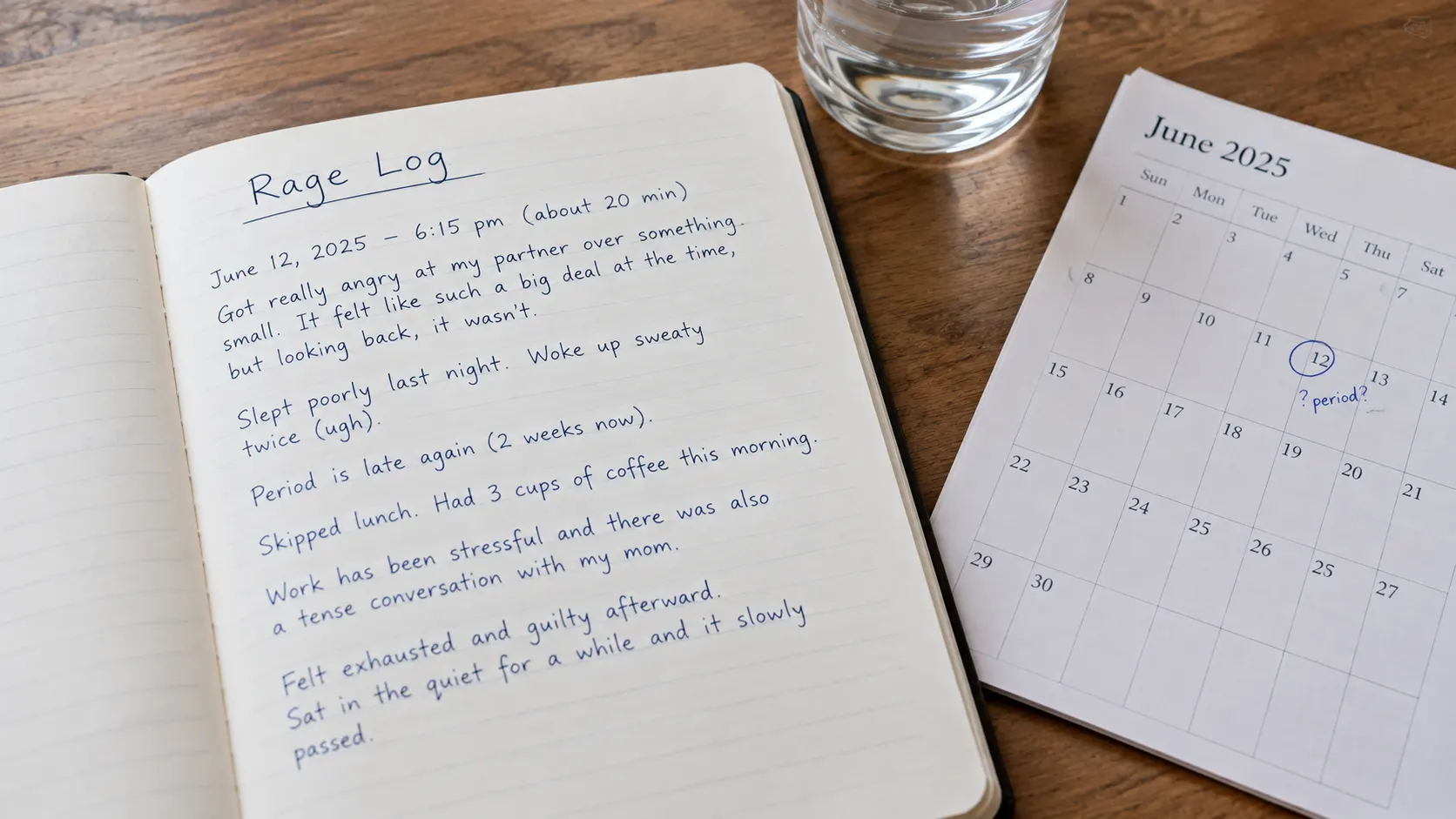
Keep a Rage Log for Two Cycles
A one-page log turns “I am out of control” into data a clinician can use. For each episode, write down:
- Date, time and how long it lasted.
- What set it off, and whether the anger matched the trigger.
- How you slept the night before, and whether night sweats woke you.
- Where you were in your cycle, or how long since your last period.
- Caffeine, alcohol and meals in the previous hours.
- How the week had been, including deadlines, caregiving and conflicts.
- How you felt afterward, and what helped you settle.
After a few weeks, the log sorts itself into questions for your appointment:
| If the log shows | Question to raise |
|---|---|
| Episodes follow bad nights or night sweats | Is sleep the first thing to treat? |
| Episodes cluster before your period | Is this tied to my cycle, and is my cycle changing? |
| Episodes arrive in the heaviest stress weeks | Is the stress response part of the picture? |
| Episodes come with nervousness, a racing pulse or heat intolerance | Should a thyroid panel be run now? |
| Low mood, hopelessness or no interest accompany the anger | Can I be screened for depression? |
When to Get Help Now and When to Book Soon
Some anger is a medical question and some is a safety question. Use this table as a sorting tool and consult a clinician for your own situation.
| What is happening | What to do |
|---|---|
| Thoughts of harming yourself or ending your life | Call or text 988 now. Call 911 if you are in immediate danger. |
| Fear that you might hurt someone, or anger that has become physical | Step away, then call or text 988, or call 911 if anyone is in immediate danger. Tell a doctor or therapist this week. |
| Anger with hopelessness, loss of interest or a flat mood | See your doctor or a therapist this week. |
| A short fuse that is frequent, damaging relationships or work, or not improving | Book a medical visit for a mood screen and thyroid test, and bring your log. |
| Occasional irritability that settles with sleep and a break | Keep the log, protect sleep, and mention it at your next visit. |
Perimenopause Rage Help in San Juan Capistrano or by Video Across California
The Natural Path sees patients in person at its San Juan Capistrano office and by video from anywhere in California, so the thyroid, stress and hormone side of a short fuse can be worked up locally or from home. The office is open Monday, Tuesday and Thursday from 10:00am to 6:00pm, a practical drive for women in Mission Viejo, Laguna Hills and San Clemente.
Our perimenopause and hormone care page explains how the evaluation reads the whole picture. Our mood, anxiety and depression page explains how the practice works alongside your mental health providers.
The telemedicine program covers patients inside or outside Orange County, and licensing limits video care to patients located in California. Hours and directions are on the contact page.
The longer read on the overlap is when depression and anxiety come out of nowhere, and when your mood is not just in your head covers the physiology.
Frequently Asked Questions
Is perimenopause rage real?
Perimenopause rage is an informal label for a real symptom. The irritability is real and well documented, and the label is informal. The Office on Women’s Health and Cleveland Clinic both list irritability among common perimenopause changes.
How long does perimenopause rage last?
It varies, and the research does not give a single timeline. In the Penn Ovarian Aging Study, irritability and mood swings decreased across the transition as assessed by hormone levels. Waiting is still a poor plan, because the anger can cost you sleep, work and relationships right now.
Is it perimenopause or my thyroid?
Either, both or neither. An overactive thyroid lists irritability and nervousness, an underactive one lists depression, and a TSH test is usually the first step.
Will hormone therapy stop it?
Not necessarily. The 2018 guideline says estrogen is not approved to treat perimenopausal depression, though there is evidence of antidepressant effects, particularly in women with hot flashes. Fit depends on your history and your prescriber’s judgment. CBT and mindfulness-based stress reduction may also help, and whole-system care and therapy are meant to work together.
Where to Start
If your anger is safe but exhausting, the most useful next step is understanding how the thyroid, the stress response and the sex hormones work as one system. Dr. Goldstein’s free Master Class walks through exactly that. Watch the free Master Class.
Written by The Natural Path clinical content team, based on the teaching of Dr. Angela Goldstein, ND.
This article is for general education and is not medical advice. It is not intended to diagnose or treat any disease, does not establish a doctor-patient relationship, and is not a substitute for care from your own clinician. Do not start, stop or change any prescribed medication based on what you read here. If you are in crisis or thinking about harming yourself or someone else, call or text 988 or call 911.