

Written by The Natural Path clinical content team, based on the teaching of Dr. Angela Goldstein, ND.
You are 41, maybe 38. Your periods were steady for twenty years, and now they skip, or arrive early, or stop for three months. The night sweats feel like something your mother described at 52. You want to know if this is early menopause, or something else wearing its clothes.
Early menopause symptoms usually start with a change in your periods: cycles that turn irregular, skip, or stop before age 45. Hot flashes, night sweats, broken sleep, mood changes, trouble concentrating, lower sex drive and vaginal dryness often follow. The US Office on Women’s Health defines menopause between 40 and 44 as early menopause, and menopause before 40 as premature menopause, also called primary ovarian insufficiency (POI).
If your periods stop or turn irregular before 45, tell a clinician. Thyroid disease, chronic stress and pregnancy can produce the same picture. Dr. Goldstein teaches that stress, thyroid and sex hormones work as one chain, so the first job is finding out which link is actually speaking, and what came before it.
Key Takeaways
- Early menopause is menopause between 40 and 44. Before 40 it is premature menopause, also called primary ovarian insufficiency (Office on Women’s Health).
- Periods change first. MedlinePlus says the first sign of POI is usually irregular or missed periods, with hot flashes and night sweats later.
- Surgery and cancer treatment are known causes, along with family history, smoking, autoimmune conditions such as thyroid disease, and genetic conditions. Often no cause is found.
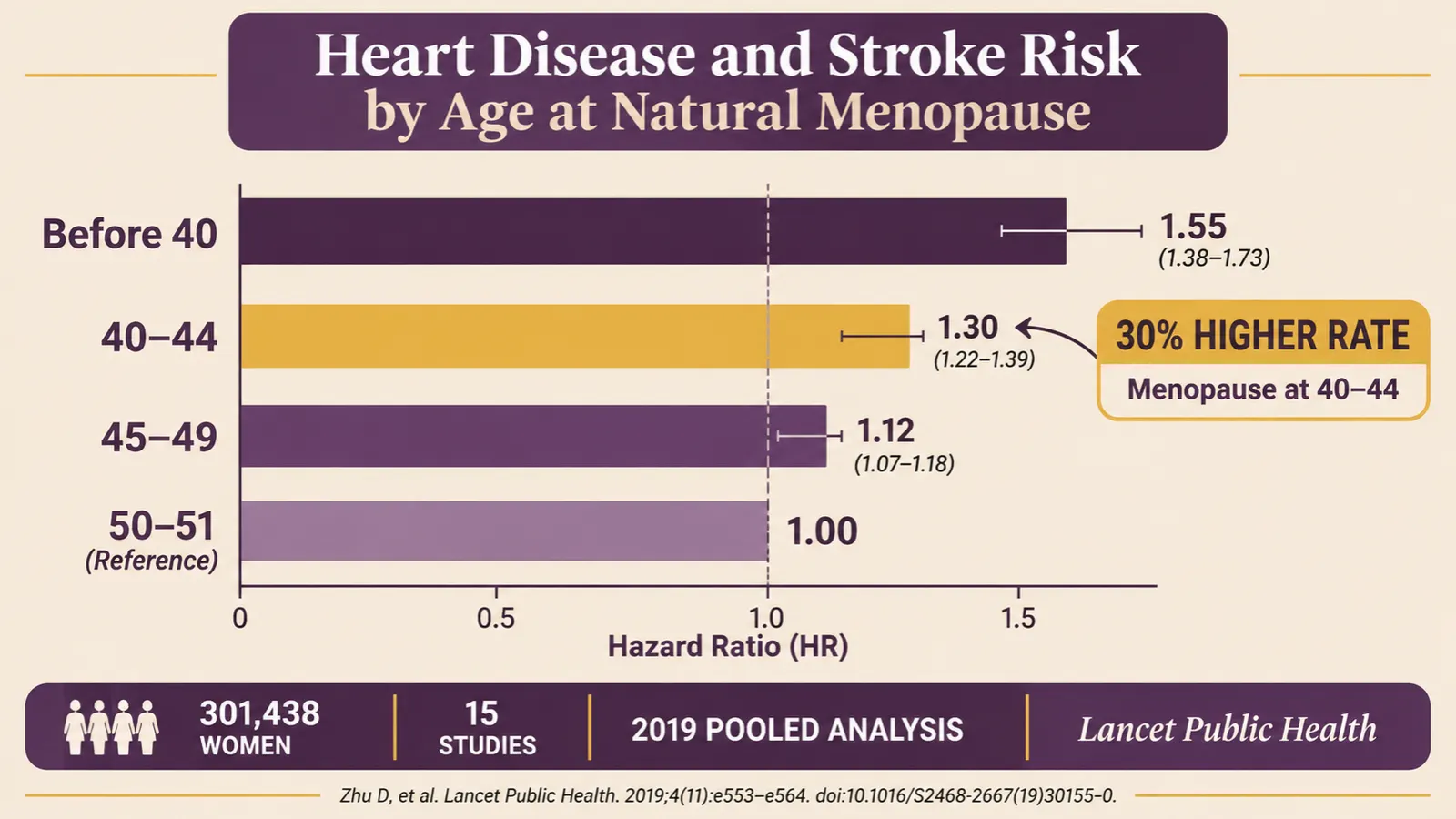
- Timing matters for bone and heart. In a 2019 pooled analysis of 301,438 women, menopause at 40 to 44 carried a 30% higher risk of a first heart or stroke event than menopause at 50 to 51.
- Rule out the look-alikes. An underactive or overactive thyroid, chronic stress and pregnancy can all change your cycle.
What Counts as Early Menopause
Early menopause is menopause that happens between ages 40 and 44. Premature menopause is menopause before 40. Both are defined by the age of your final period, and both are less common than many women assume.
If what you are noticing is the first gentle shift of your forties, with periods still coming, our perimenopause symptoms guide covers that stage. This page is about menopause that arrives before 45.
Menopause is the point when you have gone 12 months without a period. MedlinePlus states it plainly: “You have reached menopause when you have not had a period for 12 months.” ACOG puts the average age at 51.
| Term | What it means | Source |
|---|---|---|
| Menopause | 12 months with no period. Average age 51. | MedlinePlus, ACOG |
| Early menopause | Menopause between ages 40 and 44 | Office on Women’s Health |
| Premature menopause | Menopause before age 40 | Office on Women’s Health |
| Primary ovarian insufficiency (POI) | The ovaries stop working normally before 40. Periods may still come now and then. | NICHD (NIH) |
| Induced menopause | Menopause caused by surgery, chemotherapy or radiation | The Menopause Society |
Primary ovarian insufficiency (POI) is the medical term for ovaries that stop working normally before age 40. The National Institute of Child Health and Human Development (NICHD) notes that POI “used to be called ‘premature menopause'”, and that a woman with POI may still have periods and may still get pregnant. That is what separates POI from menopause in the medical sense.
How common is it? The Menopause Society’s patient page (read November 2026) says about three in 100 women go through menopause before 40. A 2016 review in JAMA Cardiology opened with the line “As many as 10% of women experience natural menopause by the age of 45 years” (Muka et al.). So early menopause is uncommon, and it is real.

Early Menopause Symptoms, From First Sign to Full Picture
The first of the early menopause symptoms is usually a change in your periods. MedlinePlus says “the first sign of POI is usually irregular or missed periods”. Cycles may come closer together, stretch further apart, skip, or stop.
The later symptoms look like natural menopause. MedlinePlus lists:
- Hot flashes
- Night sweats
- Irritability
- Poor concentration
- Decreased sex drive
- Pain during sex
- Vaginal dryness
ACOG adds detail on what those feel like (ACOG):
- Hot flashes. A hot flash is a sudden feeling of heat that rushes to the upper body and face. One can last a few seconds or several minutes, and some women get them a few times a month while others get them several times a day.
- Night sweats and sleep. Night sweats can wake you and leave you tired the next day. Sleep can also break in two other ways: trouble falling asleep, or waking long before your usual time.
- Vaginal and urinary changes. As estrogen falls, the vaginal lining may become thinner, drier and less elastic, which can make sex painful. The urethra can become dry or irritated too, which can mean more frequent urination and a higher risk of urinary tract infections.
Surgical menopause is menopause caused by removing both ovaries. The Menopause Society states that “when both ovaries are surgically removed, menopause results,” so it begins with the surgery itself.
Most women do not get every symptom, and some get only a few mild ones. If you want to see the full range sorted by the system that drives each one, our 34 symptoms of perimenopause list groups them into sex hormone, thyroid and stress response clusters.
Free 3-minute quiz from Dr. Angela Goldstein, ND
Stress, thyroid and sex hormones work as one system. Answer 22 quick questions and see which one is under the most strain for you.
What you’ll get:
- ✓A score for each system: stress, thyroid and sex hormones
- ✓Which pattern your answers fit, and how the systems pull on each other
- ✓Built on published research
- ✓A clear next step for your pattern
Free. 22 questions, about 3 minutes.
Educational content. Always talk with your doctor before changing any treatment.
What Causes Early Menopause
Early menopause can follow surgery, cancer treatment, smoking, a family history, or an autoimmune or genetic condition, and sometimes no cause is found. The Office on Women’s Health says “sometimes there is no clear cause” and lists these known ones:
- A family history of early menopause
- Smoking
- Chemotherapy or pelvic radiation
- Surgery that removed both ovaries
- Autoimmune conditions, such as thyroid disease
- Genetic conditions, such as Turner syndrome
NICHD’s page on what causes POI fills in the detail.
Genetic disorders “such as Fragile X syndrome and Turner syndrome can cause follicle depletion.” Several studies suggest about one-fifth of women with POI have an autoimmune disease. Cancer treatments “may damage the genetic material in cells, including follicle cells.” And “cigarette smoke, chemicals, and pesticides can speed up follicle depletion.”
Still, for most women with POI the exact cause stays unknown. MedlinePlus (page updated May 2026) puts that share at about 90% of POI cases.
Two points clear up common confusion:
- A hysterectomy alone does not cause menopause. MedlinePlus says removing the uterus stops your periods but “does not cause menopause unless the ovaries are also removed”. Without periods to track, symptoms become the main clue.
- Breast cancer treatment can bring it on. MedlinePlus notes that chemotherapy or hormone therapy used to treat breast cancer can make menopause start earlier than usual.
If you already live with an autoimmune condition, or suspect one, our page on early autoimmune symptoms explains what to watch for.
What Else Can Look Like Early Menopause
The main look-alikes for early menopause are an underactive thyroid, an overactive thyroid, chronic stress and pregnancy. Each can change your cycle or bring on heat, fatigue and poor sleep, and each one is checked differently.
| Look-alike | Overlap with early menopause | Source |
|---|---|---|
| Underactive thyroid | Fatigue, depression, “heavy or irregular menstrual periods or fertility problems” | NIDDK |
| Overactive thyroid | Trouble sleeping, irritability, sweating or trouble tolerating heat | NIDDK |
| Chronic stress | Stress hormones can quiet the brain signal that runs the cycle | Whirledge & Cidlowski, 2010 |
| Pregnancy | Missed periods | NICHD includes a pregnancy test in the POI workup |
The National Institute of Diabetes and Digestive and Kidney Diseases (NIDDK) lists heavy or irregular periods among the symptoms of hypothyroidism. Its hyperthyroidism list includes sweating, trouble tolerating heat and trouble sleeping. On a symptom checklist, either can pass for early menopause.
Thyroiditis is the autoimmune disorder most commonly associated with POI, according to NICHD. So thyroid disease can imitate early menopause, and it can also travel with it. A thyroid result belongs in the picture either way. Our guide on telling thyroid trouble from perimenopause walks through the overlap.
For the women who have both, Hashimoto’s and menopause covers how the two interact.
Stress belongs on the list for a physical reason. A review in Minerva Endocrinologica reports that “at the level of the hypothalamus, glucocorticoids inhibit the release of gonadotropin-releasing hormone (GnRH)”, the hormone that sets the cycle in motion. Dr. Goldstein teaches the same chain in plain words:
“So when you’re under chronic stress, your adrenal pumps out cortisol constantly. High cortisol tells your thyroid to slow down because your body thinks there’s a famine. Your thyroid slowing down disrupts your sex hormones because your body thinks it’s not safe to reproduce.”
That is why the practice reads the three systems together. As Dr. Goldstein puts it: “Your thyroid can be normal while still being shut down by stress.”
Why Early Menopause Matters for Bone and Heart
Early menopause matters because it adds years without the estrogen your ovaries used to make, and those years count. The Office on Women’s Health says: “Years without estrogen raise your risk of bone loss, heart disease, and diabetes.”
Bone. ACOG explains that women lose bone more rapidly during the first 4 to 8 years after menopause because estrogen falls. Reaching that point at 41 instead of 51 starts the clock a decade sooner. MedlinePlus states that “without enough estrogen, women with POI often develop osteoporosis,” and The Menopause Society notes that earlier bone loss “may lead to an earlier risk of bone fractures related to osteoporosis.”
Heart. ACOG says the estrogen made before menopause “protects against heart attacks and stroke.” MedlinePlus adds that lower estrogen can affect the muscles lining the arteries and increase the buildup of cholesterol.
Women whose natural menopause came at 40 to 44 had a 30% higher rate of a first non-fatal heart disease or stroke event than women whose menopause came at 50 to 51. That is the finding of a 2019 pooled analysis of 15 studies and 301,438 women in Lancet Public Health (Zhu et al., 2019), which compared every age band against 50 to 51.
| Age at natural menopause | Hazard ratio, first heart disease or stroke event | Before age 60 only |
|---|---|---|
| Before 40 (premature) | 1.55 | 1.88 |
| 40 to 44 (early) | 1.30 | 1.40 |
| 45 to 49 | 1.12 | not reported |
| 50 to 51 | 1.00 (reference) | 1.00 |
A hazard ratio compares the rate of first events, so 1.30 means about 30% higher than the reference group. In the 2019 analysis, the link held in women who had never smoked.
The link was strongest before age 60, weaker at 60 to 69, and no longer significant at 70 and older. The authors concluded that women with earlier menopause “need close monitoring in clinical practice.” A separate meta-analysis of 32 studies found a 50% higher risk of coronary heart disease when menopause came before 45 (relative risk 1.50, Muka et al., 2016).
These are associations from observational studies. They describe groups, and they show why a woman whose periods stop at 42 deserves a closer look at her bones and her heart, not a shrug.
On treatment, the Office on Women’s Health says “hormone therapy may help relieve symptoms and protect your bones.” Whether hormone support fits you depends on your history, and it is a decision to make with a clinician who has the full picture. Our page on how Dr. Goldstein approaches bioidentical hormone therapy explains how that decision is made at the practice.
When to See a Doctor About Early Menopause Symptoms
See a clinician if your periods stop or become irregular before age 45. That is the Office on Women’s Health’s own guidance: “Tell your health care provider if your periods stop or become irregular before age 45.” It adds that your provider may order blood tests, and that “testing is most useful before age 40.”
Under 40, NICHD describes how POI is diagnosed. Evaluation starts when a woman younger than 40 has irregular periods or no period for 4 months or longer. The workup can include:
- A pregnancy test, to rule out an unexpected pregnancy as the reason for missed periods
- Two FSH tests, at least a month apart. FSH (follicle-stimulating hormone) is the brain’s signal to the ovaries. NICHD says POI is likely when both results are as high as in women past menopause.
- Estrogen and LH levels
- A karyotype, a test that looks at all 46 chromosomes
Report unusual bleeding as well. ACOG notes that changes in bleeding are common in the years before menopause and that abnormal bleeding may be a sign of a problem.
A single normal panel does not close the question. Dr. Goldstein’s line on testing applies here: “Standard labs measure diseases, not function.” Our page on what perimenopause labs show explains what each marker can and cannot tell you.
For the wider menu of tests, from estradiol to thyroid and cortisol, see hormone testing for women.
When Did It Start, and What Came Before It?
When your periods changed, and what happened in the months before, often points to the system to check first. That is why the first questions at The Natural Path are about time.
Before any appointment, write down:
- The date of your last few periods, and when the pattern first changed
- Any surgery on your ovaries or uterus, and whether one or both ovaries were removed
- Any chemotherapy, pelvic radiation or breast cancer treatment, with dates
- Your mother’s and sisters’ age at menopause, if you know it
- Thyroid history, including any diagnosis, medication or past “borderline” result
- Smoking, now or in the past
- The stress of the last year or two: a loss, a move, a long stretch of overwork or caregiving, an illness
A woman whose periods stopped at 41, eight months after a hard year and a thyroid result labeled “borderline,” needs a different first step than a woman who had both ovaries removed at 41. The list makes that difference visible.
Early menopause can carry grief, too. The Office on Women’s Health notes that learning you have it “can also bring grief, especially about fertility.” That deserves room in the conversation. For what the years after the final period tend to look like, see how long menopause lasts.
Early Menopause Care in San Juan Capistrano or by Video Across California
Dr. Goldstein sees patients at the San Juan Capistrano office, and women come in from Laguna Niguel, Dana Point and nearby towns. Video visits are available anywhere in California, so you can start from home and bring your timeline list to the first conversation.
For how the practice approaches hormone changes at this stage, see perimenopause and hormone care for Orange County women.
If thyroid is part of your story, the thyroid and Hashimoto’s care page covers how it is evaluated.
Our telemedicine page explains how a video visit works. Dr. Goldstein has 25+ years in practice.
Questions about cost and coverage are answered on our page about whether functional medicine is covered by insurance in California.
Office hours and directions are on the contact page.
Frequently Asked Questions
What is the earliest age for menopause?
There is no fixed lower limit: NICHD notes that POI can begin as early as the teenage years. Menopause before 40 is called premature menopause, and The Menopause Society (patient page, read November 2026) says about 3 in 100 women go through it.
Can you go through menopause at 40?
Yes. Menopause between 40 and 44 is early menopause. As many as 10% of women reach natural menopause by 45, according to a 2016 review in JAMA Cardiology.
Is early menopause the same as perimenopause?
No. Perimenopause is the transition before the final period, and ACOG says the estrogen your ovaries make begins to fluctuate in your 30s and 40s. Early menopause means the final period itself came before 45, confirmed after 12 months without one.
Can stress cause early menopause?
Stress is not on the Office on Women’s Health list of known causes. It can still disrupt your cycle, because stress hormones inhibit the brain signal (GnRH) that drives it. Missed periods during a hard stretch deserve a check before anyone calls them menopause.
Can you still get pregnant with primary ovarian insufficiency?
It is possible. NICHD states that a woman with POI may still have periods and may still get pregnant. Talk with your own clinician about what that means for contraception or for plans to conceive.
Does a hysterectomy cause early menopause?
Only if the ovaries are removed too. MedlinePlus says removing the uterus alone stops periods but does not cause menopause. Removing both ovaries does.
Where to Start
The useful next question is which of your systems is driving your symptoms right now: your ovaries, your thyroid or your stress response.
The Hormone Orchestra Quiz is free, has 22 questions and takes about 3 minutes. It scores the three connected systems Dr. Goldstein reads together: your stress response, your thyroid and your sex hormones. Take the free hormone quiz.
Written by The Natural Path clinical content team, based on the teaching of Dr. Angela Goldstein, ND.
This article is for general education and is not medical advice. It does not establish a doctor-patient relationship and is not a substitute for care from your own clinician. Do not delay seeking care, and do not start, stop or change any prescribed medication or hormone, based on what you read here. If you have an urgent medical concern, call 911 or contact your physician.