
Written by The Natural Path clinical content team, based on the teaching of Dr. Angela Goldstein, ND.
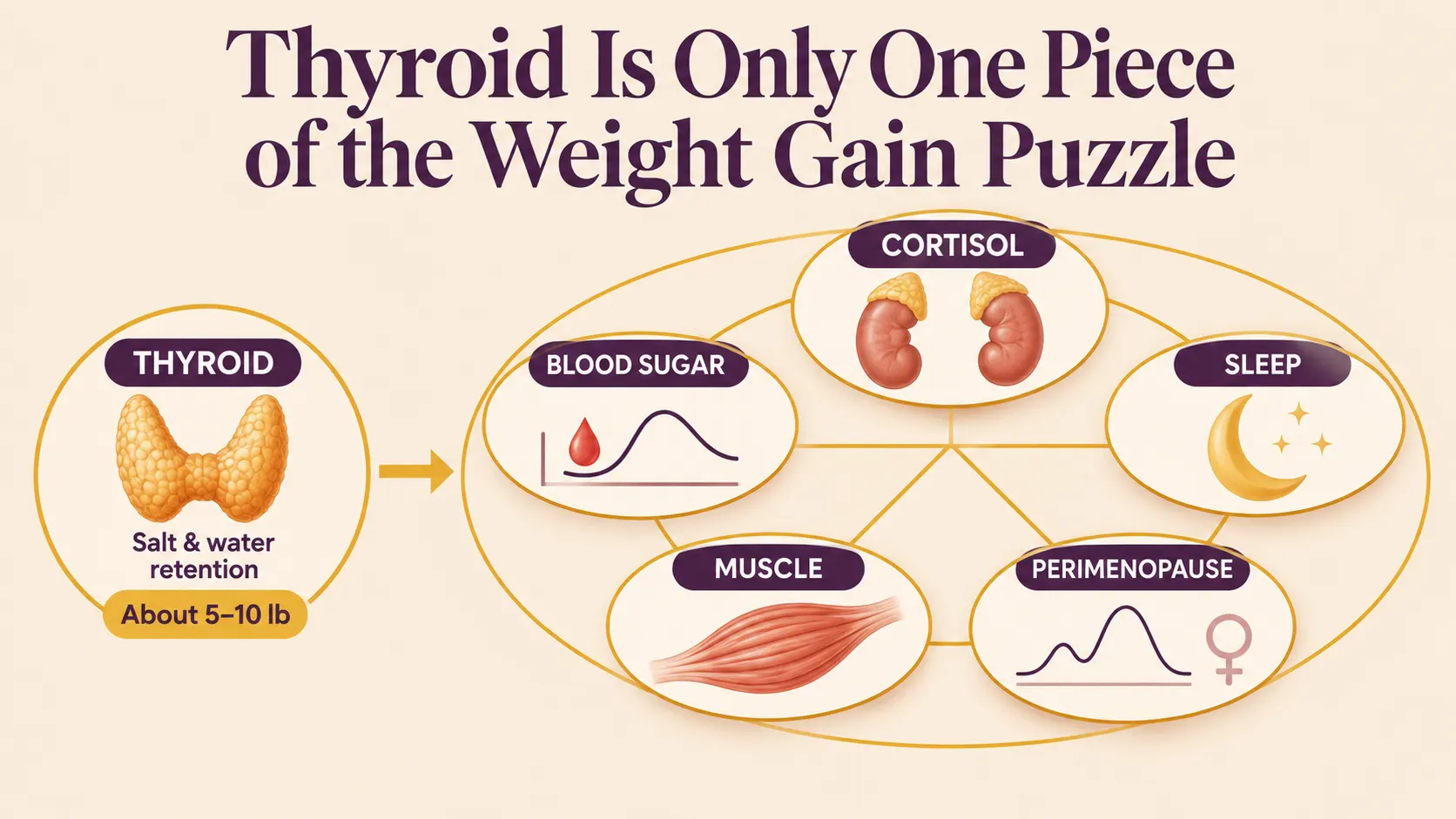
Losing weight with Hashimoto’s is harder mostly because the thyroid is one of several systems that set your weight, and thyroid treatment fixes only its share. The American Thyroid Association (ATA) puts thyroid-related gain at about 5 to 10 pounds, mostly salt and water. A 2026 meta-analysis found levothyroxine lowered body weight by an average of 1.39 kg, about 3 pounds.
Once your dose is right, the ATA says your ability to lose weight is the same as anyone’s. So the work has an order: get the dose right and keep rechecking it, then look at cortisol, blood sugar, sleep, muscle and perimenopause.
Key Takeaways
- The thyroid’s share is modest. The ATA says about 5 to 10 pounds may be thyroid-related, mostly retained salt and water.
- The dose is step one, and it moves. The ATA’s 2014 treatment guideline says levothyroxine needs rise as thyroid failure progresses and fall with aging and weight loss.
- The dose is set for the thyroid, not the scale. In a 2018 trial of 138 treated adults, pushing TSH lower for 6 months did not meaningfully change body composition.
- Other systems set the rest. Cortisol, insulin resistance, short sleep, muscle loss and the menopause transition each have published links to weight.
- Dr. Goldstein reads them together, because a TSH in range answers one question and leaves the others open.
You take your pill every morning, your TSH is “in range,” and you are eating less and moving more than you did five years ago. The scale barely moves. Maybe you have heard “it’s just stress” or “it’s just aging.” Here is what the research says is in the way, in the order worth checking it.
Why Losing Weight With Hashimoto’s Feels So Hard
Losing weight with Hashimoto’s feels hard because treating the thyroid removes only the thyroid’s part of the gain, and that part is usually small.
Hashimoto’s thyroiditis is an autoimmune condition in which the immune system attacks the thyroid. The ATA states that it is the most common cause of hypothyroidism in the United States and that it “often progresses very slowly over many years.”
Levothyroxine is the standard thyroid hormone pill (T4). Its dose is set by your TSH blood test.
The ATA’s thyroid and weight page says most thyroid-related gain comes from “retaining salt and water,” about 5 to 10 pounds depending on severity. If your other hypothyroid symptoms improved on treatment and the weight did not, the ATA says “it is unlikely that the weight gain was only due to the thyroid.” Dr. Goldstein’s approach to Hashimoto’s care starts from that point: the thyroid is one system among several.
A 2026 meta-analysis in the International Journal of Obesity pooled 23 studies and 763 adults brought into normal thyroid range with levothyroxine. Weight fell 1.39 kg on average, fat mass 0.75 kg and lean mass 0.95 kg. The authors call the changes modest and discourage levothyroxine “solely for weight loss.”
The link may also run the other way. A 2019 meta-analysis of 22 studies tied obesity to nearly double the risk of Hashimoto’s (relative risk 1.91), and the ATA’s guideline notes that cause and effect are hard to assign.
The hopeful line is in the ATA page too: once thyroid levels are normal, “the ability to gain or lose weight is the same as in patients who do not have thyroid problems.” For how much weight an underactive thyroid adds in general, see our guide to thyroid and weight gain.
Start With the Dose, Then Keep Checking It
The first lever is a levothyroxine dose that keeps your TSH in the reference range, rechecked whenever something changes. The ATA’s 2014 treatment guideline calls a TSH within the reference range the therapeutic target, and an age-specific range is generally recommended.
- Know your number and its date. Ask for your latest TSH and free T4, and the date of each. The ATA’s hypothyroidism page says blood is checked 6 to 8 weeks after starting or changing a dose.
- Expect the dose to move. The same guideline says levothyroxine needs change with “progression of thyroid failure (higher), aging (lower), weight loss (lower).” With Hashimoto’s, the gland can make less over the years, so a dose that fit three years ago may not fit now. If you do lose weight, your need may fall.
- Take it so it absorbs. The NIDDK lists grapefruit juice, espresso coffee, soy, and multivitamins with iron or calcium as things that can affect absorption. Your doctor may ask you to take it 30 to 60 minutes before your first meal. Our Hashimoto’s diet guide covers the food side of this.
- Ask about the gut if the dose keeps climbing. The ATA guideline recommends considering an evaluation for celiac disease, atrophic gastritis or H. pylori gastritis when dose needs run much higher than expected.
That last step matters for Hashimoto’s in particular. A 2012 study followed 35 people with Hashimoto’s and atypical celiac disease, meaning celiac without the classic digestive picture. Those who did not follow a gluten-free diet needed a median 49% higher levothyroxine dose to reach their TSH target. Those who went gluten-free reached it on the usual dose after about 11 months.

Free 3-minute quiz from Dr. Angela Goldstein, ND
Stress, thyroid and sex hormones work as one system. Answer 22 quick questions and see which one is under the most strain for you.
What you’ll get:
- ✓A score for each system: stress, thyroid and sex hormones
- ✓Which pattern your answers fit, and how the systems pull on each other
- ✓Built on published research
- ✓A clear next step for your pattern
Free. 22 questions, about 3 minutes.
Educational content. Always talk with your doctor before changing any treatment.
What Raising the Dose Does to Your Weight
Raising the dose to push TSH lower did not meaningfully change body composition in a randomized trial. In Samuels and colleagues’ 2018 study, 138 adults already on levothyroxine were assigned, double-blind, to one of three TSH targets for 6 months. The targets were 0.34 to 2.50, 2.51 to 5.60, and 5.61 to 12.0 mU/L.
The authors found “no substantial metabolic differences” among the groups, though participants preferred the dose they believed was higher. Their conclusion: the data “do not support adjusting LT4 doses” to improve weight or body composition.
The safety side. The ATA warns that extra thyroid hormone raises the risk of insomnia, palpitations, anxiety, loss of muscle and bone, and heart rhythm problems that can raise stroke risk. Once the extra hormone stops, “any weight loss is usually regained.”
The 2014 guideline strongly recommends against using levothyroxine to treat obesity when thyroid levels are normal. The dose has one job, restoring normal thyroid levels. Dr. Goldstein looks past it for a reason she puts plainly: “Your thyroid can be normal while still being shut down by stress.”
Cortisol: When Stress Turns the Thyroid Signal Down
Chronic stress can quiet the thyroid signal even when the pill is right, which is one reason Dr. Goldstein reads cortisol and thyroid together.
Cortisol is the main stress hormone, made by the adrenal glands.
For Hashimoto’s specifically, a 2026 review in Endokrynologia Polska on stress and autoimmune thyroid disease notes that treating chronic anxiety, depression or sleep disorders “may improve the stability of thyroid parameters.” The same review reports that cortisol suppresses TSH secretion and lowers active T3. A study of 59 premenopausal women adds a weight link: women with more central fat released more cortisol under lab stress, a cross-sectional finding that leaves the direction open.
Dr. Goldstein describes the chain this way: “High cortisol tells your thyroid to slow down because your body thinks there’s a famine.” The result, she says, is “weight gain from slower thyroid, fatigue from depleted adrenals” and hormone symptoms on top. Our explainer on how cortisol affects the thyroid walks through the research.
Blood Sugar: The Quiet Brake on Weight Loss
Insulin resistance can sit alongside hypothyroidism and usually causes no symptoms, so it is easy to miss when weight will not move.
Insulin resistance is a state in which cells respond poorly to insulin, so the body makes more insulin to keep blood sugar steady.
A 2014 review in Endokrynologia Polska concluded that in hypothyroidism “the insulin resistance of peripheral tissues prevails.” Peripheral tissues means mainly muscle and fat.
The NIDDK says people with insulin resistance “usually have no symptoms” and that health care professionals “may not test for insulin resistance.” If your dose is steady and the weight is not, ask whether fasting insulin, glucose or A1C has been checked. Our guide to insulin resistance in women explains what the tests can show.
Sleep and Muscle: Two Levers You Can Measure
Short sleep and lost muscle both make the same diet produce less fat loss, and both are things you can track.
Sleep. In a 2010 trial in the Annals of Internal Medicine, 10 overweight adults ate the same reduced-calorie diet for 14 days twice, once with 8.5 hours of sleep opportunity and once with 5.5.
With short sleep, fat lost fell from 1.4 kg to 0.6 kg, loss of fat-free mass rose from 1.5 kg to 2.4 kg, and hunger went up. The study was small and short. Within it, less sleep shifted the loss away from fat.
Muscle. The 2026 levothyroxine meta-analysis found lean mass fell by 0.95 kg on average with treatment, a drop that was significant only in subclinical hypothyroidism.
A 2017 review in Advances in Nutrition found that diet-only weight loss also costs muscle. It found adequate, not excessive, protein helps preserve lean mass. Both endurance and resistance exercise help keep muscle during weight loss, and resistance exercise also builds strength.
What to track for 4 weeks:
- Hours of sleep, and nights you wake and cannot get back to sleep
- Strength sessions per week (machines, bands or body weight all count)
- Protein at each meal, in rough portions
- Your waist measurement, not only the scale
Perimenopause: A Second Moving Part After 40
If you are in your 40s or 50s, the menopause transition changes body composition on its own and can change your thyroid dose. The long-running SWAN study followed midlife women through the transition. Greendale and colleagues (2019) found that at its start “rate of fat gain doubled, and lean mass declined,” even though total weight did not speed up.
Estrogen therapy can raise how much thyroid hormone you need. In a 2001 study in the New England Journal of Medicine, postmenopausal women on thyroxine who started estrogen saw their average TSH rise from 0.9 to 3.2. In 7 of 18 women on replacement doses, TSH rose above 7.
If you start or change estrogen, ask whether your TSH should be rechecked. For the mechanism behind midlife gain, see our guide to perimenopause weight gain.
When Hashimoto’s and the transition overlap, the symptoms blur together. Our page on Hashimoto’s and menopause sorts out which is which.
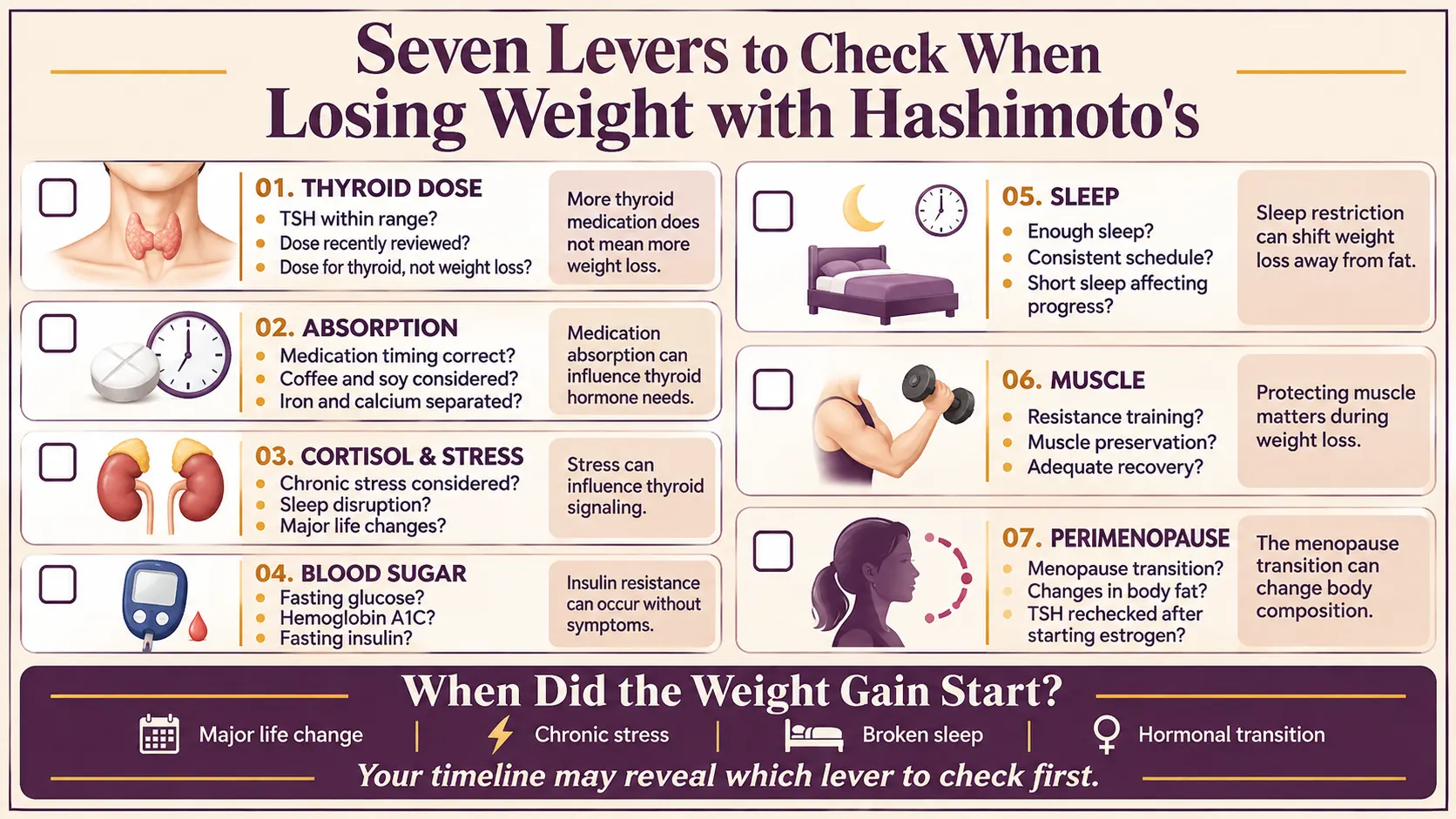
What Changes It: Seven Levers to Check
What changes weight with Hashimoto’s is checking each lever in order, starting with the thyroid and moving to the systems around it.
| Lever | What the source found | Question to ask your clinician |
|---|---|---|
| Thyroid dose | ATA 2014: TSH in the reference range is the target; needs change with progression, aging and weight loss | Is my TSH in range on this dose, and when was it last checked? |
| Absorption | NIDDK: espresso, soy, iron and calcium can interfere; ATA 2014: check the gut if the dose runs high | Am I taking it correctly, and should celiac or gastritis be ruled out? |
| Dose for weight | Samuels 2018: three TSH targets, no major change in body composition | Is my dose set for my thyroid, not my weight? |
| Cortisol | Gierach and Junik 2026: cortisol suppresses TSH and lowers active T3 | What was going on in my life when the weight started? |
| Blood sugar | Gierach 2014: peripheral insulin resistance in hypothyroidism; NIDDK: usually silent | Has anyone looked at fasting insulin, glucose or A1C? |
| Sleep and muscle | Nedeltcheva 2010: short sleep shifted loss away from fat; Cava 2017: resistance exercise preserves muscle | How do I protect muscle while I lose? |
| Perimenopause | SWAN 2019: fat gain doubled at the transition; Arafah 2001: estrogen raised thyroxine need | Should my TSH be rechecked if I start estrogen? |
The table has one more question behind it: when did the weight start, and what came before it? A move, a loss, a new job, a stretch of broken sleep. That timeline often points to which lever to pull first.
On treating the thyroid by itself, Dr. Goldstein says: “You might feel slightly better, but you won’t be truly well.” On testing, she says: “Standard labs measure diseases, not function.” That is the thinking behind metabolic and weight resistance care, where thyroid, cortisol, blood sugar and sex hormones are read together.
Hashimoto’s Weight Care in San Juan Capistrano or by Video Across California
Dr. Goldstein sees patients in person at the San Juan Capistrano office, and women come from nearby towns such as Mission Viejo and Laguna Niguel. Video visits are available anywhere in California. Here is how telemedicine visits for California patients work.
Dr. Goldstein has 25+ years in practice, and the practice does not bill insurance. Bring your TSH, free T4 and antibody results with their dates, your medicine list and a short timeline of when the weight started. The address and office hours are on the contact page.
One Google reviewer, Eileen Naber, wrote that with Dr. Goldstein “it’s not just about your bloodwork.”
Frequently Asked Questions
Why is it so hard to lose weight with Hashimoto’s?
Thyroid treatment removes only the thyroid’s share of the gain, which the ATA puts at about 5 to 10 pounds, mostly salt and water. Cortisol, insulin resistance, short sleep, muscle loss and perimenopause each have published links to the rest.
How much weight does Hashimoto’s cause?
For most people, about 5 to 10 pounds may be thyroid-related, according to the ATA, depending on how underactive the thyroid is. Most of it is retained salt and water. If other symptoms improved on treatment and the weight did not, the ATA says the thyroid was unlikely to be the only cause.
Will raising my levothyroxine dose help me lose weight?
No, based on the trial evidence so far. A 2018 randomized trial of 138 treated adults found three different TSH targets made no major difference to body composition. The ATA warns that extra thyroid hormone carries heart, bone and muscle risks, and the weight usually returns.
Can you lose weight with Hashimoto’s?
Yes. The ATA states that once thyroid levels are normal on treatment, the ability to gain or lose weight is the same as in people without thyroid problems. Progress depends on the other levers too: sleep, muscle, blood sugar and stress.
What is the best diet for losing weight with Hashimoto’s?
The trials so far do not single out one diet for Hashimoto’s weight loss. The food levers with evidence are a calorie deficit, adequate protein and taking levothyroxine away from foods that block it. Our Hashimoto’s diet guide reviews the trials on gluten-free, selenium and elimination diets.
How often should TSH be checked while losing weight?
The ATA says blood is checked 6 to 8 weeks after any dose change. The 2014 guideline lists weight loss as a reason levothyroxine needs can fall. If you lose a meaningful amount of weight, ask whether a recheck makes sense.
Where to Start
The dose is the first step, and the systems around it decide the rest. Dr. Goldstein, a naturopathic doctor with 25+ years in practice, explains how stress, thyroid and sex hormones affect each other in her free Master Class. Watch the free Master Class.
Written by The Natural Path clinical content team, based on the teaching of Dr. Angela Goldstein, ND.
This article is for general education and is not medical advice. It does not establish a doctor-patient relationship and is not a substitute for care from your own clinician. Do not start, stop or change any thyroid, hormone or prescribed medication based on what you read here. If you have an urgent medical concern, contact your physician or emergency services. Testimonials reflect individual experiences and results vary.