

Written by The Natural Path clinical content team, based on the teaching of Dr. Angela Goldstein, ND.
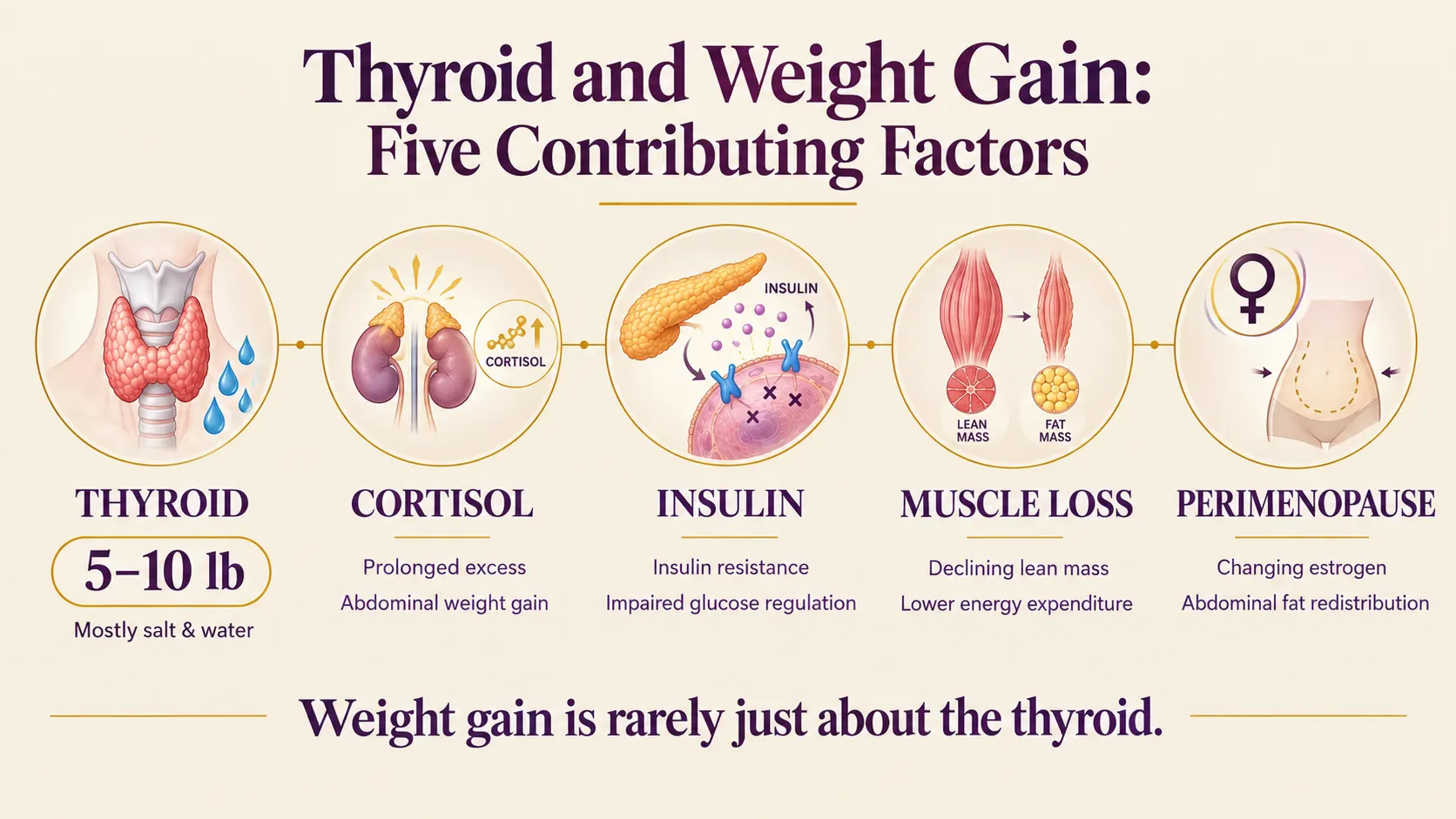
Thyroid and weight gain are linked, but modestly. The American Thyroid Association (ATA) says about 5 to 10 pounds of weight gain may be related to the thyroid in most patients, and that most of it is retained salt and water. A 2026 meta-analysis of 763 adults found that restoring normal thyroid levels with levothyroxine lowered body weight by an average of 1.39 kg (about 3 pounds). So the pill alone often leaves most of the scale where it was. The thyroid explains a slice of the gain, and the rest can involve stress hormones, blood sugar, muscle loss, sleep and the menopause transition. If your weight gain is rapid or comes with swelling, breathlessness or a new lump in the neck, see a clinician promptly.
Key Takeaways
- The ATA ties about 5 to 10 pounds of gain to the thyroid in most patients, mostly salt and water. More severe hypothyroidism may bring more.
- In a 2026 pooled analysis of 23 studies, levothyroxine lowered weight by 1.39 kg on average, and the authors describe the changes as modest.
- Weight lost after treatment is not all fat. In the pooled analysis lean body mass fell by 0.95 kg and fat mass by 0.75 kg, and one small trial found the loss came entirely from lean mass, which includes water.
- Cortisol, insulin resistance and the menopause transition each have published links to body weight, and each can be present alongside a thyroid problem.
- Dr. Goldstein reads thyroid, stress and blood sugar together, because a normal TSH answers one question and leaves the rest open.
You were told your thyroid was underactive. You started levothyroxine, your TSH came back “in range,” and the scale did not move. Or it moved a little and stopped. Or you gained weight and your TSH was always fine. Each version leaves the same question: if the thyroid is not the whole story, what is?
Thyroid and Weight Gain: How Much Does Hypothyroidism Add?
Hypothyroidism adds a modest amount of weight, and most of it is retained salt and water.
Hypothyroidism is a condition in which the thyroid gland makes too little thyroid hormone. The NIDDK lists weight gain among its common symptoms.
The ATA’s patient page on thyroid and weight gives the figures. For most patients, about 5 to 10 pounds of weight gain may be related to the thyroid, the page says. More severe hypothyroidism may bring more, though the change is usually much smaller than the weight loss seen in hyperthyroidism. Most of the weight gained is retained salt and water, according to the same page.
The NIDDK adds a caution that matters for anyone sorting symptoms: fatigue and weight gain are common and do not necessarily mean a thyroid problem. The NIDDK also reports that women are much more likely than men to develop hypothyroidism, which is part of why the question comes up so often in midlife.
The authors of the 2026 review covered below write that weight gain is commonly regarded as a hallmark of hypothyroidism, although supporting evidence is limited. The ATA draws a practical conclusion: if your other hypothyroid symptoms improve on treatment, it is unlikely the weight gain was only due to the thyroid. When the gain is large, a clinician should look at what else is going on alongside the thyroid.
For the full state-versus-cause picture, see our guide to hypothyroidism versus Hashimoto’s. If your TSH is only slightly above range, our guide to subclinical hypothyroidism covers the recheck and treatment debate.
Why Weight Often Stays After You Start Levothyroxine
Treating the thyroid usually moves the scale a little, and the pooled evidence says the loss is modest.
Levothyroxine is the thyroid hormone medicine prescribed to replace what an underactive thyroid cannot make, as the NIDDK describes it.
The newest pooled answer comes from a 2026 systematic review and meta-analysis in the International Journal of Obesity. Its title says levothyroxine brings “clinically insignificant” changes in weight and body measurements. The authors compared before and after in 763 adults across 23 studies, all of whom reached normal thyroid levels. The results, in kilograms unless noted:
| Measure | Average change after reaching normal thyroid levels | 95% confidence interval |
|---|---|---|
| Body weight | down 1.39 kg | 0.23 to 2.56 kg |
| BMI | down 0.39 kg/m² | 0.11 to 0.68 |
| Fat mass | down 0.75 kg | 0.02 to 1.47 kg |
| Lean body mass | down 0.95 kg | 0.43 to 1.47 kg |
Overt hypothyroidism showed significant drops in weight and BMI. Subclinical hypothyroidism did not. Lean body mass fell significantly only in the subclinical group. Baseline TSH and study length were not linked to the size of the change. The authors call the changes modest and say the findings support realistic counseling and discourage levothyroxine use solely for weight loss.
Two details in that table matter. The average loss was about 3 pounds. And lean body mass fell by more than fat mass did, so a falling number on the scale is not proof of fat loss.
An earlier one-year study in the Journal of Clinical Endocrinology and Metabolism followed 12 newly diagnosed adults on levothyroxine and 10 comparison participants. Body weight fell from 83.7 to 79.4 kg. The drop came from the lean compartment only, and fat mass was virtually unchanged. The authors proposed that the weight lost during treatment is excess body water from untreated myxedema, the tissue swelling of severe hypothyroidism. The study was small, and the pooled analysis later found some fat loss too.
A 2014 review in the European Thyroid Journal adds two points. Small differences in thyroid function are associated with up to 5 kg of difference in body weight. It also notes that people with obesity and a normal thyroid gland tend to have higher TSH and thyroid hormones. A slightly high TSH can therefore sit alongside extra weight without being its cause.
The ATA states that treatment of hypothyroidism returns body weight to what it was before the hypothyroidism started. Once thyroid levels are normal, it adds, the ability to gain or lose weight is the same as in people without thyroid problems. That describes the thyroid’s share. It leaves open how much of the weight you carry now arrived for other reasons during the same years.
Check the Thyroid Basics First
The pooled studies followed people who reached normal thyroid levels. So the first question is whether you have. Ask your prescriber whether your TSH and free T4 are in range on your current dose and how to take the pill so it absorbs well. If you have Hashimoto’s, our Hashimoto’s diet guide covers what to keep away from the pill and the food-side evidence.
Never raise your dose, add thyroid hormone or stop your medicine on your own. The ATA notes that thyroid hormone has been used for weight loss in the past. It warns that taking extra raises the risk of serious side effects, and that weight loss is usually regained once the excess is stopped.
Cortisol: The Stress Link
Cortisol connects to both the thyroid and body weight, and the research describes an association in each direction with some limits worth knowing.
Cortisol is the main stress hormone, made by the adrenal glands.
On the thyroid side, a 2026 review in Endokrynologia Polska reports that cortisol suppresses TRH and TSH secretion and disrupts the circadian rhythm of TSH secretion. It also shifts deiodinase activity (lower D1 and D2, higher D3), which leads to reduced T3 and increased reverse T3. In plain terms, the signal that asks the thyroid for more hormone can get quieter, and the active hormone available to tissues can fall. Our guide to cortisol and thyroid walks through the mechanism.
On the weight side, the evidence has two tiers. A review in the International Journal of Molecular Sciences reports that long-term glucocorticoid exposure arising from treatment or Cushing’s syndrome progressively leads to insulin resistance. That describes medication-level or disease-level exposure. A study of 59 premenopausal women found that women with more central fat secreted significantly more cortisol during a laboratory stress session than women with less. Lean women with central fat kept responding to repeated stressors. The authors say the cross-sectional findings support the hypothesis that stress-induced cortisol secretion may contribute to central fat. It is a single study of 59 women.
Cortisol belongs on the list of things to look at when weight does not respond to thyroid treatment.
If the stress-and-thyroid picture sounds familiar, the free Hormone Orchestra Quiz takes about 3 minutes and scores your stress response, thyroid and sex hormones. A score is a conversation starter to bring to your clinician.
Insulin: The Blood Sugar Link
Blood sugar is the second connected system, and it is easy to miss because insulin resistance is usually silent.
Insulin resistance is a state in which cells respond poorly to insulin, so the pancreas makes more to keep blood sugar steady.
A review in Endokrynologia Polska found that disorders of carbohydrate metabolism have been demonstrated in thyroid disease, and that in hypothyroidism the available data suggest the insulin resistance of peripheral tissues prevails. The role of subclinical forms is still under discussion, according to the same abstract.
The NIDDK says people with insulin resistance and prediabetes usually have no symptoms, and that health care professionals may not test for insulin resistance. So a woman can hold a “normal” TSH, a normal-looking glucose and a stubborn waistline at the same time. Our guides to insulin resistance in women and insulin resistance testing explain what the tests can and cannot show.
Midlife: Perimenopause and Lean Mass
Midlife adds a third moving part. In the SWAN cohort analysis, the rate of fat gain doubled and lean mass declined at the start of the menopause transition. Overall weight kept climbing at a steady pace and did not speed up. Fat can shift while the scale looks the same.
That matters for thyroid patients in their forties and fifties, because tiredness, weight change and mood shifts belong to both conditions. Our guide to telling thyroid from perimenopause sorts the overlap, and the perimenopause weight gain guide covers the body-composition side in full.
What the Thyroid Explains, and What Else to Check
| Contributor | What the published evidence says | What to ask |
|---|---|---|
| Thyroid hormone level | ATA: about 5 to 10 pounds, mostly salt and water. Meta-analysis: 1.39 kg average change on treatment. | Are my TSH and free T4 in range on my current dose? |
| Lean mass | Lean mass fell about 0.95 kg after treatment in the pooled analysis, more than fat mass (0.75 kg). Menopause transition is linked to lean mass decline. | Is my weight loss muscle, water or fat? |
| Cortisol and stress | Cortisol suppresses TRH and TSH in a 2026 review. Women with central fat released more cortisol under lab stress in one study. | What was happening when the weight started? |
| Insulin | Peripheral insulin resistance prevails in hypothyroidism, per a 2014 review. Usually symptom-free. | Has anyone looked at fasting glucose, A1C or a waist measurement? |
| Perimenopause | Fat gain rate doubled at the start of the transition in SWAN. | Do my cycles or sleep point to the transition? |
None of these rows proves a cause in any one person. Together they show why one number rarely explains one body.

Free 3-minute quiz from Dr. Angela Goldstein, ND
Stress, thyroid and sex hormones work as one system. Answer 22 quick questions and see which one is under the most strain for you.
What you’ll get:
- ✓A score for each system: stress, thyroid and sex hormones
- ✓Which pattern your answers fit, and how the systems pull on each other
- ✓Built on published research
- ✓A clear next step for your pattern
Free. 22 questions, about 3 minutes.
Educational content. Always talk with your doctor before changing any treatment.
How Dr. Goldstein Reads Thyroid and Weight Together
This section describes Dr. Angela Goldstein’s clinical perspective, drawn from her teaching. It is her framing, separate from the published evidence above.
Dr. Goldstein teaches that the thyroid is one of three interconnected systems, with the adrenals and sex hormones. Her stress chain starts with one line: “High cortisol tells your thyroid to slow down because your body thinks there’s a famine.” The result, as she puts it, is “weight gain from slower thyroid” alongside other symptoms from other systems. Her summary: “One problem, three systems affected, multiple symptoms.”
On medication alone she says: “You might feel slightly better, but you won’t be truly well.” And on testing: “Standard labs measure diseases, not function.” She also teaches that “Your thyroid can be normal while still being shut down by stress,” which is why she reads a thyroid result next to cortisol, blood sugar and sex hormones rather than alone.
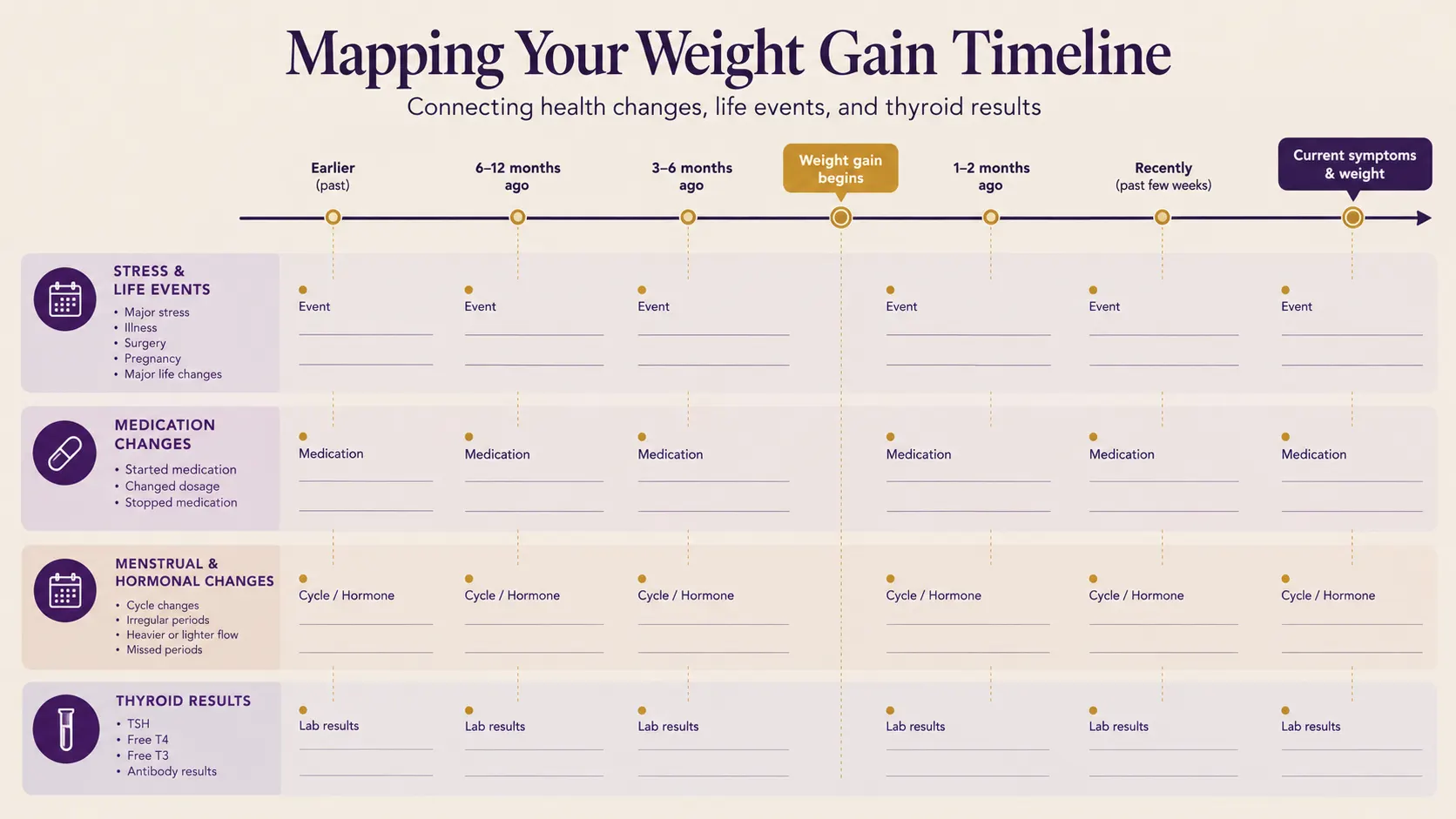
Her starting questions are about timing: when did the weight start, and what came before it? An illness, a hard year, a surgery, a pregnancy, a change in your periods. “Protocols are designed for populations, not individuals,” she teaches, so the answer shapes a plan for one woman. Our hormone testing for women page shows how those results are read against each other.
When to See a Clinician Soon
Rapid weight gain, new swelling in the face or legs, shortness of breath, or a lump in the neck deserve prompt medical attention, because they can have causes that need a diagnosis. If you are pregnant or trying to conceive, tell your prescriber about thyroid changes now.
Bring your TSH, free T4 and antibody results with their dates, your medicine list and a short timeline of when the weight started.
Care in Orange County and Across California
The Natural Path sees patients in person at its San Juan Capistrano office and by video visit anywhere in California. The office is open Monday, Tuesday and Thursday from 10:00am to 6:00pm, within reach of women in Aliso Viejo and San Clemente. Video visits require you to be in California at the time of the visit, and the telemedicine page explains the remote steps.
Two pages describe the care itself: thyroid and Hashimoto’s care and metabolic health and weight resistance. To arrange either kind of visit, start on the contact page.
Frequently Asked Questions
Does hypothyroidism cause weight gain?
Yes, modestly. The ATA says about 5 to 10 pounds may be related to the thyroid for most patients, mostly retained salt and water, with more possible in severe hypothyroidism. Large gains usually involve other factors as well.
Will I lose weight once I start levothyroxine?
Often a little. A 2026 meta-analysis found an average drop of 1.39 kg in adults who reached normal thyroid levels, and the authors discourage using levothyroxine solely for weight loss. Part of the change was lean mass.
Why am I gaining weight when my TSH is normal?
Thyroid and weight gain do not always travel together. A normal TSH shows that one part of the thyroid system is in range. Insulin resistance, cortisol, sleep, muscle loss and the menopause transition each have published links to body weight. The NIDDK notes that weight gain does not necessarily mean a thyroid problem.
Can my doctor raise my dose to help me lose weight?
Your prescriber sets your dose to your lab values and symptoms. The ATA warns that extra thyroid hormone raises the risk of serious side effects and that weight lost this way is usually regained. Never change your dose on your own.
Does treating an overactive thyroid cause weight gain?
It can. The 2014 European Thyroid Journal review reports that many patients treated for hyperthyroidism gain more weight than they lost during the active phase. It adds that the mechanism has not been fully worked out.
Can I be seen if I do not live in Orange County?
Yes, if you are in California at the time of the visit. Booking steps for in-person and video visits are on the contact page.
Where to Start
Write down when the weight started and what was happening just before it, then bring that and your lab dates to your clinician. Dr. Goldstein explains how stress, thyroid and sex hormones affect each other in her free Master Class. Watch the free Master Class.
Written by The Natural Path clinical content team, based on the teaching of Dr. Angela Goldstein, ND.
This article is for general education and is not medical advice. It is not intended to diagnose or treat any disease, does not establish a doctor-patient relationship, and is not a substitute for care from your own clinician. Do not start, stop or change any prescribed medication based on what you read here. If you have an urgent medical concern, contact your physician or emergency services.