

Written by The Natural Path clinical content team, based on the teaching of Dr. Angela Goldstein, ND.
How serious is Hashimoto’s? For most people it is a manageable, slow-moving condition, and the serious outcomes come from long-untreated low thyroid hormone, not from the diagnosis itself. Hashimoto’s is an autoimmune condition in which the immune system attacks the thyroid. The American Thyroid Association (ATA) says it often progresses very slowly over many years, and you may have no symptoms early on. If the thyroid eventually makes too little hormone, untreated hypothyroidism can strain the heart, affect pregnancy and, very rarely, become a life-threatening emergency called myxedema coma. Treatment is usually a daily thyroid hormone tablet with regular blood tests. A good result on those blood tests and feeling well are two related questions, and this page covers both.
Key Takeaways
- Hashimoto’s is usually slow-moving. Most people with it develop hypothyroidism over time, and that is the part treatment addresses.
- Untreated hypothyroidism can raise cholesterol and blood pressure and lead to heart problems. It can also affect pregnancy, for mother and baby.
- Myxedema coma is rare and is a medical emergency. Confusion, loss of consciousness, a very low body temperature or very slow breathing in someone with hypothyroidism means calling 911.
- Treatment is typically levothyroxine, with a TSH blood test 6 to 8 weeks after starting and then about once a year once the dose is right.
- Normal numbers on paper do not always match how a person feels, and research on Hashimoto’s supports taking that gap seriously.
If you were told you have Hashimoto’s and your first thought was “how bad is this?”, that reaction is reasonable. The honest answer has three parts: what it can lead to, how well it responds to treatment, and what is easy to miss along the way.
Contents: The short answer · If untreated · The one emergency · Pregnancy · Treatment · Outlook · Feeling fine on paper · Questions to bring · Local · FAQ
How Serious Is Hashimoto’s? The Short Answer
Hashimoto’s is serious enough to monitor and treat, and in most cases it is not an emergency.
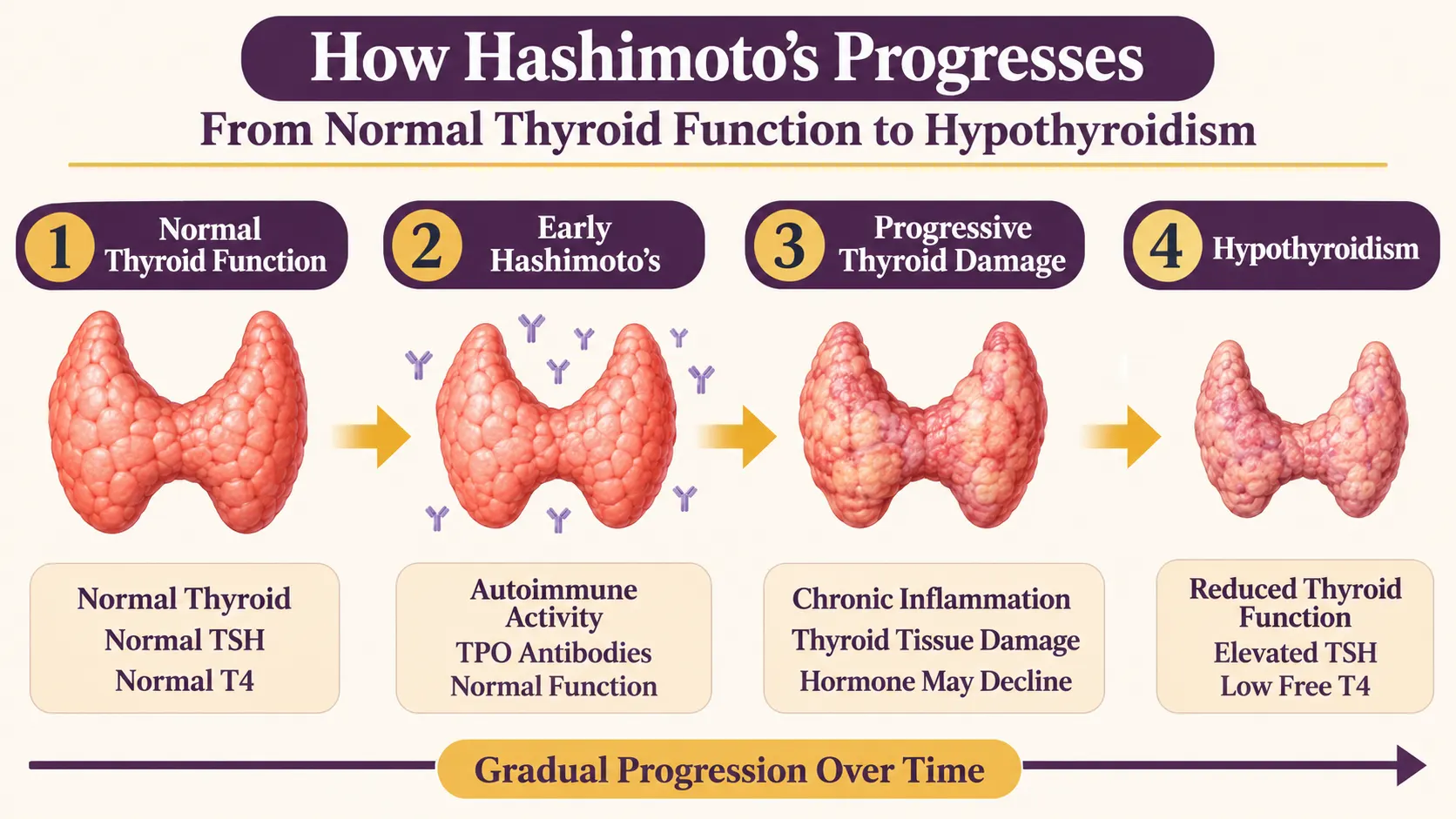
Hashimoto’s disease is an autoimmune condition in which the immune system makes antibodies that attack the thyroid gland. It is the most common cause of hypothyroidism, an underactive thyroid.
According to the National Institute of Diabetes and Digestive and Kidney Diseases (NIDDK), most people with Hashimoto’s disease develop hypothyroidism, and the condition is 4 to 10 times more common in women than men. It most often develops in women ages 30 to 50. The ATA describes the course as slow, often over many years.
That slowness works in your favor. It means there is usually time to confirm the diagnosis, start treatment if needed, and watch your numbers. NIDDK adds that if the thyroid is not yet damaged enough to cause hypothyroidism, a doctor may simply check your symptoms and thyroid hormone levels regularly.
If you are still sorting out how the diagnosis was made, how Hashimoto’s is diagnosed walks through the tests.
The two terms are not interchangeable, and hypothyroidism vs. Hashimoto’s explains the difference.
What Hashimoto’s Can Lead To If It Goes Untreated
The risks come mainly from hypothyroidism that goes untreated for years, and they affect the heart, the neck, pregnancy and, rarely, the whole body.
Thyroid hormone sets the pace for many systems. When the supply runs low and stays low, those systems slow down. The table summarizes what NIDDK, the ATA and Cleveland Clinic report.
| Area | What can happen when low thyroid hormone goes untreated | Source |
|---|---|---|
| Heart | Heart disease and heart failure, along with high cholesterol and high blood pressure | NIDDK |
| Neck | The inflamed thyroid can enlarge (goiter), causing neck discomfort, pressure or difficulty swallowing | ATA |
| Pregnancy | Problems for both mother and baby | NIDDK |
| Fertility and periods | Heavy or irregular periods and fertility problems are listed symptoms | NIDDK |
| Mood | Depression is listed among hypothyroid symptoms | NIDDK |
| Whole body | Myxedema coma, a rare condition that can threaten life | NIDDK, Cleveland Clinic |
Two points keep this in proportion. These are possible outcomes of long-standing, unaddressed hypothyroidism, and they are not a forecast for every person who hears the word Hashimoto’s. And the heart, pregnancy and myxedema risks are the same reasons that monitoring and treatment exist.

Free 3-minute quiz from Dr. Angela Goldstein, ND
Stress, thyroid and sex hormones work as one system. Answer 22 quick questions and see which one is under the most strain for you.
What you’ll get:
- ✓A score for each system: stress, thyroid and sex hormones
- ✓Which pattern your answers fit, and how the systems pull on each other
- ✓Built on published research
- ✓A clear next step for your pattern
Free. 22 questions, about 3 minutes.
Educational content. Always talk with your doctor before changing any treatment.
Myxedema Coma: The One Emergency to Know
Myxedema coma is rare, and it is a medical emergency that needs a 911 call, not a wait-and-see approach.
Myxedema coma is a life-threatening complication of severe hypothyroidism in which the body’s functions slow to a dangerous degree.
Cleveland Clinic calls it a rare, life-threatening complication and names “a long history of untreated hypothyroidism” as the biggest risk factor. Other risk factors on its list include being a woman older than 60 and living in a cold area. Triggers include skipping or stopping thyroid medication, certain medications, infections such as pneumonia, surgery and trauma.
Signs listed by Cleveland Clinic:
- Confusion, disorientation or changes in mental status
- Coma or being unconscious
- Low body temperature
- Slow breathing and a slow heart rate
- Swelling and low blood pressure
If someone with hypothyroidism shows these signs, call 911. Cleveland Clinic’s instruction is to call your emergency services number right away, and HealthLink BC says to call 9-1-1 or the local emergency number immediately. NIDDK states plainly that myxedema coma requires immediate medical treatment.
For a woman who is newly diagnosed, working with a clinician, and taking her medication, this is a very remote scenario. Knowing the signs is still worth a minute, because a family member may notice them before you do.
Hashimoto’s and Pregnancy: Tell Your Clinicians Early
If you are planning a pregnancy or are pregnant, tell both your thyroid prescriber and your obstetric clinician about your Hashimoto’s.
NIDDK states that hypothyroidism left untreated during pregnancy can affect both mother and baby, and that thyroid medicines can help prevent problems and are safe to take during pregnancy. The ATA lists planning a pregnancy or being pregnant as a reason to call your doctor, and says you may need more frequent checks. The ATA’s pregnancy page adds that hypothyroidism can first appear during pregnancy because of Hashimoto’s.
The practical step is simple. Ask for a thyroid plan before conception when you can, and keep every scheduled blood test during pregnancy.
What Treatment Usually Looks Like
Treatment depends on whether your thyroid has become underactive, and the standard approach is levothyroxine with regular blood tests.
- Watching, if the thyroid is still keeping up. NIDDK says a doctor may choose to check symptoms and thyroid hormone levels regularly. The ATA says you may have your TSH checked once or twice a year.
- Levothyroxine, if hypothyroidism develops. NIDDK calls levothyroxine the recommended way to treat hypothyroidism. The ATA says most people with hypothyroidism from Hashimoto’s need lifelong treatment, with the dose adjusted to your TSH level.
- Follow-up testing. NIDDK says a blood test is typically done about 6 to 8 weeks after you begin the medicine, with dose changes as needed, then in 6 months and once a year after that.
- The right dose, in both directions. The ATA notes that a dose that is too low, or frequent missed doses, can leave hypothyroid symptoms in place. NIDDK warns that too much thyroid hormone can cause serious problems such as atrial fibrillation or osteoporosis, and says never to stop your medicine or take a higher dose without talking with your doctor first.
Levothyroxine absorbs best on an empty stomach and can be affected by coffee, soy and some supplements. What the evidence supports for eating with Hashimoto’s covers that timing and the other diet questions in detail.
The Long-Term Outlook
With treatment, the outlook for most people is good, and it depends on steady monitoring.
NIDDK states that hypothyroidism from Hashimoto’s can be well controlled with thyroid hormone medicine as long as it is taken as instructed and follow-up blood tests are done. The ATA says that with the right dose, you can live a normal, healthy life.
Two honest qualifiers belong next to that. First, most people take thyroid medicine for the long term, so Hashimoto’s becomes a condition you manage. Second, “well controlled” is a statement about thyroid hormone numbers. Whether you feel well is a separate measurement, and the next section is about that gap.
Feeling Fine on Paper Is Not the Same as Feeling Well
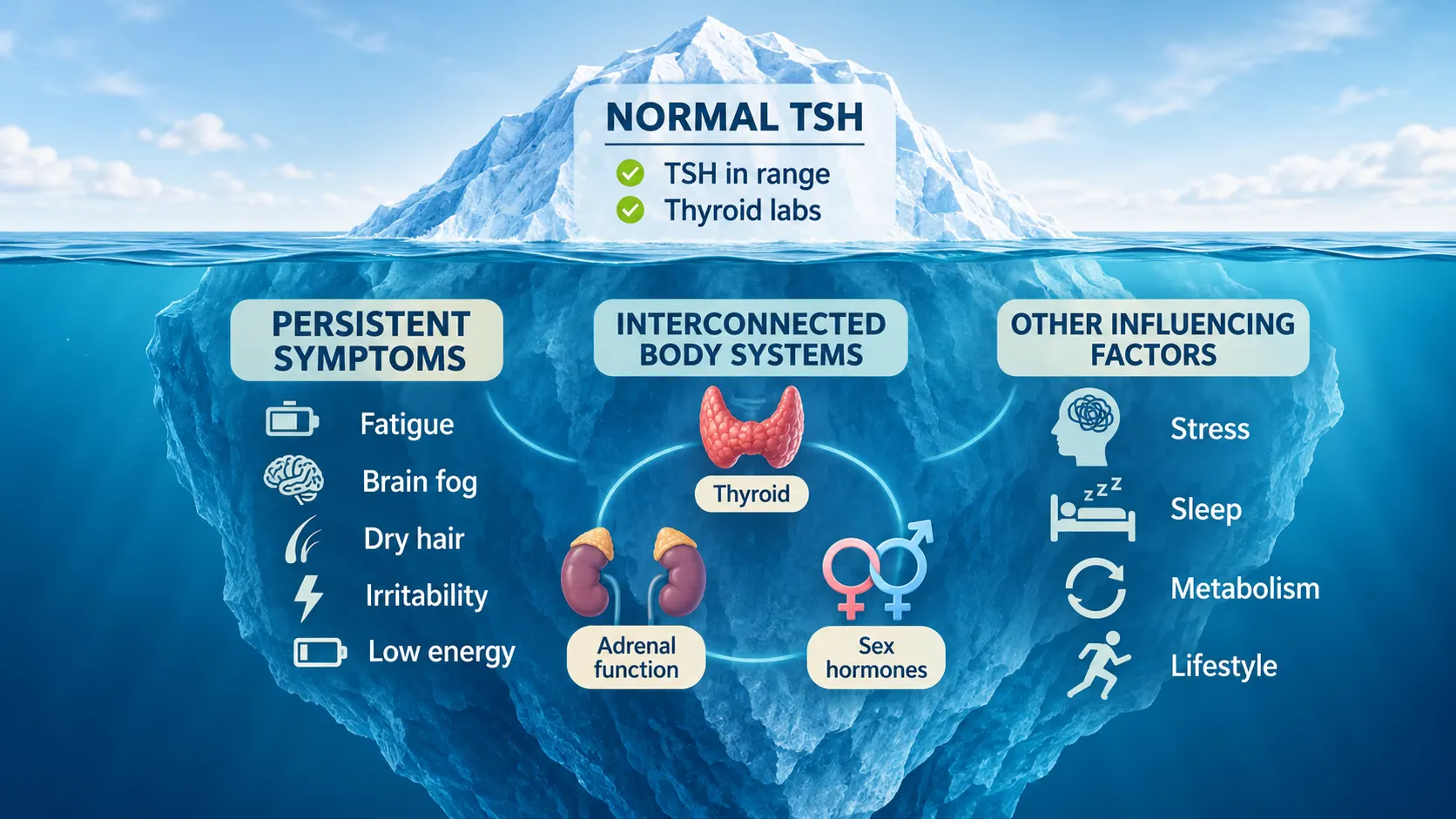
A normal TSH means your thyroid hormone level is in range. It does not settle how you feel, and the research on Hashimoto’s supports taking both seriously.
Many women hear “your labs are normal” and leave the appointment still tired, foggy or struggling. Two published findings explain why that is not unreasonable.
- A Hashimoto’s symptom load beyond the TSH. A 2011 study in Thyroid by Ott and colleagues followed 426 women with normal thyroid function who were having surgery for benign thyroid disease. Women with high TPO antibodies reported more symptoms than the rest (6.7 vs. 4.1 on average), with no difference in TSH between the groups. Chronic fatigue, dry hair, irritability and nervousness were associated with high antibodies, and quality-of-life scores were lower. The authors concluded that women with Hashimoto’s carry a high symptom load and that hypothyroidism is only a contributing factor. This was a surgical group, and only 28 women had Hashimoto’s confirmed on tissue, so it points a direction without settling the question.
- Symptoms despite treated numbers. A 2021 review in the Journal of Clinical Medicine by Borson-Chazot and colleagues states that a proportion of levothyroxine-treated patients with biochemically normal thyroid tests still complain of persistent symptoms. Those symptoms affect their quality of life. The review also found that quality of life in hypothyroidism appears to be influenced by physiological, behavioral, cognitive and lifestyle factors that are not strictly related to thyroid hormone levels.
Neither finding says the medication or the blood tests are wrong. They say the thyroid number is one input, and other inputs matter too.
This is where Dr. Goldstein’s teaching enters. She puts it this way: “Standard labs measure diseases, not function. They’re checking to see if your engine is completely broken, not whether it’s running at 40% capacity.” And on the thyroid specifically: “Your thyroid can be normal while still being shut down by stress.”
What Else Sits Around the Thyroid
Dr. Goldstein reads the thyroid as part of a chain, because stress, cortisol, the thyroid and the sex hormones all influence one another.
She describes the sequence this way: “High cortisol tells your thyroid to slow down because your body thinks there’s a famine. Your thyroid slowing down disrupts your sex hormones because your body thinks it’s not safe to reproduce.” In her 25+ years of practice, she says, “I found three systems break down most often: thyroid, adrenals, and sex hormones.”
That is her clinical framework, and it sits alongside the published guidance above. It adds questions to ask when treatment has the thyroid numbers in range and the symptoms are still there. How cortisol and the thyroid affect each other is the next page to read on that chain.
The broader pattern is covered in why normal labs and real symptoms often arrive together.
Any change to thyroid medication belongs with the clinician who prescribes it. Nothing here replaces that relationship.
Questions Worth Bringing to Your Next Appointment
Going in with specific questions turns a short visit into a useful one.
- What are my TSH and free T4, and what are my TPO antibody results? Ask for the numbers and dates, not just “normal.”
- Do I need treatment now, or are we monitoring? And if monitoring, how often is the next test?
- When did my symptoms start, and what came before them? A timeline of stress, illness, pregnancy or life changes helps connect the dots.
- If I feel unwell with in-range labs, what else should we look at?
- If I want to become pregnant, what is the thyroid plan?
A timeline helps in any thyroid appointment. A first root-cause visit usually starts there, and what to expect at a first functional medicine appointment outlines the steps.
Hashimoto’s Care in Orange County and Across California
The Natural Path sees patients in person at its San Juan Capistrano office, and by video visit anywhere in California.
The practice serves women from San Clemente to Aliso Viejo and the towns between for thyroid and Hashimoto’s care.
If you live farther away, telemedicine visits across California cover the same conversation.
The functional lab testing page explains how results are read as one picture.
To reach the office, use the contact page.
Frequently Asked Questions
Is Hashimoto’s a serious disease?
It is a chronic autoimmune condition that needs monitoring. According to NIDDK, it is the most common cause of hypothyroidism. Hypothyroidism from it can be well controlled with thyroid hormone medicine when the medicine is taken as instructed and follow-up blood tests are done. The serious outcomes are tied to long-untreated hypothyroidism.
Can Hashimoto’s kill you?
Hashimoto’s itself is not described as a fatal disease. The life-threatening risk is myxedema coma, a rare complication of severe, long-untreated hypothyroidism, per Cleveland Clinic. Taking prescribed medication and keeping blood tests current guards against it.
Do I need treatment if my TSH is normal?
Not always. NIDDK says that when the thyroid is not damaged enough to cause hypothyroidism, a doctor may choose to check symptoms and thyroid hormone levels regularly. The ATA says TSH is typically checked once or twice per year in that situation.
Is Hashimoto’s lifelong?
For most people with hypothyroidism from Hashimoto’s, yes. The ATA says most need lifelong treatment, with the dose adjusted over time based on TSH.
Can I have a healthy pregnancy with Hashimoto’s?
NIDDK says thyroid medicines can help prevent problems and are safe to take during pregnancy. The ATA lists planning a pregnancy or being pregnant as a reason to call your doctor, and says you may need more frequent checks.
Why do I still feel unwell if my labs are normal?
Research on Hashimoto’s reports a high symptom load that is only partly explained by thyroid hormone levels. A review of treated hypothyroidism found persistent symptoms in a proportion of patients with normal results. It is a reason to look at the whole picture with your clinician.
Where to Start
If your labs say you are fine and you do not feel fine, watch Dr. Goldstein’s free Master Class, where she explains how she reads the thyroid, stress hormones and sex hormones as one system.
Written by The Natural Path clinical content team, based on the teaching of Dr. Angela Goldstein, ND, licensed naturopathic doctor with 25+ years in practice.
This article is for general education and is not medical advice. It does not establish a doctor-patient relationship and is not a substitute for care from your own clinician. Do not delay seeking care, and do not stop or change any prescribed medication, based on what you read here. If you have an urgent medical concern, call 911 or contact your physician.