
Written by The Natural Path clinical content team, based on the teaching of Dr. Angela Goldstein, ND.
Perimenopause hair loss usually takes one of two forms, or both at once: slow thinning called female pattern hair loss, or sudden shedding called telogen effluvium. The American Academy of Dermatology (AAD) says female pattern hair loss is the most common cause of hair loss in women, that it usually begins in midlife, and that hormones may play a role. Shedding appears a few months after a trigger such as heavy stress, a high fever or surgery. Thyroid disease, low iron stores and shifts in estrogen and androgens can each contribute. Ask your doctor for a TSH and a ferritin test, write down what happened in the three months before the shedding began, and see a dermatologist if your part keeps widening.
Key Takeaways
- Two patterns look alike: thinning over years (female pattern hair loss) and heavy shedding a few months after a trigger (telogen effluvium).
- Most hair research studies postmenopausal women, and the hormone explanation is suggestive, not settled.
- Thyroid disease can cause both shedding and thinning, and the first blood test is usually a TSH.
- Low ferritin is common in women with and without hair loss, so the number needs context.
- A three-month look-back at stressors is the most useful history you can bring.
- A dermatologist diagnoses and treats the hair pattern. A whole-system workup looks at the thyroid, stress response and sex hormones behind it.
Hair thinning is one of the quieter symptoms of the menopause transition, and one of the most upsetting. In a cross-sectional study of 178 postmenopausal women aged 50 to 65, 52.2% had female pattern hair loss, and 73.2% of those cases were the mildest grade. A thinner ponytail, a wider part and a fuller drain are real changes and deserve a real workup.
Many women hear one of the three answers Dr. Goldstein names: “It’s just stress, take an antidepressant. It’s just aging, learn to live with it. Or it’s all in your head, see a therapist.” Hair loss is one line on our list of the 34 symptoms of perimenopause. This page goes further: which kind you may have, which causes to rule out first, and when a dermatologist should take over.
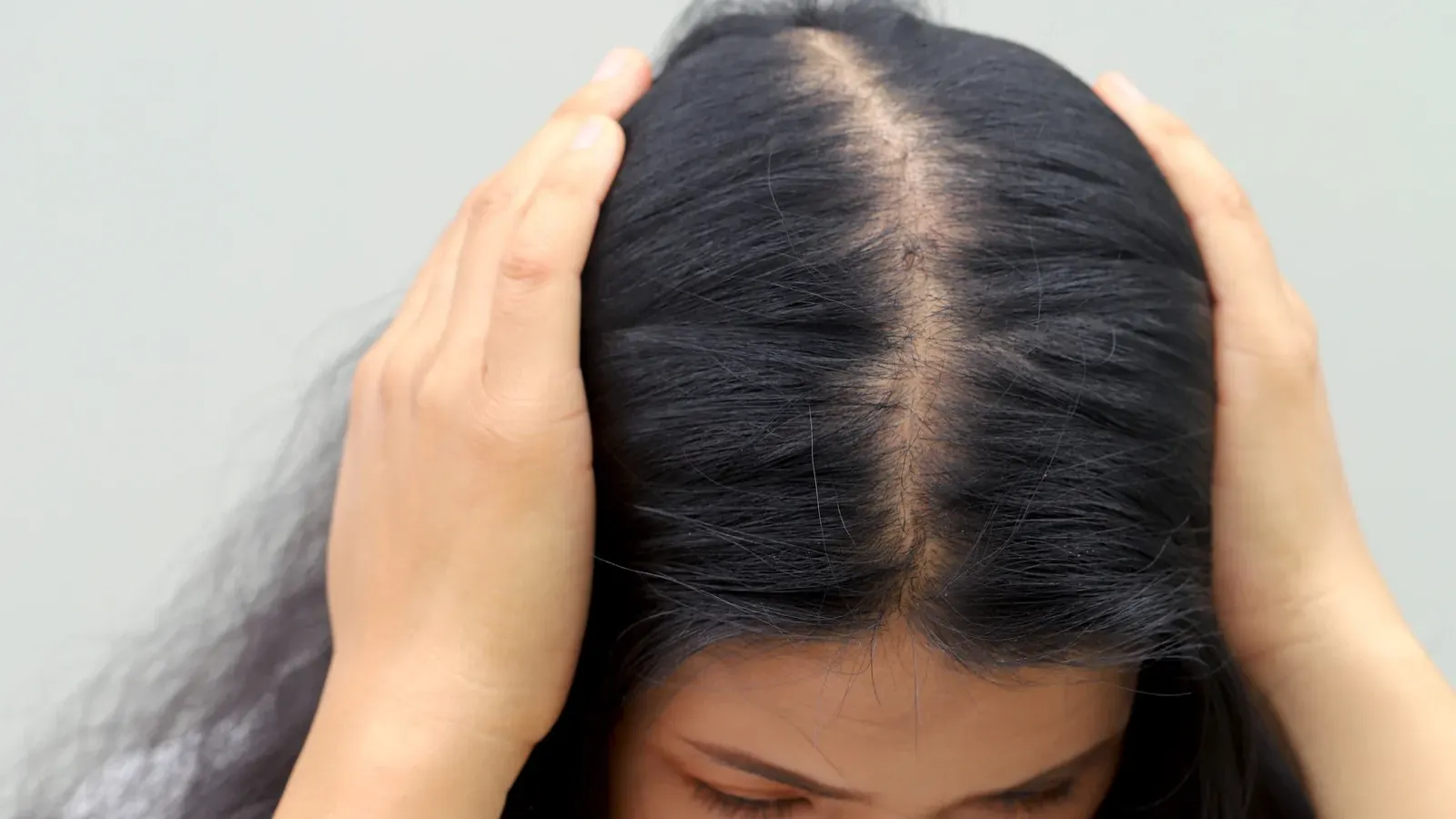
Two Patterns That Look Alike: Thinning Versus Shedding
Perimenopause hair loss is most often female pattern hair loss, telogen effluvium, or a mix of the two, and they behave differently.
Female pattern hair loss (FPHL) is a progressive, hereditary kind of hair thinning, also called female androgenetic alopecia, that usually begins in midlife.
Telogen effluvium is excessive hair shedding that occurs when more hairs than usual move into the resting phase of the hair cycle at the same time.
The AAD calls FPHL “the most-common cause of hair loss in women” and says that for most women it begins in their 40s, 50s or 60s. A dermatology review in the International Journal of Endocrinology and Metabolism describes diffuse thinning of the crown region with preservation of the frontal hairline as the classic pattern. The AAD describes a part that gets wider and temples that may recede. The AAD also lists the shedding side: it is normal to lose 50 to 100 hairs a day, and a person with significantly more has excessive shedding.
| Female pattern hair loss | Telogen effluvium (shedding) | |
|---|---|---|
| What you notice | A wider part, thinning at the crown, possible recession at the temples | Far more hair in the brush, shower and pillow, often all over the scalp |
| Timing | Gradual and progressive over years | Starts roughly two to three months after a trigger |
| Common triggers | Inherited genes, with hormones possibly involved | High stress, high fever, surgery, illness, losing 20 pounds or more, stopping birth control pills, thyroid disease |
| Usual course | Women tend to continue losing hair without treatment | Stops once the body readjusts, with fullness tending to return within six to nine months |
| Best first step | Dermatologist exam | Timeline, TSH and ferritin, then a dermatologist if it lasts |
| Sources | AAD; Herskovitz and Tosti 2013 | AAD; Asghar et al. 2020 |
The two can overlap, and the AAD notes that a dermatologist can tell whether you have hair loss, excessive shedding, or both. Shedding sends you looking for a trigger. Thinning sends you looking for a diagnosis and a long-term plan.
A 2020 review in Cureus defines acute telogen effluvium as shedding under six months and says it usually remits in around 95% of cases. Chronic telogen effluvium lasts longer and mostly affects middle-aged women.
Estrogen, Androgens and Perimenopause Hair Loss
Hormone shifts are a plausible driver of perimenopause hair loss, and the research supports an association with menopause more firmly than it supports a specific hormone mechanism.
The AAD says that because FPHL is more common after menopause, hormones may play a role. A 2026 systematic review of 40 studies in the American Journal of Clinical Dermatology found that alopecia, particularly female pattern hair loss and frontal fibrosing alopecia, showed the strongest postmenopausal associations among the skin conditions studied. Most cases presented after menopause, and earlier or surgical menopause conferred greater risk. In that review, menopausal hormone therapy was linked to a higher risk of frontal fibrosing alopecia, and findings for the other skin conditions were variable or absent.
The popular explanation is that estrogen falls while androgens stay put, so androgens gain the upper hand at the hair follicle. That is a hypothesis, and the data are less tidy:
- The same study measured testosterone, estradiol and TSH. After adjusting for age and family history of hair loss, only a body mass index of 25 or higher remained significantly associated with FPHL.
- The dermatology review of FPHL states that generally, FPHL is not associated with elevated androgens. Some women do have signs of androgen excess, such as excess facial or body hair, acne and irregular periods, and the most common endocrine abnormality linked to FPHL is polycystic ovary syndrome (PCOS).
So a blood test for androgens is worth requesting when you also have those extra signs, and a normal result still leaves the hair pattern to be examined. Our guide to what a perimenopause test shows explains what hormone testing can and cannot tell you, and the low estrogen symptoms page covers the rest of the estrogen picture.
Dr. Goldstein explains why one hormone rarely explains a symptom: “Think of your endocrine system like an orchestra… if one instrument is out of tune, if one hormone system is off, the whole orchestra sounds terrible.”
Free 3-minute quiz from Dr. Angela Goldstein, ND
Stress, thyroid and sex hormones work as one system. Answer 22 quick questions and see which one is under the most strain for you.
What you’ll get:
- ✓A score for each system: stress, thyroid and sex hormones
- ✓Which pattern your answers fit, and how the systems pull on each other
- ✓Built on published research
- ✓A clear next step for your pattern
Free. 22 questions, about 3 minutes.
Educational content. Always talk with your doctor before changing any treatment.
Thyroid Disease and Perimenopause Hair Loss: Underactive and Overactive
Both an underactive and an overactive thyroid can thin or shed hair, and thyroid problems are common enough in midlife women that a thyroid test belongs in every hair loss workup.
Hypothyroidism is an underactive thyroid, a gland making too little thyroid hormone, which slows many body functions. Hyperthyroidism is the opposite, an overactive thyroid making more hormone than the body needs.
The NIDDK lists dry, thinning hair among the symptoms of hypothyroidism and says women are much more likely than men to develop it. For hyperthyroidism, the NIDDK says it is more common in women and people older than 60, and its symptom list does not mention hair. The dermatology literature does. A 2023 review in Cureus states that hair loss is observed in approximately 50% of individuals with hyperthyroidism and 33% with hypothyroidism. The 2020 review adds that either condition can cause telogen effluvium, reversed once the thyroid state is corrected.
| Underactive thyroid | Overactive thyroid | |
|---|---|---|
| Hair changes described | Slow-growing, coarse, dry, brittle hair; diffuse thinning; loss of the outer third of the eyebrows | Fine, silky hair; diffuse non-scarring thinning is possible |
| Other signs the NIDDK lists | Fatigue, weight gain, trouble tolerating cold, dry skin, heavy or irregular periods | Weight loss, rapid or irregular heartbeat, nervousness, shaky hands, sweating |
Hair changes can come first. The 2023 review notes that shedding may occur months before other symptoms and that replacement medication often halts hair loss, except with long-term atrophic follicles tied to hypothyroidism. It also reports that people with alopecia areata have a higher prevalence of autoimmune conditions, including Hashimoto’s thyroiditis.
You cannot sort this out from symptoms. The NIDDK says a hyperthyroidism diagnosis can’t be based on symptoms alone, and that health care professionals usually check TSH first, with T4, T3 and thyroid antibody tests also possible. Our page on telling a thyroid problem from perimenopause lays out the symptom overlap.
Dr. Goldstein reads the thyroid inside the larger system. She says: “Your thyroid can be normal while still being shut down by stress.” The Natural Path’s page on thyroid and Hashimoto’s care shows how that read works in practice.
Iron and Ferritin: What the Evidence Actually Shows
Ferritin, the blood marker of stored iron, is worth checking in perimenopause hair loss, and the research is more divided than most hair articles admit.
Ferritin is the protein that stores iron in the body, and a ferritin blood test is the usual way to estimate those stores.
Perimenopause can bring heavy periods, which are one route to low iron. A 2025 review in Research and Practice in Thrombosis and Haemostasis lists irregular heavy menstrual cycles among the effects of perimenopausal hormone fluctuation. It names fibroids as the most common reason for heavy menstrual bleeding at this age, and it points out that iron deficiency anemia overlaps with perimenopause symptoms.
Whether low iron causes hair loss is where the studies split:
| Study | What it found |
|---|---|
| Olsen et al., J Am Acad Dermatol 2010 | In 381 women with FPHL or chronic telogen effluvium and 76 controls, iron deficiency was common but not significantly more common in the hair loss groups. With ferritin of 40 or below, it appeared in 58.8% of premenopausal women with FPHL, 63.8% with chronic telogen effluvium and 72.3% of controls. |
| Treister-Goltzman et al., Skin Appendage Disord 2022 | A meta-analysis of 36 studies and 10,029 participants found that women with nonscarring alopecia had lower ferritin values than women without it, and concluded that women with hair loss can benefit from higher ferritin levels. |
| Asghar et al., Cureus 2020 | Decreased body iron stores can cause telogen effluvium, but the review calls the relationship very controversial. |
Olsen’s team notes that the effect of correcting iron deficiency on hair loss is unknown.
What this means in practice:
- Ask for ferritin and a complete blood count, and ask for the actual number, since a result flagged “normal” can sit anywhere in a wide range.
- Know that cutoffs differ. Olsen’s two definitions, 15 and 40, gave very different prevalence figures.
- Treat the cause of low iron, not just the number. If heavy periods or a fibroid explain it, that belongs in the same conversation.
- Supplement only when a test shows a gap, and with your clinician. The AAD says a blood test may reveal too little biotin, iron or zinc, which is a reason to test first.
Stress, Cortisol and the Shedding Timeline
Heavy stress is a documented trigger for telogen effluvium, and the shedding arrives months after the event, which is why it is easy to miss. The AAD lists experiencing lots of stress, including caring for a sick loved one, divorce or job loss. Other triggers on its list are a high fever, an operation, recovering from an illness, losing 20 pounds or more, and stopping birth control pills. Shedding usually appears a few months later. If the stressor continues, it can last much longer. The 2020 review cautions that the stress link is ambiguous, since hair loss is itself stressful.
The biology is better understood in the lab and in animals than in women. A 2005 study in the FASEB Journal found that organ-cultured human scalp hair follicles respond to the stress signal CRH and secrete cortisol, and that CRH changed hair growth measures in the dish, including hair shaft elongation and catagen induction (the shift toward the regression phase). A 2021 Nature study in mice found that under chronic stress, increased levels of corticosterone prolong hair follicle stem cell quiescence and keep follicles in an extended resting phase. Corticosterone is the rodent equivalent of cortisol, and that study did not test women.
Dr. Goldstein connects cortisol to the rest of the hormone picture: “So when you’re under chronic stress, your adrenal pumps out cortisol constantly. High cortisol tells your thyroid to slow down because your body thinks there’s a famine. Your thyroid slowing down disrupts your sex hormones because your body thinks it’s not safe to reproduce.” The first link in that chain has support in the literature. A 2026 paper in Endokrynologia Polska states that cortisol inhibits the secretion of thyrotropin-releasing hormone (TRH) in the hypothalamus and thyroid-stimulating hormone (TSH) in the pituitary gland. Our article on how cortisol and thyroid interact walks through the circuit.
The three-month look-back. Because shedding lags its trigger by two to three months, count backward from when the shedding began and write down what happened in that window:
- A fever, infection, surgery or hospital stay
- Rapid weight loss or a crash diet
- A loss, a move, a work crisis or months of broken sleep
- A new medication, or stopping birth control pills
- A change in your cycle, such as a skipped period or unusually heavy bleeding
Dr. Goldstein’s root-cause question is when did this start, and what was going on before it. For shedding, that timeline is the most useful thing to hand a clinician.
Not sure which system is speaking loudest? Take the free 3-minute hormone quiz. It scores three systems: your stress response, your thyroid and your sex hormones.
Telling the Causes Apart: What You Notice and What to Ask For
Your pattern points toward a likely cause, and each cause has its own first test.
| What you notice | What it may point to | What to ask for |
|---|---|---|
| Part widening, crown thinning, temple recession over years | Female pattern hair loss | A dermatologist exam |
| Handfuls of hair all over, starting two to three months after a fever, surgery, loss or crash diet | Telogen effluvium | A three-month timeline, TSH, ferritin and CBC |
| Dry, brittle hair with fatigue, cold intolerance, weight gain, heavy or irregular periods | Underactive thyroid | TSH, with T4, T3 and thyroid antibodies if indicated |
| Fine hair with a racing heart, sweating, shakiness, weight loss | Overactive thyroid | TSH and a prompt visit with your doctor |
| Hair loss with heavy periods and fatigue | Low iron stores | Ferritin and CBC, plus a look at the bleeding itself |
| Hair loss with facial hair, acne and irregular periods | Possible androgen excess such as PCOS | A clinician-ordered hormone workup |
| Round or oval bald patches | Alopecia areata | A dermatologist, plus a thyroid antibody check |
These are patterns to bring to a clinician, not diagnoses, and most women fit more than one row. If the thyroid row fits, the antibody result matters, and our guide to hypothyroidism versus Hashimoto’s explains why.
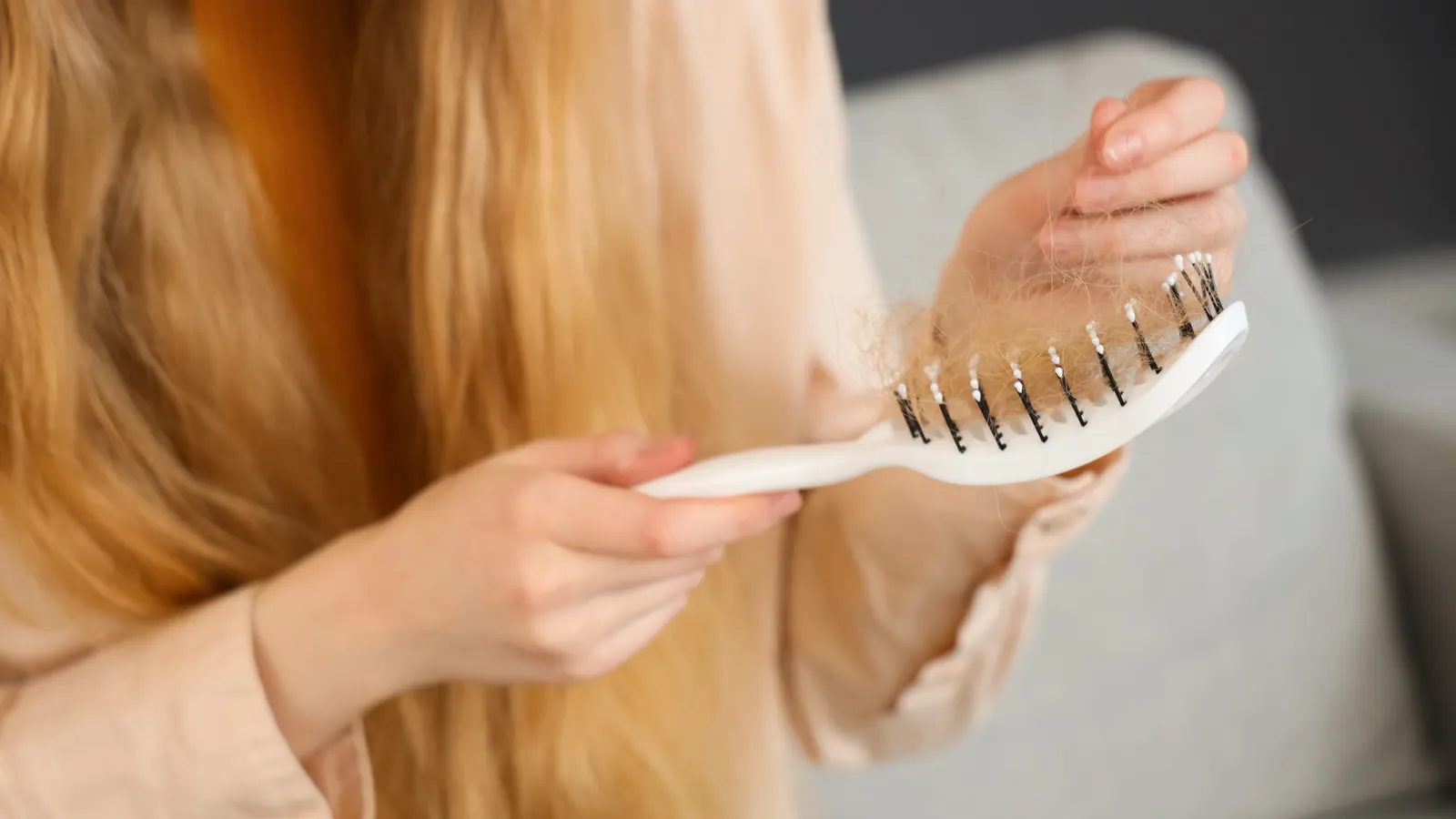
When to See a Dermatologist
See a dermatologist early, because other conditions can look like female pattern hair loss and treatment works best when it starts at the first sign.
The AAD says that for female pattern hair loss, it’s best to make an appointment to see a dermatologist and that treatment delivers the best results when started at the first sign of hair loss. Our own rules of thumb for booking sooner:
- Your part keeps widening or the thinning is clearly progressing.
- Shedding has lasted more than six months. The 2020 review recommends a scalp biopsy when telogen loss lasts longer than that.
- You have round bald patches, which point to a different diagnosis.
- Hair loss came on very quickly or comes with a new medication.
A visit starts with questions about how long you have had hair loss and whether it came on quickly, then a close scalp exam and a gentle hair pull test. The AAD says you may need a blood test or scalp biopsy if a disease, vitamin deficiency, hormone imbalance or infection is suspected.
On treatment, the AAD says the FDA has approved non-prescription minoxidil for women and calls it the most-recommended treatment for FPHL. Prescription pills such as spironolactone and finasteride are FDA-approved for other conditions, not FPHL, and the AAD says women who are pregnant, planning pregnancy or breastfeeding should avoid minoxidil. The AAD lists at-home laser devices, platelet-rich plasma and supplements as options with limited evidence, and says hair loss shampoos cannot regrow hair or stop progression.
The dermatologist treats the scalp. The thyroid, stress response and sex hormones behind the pattern are separate work, and the two can run side by side.
When the Labs Come Back Normal
A normal TSH and ferritin mean those two causes were not found on that day, and the hair loss can still be real. Dr. Goldstein says: “Standard labs measure diseases, not function. They’re checking to see if your engine is completely broken, not whether it’s running at 40% capacity.”
For some women a clear workup narrows the answer to the follicle itself and a dermatologist takes it from there. For others the shedding continues with no cause on paper. Dr. Goldstein describes her approach as looking for the underlying driver instead of managing symptoms in isolation. That means reading the thyroid, the stress response and the sex hormones together, because as she puts it, “You cannot fix one without addressing the others.”
Our article on why a normal panel can still miss a struggling system explains the gap, and the practice’s page on perimenopause and hormone care shows how the work is done.
Perimenopause Hair Loss Care Near You: San Juan Capistrano or Video Across California
The Natural Path sees patients in person in San Juan Capistrano and by video from anywhere in California, so the thyroid, stress and hormone side of hair loss can be worked up locally or from home. The office is open Monday, Tuesday and Thursday from 10:00am to 6:00pm, a practical drive for women in Mission Viejo, Lake Forest and San Clemente. The contact page has the details.
The telemedicine program covers patients anywhere in the state, and licensing limits video care to patients located in California. A scalp exam, dermatoscopy or biopsy happens in a dermatologist’s office, so plan on that visit separately.
Frequently Asked Questions
Does perimenopause cause hair loss?
It can contribute. Female pattern hair loss typically begins in midlife and hormones may play a role, according to the AAD. Thyroid disease, low iron and stress can cause hair loss on their own, so the cause needs sorting. Our perimenopause symptoms guide shows where hair changes sit among the other symptoms.
Will my hair grow back?
It depends on the pattern. Shedding usually stops once the body readjusts, with fullness tending to return within six to nine months. Female pattern hair loss is progressive, so early evaluation matters.
How do I know if it is telogen effluvium or female pattern hair loss?
Timing and location are the clues. Shedding all over the scalp two to three months after a trigger suggests telogen effluvium. A gradually widening part suggests female pattern hair loss. A dermatologist can tell whether you have one or both.
Can low ferritin cause hair loss in perimenopause?
Possibly, but the evidence is mixed, as the iron section above shows. Ask for a ferritin test, and do not start iron on a guess.
Should I take biotin for perimenopause hair loss?
The AAD says that in most studies of supplements such as biotin, the supplements had no effect on hair growth and thickness. Test first and discuss any supplement with your clinician.
Can hormone therapy help perimenopause hair loss?
The evidence is limited and mixed. In the 2026 systematic review, menopausal hormone therapy was linked to a higher risk of frontal fibrosing alopecia, and findings for other skin conditions were variable or absent. This is a decision to make with your clinician after the hair pattern and the thyroid, iron and stress picture are clear.
Where to Start
The most useful next step is understanding how the thyroid, the stress response and the sex hormones work as one system, because that system sits behind many of the causes above. Dr. Goldstein’s free Master Class walks through exactly that. Watch the free Master Class.
Written by The Natural Path clinical content team, based on the teaching of Dr. Angela Goldstein, ND.
This article is for general education and is not medical advice. It is not intended to diagnose or treat any disease, does not establish a doctor-patient relationship, and is not a substitute for care from your own clinician or dermatologist. Do not start, stop or change any prescribed medication or supplement based on what you read here. If you have an urgent medical concern, contact your physician or call 911.