

Written by The Natural Path clinical content team, based on the teaching of Dr. Angela Goldstein, ND.
Is Hashimoto’s genetic? Partly, yes. Hashimoto’s disease runs in families, and having a close relative with it or with another autoimmune condition raises your chance of developing it. Genes are only one piece, though. Researchers describe Hashimoto’s as the result of genetic and environmental factors together, and the inheritance pattern is unclear.
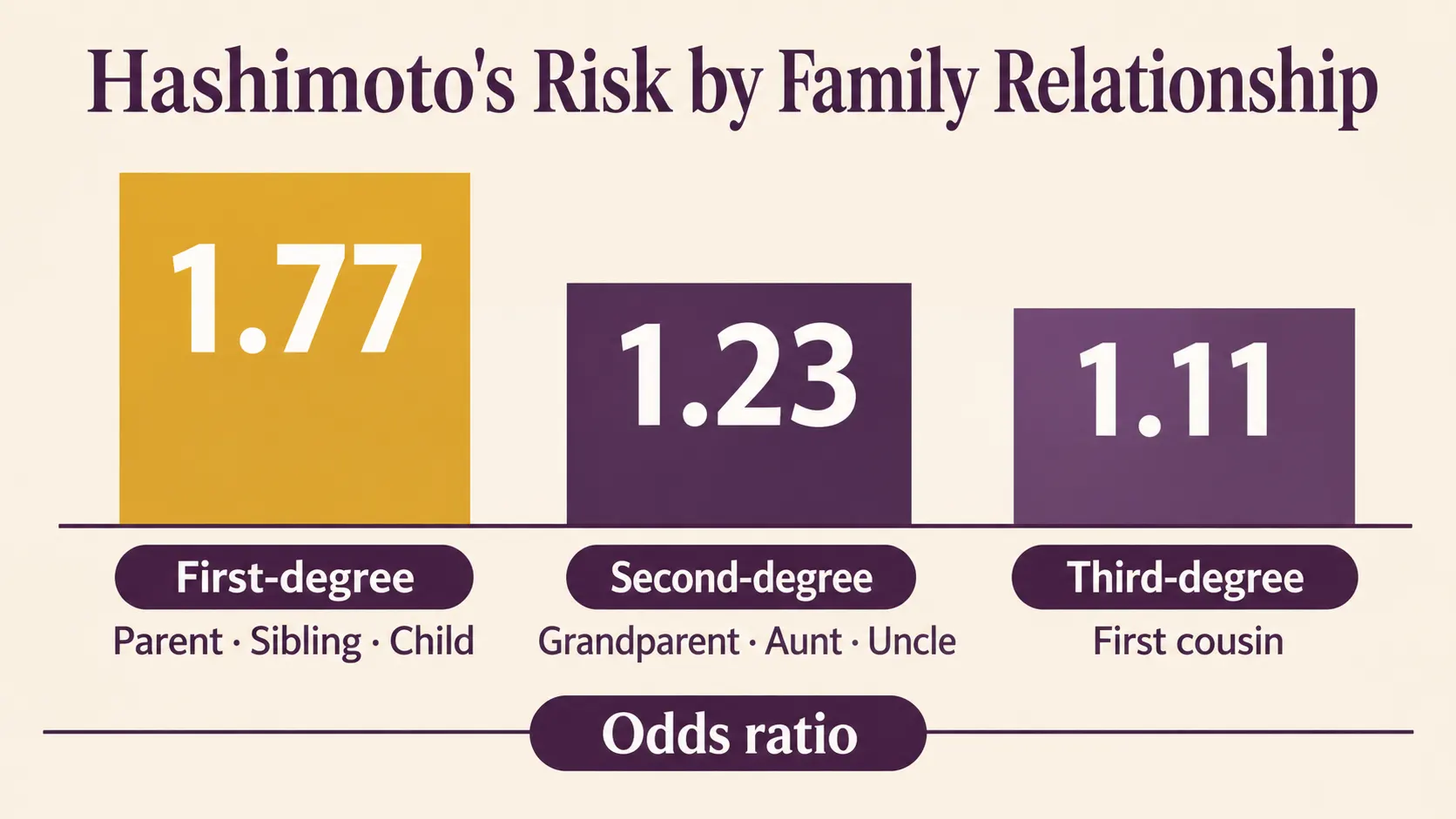
In the largest family study to date, a first-degree relative of someone with Hashimoto’s had 1.77 times the odds of having it, which is a real increase. A family history tells you to pay attention.
Key Takeaways
- Hashimoto’s does run in families. The National Institute of Diabetes and Digestive and Kidney Diseases (NIDDK) says your chance increases if other family members have it.
- No single gene causes it. Genes load part of the risk, and the rest comes from what happens in a life.
- In a 2025 Utah study, first-degree relatives had 1.77 times the odds, second-degree relatives 1.23 times and third-degree relatives 1.11 times.
- Stress, the gut, vitamin D status, infections and hormone shifts are all studied alongside the genes. Researchers have not shown that any of them can prevent Hashimoto’s.
- If it runs in your family, the useful step is a conversation with your clinician about thyroid antibody tests, along with a timeline of when your symptoms started.
If your mother, sister or aunt has Hashimoto’s and you are starting to feel off, the question “is this coming for me?” is a fair one. The answer has two halves: what the genetic research shows, and what it leaves open. Dr. Angela Goldstein, ND, teaches that the thyroid is one link in a chain that runs from stress to cortisol to thyroid to sex hormones, which is why this page looks past the genes too.
Contents: The short answer · What the numbers say · Why genes are not destiny · What is not fixed · Dr. Goldstein’s teaching · If it runs in your family · Local · FAQ
Is Hashimoto’s Genetic? The Short Answer
Hashimoto’s has a genetic component, and it is not a simple one.
Hashimoto’s disease is an autoimmune condition in which the immune system makes antibodies that attack the thyroid gland. It is the most common cause of hypothyroidism, an underactive thyroid.
Four reliable sources agree on the main point, in slightly different words.
| Source | What it says about family and genes |
|---|---|
| NIDDK | Researchers do not know why some people develop it, a family history of thyroid disease is common, and “your chance of developing Hashimoto’s disease increases if other family members have the disease.” Genes are listed among several factors that may play a role. |
| American Thyroid Association (ATA) | “Hashimoto’s thyroiditis often runs in families.” |
| MedlinePlus Genetics | Thought to result from a combination of genetic and environmental factors. The inheritance pattern is unclear. The condition can cluster in families, and a close relative with Hashimoto’s or another autoimmune disorder likely increases a person’s risk. |
| Cleveland Clinic | Research suggests genetics increase your risk. Biological family members with Hashimoto’s or other thyroid conditions make you more likely to get it. |
Notice the wording in the third row. “Another autoimmune disorder” matters. NIDDK also lists celiac disease, lupus, rheumatoid arthritis, Sjögren’s syndrome and type 1 diabetes as conditions that make Hashimoto’s more likely. So the family history worth writing down is wider than thyroid disease alone.
Hashimoto’s is the most common cause of an underactive thyroid, but not the only one, and hypothyroidism vs Hashimoto’s explains the difference between the disease and the low-thyroid state it can lead to.
How Much Does Family History Raise the Risk?
A first-degree relative with Hashimoto’s raises your odds by a measurable amount, and the increase shrinks as the relationship gets more distant.
The most useful recent numbers come from a 2025 study in The Journal of Clinical Endocrinology & Metabolism by Bujnis and colleagues. They used the Utah Population Database, which links medical and genealogical records. The study included 92,405 people with Hashimoto’s, matched to controls, and 2,960,650 of their relatives.
| Relationship to a person with Hashimoto’s | Odds ratio (95% confidence interval) |
|---|---|
| First-degree (parent, sibling, child) | 1.77 (1.74 to 1.80) |
| Second-degree (for example aunt, grandparent) | 1.23 (1.22 to 1.27) |
| Third-degree (for example first cousin) | 1.11 (1.10 to 1.12) |
An odds ratio of 1.77 means the odds are 1.77 times those of the comparison group. It does not mean a 77 percent chance of developing the disease. The same study found Hashimoto’s was 2.71 times more common in women than in men in that cohort. The authors describe it as the first study to estimate increased risk for second- and third-degree relatives, who are less likely to share a household or environment with the affected person.
The paper’s own table gives the second-degree interval as 1.22 to 1.25 rather than the 1.22 to 1.27 in its abstract. The estimate of 1.23 is the same in both.
You may have seen much bigger numbers elsewhere. The Utah paper notes that earlier studies of first-degree relatives, which were limited to small samples, reported relative risks of roughly 4.5 to 32. A relative risk and an odds ratio are different measures from different populations, so the figures cannot be lined up one for one. The Utah study is the largest of its kind.
Two limits are worth saying plainly. This is one population, in one state. And an odds ratio compares groups. It cannot tell you where you personally land.

Free 3-minute quiz from Dr. Angela Goldstein, ND
Stress, thyroid and sex hormones work as one system. Answer 22 quick questions and see which one is under the most strain for you.
What you’ll get:
- ✓A score for each system: stress, thyroid and sex hormones
- ✓Which pattern your answers fit, and how the systems pull on each other
- ✓Built on published research
- ✓A clear next step for your pattern
Free. 22 questions, about 3 minutes.
Educational content. Always talk with your doctor before changing any treatment.
Why Genes Are Not Destiny
Genes explain a large share of who is susceptible, and they leave a large share open.
Twin studies are where the strong numbers come from. The Bujnis paper reports that twin studies estimate heritability of Hashimoto’s at about 65 percent. A separate 2015 twin study in Diabetologia looked at thyroid peroxidase antibodies in twins where one had type 1 diabetes, and estimated their heritability at 69 percent (95% confidence interval 50 to 82). That study measured antibody levels, not a Hashimoto’s diagnosis.
Heritability describes how much of the variation across a group traces back to genes, so a figure of 65 percent says nothing about what share of your own risk is fixed.
Four findings keep the genetic story in proportion:
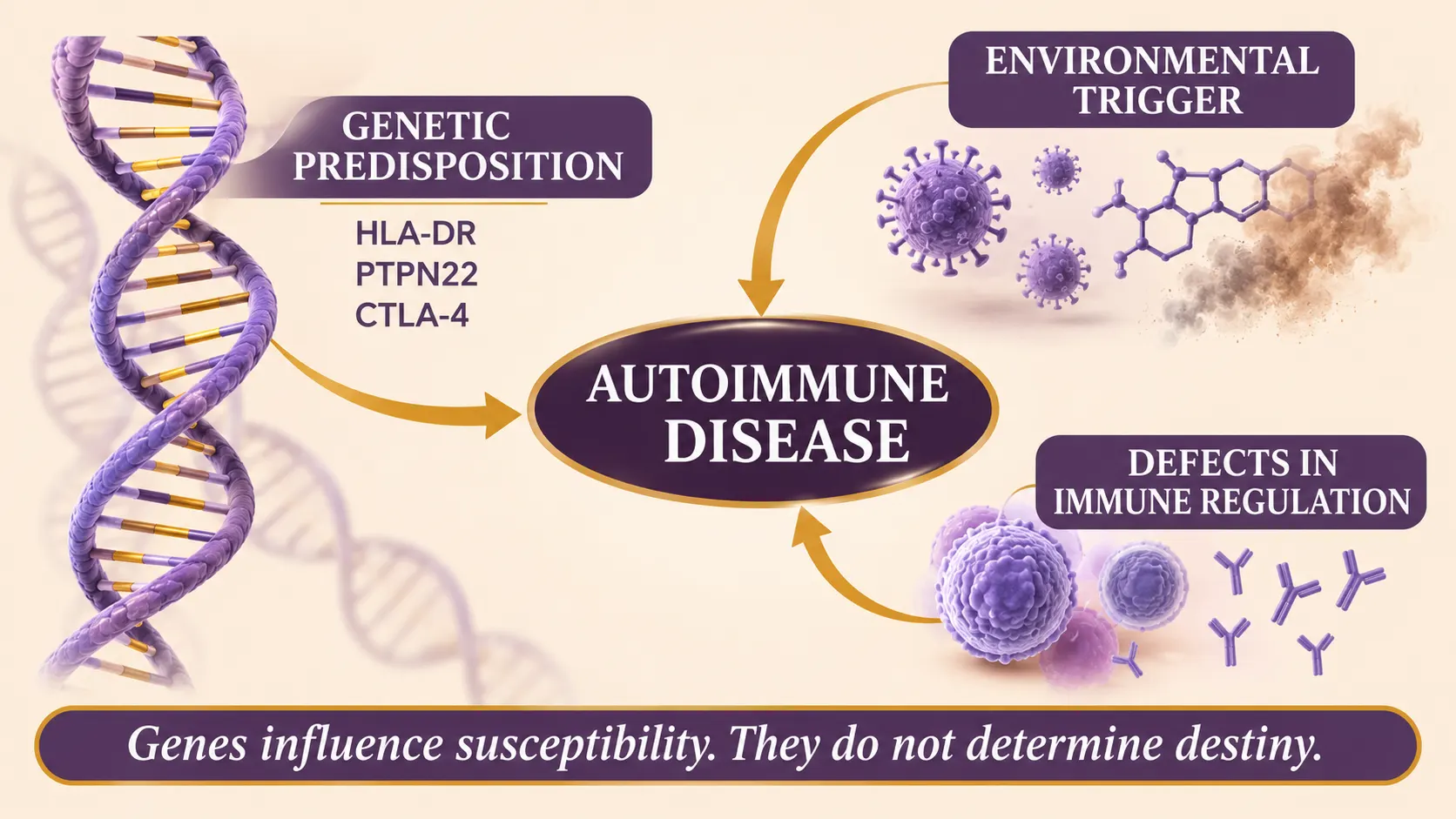
- No single gene does it. A 2013 conference abstract by Hubalewska-Dydejczyk says susceptibility is thought to involve several altered genes. They include the immune-system genes HLA-DR, PTPN22 and CTLA-4, and none has an effect large enough to explain Hashimoto’s alone. The abstract concludes it is impossible to identify a single causal gene.
- Spouses show a pattern too. The Utah study also found raised odds of Hashimoto’s in the husbands of affected wives (1.50) and the wives of affected husbands (1.58). The authors read this as pointing to a significant environmental component, since spouses share a household and not their genes.
- Identical twins often differ. A 2025 review in Frontiers in Immunology by Kumar and colleagues reports that concordance for autoimmune disease among identical twins is typically less than 50 percent. That figure covers autoimmune disease in general, not Hashimoto’s alone. The authors say it underscores the importance of environmental triggers and immune regulation.
- The same review frames it as a convergence. Its working hypothesis is that autoimmune disease arises when three factors converge: genetic predisposition, exposure to an environmental trigger and defects in immune regulation. Our guide to what causes autoimmune disease walks through that model.
Put together: genes set the odds. A life decides much of what happens next.
What Is Not Fixed in Your Genes
Several factors beyond DNA are studied in Hashimoto’s, and each comes with a limit on what the evidence shows.
Cleveland Clinic states there is no known way to prevent Hashimoto’s, so read the list below as what shapes the picture and what clinicians look at, with no promise attached.
- Stress. A 2018 Swedish cohort study in JAMA followed 106,464 people with stress-related disorders, such as PTSD and adjustment disorder, along with more than a million matched people and 126,652 full siblings. Those with stress-related disorders had a higher rate of later autoimmune disease (hazard ratio 1.36), and the pattern held in the sibling comparison. The study covered 41 autoimmune diseases together and was not specific to Hashimoto’s. The authors say more research is needed on mechanisms.
- The gut. A 2026 cross-sectional study in Thyroid Research compared 67 people with Hashimoto’s with 23 healthy controls. Gut bacteria differed across thyroid-function states, and the authors say certain bacteria “may contribute” to immune regulation and progression. A snapshot study cannot show which came first.
- Vitamin D. A 2025 review of vitamin D receptor variants says low vitamin D is associated with higher risk of autoimmune disease, Hashimoto’s included. It also says the role of supplementation in preventing autoimmune disease has not been definitively confirmed.
- Infections. NIDDK lists viruses, such as hepatitis C, among factors that may play a role alongside genes.
- Hormone shifts. MedlinePlus notes Hashimoto’s occurs more often in women, which may be related to hormonal factors. NIDDK says it most often develops in women ages 30 to 50, a range that runs into perimenopause. How the transition and a thyroid diagnosis interact is covered in Hashimoto’s and menopause.
Every item above is an association or a lead. That is where the research stands, and it is why the question of what else is going on in this body stays open even when the family history is known.
How Dr. Goldstein’s Teaching Applies to a Family History
Dr. Goldstein teaches that the thyroid is one link in a chain, and that framing changes how a family history reads.
She describes the sequence this way: “High cortisol tells your thyroid to slow down because your body thinks there’s a famine. Your thyroid slowing down disrupts your sex hormones because your body thinks it’s not safe to reproduce.” In her 25+ years of practice, she says, “I found three systems break down most often. Thyroid, adrenals, and sex hormones.”
That is her clinical framework. It sits alongside the published research above, and it points to a different set of questions.
For a woman whose mother had Hashimoto’s, the chain suggests asking for a timeline along with the thyroid number: when did this start, and what came before it? A move, a loss, a pregnancy, a long run of poor sleep, a viral illness, the start of perimenopause. The genes were there all along. The timeline shows what changed.
She also makes the point that numbers on a lab report and function are different things: “Your thyroid can be normal while still being shut down by stress.” How cortisol and the thyroid affect each other is the next page to read on that chain.
The gap between a normal lab report and real symptoms has its own page: why normal labs and real symptoms often arrive together.
If Hashimoto’s Runs in Your Family
If it runs in your family, the practical move is to tell your clinician and ask what, if anything, to check.
No source cited here recommends testing every relative on a schedule, so treat this as a conversation, not a rule. These are reasonable things to bring up:
- Your family history, in detail. Include parents, siblings, aunts, grandparents, and the other autoimmune conditions NIDDK lists: celiac disease, lupus, rheumatoid arthritis, Sjögren’s syndrome and type 1 diabetes.
- Your symptoms and when they began. Write the start date and what was happening in your life around it.
- Which thyroid tests make sense. NIDDK says diagnosis rests on history, a physical exam and blood tests, including TSH, the thyroid hormones and thyroid peroxidase (TPO) antibodies, which are present in most people with Hashimoto’s. The ATA names TPO and thyroglobulin (Tg) antibodies as the ones that affect the gland. Our page on how Hashimoto’s is diagnosed covers what each result means.
- What a positive antibody result with normal hormone levels means. The ATA says that if antibody levels are high and thyroid hormone levels are normal, you do not require treatment with thyroid hormone, and that repeating antibody levels is not needed. The ATA adds that you do need to monitor your TSH level over time, and subclinical hypothyroidism explains the borderline zone.
A DNA test is a different matter. The sources above describe no single gene that decides the outcome, which suggests a genetic result cannot settle the question for you. Antibody and hormone blood tests are how the condition is actually identified.
If you already have the diagnosis, these are the follow-up reads:
Any change to thyroid medication belongs with the clinician who prescribes it.
Hashimoto’s Care in Orange County and Across California
The Natural Path sees patients in person at its San Juan Capistrano office, and by video visit anywhere in California.
Women come from Laguna Niguel to Lake Forest and the towns between for thyroid and Hashimoto’s care.
If you live elsewhere in the state, telemedicine visits across California cover the same conversation, including a walk through your family history and symptom timeline.
The functional lab testing page explains how results are read as one picture.
To reach the office, use the contact page.
Frequently Asked Questions
Is Hashimoto’s hereditary?
It tends to run in families, and the inheritance pattern is unclear. MedlinePlus says a close relative with Hashimoto’s or another autoimmune disorder likely increases a person’s risk, and the ATA says it often runs in families.
Can you inherit Hashimoto’s from your mother or father?
You can inherit susceptibility, and the Utah study found first-degree relatives had 1.77 times the odds of Hashimoto’s. A parent’s diagnosis raises your odds.
Does Hashimoto’s run in families on one side only?
The sources reviewed here do not break risk down by side of the family. NIDDK and Cleveland Clinic both speak of family members in general, so the useful step is to ask about relatives on both sides.
Can you get Hashimoto’s with no family history?
The sources describe family history as raising the chance, not as required. NIDDK says researchers do not know why some people develop Hashimoto’s, and several factors may play a role.
Is there a genetic test for Hashimoto’s?
Researchers have not found one gene that decides the outcome, so a genetic result cannot settle whether you will develop it. According to NIDDK, diagnosis relies on a medical history, a physical exam and blood tests, including TPO antibodies.
Can I prevent Hashimoto’s if it runs in my family?
Cleveland Clinic says there is no known way to prevent it. Research on stress, gut health and vitamin D shows associations, and none of it has been shown to prevent the disease. What you can do is notice early symptoms and bring them to a clinician with your family history and a timeline.
Where to Start
If a parent, sister or aunt has Hashimoto’s and you are tracking symptoms of your own, take the free Natural Path hormone quiz to see how your stress, thyroid and sex-hormone symptoms line up.
Written by The Natural Path clinical content team, based on the teaching of Dr. Angela Goldstein, ND, licensed naturopathic doctor with 25+ years in practice.
This article is for general education and is not medical advice. It does not establish a doctor-patient relationship and is not a substitute for care from your own clinician. Do not delay seeking care, and do not stop or change any prescribed medication, based on what you read here. If you have an urgent medical concern, call 911 or contact your physician.